
Oct
An IRS notice usually arrives on an ordinary day. You open the envelope, see a balance with penalties and interest stacked on top, and your stomach drops. Maybe you have unfiled returns, a payroll gap from a slow quarter, or an audit letter you don’t fully understand.
You are not the first taxpayer in this spot, and you have more options than the notice suggests. The Republic Tax Relief blog exists to give you plain-English answers about IRS and state tax problems, written by people who resolve them every day. Each article explains how a process works, what your choices are, and when it makes sense to bring in professional representation.
This page is your starting point. Use it to find the right guide for your tax situation, understand the main paths to resolution, and decide your next step.
On this page:
- What Our Tax Relief Blog Covers and Who It Helps
- IRS Tax Relief Options and Programs, Explained
- IRS Collection: Wage Garnishments, Levies, and Liens
- IRS Audits and Audit Representation
- Tax Help for Small Business Owners
- Tax Reform and the One Big Beautiful Bill: Tax Changes to Know
- Penalties and Interest: Why Waiting Costs More
- When to Hire a Tax Attorney or Tax Professional
- Tax Relief FAQ
- Speak With a Tax Relief Professional
What Our Tax Relief Blog Covers and Who It Helps
Our educational articles focus on one thing: helping taxpayers facing IRS and state tax debt understand their options and take action. We write for individuals and families, self-employed people, and business owners of every size. Every topic ties back to resolving a real tax problem, not general money tips.
You can browse our category archives by the issue you are dealing with:
- Owing back taxes. How balances grow, what the IRS can do, and how back tax relief works.
- Collection threats. Levies, liens, and wage garnishments, and how to stop or release them.
- Audits and notices. What an exam involves and how representation changes the process.
- Business tax problems. Payroll tax, sales tax, franchise tax, and industry-specific issues.
- Tax law updates. New tax rules and how they affect people who already owe.
Practical takeaway: Find your most recent IRS or state notice. The notice number in the top or bottom corner (for example, CP14, CP504, or LT11) tells you how far along the collection process you are. Use it to pick the article that matches your stage.
If you want the full picture first, start with our complete guide to tax resolution services.
IRS Tax Relief Options and Programs, Explained
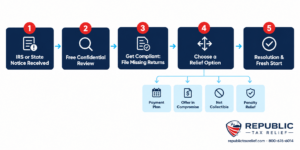
The right relief depends on three things: how much you owe, what you can realistically pay, and whether you are current on filing. The IRS will not approve most programs until every required return is filed. Here is a quick comparison of the main tax relief programs.
| Option | Best fit for | What it does | Learn more |
|---|---|---|---|
| Installment agreement | You can pay over time | Monthly payments; stops most enforcement while in good standing | IRS payment plans |
| Offer in compromise | You can’t pay the full debt before it expires | Settles for less, based on your ability to pay | How the OIC program works |
| Currently not collectible | Basic living costs use up your income | Pauses collection during financial hardship | CNC status |
| Penalty abatement | Good history or a reasonable cause | Removes some penalties (and related interest) | Penalty relief |
| Innocent spouse relief | A spouse or ex caused the debt | Can remove your share of a joint liability | Innocent spouse relief |
Many cases use more than one option. A common combination is first-time penalty abatement to shrink the balance, followed by a payment plan for what remains.
Example: Picking the right path
Maria owes $38,000 after two years of freelance income with no estimated payments. She earns enough to cover rent, food, and a car payment, with about $700 a month left over. An offer in compromise is unlikely, because the IRS would see she can pay over time. A payment plan, paired with a penalty abatement request, is the more realistic path.
Practical takeaway: Write down your monthly take-home pay and your necessary expenses. That one number, what’s left over, drives almost every IRS decision. For a deeper look at each path, read our guide to tax debt relief options. If you have unfiled years, start with catching up on unfiled returns.
IRS Collection: Wage Garnishments, Levies, and Liens
IRS enforcement follows a set order, and the notices tell you where you stand. The agency generally must send a Final Notice of Intent to Levy and give you 30 days to respond before it seizes wages or bank funds. That window is your best chance to request a hearing and protect your income.
Here is what each enforcement tool means for you:
- Federal tax lien. A public legal claim against your property. It can hurt your ability to borrow or sell. See how to release or remove a federal tax lien.
- Bank levy. The bank freezes funds, then sends them to the IRS after 21 days. Learn about stopping IRS and California bank levies.
- Wage garnishments. Your employer must send part of every paycheck until the debt is resolved or the levy is released. Read our guide to wage garnishment relief.
State agencies such as California’s Franchise Tax Board and EDD use similar tools, often with less warning. California’s state tax issues can move fast, so do not assume a state notice can wait.
Example: Responding inside the window
A contractor receives a final levy notice on a Monday. He calls a tax professional that week, who requests a Collection Due Process hearing and submits his financial information. The levy is put on hold while the case is reviewed, and he ends up in a payment plan instead of losing his paycheck.
Practical takeaway: Note the date on any notice that mentions “levy” or “intent to seize.” Count 30 days forward and act before that date. Our overview of IRS collections defense explains each stage of IRS collection in detail.
IRS Audits and Audit Representation
An audit is a review of your tax returns to confirm income, deductions, and credits were reported correctly. Most IRS audits are handled by mail and focus on a few specific items. Others are in-person field exams that can cover several years of business records.
Common audit triggers include:
- Income that doesn’t match the W-2 or 1099 forms the IRS received
- Large or unusual deduction claims compared to your income
- Refundable tax credit claims, such as the earned income tax credit or child tax credit
- Cash-heavy businesses or mixed personal and business spending
With tax audit representation, a licensed professional can speak with the IRS for you under a signed power of attorney (Form 2848). In many cases, you never have to sit across from the auditor yourself. Your representative organizes records, answers questions precisely, and pushes back on findings the law doesn’t support.
Example: A records gap
A restaurant owner is asked to support $60,000 in supply expenses. Half the receipts are missing. Her representative rebuilds the figures from bank statements and vendor invoices, and the IRS accepts most of the deduction instead of disallowing all of it.
Practical takeaway: Don’t send the IRS more than the letter asks for, and don’t miss the response date. Business owners can learn more about the process on our business IRS audits page.
Tax Help for Small Business Owners
Running a business means juggling cash flow, payroll, and tax obligations at the same time. Many small business owners fall behind during one rough stretch, then struggle to catch up as penalties grow. Business tax debt is often more urgent than personal debt, because some of it belongs to your employees.
The business tax problems we see most often:
- Payroll tax. Withheld income tax and Social Security are “trust fund” taxes. Owners and managers can be held personally liable through the Trust Fund Recovery Penalty. Read about payroll tax debt relief.
- State business taxes. California franchise tax, sales tax, and EDD payroll assessments can trigger their own liens and levies.
- Unfiled business returns. The IRS may file a substitute return for you, usually with a higher balance than you actually owe.
Industry matters, too. Contractors, real estate professionals, medical practices, and e-commerce sellers each face patterns we know well. See our pages on construction, real estate, medical professionals, and e-commerce businesses.
Example: Protecting the business
A family-owned business in Los Angeles skipped two quarters of payroll deposits to make rent. A tax professional set up a business installment agreement and made sure new deposits stayed current, so the IRS paused enforcement and the company kept operating.
Practical takeaway: Make every current payroll deposit, even while you resolve older balances. Staying current is the first thing the IRS checks. Explore small business tax relief or our broader business tax debt relief options.
Tax Reform and the One Big Beautiful Bill: Tax Changes to Know
The One, Big, Beautiful Bill Act was signed into law on July 4, 2025, as Public Law 119-21, and it changes many federal taxes, credits, and deductions (IRS). The IRS highlights four new deductions for individuals: the deduction for seniors, no tax on tips, no tax on overtime, and no tax on car loan interest, all claimed on the new Schedule 1-A (IRS).
Other tax provisions worth knowing:
- The lower TCJA tax rates and higher standard deduction are now permanent.
- The child tax credit rises to $2,200 per child, indexed for inflation.
- For 2025 through 2028, qualifying workers can deduct up to $25,000 in tips and up to $12,500 in overtime pay ($25,000 for joint filers), subject to income limits.
Here is what this recent tax legislation does not do: it does not erase back taxes you already owe. Penalties and interest on old balances keep growing, and the IRS can apply a new refund to a past-due balance before you ever see it.
Example: A refund that never arrives
A server expects a bigger refund in tax season thanks to the tips deduction. Because she still owes $9,000 from an earlier tax year, the IRS applies her refund to that debt. A payment plan or other resolution set up ahead of time would have given her a clearer plan for her money.
Practical takeaway: New tax rules can lower future bills, but old debt still needs its own plan. Ask a tax professional how the changes affect your situation before you count on a refund.
Penalties and Interest: Why Waiting Costs More
Unpaid back taxes rarely stay the same size. Penalties and interest continue to accrue every month until the balance is resolved. The good news is that acting early, even before you can pay in full, slows that growth.
Key numbers from the IRS (IRS):
| Situation | Monthly failure-to-pay penalty |
|---|---|
| Standard unpaid balance | 0.5% of unpaid tax, capped at 25% |
| Filed on time, approved payment plan | Reduced to 0.25% |
| Unpaid 10 days after a notice of intent to levy | Increases to 1% |
The failure-to-file penalty is much steeper, generally 5% per month. That is why filing, even when you can’t pay, matters so much. Interest is charged on top of both penalties.
Example: The cost of a year
A taxpayer owes $20,000 and does nothing for 12 months after filing. The failure-to-pay penalty alone adds about $1,200, before interest. With an approved payment plan, that penalty rate would have been cut in half.
Practical takeaway: If you have a clean history for the past three years, you may qualify for first-time penalty abatement. Ask about it before agreeing to any payment amount.
When to Hire a Tax Attorney or Tax Professional
Some tax matters can be handled with a phone call. Others carry enough risk that professional help pays for itself. Only licensed tax attorneys, CPAs, and enrolled agents have unlimited rights to represent you before the IRS.
It’s time to seek professional help if:
- You received a final notice of intent to levy, or a levy or garnishment has started
- You owe payroll tax or face personal liability for business debt
- You have several years of unfiled returns or a substitute return from the IRS
- You are under audit, especially a field exam
- You have both federal and state tax issues at the same time
- You are considering an offer in compromise or currently not collectible status
A good tax firm will review your IRS transcripts, explain every option, and tell you honestly which ones fit. No one can guarantee a specific result, and you should be wary of anyone who promises one. What experienced tax representation does provide is accuracy, deadlines met, and someone handling IRS contact so you don’t have to.
What our clients say
“I had a fantastic experience working with Rebekah this year. She was incredibly knowledgeable, thorough and patient in answering all of my questions. From start to finish she was extremely professional and very friendly. She took the time to explain everything clearly and made sure I got the best outcome possible. I left feeling confident and well taken care of. If you’re looking for someone who truly knows their stuff and makes tax season a breeze, Rebekah is the one to call. I highly highly recommend!” — Moneymoves, Google review
Practical takeaway: Before hiring anyone, ask who will work your case, what their license is, and how they will communicate with you. Learn more about our tax relief services, back tax help, and our awards and recognition.
Tax Relief FAQ
What is federal tax relief?
Federal tax relief refers to IRS programs that make a tax debt more manageable. These include payment plans, offers in compromise, currently not collectible status, penalty abatement, and innocent spouse relief. Which one fits depends on your income, expenses, assets, and filing history.
Can the IRS forgive tax debt?
The IRS can accept less than the full balance through an offer in compromise, but only when the numbers show you can’t pay in full. Penalties can also be removed in some cases. Most taxpayers resolve their debt through a payment plan instead.
How quickly can a levy or wage garnishment be stopped?
It depends on where you are in the process. Acting within the 30-day window on a final notice gives you the strongest options. Even after a levy starts, a representative can often request a release once a resolution is in place.
Do I need a tax attorney, or can a tax professional help?
Licensed tax attorneys, CPAs, and enrolled agents can all represent you before the IRS. Complex matters, such as large business liabilities or cases with legal exposure, may call for an attorney. A consultation will help you decide.
Will new tax laws reduce what I already owe?
No. Tax changes like the One Big Beautiful Bill affect current and future returns. Balances from earlier years still need their own resolution plan.
Is my information kept confidential?
Yes. Everything you share with a licensed tax professional is handled under strict confidentiality standards, and documents should always be uploaded through secure, encrypted channels.
Speak With a Tax Relief Professional
Summary: Tax debt grows when it’s ignored and shrinks when it’s managed. File what’s missing, find your notice stage, and match your finances to the right program, whether that’s a payment plan, penalty relief, an offer, or a pause in collection. When levies, audits, payroll tax, or multiple years are involved, professional representation protects your income and your peace of mind.
Your first step toward resolving your tax debt is a confidential conversation. We’ll review your situation, explain your realistic options, and tell you plainly what to expect.
Your privacy is protected. Every document you share is safeguarded with bank-grade 256-bit encryption and handled under strict tax professional confidentiality standards, so you can focus on solving the problem.
Speak With a Tax Relief Professional or call 800-676-6014 today.
About Republic Tax Relief: Republic Tax Relief helps individuals, families, and businesses resolve IRS and state tax debt. Our team handles tax resolution, audit representation, collection defense, payroll tax problems, and penalty relief, with honest guidance at every step. Call 800-676-6014 or contact us for a confidential consultation.