
Oct
An IRS letter can stop your day cold. It might be a balance due notice for a tax year you thought was settled, a warning about a levy, or a reminder that returns from three years ago never got filed. Most people in that spot don’t need more fear. They need clear answers about what happens next and which relief programs fit their situation.
That’s why we built the Republic Tax Relief IRS Tax Relief Blog. Since 2005, our enrolled agents, tax attorneys, and CPAs have helped individuals and businesses resolve IRS and state tax problems, with more than 18,000 cases resolved. Here you’ll find plain-English IRS tax relief guides, updates on rule changes, and practical tips you can use today. You’ll also get a straight answer on when it’s time to bring in professional help.
Table of Contents
- What Our IRS Tax Relief Guides Cover
- Find the Right Tax Help for Your Situation
- IRS Tax Relief Programs Explained
- Back Tax Help: Filing Compliance Comes First
- IRS Collection Actions: Liens, Levies, and Garnishments
- Business Tax Relief: Payroll Taxes, Audits, and State Agencies
- When to Get Professional Help
- IRS Tax Relief Updates and Tips to Stay Compliant
- What Our Clients Say
- Frequently Asked Questions
- Key Takeaways
What Our IRS Tax Relief Guides Cover
Every article here is built around the questions people ask on their first call with us. We keep each guide focused on one problem, so you can find your answer fast and skip what doesn’t apply.
- Relief programs: payment plans, Offer in Compromise, Currently Not Collectible status, and penalty abatement
- Back tax help: unfiled returns and getting back into compliance
- Collection defense: liens, bank levies, and wage garnishments
- Business tax issues: payroll taxes, audits, and state tax agencies
- IRS tax relief updates: filing season deadlines and rule changes that affect what you owe
Practical takeaway: Pull out your most recent IRS notice and find the notice number in the top-right corner, such as CP14, CP504, or LT11. That number shows where you are in the collection process and which guide to read first.
Find the Right Tax Help for Your Situation
Your next step depends on what’s happening right now, not just on how much you owe. Use this table to match your situation to the right resource.
| If this is happening | What it usually means | Where to start |
|---|---|---|
| Balance due notice (CP14, CP501) | Early collection stage, most options still open | Tax Debt Relief Options |
| CP504 or Final Notice of Intent to Levy (LT11/Letter 1058) | A levy may be coming soon | IRS Collections Defense |
| Money frozen or taken from your bank account | A bank levy was issued | Bank Levy Help |
| Smaller paychecks | A wage levy is in place | Wage Garnishment Relief |
| Years of unfiled returns | The IRS may file returns for you | Unfiled Tax Returns |
| Notice of Federal Tax Lien | A public claim against your property | Tax Lien Help |
| Business behind on payroll deposits | Personal liability risk for owners | Payroll Tax Debt Relief |
Example: A freelance designer owes about $28,000 across two tax years and just received a CP504. She isn’t at the levy stage yet, but she’s close. Her best move is to confirm all returns are filed and get a resolution request in front of the IRS before the final notice arrives. (Illustrative example only.)
IRS Tax Relief Programs Explained
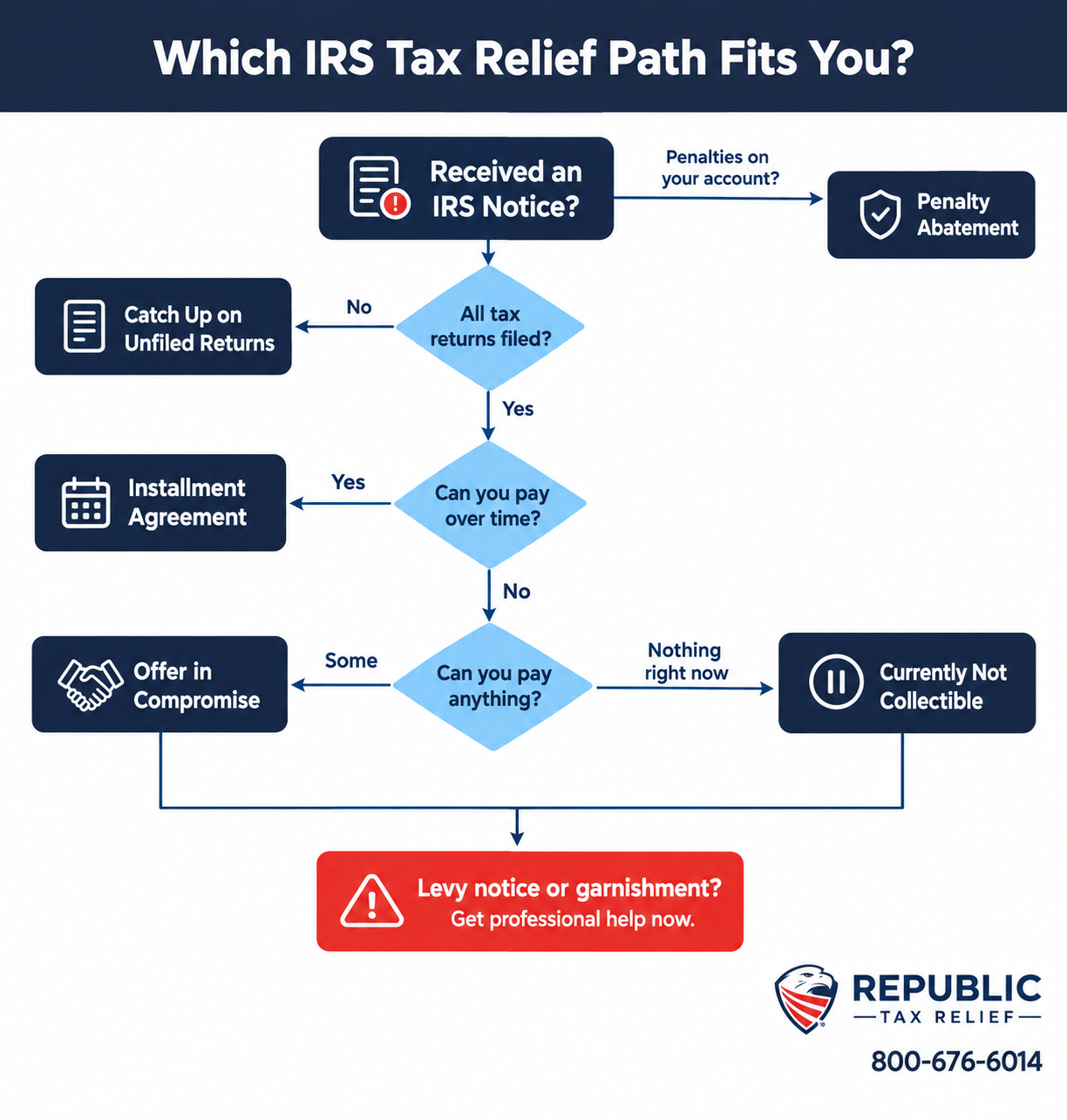
The IRS offers several tax relief programs. Which one fits depends on your income, expenses, assets, and filing history. For a full overview, see our Tax Resolution Services guide.
Installment Agreements
An installment agreement lets you pay your balance over time in monthly payments. Penalties and interest keep adding up, but enforced collection like levies generally stops while the plan is in good standing. Learn more about IRS payment plans.
Offer in Compromise
An offer in compromise lets some taxpayers settle for less than the full amount owed. The IRS looks at your “reasonable collection potential,” which is roughly what it could collect from your income and assets. See how the OIC program works.
Currently Not Collectible Status
If paying anything would leave you unable to cover basic living expenses, the IRS may pause collection. The debt doesn’t disappear, but levies stop while your hardship continues. Read about Currently Not Collectible status.
Penalty Abatement: First-Time Abatement and Reasonable Cause
Penalties can make up a large share of what you owe. According to the IRS, first-time abatement may apply if you had no penalties in the prior three tax years, have filed all currently required returns, and have paid or arranged to pay the tax due. Reasonable cause relief may apply when events like serious illness or a disaster kept you from complying. Our penalty abatement guide covers both.
Innocent Spouse and Equitable Relief
If a current or former spouse caused the tax problem on a joint return, you may qualify for relief from some or all of that debt. Equitable relief can apply even when other types don’t. See our innocent spouse relief guide.
Practical takeaway: Relief options can work together. For example, a successful penalty abatement request can shrink your balance before you set up a payment plan on the rest.
Back Tax Help: Filing Compliance Comes First
The IRS generally won’t approve a payment plan or settlement until all required returns are filed. That’s why filing past-due tax returns is usually step one in any back tax case. Our Back Tax Help guide explains the full process.
- The failure-to-file penalty grows fast. It’s generally 5% of unpaid tax per month, up to 25%. The failure-to-pay penalty is 0.5% per month, also capped at 25%.
- The IRS may file for you. A Substitute for Return often leaves out deductions and credits you’re entitled to, so the balance is usually higher than it should be.
- Old refunds can be lost. You generally have three years from the original due date to claim a refund. After that, the money stays with the IRS.
Example: A contractor with five unfiled years assumes he owes a fortune. Once a tax professional pulls his IRS transcripts and reconstructs his expenses, two of those years show refunds that offset part of what he owes. (Illustrative example only.)
IRS Collection Actions: Liens, Levies, and Garnishments
These terms get mixed up, but they work differently:
- Tax lien: A legal claim against your property that can hurt your credit and block a sale or refinance
- Levy: The actual seizure of money or property, such as funds in a bank account
- Wage garnishment: A continuous levy that takes part of every paycheck until the debt is resolved or released
You have rights during IRS collection. The Taxpayer Bill of Rights includes the right to challenge the IRS’s position and be heard. After a Final Notice of Intent to Levy, you generally have 30 days to request a Collection Due Process hearing, which can pause the levy while your case is reviewed.
Practical takeaway: Write down the date on any levy notice the day you receive it. Missing the 30-day window can cost you your strongest appeal rights.
Business Tax Relief: Payroll Taxes, Audits, and State Agencies
Business tax debt can turn personal quickly. When payroll taxes go unpaid, the IRS can assess the Trust Fund Recovery Penalty against owners and other “responsible persons.” That makes the withheld portion of those taxes a personal debt.
State tax agencies add another layer. In California, business owners may face the FTB for income tax, the EDD for employment payroll tax controversies, and the CDTFA for sales tax. Each agency has its own rules and its own collection tools.
Helpful resources for business taxpayers:
- Business Tax Debt Relief
- Business IRS Audits
- Small Business Tax Relief and Resolution
- Industry guides for construction, real estate, medical practices, and e-commerce
Practical takeaway: If your business is behind on payroll deposits, make current-quarter deposits a priority. New unpaid quarters make any resolution harder to get.
When to Get Professional Help
Some tax problems can be handled with a phone call. Others carry real risk if handled alone. It’s time to talk to a tax professional if you:
- Received a Final Notice of Intent to Levy or have an active levy
- Have several years of unfiled returns
- Own a business with unpaid payroll taxes
- Are facing an IRS audit or a state tax exam
- Have tried calling the IRS and gotten nowhere
The Taxpayer Advocate Service is a free, independent organization within the IRS. It helps when you’re facing significant hardship or when normal IRS channels have failed. Here’s how it compares to private representation:
| Taxpayer Advocate Service | Private Tax Professional | |
|---|---|---|
| Cost | Free | Fee-based |
| Best for | Stuck cases and hardship | Full case strategy and negotiation |
| Speaks to the IRS for you | In specific cases | Yes, through a power of attorney (Form 2848) |
| Handles state tax agencies | No | Yes, depending on the firm |
When you hire Republic Tax Relief, we start by filing an authorization with the IRS and your state tax agency to review your full account history. From there, an enrolled agent, CPA, or tax attorney builds a resolution strategy around your actual numbers.
IRS Tax Relief Updates and Tips to Stay Compliant
Rules, thresholds, and deadlines change every filing season. A few IRS tax relief tips hold up year after year:
- File even if you can’t pay. It stops the larger failure-to-file penalty from growing.
- Watch the extension deadline. For most taxpayers, extended 2025 tax returns are due October 15, 2026.
- Expect refund offsets. If you owe back taxes, the IRS can apply your refund to the old balance.
- Adjust withholding or estimated payments. Don’t let the current tax year add new debt while you resolve old years.
- Be wary of big promises. No honest firm can guarantee a settlement amount before reviewing your finances.
Practical takeaway: Keep a folder with every IRS letter and the date you received it. Response deadlines run from the notice date, not the date you open it.
What Our Clients Say
“As of today, June 23rd, Republic Tax Relief has been awesome. I have always been skeptical of using these tax companies. But, I decided to take a chance because of I couldn’t get anywhere with the IRS by myself. I had 3 companies on my list, Republic Tax Relief, TRA Tax Relief and Optima Tax Relief. I was about to go with TRA but they were tremendously high, so I decided to call Republic and gave me an affordable price based upon my situation. I never got a chance to call Optima because I was impressed with the communication and cost with RTR. I started off with Ken at RTR, then I spoke to Chris, and now I’m working with Rebekah. All three have been great communicating and answering my very thorough questions. They gave me a level of comfort to trust them. Now, it is just a waiting game and in 3 years I will be able to come back and provide an update. Also, RTR has allowed me to pay my fees to them in 6 installments making it very worthy to use them. Thank you Ken, Chris, and Rebekah!”
— Alwynn VanBuren, Google Review ★★★★★
Frequently Asked Questions
Is the IRS Fresh Start program real?
Yes. “Fresh Start” is the name for IRS policy changes that made payment plans, lien relief, and offers in compromise easier to access. It isn’t a single application but a set of relief options. Our article on the Offer in Compromise and Fresh Start program explains more.
Can the IRS forgive tax debt?
The IRS can accept less than the full amount through an Offer in Compromise, remove penalties through abatement, or pause collection through Currently Not Collectible status. Eligibility depends on your income, assets, expenses, and filing history.
How long can the IRS collect back taxes?
In most cases, the IRS has 10 years from the date a tax is assessed to collect it. Certain actions, such as submitting an Offer in Compromise or requesting a Collection Due Process hearing, can pause that clock.
Will the IRS take my refund if I owe back taxes?
Yes. The IRS can apply your refund to past-due federal tax debt, and some state tax debts can also be offset. This usually happens automatically during processing.
Can I get IRS tax relief if I haven’t filed my tax returns?
Most relief options require you to be current on required returns first. A tax professional can help you catch up on unfiled years and request relief at the same time.
Do I need an enrolled agent, CPA, or tax attorney?
All three can represent you before the IRS. What matters most is experience with tax resolution and IRS collection, since that’s different from routine tax preparation.
Key Takeaways
- Your IRS notice number tells you where you are in the collection process.
- Filing compliance comes before almost every relief option.
- Installment agreements, offers in compromise, CNC status, and penalty abatement can work together.
- You have appeal rights, but they come with strict deadlines.
- Business owners can become personally liable for unpaid payroll taxes.
Bookmark this IRS tax relief blog and check back for new guides, updates, and tips. If your situation feels urgent, don’t wait for the next notice.
Speak With a Tax Relief Professional
You don’t have to figure out the IRS alone. Our team will review your situation, explain your options in plain English, and tell you honestly what relief you may qualify for.
📞 Call 800-676-6014 or request your free, confidential consultation.
Your information is protected with bank-grade 256-bit encryption and handled under strict attorney-client and tax professional confidentiality standards, so you can share your documents with complete confidence.
About Republic Tax Relief
Republic Tax Relief helps individuals and businesses resolve IRS and state tax debt. Since 2005, our in-house team of enrolled agents, tax attorneys, and CPAs has resolved more than 18,000 cases, including installment agreements, offers in compromise, penalty abatement, and lien and levy releases. Call 800-676-6014 or contact us for a free consultation. Results vary based on individual circumstances.