
Oct
Owing money to the IRS that you can’t pay today is stressful, but it is rarely a dead end. The IRS has formal programs for people in exactly this spot. The hard part is knowing which one fits you, what deadlines apply, and what to do first.
That is why we built this tax debt relief blog. Each article explains one piece of the process in plain English: how payment plans work, when the IRS may settle for less, how to stop a levy, and when it makes sense to bring in a professional. We cover federal tax debt and state tax problems for individuals, the self-employed, and businesses of every size.
Use this page as your starting point. Find your situation below, read the guide that matches it, and take the next step with a clear head.
Tax Debt Help: What Our Guides Cover
Our tax debt relief guides are organized around the problem you’re facing right now, not around tax code sections. Start with the topic closest to your situation:
- You owe and can’t pay in full. Read back tax help and our overview of tax debt relief options.
- The IRS is already taking money. Go straight to bank levy help or wage garnishment relief.
- You have years of missing returns. See unfiled tax returns. Most relief programs require you to be current on filing first.
- A lien is hurting your credit or a sale. Read tax lien help.
- You run a business. Start with business tax debt relief.
Practical takeaway: Pull out the most recent IRS or state notice you received. The notice number in the top or bottom right corner (for example, CP14, CP504, or LT11) tells you how far along collection is, and which guide to read first.
IRS Tax Debt Relief Options at a Glance
The IRS offers tax debt relief through a handful of formal programs, and each one fits a different financial picture. The right choice depends on what you owe, what you earn, what you own, and how far collection has gone.
| Relief program | Best fit when… | What it does | Read the full guide |
|---|---|---|---|
| Installment agreement | You can pay the debt over time | Monthly payments; the failure-to-pay penalty is cut in half while the plan is active | IRS payment plans |
| Offer in Compromise | You can’t realistically pay the debt in full | IRS may accept less, based on your ability to pay | How the OIC program works |
| Currently Not Collectible | Basic living costs use up your income | Pauses active collection; interest still grows | CNC status |
| Penalty abatement | Penalties make up a big part of the bill | Removes penalties for a clean history or reasonable cause | Penalty abatement |
| Innocent spouse relief | A spouse or ex caused the tax problem | Can relieve you of tax on a joint return | Innocent spouse relief |
| Collection defense | A levy or final notice is in motion | Uses appeals and hearings to stop or delay collection | IRS collections defense |
For smaller balances, the IRS lets individuals apply online for a payment plan: a short-term plan of up to 180 days when the total is under $100,000, or a long-term plan when the total is under $50,000 in combined tax, penalties, and interest. Larger or more complicated cases usually need full financial disclosure and negotiation.
Example: Dana owes $38,000 from two years of self-employment. Her income covers her bills plus about $700 a month. A long-term installment agreement fits her better than an offer, because the IRS would likely see that she can pay the full amount over time.
Practical takeaway: Before choosing an option, write down three numbers: your total balance, your monthly income, and your necessary monthly expenses. Every IRS relief program is decided by some version of that math.
Tax Debt Relief Tips for Your First 30 Days
What you do in the first month after a serious notice often shapes your options for the next year. These tax debt relief tips focus on protecting your rights and keeping doors open.
- Open every letter and note the deadline. A final notice of intent to levy usually gives you 30 days to request a Collection Due Process hearing. Missing it can limit your appeal rights.
- Get the real numbers. Your IRS account transcripts show each tax year, the amount of tax owed, penalties, and interest. Notices alone can be incomplete.
- Stay current this year. Keep up with current tax payments or estimated payments. The IRS rarely approves a relief program for someone who is still adding new debt.
- Gather your financial records. Pay stubs, bank statements, and a list of monthly bills will be needed for almost any negotiation.
- Don’t make promises you can’t keep. Agreeing to a payment you can’t afford often leads to a default, and a defaulted agreement is harder to fix.
- Check for state tax debt too. States such as California run their own collection systems, and a federal deal does not cover state tax liabilities.
Example: Marcus received an LT11 notice and set it aside for six weeks. By the time he called for help, his window for a timely hearing had closed. He still had options, but fewer of them. Acting within the first two weeks would have preserved more leverage.
Practical takeaway: Put the response deadline from your notice in your phone calendar today, with a reminder 10 days before it.
Debt Settlement, Debt Consolidation, and IRS Relief Programs: What’s the Difference?
IRS debt does not work like credit card debt, so the usual debt solutions don’t always carry over. Knowing the difference can save you money and time.
- Debt settlement usually means negotiating unsecured debt, like credit cards, for a lump sum. Many debt settlement companies do not handle IRS cases at all. With the IRS, “settling” happens only through formal programs such as an Offer in Compromise.
- Debt consolidation means taking a loan to pay off several debts. Using a loan or credit card to pay the IRS can make sense in some cases, but it swaps a tax bill for a private debt with its own interest and fewer hardship protections.
- IRS relief programs follow federal tax law. They come with set rules, appeal rights, and protections that private lenders don’t offer.
One more thing to know: when a private lender forgives part of a debt, the forgiven debt can count as taxable income. A cancellation of debt notice (Form 1099-C) can create a new tax bill if no exclusion applies. Settling credit card debt for less can quietly add to an IRS problem.
Red Flags When Comparing Tax Debt Relief Companies
Most firms are honest, but this field attracts some bad actors. Be careful with any company that:
- Promises to settle your tax debt for “pennies on the dollar” before reviewing your finances
- Guarantees a specific result or approval date
- Asks for large fees before explaining your options in writing
- Can’t tell you who will actually represent you before the IRS
You can check a preparer’s credentials in the IRS Directory of Federal Tax Return Preparers with Credentials and Select Qualifications. Look for a CPA, enrolled agent, or tax attorney.
Practical takeaway: Ask any firm you speak with, “Which program do you think I qualify for, and why?” A trustworthy answer refers to your income, expenses, and assets, not to a sales script.
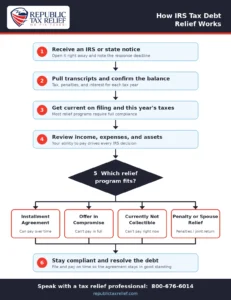
How the IRS Debt Relief Process Works, Step by Step
Most IRS tax debt strategies follow the same six steps, whether you owe $8,000 or $800,000. The flowchart below shows the path from first notice to resolution.
- Receive an IRS or state notice. Open it right away and note the response deadline.
- Pull transcripts and confirm the balance. Check tax, penalties, and interest for each tax year.
- Get current on filing and this year’s taxes. Most relief programs require full compliance.
- Review income, expenses, and assets. Your ability to pay drives every IRS decision.
- Choose the relief program that fits. An installment agreement, Offer in Compromise, Currently Not Collectible status, penalty abatement, or innocent spouse relief.
- Stay compliant. File and pay on time so the agreement stays in good standing.
Practical takeaway: Steps 2 through 4 are where most cases are won or lost. A complete, accurate financial picture gives you the strongest footing with the IRS.
Tax Debt Solutions for Business Owners
Business tax debt carries extra risk because the IRS treats unpaid payroll taxes very seriously. Withheld employee taxes are held “in trust,” and the IRS may assess the Trust Fund Recovery Penalty against owners or managers personally.
- Behind on payroll deposits? Read payroll tax debt relief.
- Facing an exam? See business IRS audits.
- Industry-specific guides: construction, real estate, medical practices, e-commerce, and small businesses.
Example: A contractor falls two quarters behind on Form 941 deposits during a slow season. Paying current deposits first, then negotiating the back balance, can help keep the business open while the old debt is resolved.
Practical takeaway: If cash is tight, protect current payroll deposits before older balances. New payroll debt is one of the fastest ways to escalate an IRS case.
Innocent Spouse Relief and Other Tax Issues for Couples
Filing jointly makes both spouses responsible for the full tax bill, even after divorce. Innocent spouse relief can help when a spouse or former spouse understated income or claimed false deductions without your knowledge. There are four types of relief, each with its own deadline and rules, so timing matters.
Practical takeaway: If an IRS bill came from a former partner’s business or income you didn’t know about, read our innocent spouse relief guide before agreeing to any payment plan.
When to Get IRS Debt Relief Help From a Tax Professional
Some tax problems can be handled with a phone call. Others call for a licensed tax professional who can represent you, speak with the IRS on your behalf, and protect your rights. Consider getting help when:
- You owe more than $50,000, or the debt spans several tax years
- The IRS has filed a lien, issued a levy, or sent a final notice
- You have unfiled returns along with a balance due
- You own a business with payroll tax debt
- You think you may qualify to settle your tax debt through an offer
A qualified tax professional usually starts by filing a power of attorney (Form 2848), pulling your transcripts, and building a full financial picture before recommending a strategy. If you’ve tried normal IRS channels without success, the Taxpayer Advocate Service, an independent organization within the IRS, is another free resource.
“My experience with republic tax relief was a calming experience. Rebekah Huffman was wonderful in helping me and keeping me informed on what was going on. I would recommend her and the company to anyone. Great job. I’m relieved.” — Mary Todd, Google review
Practical takeaway: Ask for a written explanation of your options and fees before you sign anything. To compare providers, read our complete guide to tax resolution services or learn what tax relief services include. You can also see our awards and recognition.
Frequently Asked Questions About IRS Tax Debt Relief
Can the IRS forgive tax debt?
The IRS doesn’t wipe out debt on request, but it has formal ways to reduce what you pay. An Offer in Compromise may let you resolve tax debt for less when you can’t pay in full. Penalty abatement can remove penalties, and the IRS generally has 10 years from assessment to collect.
How long does tax debt relief take?
It depends on the program. An online payment plan can be approved the same day. An Offer in Compromise or an appeal often takes several months, and collection is usually limited while it’s under review.
Will a payment plan stop a levy?
In most cases, the IRS can’t levy while an installment agreement request is pending or while an approved plan is in good standing. A levy already in place may need a separate release request, which is often part of the negotiation.
Is debt consolidation a good way to pay back taxes to the IRS?
Sometimes, if the loan rate is low and the payment is affordable. The trade-off is losing IRS hardship protections and appeal rights. Compare the total cost with an installment agreement with the IRS before borrowing.
Does an IRS agreement cover my state tax debt?
No. State tax agencies run their own collection and relief programs. If you owe both, you’ll need a plan for each so one agency doesn’t undercut the other.
How do I know if I need a tax attorney or other tax professional?
If you’re facing a levy, lien, garnishment, payroll tax debt, or a balance over $50,000, professional representation is worth considering. A licensed professional can speak to the IRS for you and help you choose the right relief program.
Summary: Your Next Step With Tax Debt
Owing the IRS is serious, but it’s manageable once you know your options. Use this tax debt relief blog as your map:
- Find your current notice and its deadline
- Match your situation to a relief program in the table above
- Stay current on this year’s taxes while you resolve old ones
- Get professional help when collection is active or the numbers are large
Sources
- Internal Revenue Service, The IRS has options to help taxpayers pay their tax bill (Tax Tip 2025-29)
- Taxpayer Advocate Service, About Us
- Internal Revenue Service, Directory of Federal Tax Return Preparers with Credentials and Select Qualifications
Speak With a Tax Relief Professional
You don’t have to sort this out alone. Republic Tax Relief helps individuals and businesses resolve IRS and state tax debt with clear, honest guidance from the first call. We’ll review your situation, explain the options that fit, and handle communication with the tax agencies for you.
Your information stays private. Every document you share is protected with bank-grade 256-bit encryption and handled under strict client confidentiality standards.
Call 800-676-6014 or request your confidential consultation today.
About Republic Tax Relief: Republic Tax Relief is a tax resolution firm helping individuals and businesses resolve IRS and state tax debt, including back taxes, levies, liens, wage garnishments, payroll tax problems, and unfiled returns. To speak with our team, call 800-676-6014.
This article provides general information, not legal or tax advice for your specific situation. Results vary based on each taxpayer’s facts.