
Now Serving Ohio Taxpayers Statewide
IRS Tax Relief in Ohio for Taxpayers Facing Back Taxes, State Income Tax Bills and Tax Debt
An IRS letter in the mailbox. A bill from the Ohio Department of Taxation. Maybe a city income tax notice on top of both. If you live in Ohio, your tax problem often has more than one layer, and each layer has its own rules.
Republic Tax Relief helps Ohio individuals and business owners sort out the whole picture and choose the right path out. We work with you by phone, video and secure upload, so you get experienced help without driving to an office.
Free, confidential consultation. No obligation. Hablamos español.
IRS, Ohio Department of Taxation and Ohio Attorney General collections
Wage earners, self-employed, LLCs, S corps and employers
Secure, fully virtual service backed by our California offices
See our awards and recognition
Why IRS and State Income Tax Problems Feel Different in Ohio
Most states have two tax collectors to worry about: the IRS and the state. Ohio taxpayers often have four. Federal tax goes to the IRS, state income tax goes to Columbus, and many cities and school districts charge their own income tax on top.
Then there is property tax, billed by your county. When money gets tight, people tend to fall behind on more than one of these at once. Fixing one while ignoring the others can leave you right back where you started.
There is one more Ohio twist. If a state tax bill goes unpaid long enough, it can be passed to the Ohio Attorney General for collection. At that point, you are dealing with a different office, different phone lines and a tougher tone.
Signs you need help now
- You received an IRS final notice of intent to levy or a wage garnishment warning
- Your bank account was frozen or your tax refund was taken to cover an old balance
- You have several years of unfiled tax returns
- A letter came from the Ohio Attorney General’s Collections Enforcement Section
- Your business is behind on payroll, sales or withholding tax
Who Collects What: IRS, State Income Tax, City Tax and Property Tax in Ohio
Knowing who sent the bill tells you which rules apply and which relief programs are on the table. Here is a quick map of Ohio’s tax layers.
| Tax | Who Bills It | What Happens if It Goes Unpaid |
|---|---|---|
| Federal tax | Internal Revenue Service | Penalties and interest, refund offsets, federal tax liens, bank levies and wage garnishment |
| Ohio state income tax | Ohio Department of Taxation | Assessments that can be certified to the Ohio Attorney General for collection |
| School district income tax | Ohio Department of Taxation | Collected alongside state income tax and handled the same way when delinquent |
| Municipal income tax | Your city or its collection agency | Local penalties, collection letters and, in some cities, referral to outside collectors |
| Property tax | County treasurer | Delinquency charges and, over time, possible tax lien or foreclosure action |
According to the Ohio Attorney General’s Office, the Tax Commissioner administers most state taxes, including state income tax and sales tax, while the Attorney General’s Collections Enforcement Section handles debts owed to the state once they are certified. That handoff matters, because the options for a certified debt are not the same as the options for a fresh assessment.
A note on Ohio’s newer flat state income tax
Ohio moved to a flat rate on nonbusiness income under its most recent budget law. The current rates are set in Ohio Revised Code Section 5747.02, and business income keeps its own rate and deduction. A lower rate going forward does not erase old balances, so past-due years still need a plan.
Where property tax fits
Property tax is billed and collected at the county level, not by the IRS or the state. While we focus on federal and state tax debt, we account for your property tax bill when we build a realistic payment plan, so your home stays protected while you resolve the rest.
Ohio Disaster Tax Relief: Is Your County a Covered Disaster Area?
Ohio disaster tax relief update
The Internal Revenue Service announced filing and payment relief for Ohio individuals and businesses affected by severe storms, straight-line winds, tornadoes, flooding and landslides that began on August 10, 2026. The covered counties are Clermont, Franklin, Hamilton, Licking, Morgan, Muskingum and Perry counties. Affected taxpayers have until February 1, 2027, to file and pay many federal individual and business tax returns that came due during the relief window (official IRS announcement).
This matters for Central Ohio. Franklin and Licking counties include all or part of many communities we serve, from Upper Arlington and Gahanna to Granville and New Albany. If you live there, or your principal place of business is there, the IRS already treats you as affected.
What the disaster relief covers
- Extended individual returns: The deadline applies to people who had a valid extension to file their 2025 individual income tax return. Payments on those returns were due on April 15, so they do not qualify for the delay.
- Estimated income tax payments originally due during the window are pushed to the new deadline without estimated tax penalties.
- Quarterly payroll and certain excise tax returns normally due November 2 also move to February 1, 2027.
- Payroll and excise tax deposits: Deposits are not postponed, but penalties on payroll and excise tax deposits due from August 10 through August 24 are abated if the deposits were made by August 25.
- Existing payment plans: A missed installment agreement payment during the window will not default your plan, though interest and late-payment penalties keep adding up. Direct debit payments continue unless you contact the IRS or their bank.
- Refund claims: A recent federal law treats a disaster postponement like an extension when the IRS figures the time limit for a tax refund, which can give you more time to claim a refund.
If you live outside the covered disaster area
Relief can still apply if the records necessary to meet a deadline are in a covered county, such as with your tax professional. Relief workers helping in the area may qualify too. In those cases, you need to call IRS Special Services at 866-562-5227 to ask for it.
Claiming a casualty loss? Use FEMA disaster declaration number 4945-DR on the tax return for the disaster year or the prior year. Disaster relief only delays deadlines. It does not cancel the tax bill, which is why many Ohio clients use the extra time to set up a lasting solution with us.
Tax Relief Options for Ohio Taxpayers With Tax Debt
There is no single fix that fits everyone. The right option depends on your income, expenses, assets, filing history and which agency holds the debt. Here is how the main paths compare.
| Option | Best For | What It Does |
|---|---|---|
| Installment agreement | People who can pay over time | Spreads the tax balance into monthly payments and stops most collection |
| Offer in compromise | Those who truly cannot pay in full | Settles for less based on assets and monthly disposable income |
| Currently not collectible | Severe hardship | Pauses active collection while your finances recover |
| Penalty abatement | Good history or a solid reason | Removes penalties for first-time relief or reasonable cause |
| Innocent spouse relief | Spouses hit by a partner’s errors | Separates you from tax you should not owe |
Payment plan options for federal and Ohio balances
A payment plan is the most common path, but the terms must fit your real budget. We build the numbers first, so you do not agree to a payment you cannot keep. On the state side, a certified Ohio debt is handled through the Attorney General’s office rather than the Department of Taxation.
Can you qualify for an offer?
Many people hear ads about settling for “pennies on the dollar.” The truth is that the IRS looks closely at what you own and what you can pay each month. You may be eligible if your reasonable collection potential is lower than what you owe, and we will tell you honestly if you are not. Learn more on our IRS Fresh Start Program page.
Penalty relief and abatement
Penalties can make up a large share of an old tax bill. A serious illness, a death in the family or a natural disaster can support reasonable cause. Taxpayers who do not qualify for the disaster delay may still qualify for penalty abatement on these grounds.
Stopping liens, levies and garnishments
If collection has already started, speed matters. We can step in to stop a bank levy, address a federal tax lien and use our IRS collections defense process to protect your paycheck and accounts.
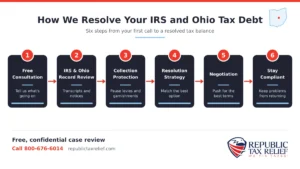
How We Resolve Your IRS Tax Debt From Start to Finish
You do not have to figure out which form to send or who to call. Here is what working with us looks like.
Got a notice with a deadline on it?
Do not wait for the next letter. Call now and we will tell you where you stand.
Tax Relief for Taxpayers Across Central Ohio
We serve taxpayers in every corner of Ohio, and we are now actively serving the Columbus metro area and its fast-growing suburbs. These are communities full of commuters, new homeowners and small business owners who often pay income tax to more than one city.
That commuter pattern creates real headaches. A Marysville resident working in Dublin or a Pickerington family with a side business can owe city tax in two places, plus state and federal tax. We help untangle it.
| Community | County | Disaster Relief Area? |
|---|---|---|
| Delaware | Delaware | No |
| Dublin | Franklin, Delaware, Union | Franklin County portion |
| Gahanna | Franklin | Yes |
| Granville | Licking | Yes |
| Grove City | Franklin | Yes |
| Hilliard | Franklin | Yes |
| Marysville | Union | No |
| New Albany | Franklin, Licking | Yes |
| Pickerington | Fairfield, Franklin | Franklin County portion |
| Powell | Delaware | No |
| Reynoldsburg | Franklin, Licking, Fairfield | Franklin and Licking portions |
| Upper Arlington | Franklin | Yes |
| Westerville | Franklin, Delaware | Franklin County portion |
| Worthington | Franklin | Yes |
Relief depends on where you live or where your business is based, not your mailing city. Not sure which county your address is in? We will check it during your free call.
Delaware, Powell and Westerville
Growth in southern Delaware County has brought many first-time business owners and remote workers. We often see estimated tax shortfalls here, where income jumped but quarterly payments did not keep up.
Dublin, Hilliard, Upper Arlington and Worthington
Northwest Columbus is home to many professionals, consultants and practice owners. Higher incomes can mean larger balances, more audit attention and more at stake when a lien hits. See our support for medical professionals and real estate professionals.
Gahanna, New Albany, Reynoldsburg and Granville
The eastern suburbs have grown fast with new commercial and industrial projects. That growth draws contractors and trades businesses, where payroll tax trouble can build quickly. Our construction tax resolution services are built for these owners.
Grove City, Marysville and Pickerington
Many families here juggle W-2 jobs with gig work or online sales. Side income without withholding is one of the most common reasons we see surprise tax bills. Online sellers can learn more about tax resolution for e-commerce businesses.
Not in Central Ohio? We help taxpayers in Cleveland, Cincinnati, Toledo, Akron, Dayton and everywhere in between.
Help for Ohio Business Owners: Payroll, Sales Tax and State Tax Debt
Business tax debt carries a sharper edge than personal debt. Payroll taxes withheld from employees and sales tax collected from customers are treated as money held in trust for the government.
- Federal payroll taxes: The IRS can hold owners and other responsible people personally liable for unpaid trust fund taxes. Learn about payroll tax debt relief.
- Ohio sales and withholding tax: Unpaid balances can follow responsible officers personally and can even affect business licenses, such as a liquor permit transfer.
- Commercial activity tax (CAT): Ohio’s gross receipts tax has its own filing rules, and missed returns can lead to assessments.
- Audits: We provide business IRS audit representation so you are not facing an examiner alone.
Our goal is to protect both you and your company. Explore our business tax debt relief options and small business tax relief services.
Expert Insight: The Hidden Risks of Handling the IRS Alone or With AI
We get it. Calling the IRS yourself or asking a chatbot feels faster and cheaper. But in tax resolution, the mistakes that cost the most are usually the ones you cannot see coming.
What you say on the phone is on the record
Revenue officers take notes. A casual comment about a vehicle, a side job or a family member’s help can show up later as an asset or income the IRS expects you to use.
A “yes” can lock you in
Agreeing to a payment you cannot afford is one of the fastest ways to default and restart collection. A default can also make your next request harder.
AI does not know your file
A chatbot cannot pull your transcripts, see a pending lien or know that your debt was certified to the Ohio Attorney General. It can sound confident and still be wrong about deadlines that cannot be undone.
Your data deserves protection
Pasting Social Security numbers, bank statements or notices into public AI tools can expose sensitive data. AI also cannot sign a power of attorney or speak to the IRS for you.
Curious how the two compare in real negotiations? Read Can AI Get a Better Settlement Than a Tax Attorney?
Why Ohio Taxpayers Choose Republic Tax Relief
We do not have an Ohio storefront, and we will not pretend to. What we offer instead is focused tax resolution experience delivered securely to wherever you are.
- Real offices, real people: Our team works from California offices in Corona and Laguna Hills. Federal tax representation works the same in every state.
- One team for every layer: We coordinate your IRS case with Ohio state issues, so nothing falls through the cracks.
- Honest advice: If an option is not a fit, we tell you. No promises about results we cannot control.
- Flexible scheduling: Phone and video appointments that work around Ohio’s Eastern Time workday.
- Spanish-speaking support: Help is available in Spanish when you need it.
Your privacy is protected. Every tax return, bank statement and Social Security number you share is guarded by strict professional confidentiality and bank-grade 256-bit encryption, fully meeting federal data protection standards.
Frequently Asked Questions About Ohio Tax Relief
Can you help me if you do not have an office in Ohio?
Yes. IRS representation is federal and is handled by phone, mail, fax and secure online systems, not in person. We work with Ohio clients remotely from our California offices, and many never need to meet anyone face to face.
I owe both the IRS and Ohio. Which should I deal with first?
It depends on which agency is closest to taking action. A pending levy or garnishment usually comes first. We review both balances and plan payments so one agreement does not make the other impossible to keep.
Why did I get a letter from the Ohio Attorney General about taxes?
When an Ohio tax assessment stays unpaid, the Department of Taxation can certify it to the Attorney General’s Collections Enforcement Section. Your options then run through that office. Acting quickly gives you the best chance of a manageable arrangement.
Does the Ohio disaster relief erase my tax bill?
No. Disaster relief postpones certain filing and payment deadlines for taxpayers in covered counties. The tax is still owed, and interest continues on unpaid balances. It can, however, buy time to choose the right long-term solution.
Will the IRS keep my tax refund if I owe back taxes?
Usually, yes. The IRS can apply a federal refund to past-due federal tax, and Ohio can offset state refunds for state debts. A resolution plan helps you know what to expect and stop surprises.
Can you help with my city income tax too?
We factor city and school district income tax into your overall plan and help you understand those notices. Our core representation focuses on IRS and Ohio state tax debt, and we will be clear about what we handle directly.
How much does tax relief help cost?
Your first consultation is free. Fees depend on how many years are involved, which agencies hold the debt and the option you pursue. We explain the cost up front before you commit to anything.
Have more questions? Visit our tax relief questions page or read the guide to common IRS notices.
Speak With a Tax Relief Professional Today
Whether you are in Worthington, Westerville or anywhere else in Ohio, you do not have to face the IRS or the state alone. One call can show you which options are realistic for you.
The sooner we start, the more options you keep.
About Republic Tax Relief
Republic Tax Relief helps individuals and businesses nationwide resolve IRS and state tax debt, including back taxes, unfiled returns, liens, levies, wage garnishments and payroll tax problems. Learn more about our tax resolution services. Call 800-676-6014 or contact us online.
This page provides general information and is not legal or tax advice for your specific situation. Results depend on individual facts and agency decisions.