
Tax Compliance Blog: A Practical Guide to Business Tax Compliance and Getting Right With the IRS
Most business owners don’t fall behind with the IRS on purpose. A slow quarter turns into a skipped payroll deposit. One late return turns into three. Then the letters start arriving, and every envelope feels heavier than the last.
This tax compliance blog is for anyone in that spot, whether you run a two-person shop or a company with a full payroll. You’ll learn what the IRS expects from your business, which tax compliance issues cause the most trouble, and how professionals help taxpayers get back into tax compliance without guesswork. The goal is simple: give you a clear picture and a realistic next step.
What Business Tax Compliance Really Means
IRS compliance comes down to three things: filing every required return, paying what you owe on time, and keeping records that back up both. Miss any one of them and your business is out of compliance, even if the other two are perfect.
- Filing compliance: Every income tax return, payroll return, and information return is filed by its deadline.
- Payment compliance: Federal tax deposits, estimated taxes, and balances due are paid in full or covered by an approved arrangement.
- Reporting and recordkeeping: W-2s and 1099s go out correctly, and your books can support every number on your returns.
Example: A restaurant owner files her business return every year but has been short on Form 941 deposits for two quarters. On paper she “files,” but the IRS sees unpaid payroll taxes, which is one of the fastest ways to draw collection attention.
Takeaway: Being “current” means filed and paid. If you only check one box, you’re not there yet.
Business Tax Compliance Requirements and Deadlines
Your exact business tax obligations depend on your entity type, whether you have employees, and the states you operate in. The table below covers the most common federal tax filing deadlines for calendar-year businesses. When a due date lands on a weekend or legal holiday, it moves to the next business day.
| Obligation | Form | Typical Due Date |
|---|---|---|
| S corporation and partnership returns | Form 1120-S / Form 1065 | March 15 |
| C corporation return | Form 1120 | April 15 |
| Sole proprietor business income | Schedule C (Form 1040) | April 15 |
| Quarterly payroll tax return | Form 941 | April 30, July 31, October 31, January 31 |
| Annual federal unemployment (FUTA) | Form 940 | January 31 |
| Employee wage statements | Form W-2 | January 31 |
| Contractor payments | Form 1099-NEC | January 31 |
| Estimated tax payments (owners and some entities) | Form 1040-ES / 1120-W | April 15, June 15, September 15, January 15 |
Payroll deposits run on their own schedule. Most employers deposit monthly or semiweekly based on the size of their past payroll liability, and those deposits matter just as much as the 941 itself. State payroll, sales tax, and franchise tax deadlines add another layer for many businesses.
2026 Changes That Affect Information Reporting
- Higher 1099 threshold: For payments made in 2026, the reporting threshold for Form 1099-NEC and most Form 1099-MISC boxes rose from $600 to $2,000 under the One Big Beautiful Bill Act. These forms are first filed in early 2027.
- Form 1099-K: The threshold for payment apps and card processors returned to more than $20,000 and more than 200 transactions.
- E-filing: Businesses that file 10 or more information returns in total during a year generally must file them electronically.
- Income is still income: A contractor paid $1,500 may not get a 1099, but you still need records of that payment for your deductions.
Takeaway: Put every date above on one shared tax compliance calendar, including payroll deposit dates, and assign one person to own it.
Tax Compliance Checklist for Business Owners
Use this tax compliance checklist as a quick health check. If you can’t confidently answer “yes” to each line, that’s the area to fix first.
- All federal and state income tax returns are filed for at least the past six years.
- Every Form 941 and Form 940 is filed, and payroll deposits were made on time.
- W-2s and 1099s were issued to workers and filed with the government.
- Workers are correctly classified as employees or independent contractors.
- Estimated tax payments are being made for the current year.
- Sales tax and state payroll accounts are filed and paid.
- Every IRS or state notice has been read and answered by its deadline.
- Business tax records are organized and kept for the required period.
How Long to Keep Business Tax Records
The IRS says most records should be kept for at least three years after you file, while employment tax records should be kept for at least four years. Longer periods apply if income was significantly underreported or if a return was never filed. A clean document retention system also makes any future IRS audit far less painful.
Takeaway: If two or more checklist items are a “no,” you likely have a tax compliance issue that needs a professional review, not just a better spreadsheet.
Common Tax Compliance Problems and IRS Penalties
Most business tax compliance problems start small and grow because of time, not bad intent. These are the issues we see most often:
- Unfiled tax returns: One missed year often becomes several. Past due returns also stop the clock that limits how long the IRS can assess tax.
- Missed payroll deposits: Withheld taxes belong to your employees and the government. If they go unpaid, owners and other responsible people can be held personally liable through the Trust Fund Recovery Penalty.
- Worker misclassification: Treating employees as contractors can lead to back payroll taxes and penalties.
- Ignored IRS notices: Each unanswered letter moves your account closer to liens and levies.
- Weak records: Missing receipts and mixed personal and business accounts make returns hard to defend.
IRS Tax Penalties at a Glance
| Penalty | How It Works |
|---|---|
| Failure to file penalty | 5% of unpaid tax for each month or part of a month a return is late, up to 25% |
| Failure to pay penalty | 0.5% of unpaid tax per month, up to 25% |
| Failure to deposit penalty | 2% to 15% of the late or missed payroll deposit, depending on how late it is |
| Trust Fund Recovery Penalty | Equal to the unpaid trust fund taxes, assessed against responsible individuals |
| Interest | Charged on unpaid tax and many penalties until the balance is paid |
Example: A contractor owes $40,000 on a return filed five months late. The failure to file penalty alone can reach $10,000 before interest. Filing on time, even without full payment, would have kept that number much smaller.
Takeaway: The failure to file penalty is ten times steeper per month than the failure to pay penalty. Filing is almost always the first priority. If penalties have already stacked up, IRS penalty abatement may reduce them if you qualify.
How to Get Back Into Tax Compliance
Catching up can feel overwhelming, but the process follows a clear order. Here is how a tax resolution team typically moves a business or individual from behind to current.
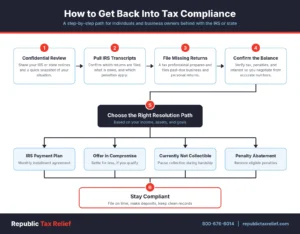
- Confidential review: A professional looks at your notices, deadlines, and any active collection action.
- Pull IRS transcripts: With your authorization, your representative confirms what’s filed, what’s owed, and which penalties apply. Eligible businesses can also request a tax compliance check through the IRS Business Tax Account.
- File missing returns: The IRS generally looks for the last six years of returns before it will approve most relief options. Learn more about catching up on unfiled tax returns.
- Confirm the balance: Tax, penalties, and interest are verified so you negotiate from accurate numbers.
- Choose a resolution path: Options include an IRS payment plan, an Offer in Compromise, Currently Not Collectible status, or penalty relief.
- Stay compliant: Current-year filings and deposits must stay on track, or most agreements can default.
If the IRS has already filed a lien, levied a bank account, or contacted your employer, collection defense comes first. Our guide to IRS collections defense explains how that process works.
Takeaway: Every relief option depends on step six. The IRS rarely approves a deal for a taxpayer who keeps adding new balances.
When to Get Professional Tax Compliance Help
Some businesses only need a bookkeeper and a calendar. Others need a licensed tax compliance professional who can speak to the IRS on their behalf. You likely need IRS compliance help if any of these apply:
- You have more than one year of unfiled business or personal returns.
- Payroll taxes are unpaid, or you received a letter about the Trust Fund Recovery Penalty.
- You received a final notice, a lien notice, or a levy.
- You owe both the IRS and a state agency, such as the California Franchise Tax Board or EDD.
- You’re facing a business tax audit or an IRS compliance check.
What a Tax Resolution Professional Does
- Files a power of attorney (Form 2848) so the IRS contacts your representative instead of you.
- Requests collection holds while your case is reviewed, when available.
- Reconstructs records and coordinates past due returns.
- Builds the financial case for the relief option that fits your ability to pay.
- Sets up a compliance plan so the same problem doesn’t come back.
Republic Tax Relief helps individuals and businesses across industries, including construction, medical practices, real estate, and e-commerce. If payroll is the main issue, see our payroll tax debt relief page, or explore our full business tax resolution services.
★★★★★ “Republic Tax was great, very efficient and honest about the process and got me the outcome I desired which was non collectable, very good company 5 stars. Jocelin was amazing, great customer service, kind, explained everything thoroughly, 10 stars for Jocelin. Thank you.”
— Jermaine K., Google Review
Your information stays protected. Every tax return, bank statement, and SSN you share is held under strict tax professional confidentiality and secured with bank-grade 256-bit encryption, from upload to resolution.
Takeaway: Results depend on your facts, and no honest firm can promise a specific outcome. What a qualified team can promise is a clear plan, accurate filings, and someone handling the IRS for you.
Tax Compliance FAQs
What does it mean to be in tax compliance with the IRS?
It means all required tax returns are filed and all taxes are paid or covered by an approved arrangement, such as an installment agreement. Businesses must also be current on payroll deposits and information returns.
How many years of back returns does the IRS require?
The IRS generally asks for the last six years of filed returns before approving most relief options. Your exact requirement can vary, so a professional should review your transcripts first.
Can I get relief from IRS penalties for late filing?
Possibly. First-time penalty abatement and reasonable cause relief can remove some failure to file, failure to pay, and failure to deposit penalties if you meet the IRS requirements.
What happens if my business doesn’t pay payroll taxes?
The IRS can assess penalties, file liens, and levy business assets. It can also hold owners and other responsible people personally liable for unpaid trust fund taxes through the Trust Fund Recovery Penalty.
Do I need a professional to get back into tax compliance?
Not always, but professional help is wise if you have multiple unfiled years, unpaid payroll taxes, active collection notices, or both IRS and state balances. A representative can communicate with the IRS for you and identify relief you may qualify for.
Key Takeaways
- Tax compliance means filed, paid, and documented. All three count.
- Payroll taxes and unfiled returns create the biggest risks for business owners.
- The failure to file penalty grows faster than the failure to pay penalty, so file first.
- Most relief options require you to be current on filings and new payments.
- A licensed tax resolution team can handle the IRS for you and build a plan that fits your situation.
We hope this tax compliance blog gave you a clearer view of where you stand. If you’re behind, the sooner you act, the more options you usually have.
Speak With a Tax Relief Professional
Behind on returns, payroll taxes, or IRS payments? Get a free, confidential consultation with Republic Tax Relief. We’ll review your situation, explain your options in plain English, and show you the path back to compliance.
Republic Tax Relief helps individuals and businesses resolve IRS and state tax problems, including unfiled returns, payroll tax debt, liens, levies, and wage garnishments. With offices in Corona and Laguna Hills, California, our team represents taxpayers nationwide and builds practical, compliant solutions for every client. See our awards and recognition. Call 800-676-6014 or contact us today.This article is for general information and is not legal or tax advice. Every situation is different. Speak with a qualified tax professional about your specific case.