
Oct
A general contractor can finish a $400,000 job on time and on budget and still end up owing the IRS more than the project netted. It happens more often than most builders expect. Retainage gets held for months, a client pays a draw 60 days late, and the payroll tax deposits slip for a quarter or two. By the time IRS notices start showing up, the original balance has picked up penalties and interest, and a revenue officer may already have your file.
If that sounds familiar, you are not careless, and you are not alone. The construction business runs on uneven cash flow, and the tax system does not wait for your customers to pay. This construction tax resolution blog explains why contractor tax problems happen, what the IRS can do if they go unanswered, which relief options actually fit construction companies, and when it makes sense to bring in a professional.
Table of Contents
- Why Construction Businesses Fall Behind on Taxes
- The Most Common Construction Tax Problems
- Payroll Tax Debt and the Trust Fund Recovery Penalty
- What the IRS Can Do If Construction Tax Debt Goes Unpaid
- Tax Relief Options for Contractors
- How the Construction Tax Resolution Process Works
- When to Hire a Tax Resolution Professional for Your Construction Business
- Construction Tax Resolution FAQs
- Key Takeaways
Why Construction Businesses Fall Behind on Taxes
Most construction tax debt does not start with a bad decision. It starts with a timing problem. You pay crews, suppliers, and equipment loans every week, but the money from the job may not land for 30, 60, or 90 days. The IRS expects its share on its own schedule.
Here are the pressure points we see most often with general contractors, subcontractors, and trade contractors:
- Retainage and slow draws. Five to ten percent of each payment may be held until project completion, which can be months away.
- Construction payroll swings. Headcount rises and falls by season and by job, so payroll tax deposits change constantly and are easy to miss.
- Subcontractor payments and 1099s. Missing 1099 filings, or treating workers as subcontractors when the IRS sees them as employees, can trigger back employment taxes.
- Work in progress (WIP) and accounting methods. Under the percentage of completion method, you can owe tax on income you have earned on paper but not yet collected. The completed contract method has its own rules and limits.
- Equipment and depreciation. Large depreciation write-offs lower taxes in the year you buy equipment, but selling that equipment later can create a tax bill many owners do not plan for.
Example: A framing subcontractor has a strong year on paper because three big jobs are 70% complete. The cash is still tied up in retainage, but the tax on that income is due in April. The owner pays the crew first, skips estimated payments, and ends the year with a five-figure balance.
Practical takeaway: Your job costing reports and WIP schedule are not just for bidding. They are the first documents a tax professional will ask for, because they explain why you owe and what you can realistically pay.
The Most Common Construction Tax Problems
Construction business tax problems tend to fall into a few familiar groups. The table below shows what each one looks like and the resolution path that usually fits.
| Problem | What It Looks Like | Common Resolution Path |
|---|---|---|
| Unpaid payroll taxes | Missed Form 941 deposits or unpaid Form 940 balances | Get current on deposits, then an installment agreement or other relief |
| Personal liability for business taxes | IRS interview about who signs checks and pays bills | Representation during the Trust Fund Recovery Penalty review |
| Unfiled or past-due returns | Missing business, payroll, or personal returns | Professionally prepared catch-up returns before negotiating |
| Worker classification issues | Crew paid on 1099s instead of W-2s | Audit or examination representation |
| Growing tax penalties and interest | Balance keeps rising even after payments | Penalty abatement request based on reasonable cause |
| State tax debt | State income, payroll, or sales and use tax balances | State payment plan or settlement, coordinated with the IRS case |
Practical takeaway: Most contractors have more than one of these problems at once. A good plan addresses all of them together so fixing one does not make another worse.
Payroll Tax Debt and the Trust Fund Recovery Penalty
If you only take one thing from this article, make it this: payroll tax debt is the most dangerous kind of contractor tax debt. The income tax and the employee share of Social Security and Medicare you withhold from paychecks are called “trust fund” taxes, because you are holding that money for your employees.
When a business does not pay those taxes, the IRS can assess the Trust Fund Recovery Penalty against any “responsible person.” According to the IRS, the penalty equals the unpaid trust fund tax, and once it is assessed, the agency can pursue that person’s personal assets (IRS: Employment Taxes and the Trust Fund Recovery Penalty). The IRS also treats paying other creditors instead of payroll taxes as a sign of willfulness.
- Who can be responsible: Owners, officers, partners, and sometimes bookkeepers or office managers with check-signing authority.
- Why it matters: An LLC or corporation does not shield you from this penalty.
- What to do: Do not sit for an IRS interview (Form 4180) without representation.
Example: A remodeling company owner paid the lumber yard to keep a job moving instead of making a $22,000 payroll deposit. The business later closed, but the IRS assessed the trust fund portion against the owner personally. That is a common and avoidable outcome.
Learn more about payroll tax debt relief for business owners.
What the IRS Can Do If Construction Tax Debt Goes Unpaid
The IRS collection process usually builds in stages. Early notices are reminders. Later notices come with deadlines and real consequences. For larger business balances, a revenue officer may be assigned to visit your office or jobsite.
Here is what can happen if IRS problems for contractors are left alone:
- Federal tax lien: A public claim against your property that can hurt bonding capacity, equipment financing, and supplier credit. See our guide to tax lien help.
- Bank levy: The IRS can freeze and take funds in your business bank account, sometimes right before payroll. Learn about bank levy help.
- Levies on receivables: The IRS can send levy notices to general contractors or property owners who owe you money, which can damage client relationships.
- Asset seizure: In serious cases, trucks, tools, and heavy equipment can be seized.
Practical takeaway: A Final Notice of Intent to Levy usually gives you 30 days to act and preserves your appeal rights. Calling a professional during that window gives you far more options than calling after a levy hits. Read more about IRS collections defense.
Tax Relief Options for Contractors
There is no single program that fits every construction company. The right option depends on how much you owe, your cash flow, your equipment and other business assets, and whether the business is still operating.
Installment Agreement
A payment plan lets you pay the balance over time while collection activity pauses. For a contractor with steady work but uneven cash, this is often the most practical fix. Payment amounts can be built around realistic monthly cash flow. See how IRS installment agreements work.
Offer in Compromise
An Offer in Compromise allows some taxpayers to settle for less than the full amount owed. The IRS looks at your ability to pay, income, expenses, and asset equity when deciding whether to accept (IRS: Offer in Compromise). Equipment value, receivables, and retainage all count, so construction offers need careful financial analysis. Learn how the OIC program works.
Currently Not Collectible Status
If paying anything would leave you unable to cover basic living or business expenses, the IRS may temporarily pause collection. This can fit a contractor coming off a slow season or a lost major client. Read about Currently Not Collectible status.
Penalty Abatement
Penalties can make up a large share of a construction tax bill. Relief may be available for first-time issues or for reasonable cause, such as a serious illness, disaster, or loss of records. See our guide to IRS penalty abatement.
Catching Up Unfiled Returns
The IRS generally will not approve a payment plan or settlement until required returns are filed. A tax professional can prepare past-due business and payroll returns correctly so your balance reflects real numbers, not IRS estimates. Learn about unfiled tax returns.
Practical takeaway: Many contractors combine options, for example penalty abatement to shrink the balance, followed by an installment agreement for what remains.
How the Construction Tax Resolution Process Works
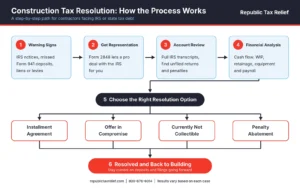
- Recognize the warning signs. IRS notices, missed Form 941 deposits, a lien filing, or a revenue officer visit.
- Get representation. Form 2848 authorizes a qualified professional to speak with the IRS on your behalf (IRS: About Form 2848). Calls and letters can then go through your representative.
- Review the full account. IRS transcripts show every balance, unfiled year, and penalty.
- Analyze your finances. Cash flow, WIP, retainage, equipment, payroll, and bank accounts are reviewed to see what you can truly afford.
- Choose and negotiate the right option. Payment plan, settlement, hardship status, penalty relief, or a combination.
- Stay compliant. Keep deposits and filings current so the agreement stays in good standing.
Practical takeaway: Most of the delays in a case come from missing documents. Gathering records early can speed up the process.
When to Hire a Tax Resolution Professional for Your Construction Business
You can call the IRS yourself, but construction cases have moving parts that are easy to get wrong. A tax professional for contractors understands how job costing, retainage, and equipment values affect what the IRS will accept.
Signs it is time to get help
- You owe payroll taxes or have been contacted about the Trust Fund Recovery Penalty.
- A revenue officer has been assigned or has visited.
- You received a Final Notice of Intent to Levy, or a levy has already hit.
- You have more than one year of unfiled returns.
- You owe both the IRS and your state.
What to look for
- Enrolled agents, CPAs, or tax attorneys who can represent you before the IRS.
- Experience with construction companies and their financial records.
- A clear explanation of options and fees, with no guaranteed outcomes. No honest firm can promise a specific result.
What to have ready for a consultation
- Every IRS and state notice you have received
- Recent profit and loss statements and your WIP schedule
- Payroll reports and Forms 941 and 940
- Three to six months of business bank statements
- An equipment list and accounts receivable aging report
“I had a great experience with Republic tax relief I was helped with all my tax forms they was kind they help me get the situation taken care of calling tax relief was great and I will continue to reach out to Republic tax relief”
~Margaret Hudson, Google Review
Republic Tax Relief has helped individuals and business owners since 2005, with enrolled agents, tax attorneys, and CPAs handling cases in house. Learn more about our construction tax resolution services or our broader business tax resolution services.
Construction Tax Resolution FAQs
Can the IRS hold me personally responsible for my construction company’s tax debt?
Yes, for unpaid payroll trust fund taxes. The IRS can assess the Trust Fund Recovery Penalty against owners, officers, or others who had authority to pay the taxes and did not. Business structure does not protect you from this penalty.
Can the IRS levy money my clients owe my construction business?
Yes. The IRS can issue levies to customers, general contractors, or property owners who owe you payments. Responding to notices before a final levy deadline gives you the best chance to prevent this.
Will the IRS settle construction tax debt for less than I owe?
Sometimes. An Offer in Compromise may be accepted when the IRS believes it cannot collect the full balance based on your income, expenses, and asset equity. Many contractors do not qualify, which is why a full financial review comes first.
Do I need to file my past-due returns before getting tax relief?
In most cases, yes. The IRS generally requires all required returns to be filed before it approves a payment plan or settlement. A tax professional can prepare those returns as part of your case.
How long does construction tax resolution take?
It depends on the option and how quickly records are gathered. A payment plan can sometimes be set up within weeks, while an Offer in Compromise can take many months. Representation can often pause or limit collection activity while the case is reviewed.
Key Takeaways
- Contractor tax debt usually starts with cash flow timing, not bad intent.
- Payroll tax debt carries the highest risk because it can become your personal liability.
- Liens, bank levies, and levies on receivables can disrupt jobs and client relationships.
- Installment agreements, Offers in Compromise, Currently Not Collectible status, and penalty abatement are all possible paths.
- Acting early, with organized records and qualified representation, gives you the most options.
The main lesson from this construction tax resolution blog is simple: the sooner you act, the more choices you keep. You do not have to sort out IRS problems on your own while also running jobsites.
Speak With a Tax Relief Professional
Whether you are a general contractor, subcontractor, or builder, our team can review your IRS or state tax situation and explain your options in plain language. Your consultation is free and confidential.
Call 800-676-6014 or request your free consultation.
Everything you share stays under strict tax client confidentiality and is protected with bank-grade 256-bit encryption, so you can send returns, bank statements, and payroll records with confidence.
About Republic Tax Relief: Republic Tax Relief helps individuals and businesses resolve IRS and state tax debt, stop wage garnishments and bank levies, and get back on track. Since 2005, our in-house team of enrolled agents, tax attorneys, and CPAs has worked with contractors, small business owners, and families across the country. Call 800-676-6014 or visit our Contact page to get started. Results vary based on individual circumstances.
Sources: