
Oct

You can own a million dollars in rental property and still not have the cash to cover a $40,000 IRS bill. That gap between what you own and what you can pay is where most real estate tax debt starts, and it is why the IRS treats property owners differently than wage earners.
This real estate tax resolution blog is for investors, landlords, and property owners who already owe the IRS or a state tax agency, or who just opened a notice they did not expect. Below, you will learn the investor tax problems that most often turn into debt, how the IRS collects from people who own property, and which resolution paths fit common real-world situations. For a full overview of our services for agents, brokers, and investors, see our page on tax resolution for real estate professionals.
This article is general education, not legal advice for your situation. For a confidential review of your case, call 800-676-6014.
In This Guide
- Why Rental Property Creates IRS Tax Problems
- IRS Audit Red Flags for Real Estate Investors
- How the IRS Collects From Landlords and Property Owners
- Five Investor Scenarios and How They Get Resolved
- Real Estate Tax Debt Relief Options at a Glance
- What a Real Estate Tax Resolution Professional Does
- Key Takeaways
- Real Estate Investor Tax FAQs
Why Rental Property Creates IRS Tax Problems
Real estate is built to grow wealth slowly, but the tax bill often arrives all at once. A sale, a missed deadline, or an audit adjustment can create a large balance in a single tax year while your money stays tied up in buildings.
Here are the most common ways investors end up with real estate tax debt:
- Gains with no cash. A failed 1031 exchange or a refinance-then-sell can leave you owing capital gains tax on money you already reinvested.
- Depreciation recapture. When you sell, depreciation from past years is taxed again, often at rates up to 25%. The IRS reduces your basis by depreciation you were allowed to take, even if you never claimed it.
- Disallowed losses. Rental losses are usually passive. If the IRS rejects a Real Estate Professional Status (REPS) or material participation claim, years of deductions can come back as a bill.
- Unfiled returns. Landlords with several properties sometimes fall behind on filing, and the IRS may file a substitute return that ignores your expenses and depreciation.
- No withholding on rental income. Rent is paid without tax taken out, so missed estimated payments add penalties and interest.
| Where the problem starts | What it can lead to |
|---|---|
| Failed 1031 or like-kind exchange | Full gain taxed in the year of sale |
| Audit of REPS or passive losses | Additional tax for several years, plus penalties |
| Cost segregation or depreciation errors | Adjusted returns and recapture surprises at sale |
| Unfiled Schedule E returns | Inflated IRS-prepared balances and growing tax penalties |
Practical takeaway: Before you sell or exchange any property, ask your tax advisor to estimate the tax due, including recapture, so you set the cash aside at closing.
IRS Audit Red Flags for Real Estate Investors
Many real estate investor tax problems begin with an IRS audit, not a missed payment. The IRS knows where rental returns tend to go wrong, and a tax examination usually focuses on a few issues.
Real Estate Professional Status and material participation
To claim REPS, you generally need more than 750 hours a year in real property businesses, and those hours must be more than half of all your working time (IRS Publication 925). Investors with a full-time W-2 job who claim REPS draw close review. Calendar-based time logs hold up far better than estimates rebuilt years later.
Short-term rentals (STR)
When the average guest stay is seven days or less, the activity is generally not treated as a rental under the passive activity rules. That can help or hurt, depending on your material participation. If you provide hotel-like services, income may belong on Schedule C instead of Schedule E, which can add self-employment tax (IRS Publication 527).
Cost segregation and large depreciation claims
Cost segregation studies speed up depreciation, but weak studies or misclassified assets can be challenged. Keep the study, invoices, and placed-in-service dates together.
Example: A nurse who owns four rentals claims REPS to deduct $60,000 in losses. Her hospital schedule shows 1,900 work hours, so her rental hours cannot be more than half. The IRS disallows the losses for three years, and she now owes tax she never planned for.
If you are facing an exam now, see our guide to IRS audit representation.
How the IRS Collects From Landlords and Property Owners
Once a balance is assessed, IRS collection follows a set order. The difference for property owners is what the IRS can reach: your rent, your equity, and your ability to sell or refinance.
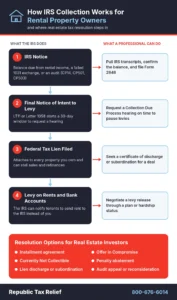
- Notices. The IRS mails balance-due letters such as CP14, CP501, and CP503. Each one means penalties and interest are still growing.
- Final notice of intent to levy. An LT11 or Letter 1058 gives you 30 days to request a Collection Due Process hearing, which can pause levies.
- Federal tax lien. A lien protects the government’s interest in all your property, including real estate (IRS: Understanding a Federal Tax Lien). It can stall closings and refinances across your portfolio.
- Levy. The IRS can levy bank accounts and send a notice of levy to your tenants, requiring them to pay rent to the IRS. Larger cases may be assigned to a revenue officer, and property seizure is possible in serious cases.
Practical takeaway: Write down the date on any final notice. Acting inside that 30-day window protects your appeal rights. Learn more about IRS collections defense and bank levy help.
Five Investor Scenarios and How They Get Resolved
Real estate tax debt resolution depends on your income, your equity, and what caused the debt. These common situations show how the pieces fit. Results always depend on your facts.
1. A failed 1031 exchange left a tax bill you cannot pay
You missed the 45-day identification deadline, and the full gain became taxable. Options often include an installment agreement sized to your rental cash flow, plus a penalty abatement request if you have a clean history or reasonable cause.
2. An audit wiped out years of passive losses
If the exam result is wrong, a representative can pursue an appeal or audit reconsideration with better records. If the result stands, the next step is a payment plan or settlement review.
3. Years of unfiled returns with rental income
The IRS may have filed substitute returns with no expenses or depreciation. Filing accurate past-due returns often cuts the balance before any deal is negotiated. See our guide to unfiled tax returns.
4. The IRS is levying your rent
A levy on rents can leave you unable to pay the mortgage, which hurts everyone, including the IRS. A professional can push for a levy release by setting up a plan or showing hardship, which may lead to Currently Not Collectible status.
5. A lien is blocking a sale or refinance
A certificate of discharge can free a single property for sale, often with proceeds going toward the debt. Subordination can let a lender move ahead of the IRS so a refinance can close. Learn more about tax lien help.
Real Estate Tax Debt Relief Options at a Glance
| Option | Best for | What property owners should know |
|---|---|---|
| Installment agreement | You can pay over time | Payments should reflect real net rental income, not gross rent |
| Offer in Compromise (OIC) | You cannot pay in full before the collection period ends | The IRS counts property equity, so realistic values matter. See how the OIC program works |
| Currently Not Collectible | No ability to pay right now | Pauses active collection, but interest still grows |
| Penalty abatement | Clean history or reasonable cause | Can remove a large share of penalties on older years |
| Lien discharge or subordination | A lien is blocking a deal | Lets a specific sale or refinance move forward |
| Innocent spouse relief | A spouse’s rental reporting created the debt | May remove your share. See innocent spouse relief |
Compare more paths in our guide to tax debt relief options. If your rentals run through a business entity, see business tax debt relief.
What a Real Estate Tax Resolution Professional Does
IRS help for real estate investors goes beyond filling out forms. The value is in how your properties are presented and which option is chosen first.
- Steps in as your representative. With Form 2848, your representative speaks to the IRS so you don’t have to.
- Pulls your full record. Transcripts show every balance, filing gap, and how long the IRS has left to collect.
- Builds an accurate financial statement. On Form 433-A, rental income, expenses, and equity can be shown using quick-sale value and costs of sale, so your ability to pay isn’t overstated.
- Compares every option. A payment plan, Form 656 offer, or hardship status is weighed against your goals, such as keeping certain properties.
- Keeps you compliant. Most deals require current filings and estimated payments, so planning ahead prevents a repeat.
What to gather before your consultation: recent IRS or state notices, the last few years of returns (especially Schedule E), a list of properties with loan balances, and recent bank statements.
★★★★★
“Viry was wonderful. She was professional and kept me updated on all the information I needed to know. 10/10 I would recommend this company for all your tax needs.”
NaTasha Harris, Google Review
Our team includes enrolled agents, tax attorneys, and CPAs, and our work has been recognized in the industry. Explore our full tax resolution services.
Key Takeaways
- Real estate tax problems usually come from gains, recapture, disallowed losses, or unfiled returns, not just missed payments.
- The IRS can lien every property you own and levy rent directly from tenants.
- Deadlines matter most: a final notice gives you 30 days to protect your appeal rights.
- Relief options, from payment plans to lien discharge, can be matched to your properties and cash flow.
- This real estate tax resolution blog covers the basics, but your best path depends on a review of your actual records.
Real Estate Investor Tax FAQs
Can the IRS take rent directly from my tenants?
Yes. The IRS can serve a notice of levy on your tenants, requiring them to send rent to the IRS instead of you. A payment plan, hardship status, or a timely hearing request can often stop or release the levy.
Will the IRS force me to sell my rental property?
Not usually as a first step. The IRS may ask you to sell or borrow against equity to pay, but a professional can show realistic values and costs of sale. A payment plan or other option may let you keep the property.
What happens if my 1031 exchange fails?
The gain generally becomes taxable in the year of sale, including depreciation recapture. If you cannot pay the full amount, an installment agreement and penalty relief may help.
Does short-term rental income count as self-employment income?
It can. If you provide substantial services, like a hotel would, the income may be reported on Schedule C and subject to self-employment tax. Typical rentals without those services stay on Schedule E.
Can I fix an IRS audit result on my rental losses?
Often, yes. You may be able to appeal within the deadline in your letter, or request audit reconsideration later if you have records the IRS did not see.
How long does real estate tax resolution take?
Simple payment plans can be set up in weeks. Offers, audit appeals, and lien discharge requests often take several months, depending on the IRS workload and your case.
Speak With a Tax Relief Professional
Your properties took years to build. Don’t let an IRS balance, a lien, or a rent levy undo that work. The sooner you act, the more options you keep.
Call 800-676-6014 or schedule your confidential consultation today.
Your tax returns, Social Security number, and bank statements stay private. Every document you share is protected with bank-grade 256-bit encryption and handled under strict attorney-client and tax professional privilege standards.
Sources
- IRS Publication 527, Residential Rental Property
- IRS Publication 925, Passive Activity and At-Risk Rules
- IRS: Understanding a Federal Tax Lien
About Republic Tax Relief
Republic Tax Relief helps individuals and businesses resolve IRS and state tax problems, from back taxes and unfiled returns to levies, liens, and audits. Since 2005, our in-house team of enrolled agents, tax attorneys, and CPAs has worked one-on-one with each client to find a realistic path forward. Call 800-676-6014 or contact us online to speak with our team.
This content is for general information only and is not legal or tax advice. Results depend on each taxpayer’s facts and circumstances.