

Oct
You can earn a strong income and still end up with an IRS balance that keeps you up at night. For doctors, dentists, and practice owners, it usually happens quietly: a few missed estimated payments, a payroll deposit that slipped, or a year you meant to file and never did.
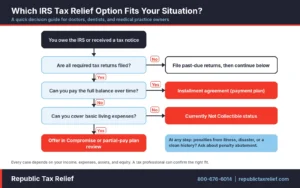
The IRS has a set list of relief programs, but it does not hand them out based on how stressed you are. It decides based on your numbers. This guide to tax relief for medical professionals explains how the IRS makes that call, walks through six situations we see often in healthcare, and shows when it makes sense to bring in a professional.
In This Guide
- How the IRS Decides Which Relief a Doctor Qualifies For
- Six Physician Tax Debt Scenarios and the Relief That Usually Fits
- When to Bring In a Tax Resolution Professional
- What to Gather Before Your Tax Relief Consultation
- Key Takeaways for Doctors With Tax Debt
- What Our Clients Say
- Tax Debt Relief FAQs for Doctors and Physicians
- Speak With a Tax Relief Professional
How the IRS Decides Which Relief a Doctor Qualifies For
When you owe more than a simple payment plan allows, the IRS usually asks for a detailed financial statement. For individuals, that is Form 433-A. For a medical practice, it is often Form 433-B. These forms list your income, monthly expenses, assets, and the equity you hold in them.
The IRS then compares your living expenses with its Collection Financial Standards, which set allowances for housing, food, transportation, and health care. This is where many physicians get surprised. A large mortgage, private school tuition, or a pricey car lease may not count in full, so the IRS may decide you can afford a much higher payment than you expected.
| What the IRS Reviews | What It Means for a Physician |
|---|---|
| Income | Current pay plus future earning potential. A high earning potential makes a settlement harder to get. |
| Monthly expenses | Compared to IRS standards. Costs above those amounts may be disallowed unless you can show they are necessary. |
| Assets and equity | Home equity, retirement accounts, practice equipment, and receivables. The IRS may expect you to use some of that equity. |
| Tax compliance | All required returns filed and current-year estimated tax payments or payroll deposits made. This is usually required before any agreement. |
Practical takeaway: Before you agree to a monthly payment, know how the IRS will calculate what you can afford. A tax professional can document necessary costs the IRS might otherwise question, so your payment reflects your real budget.
Six Physician Tax Debt Scenarios and the Relief That Usually Fits
No two cases are the same, but most doctor tax problems follow a handful of patterns. Find the one closest to yours below.
1. The Employed Physician Facing a Wage Garnishment
A hospital-employed doctor earns W-2 pay plus side income from moonlighting or expert witness work. No one withholds tax from that side income, the balance grows, and the IRS eventually sends a levy to the employer.
- What usually fits: An installment agreement, followed by a request to release the levy.
- Takeaway: A wage levy can often be released once a payment plan is approved, but someone has to ask for the release. Learn more about wage garnishment relief.
2. The 1099 Locum or Contractor With Unfiled Years
A locum tenens physician or travel CRNA works in several states, misses quarterly taxes, and stops filing. The IRS may file substitute returns that ignore legitimate deductions, which inflates the bill.
- What usually fits: Filing accurate past-due returns first, then a payment plan or penalty relief on the corrected balance.
- Takeaway: Getting compliant often lowers what you owe before negotiation even starts. See how to catch up on unfiled tax returns.
3. The Practice Owner Behind on Form 941 Payroll Taxes
Insurance reimbursements run slow, and payroll tax deposits get pushed back to keep staff paid. Unpaid trust fund taxes can lead to the Trust Fund Recovery Penalty, which makes the debt personal for owners and other responsible people.
- What usually fits: Staying current on new deposits, filing any missing Form 941 and Form 940 returns, and negotiating an in-business installment agreement.
- Takeaway: The IRS rarely works with a practice that keeps falling further behind. Read about payroll tax debt relief.
4. The Doctor Whose Income Has Dropped
A disability, early retirement, or practice closure can cut income sharply while an old tax bill remains. Here, the IRS may see that you truly cannot pay the full balance.
- What usually fits: An Offer in Compromise if your numbers support it, or Currently Not Collectible status if paying anything would cause financial hardship.
- Takeaway: Timing matters. An offer filed after a real income drop has a better chance than one filed while you are still earning at your peak.
5. The Dentist or Specialist With a Lien Blocking a Loan or Sale
A federal tax lien shows up when you try to refinance, buy into a group, or sell your practice. The deal stalls until the lien is addressed.
- What usually fits: Lien subordination, discharge of a specific property, withdrawal, or release once the debt is paid or resolved.
- Takeaway: A lien does not always have to be paid in full before a deal can close. Explore tax lien help.
6. The Surgeon Hit With Penalties After a Hard Year
A serious illness, a death in the family, or a natural disaster pulled attention away from taxes. Penalties and interest now make up a large share of the balance.
- What usually fits: First-time penalty abatement for a clean history, or reasonable cause relief backed by records.
- Takeaway: Penalty relief can shrink the balance before you set up a plan. Learn how to request IRS penalty abatement.
| Your Situation | Relief Options That Often Fit |
|---|---|
| W-2 physician with a wage levy | Installment agreement, levy release |
| 1099 contractor with unfiled years | File past-due returns, then payment plan or penalty relief |
| Practice owner with payroll tax debt | In-business installment agreement, penalty review |
| Income dropped sharply | Offer in Compromise or Currently Not Collectible |
| Lien blocking a loan or sale | Subordination, discharge, withdrawal, or release |
| Penalties after a hardship | First-time abatement or reasonable cause relief |
When to Bring In a Tax Resolution Professional
A small balance with no collection activity is sometimes manageable on your own. Physician tax problems rarely stay small, though, and the stakes rise quickly once collections begin. These are signs it is time to get help:
- You received a CP504, LT11, or Letter 1058 warning of a levy.
- A revenue officer has called, written, or visited your practice.
- The IRS asked you to complete Form 433-A or Form 433-B.
- You received Letter 1153 proposing the Trust Fund Recovery Penalty.
- You owe both the IRS and a state agency, such as the California Franchise Tax Board or EDD.
- Your balance is over $50,000, which usually means a full financial review.
Once you sign Form 2848, a qualified representative can speak with the IRS for you. The IRS then contacts your representative instead of calling your office. Your representative can pull your transcripts, request collection holds when available, and negotiate the option that fits your finances.
Practical takeaway: Professional help is about more than paperwork. It protects your time with patients and keeps you from saying something to the IRS that limits your options later. See how our tax resolution services for medical professionals work from start to finish.
What to Gather Before Your Tax Relief Consultation
You do not need a perfect file before you call. Bringing what you have helps a professional give you a clear picture on the first call.
- Every IRS and state notice, newest first
- Your last three filed returns, or a list of the years you have not filed
- W-2s, 1099s, and K-1s for the years in question
- Practice profit and loss statements and payroll reports, including Form 941 filings
- Three to six months of personal and practice bank statements
- A list of monthly expenses, such as housing, vehicles, insurance, student loans, and child care
- A list of assets, including your home, retirement accounts, equipment, and receivables
Practical takeaway: Missing documents are common. A representative can request IRS transcripts to fill in income records you no longer have.
Key Takeaways for Doctors With Tax Debt
- The IRS chooses relief based on your income, expenses, assets, and equity, not your title or earnings history alone.
- High-earning doctors most often resolve debt through installment agreements and penalty relief.
- Settlements and hardship status usually fit only after a real drop in income.
- Unfiled returns and unpaid payroll taxes need attention first, because they block most agreements.
- Acting before a final levy notice gives you more options and more control.
What Our Clients Say
★★★★★
“I had a complicated case with years of unfiled taxes and they cleaned it all up perfectly. I am so impressed by their organization and attention to detail!!”
~Camden Blake, Google Review
Results vary based on each client’s facts and circumstances.
Tax Debt Relief FAQs for Doctors and Physicians
Can I get IRS tax relief if I still earn a high income?
Yes. High earners usually qualify for installment agreements and may qualify for penalty abatement. A settlement through an Offer in Compromise is less likely while your income is high, because the IRS counts future earning potential.
How much can I owe and still get a simple IRS payment plan?
Individuals who owe $50,000 or less in combined tax, penalties, and interest can generally apply for a streamlined plan of up to 72 months without a full financial statement, according to the IRS. Larger balances usually require Form 433-A or Form 433-F.
Does a payment plan stop an IRS levy?
The IRS generally cannot levy while a payment plan request is being considered or while an approved plan is in good standing. You must keep making payments and file future returns on time to keep that protection.
Will the IRS make me sell my home or practice equipment?
Not usually. The IRS looks at the equity in your assets when deciding what you can pay, and it may expect you to use some of it. Seizing a primary residence is rare and requires approval from a federal court.
Can IRS penalties be removed if I was on medical leave?
Possibly. Serious illness can support a reasonable cause request if you can show it kept you from filing or paying on time. If you have a clean history for the past three years, first-time abatement may also apply.
Do I have to speak with the IRS myself?
No. When you sign Form 2848, a qualified tax professional can represent you, take IRS calls, and negotiate for you.
Speak With a Tax Relief Professional
Every month you wait adds penalties and interest, and the IRS moves closer to stronger collection tools. Republic Tax Relief offers tax relief for medical professionals who want a clear plan and a team that answers the phone. We review your notices, explain your options in plain terms, and handle the IRS so you can focus on your patients.
Your financial records deserve the same protection you give patient charts. Every tax return, bank statement, and Social Security number you share is guarded by strict professional confidentiality and bank-grade 256-bit encryption.
Call 800-676-6014 or schedule your free, confidential consultation today.
About Republic Tax Relief
Republic Tax Relief helps individuals, medical professionals, and business owners resolve IRS and state tax problems, including back taxes, unfiled returns, levies, liens, wage garnishments, and payroll tax debt. Our team of tax professionals negotiates directly with tax agencies to find a realistic path to resolution for each client. Call 800-676-6014 or visit our contact page to get started.
Disclaimer: This article is for general educational purposes and is not legal or tax advice for your specific situation. Tax laws change, and results depend on each taxpayer’s facts. Speak with a qualified tax professional before making decisions about your tax debt.
Sources
- Internal Revenue Service, Collection Financial Standards
- Internal Revenue Service, Payment Plans; Installment Agreements
- Internal Revenue Service, About Form 2848, Power of Attorney and Declaration of Representative