
Oct
You meant to file. Then one year slipped, the next felt harder, and now the envelopes from the IRS stay unopened in a drawer. If that sounds familiar, you are not alone. The IRS deals with millions of non-filers, and most of them get back on track.
Here is the honest part: unfiled taxes do not fade away. Penalties grow every month, and the IRS may file a return for you that shows a much higher tax bill than you actually owe. The good news is that the IRS generally wants your recent returns more than it wants a fight. A clear plan, built with a tax professional, can turn years of unfiled tax returns into a manageable, finished project.
This Unfiled Tax Returns Blog explains what the IRS can do, how far back it looks, what the penalties really cost, and what happens once you are caught up.
Table of Contents
- Why Unfiled Taxes Get the IRS’s Attention
- What Happens When the IRS Files a Substitute for Return
- The IRS 6-Year Rule and the Statute of Limitations
- Failure to File Penalty vs Failure to Pay Penalty
- Missing W-2s or 1099s: Using Wage and Income Transcripts
- How Back Tax Returns Get Filed With Professional Help
- Tax Relief Options Once Your Unfiled Returns Are Filed
- Business Owners With Years of Unfiled Returns
- What Our Clients Say
- Unfiled Tax Return FAQs
- Speak With a Tax Relief Professional
Why Unfiled Taxes Get the IRS’s Attention
The IRS receives a copy of nearly every W-2 and 1099 issued in your name. When income shows up on its system and no tax return matches it, a computer flags the gap. That is why non-filers often get letters years after the fact, even when they assumed nobody noticed.
Ignoring those letters usually leads to the same path: notices, a proposed assessment, and eventually IRS collection action. That can include a federal tax lien on your property or a levy on your bank account or wages.
Common notices non-filers receive:
- CP59 / CP80 / CP88: The IRS says it has no record of your return.
- Letter 2566 or CP2566: The IRS proposes a tax based on its own records.
- CP504 or LT11/Letter 1058: Collection notices that can lead to a levy.
Practical takeaway: Open every IRS letter and note the date on it. Many notices carry 30- to 90-day response windows, and a tax professional can often do more for you inside that window than after it closes.
What Happens When the IRS Files a Substitute for Return
If you do not file, the IRS can prepare a return for you. This is called an IRS Substitute for Return (SFR). It sounds helpful, but it rarely works in your favor.
An SFR uses only the income the IRS knows about. It generally ignores the deductions, credits, dependents, and business expenses you may be entitled to, and it often uses the least favorable filing status. The result is a tax bill that can be far higher than what you truly owe.
Example: A self-employed contractor earned $85,000 in 1099 income but had $30,000 in legitimate business expenses. An SFR would tax the full $85,000, plus self-employment tax, with no expense deductions. Filing an accurate original return can replace that SFR assessment and bring the balance down to the real amount.
An SFR also starts the clock on penalties and collection. Once the IRS assesses that tax, it can file liens and move toward levies. If you already have an SFR on your account, you generally still have the right to file your own return to correct it. A tax resolution team can submit that return and ask the IRS to adjust the assessment.
The IRS 6-Year Rule and the Statute of Limitations
One of the most common questions we hear is, “How far back can the IRS come after you for unfiled taxes?” The answer has two parts.
The IRS 6-year rule for unfiled returns
Under IRS Policy Statement 5-133, the IRS generally enforces filing requirements for no more than the last six years (IRS: Filing Past Due Tax Returns). In most cases, filing the last six years of returns puts you back in filing compliance. That is the condition you need to qualify for most relief programs.
The six-year guideline is not a hard ceiling, though. The IRS can ask for older years when the facts call for it, such as large unreported income, business returns, or a case assigned to a revenue officer.
Why the statute of limitations doesn’t protect non-filers
The normal three-year limit on IRS assessments only starts once a return is filed. If you never file, that clock never starts. This is why unfiled taxes from 10 or 15 years ago can technically still be assessed.
| Time limit | What it means for you |
|---|---|
| No deadline | The IRS can assess tax on a year you never filed |
| 6 years | The years the IRS usually requires to consider you compliant |
| 3 years | Your window to claim a tax refund on a late return |
| 10 years | How long the IRS generally has to collect after it assesses tax |
Practical takeaway: If you are owed a refund for an older year, every month matters. After three years from the original due date, that refund is generally lost for good.
Failure to File Penalty vs Failure to Pay Penalty
These two penalties are often confused, but they are very different in size. Understanding failure to file penalty vs failure to pay penalty shows why filing quickly matters, even if you can’t pay.
| Penalty | Rate | Maximum | Key point |
|---|---|---|---|
| Failure to file | 5% of unpaid tax per month | 25% | Ten times larger than the failure-to-pay rate |
| Failure to pay | 0.5% of unpaid tax per month | 25% | Drops to 0.25% during an approved payment plan |
| Minimum late-filing penalty | Lesser of $525 or 100% of tax owed | — | Applies to returns over 60 days late (returns filed in 2026) |
When both penalties apply in the same month, the failure-to-file amount is reduced by the failure-to-pay amount (IRS: Failure to File Penalty). Interest also builds on both the tax and the penalties until paid.
Example: If you owe $10,000 and file five months late without paying, the failure-to-file penalty alone can reach about $2,250. Had you filed on time and simply not paid, the failure-to-pay penalty for those same five months would be about $250.
Practical takeaway: File even if you cannot pay. You may also qualify for IRS penalty abatement, such as first-time abatement or reasonable cause relief for illness, disaster, or other events outside your control.
Missing W-2s or 1099s: Using Wage and Income Transcripts
Many people delay filing because their paperwork is gone. Old employers closed, a shoebox of receipts got lost, or a move scattered everything. Missing W-2 or 1099 forms do not have to stop the process.
The IRS keeps wage and income transcripts that list what employers, banks, and other payers reported under your Social Security number. These generally go back about 10 years. A tax professional can pull your tax transcripts directly through IRS practitioner channels, often faster than requesting them yourself.
What transcripts can and can’t show:
- They show: W-2 wages, 1099-NEC and 1099-K income, interest, dividends, mortgage interest, and some retirement distributions.
- They don’t show: Cash income, most business expenses, or deductions you can still claim.
- Why it matters: Your filed return should match IRS records. A mismatch can trigger follow-up letters or an exam.
Practical takeaway: For business expenses with missing receipts, bank and credit card statements can often help rebuild a reasonable, supportable record.
How Back Tax Returns Get Filed With Professional Help
People often search for how to file back tax returns, expecting a simple checklist. In practice, dealing with unfiled tax returns is part paperwork and part strategy. The order you file in, and what you say to the IRS while you do it, can affect penalties and collection.
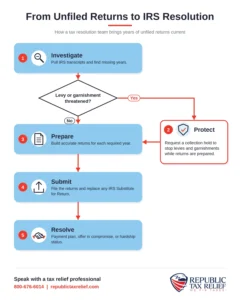
Here is how an experienced team typically handles it:
- Investigate. Pull your IRS account and wage and income transcripts to see which years are missing, whether any SFRs exist, and how close you are to collection.
- Protect. If a levy or garnishment is near, request a collection hold while the missing returns are prepared.
- Prepare. Build accurate returns for each required year, using the correct filing status and every deduction and credit the law allows.
- Submit. File the returns and confirm the IRS processes them, including any SFR replacements.
- Resolve. Once the balance is known, choose the right relief option for the total tax debt.
At Republic Tax Relief, our tax resolution team represents individuals and businesses before the IRS and state tax agencies. With a signed power of attorney (Form 2848), we can speak to the IRS for you, so you don’t have to handle those calls alone. Our unfiled tax returns services page covers how we approach each case.
Tax Relief Options Once Your Unfiled Returns Are Filed
Filing is the door to relief. The IRS generally will not approve a payment plan or settlement until you are current with your filing. Once you are compliant, these options open up:
| Option | Best for | Learn more |
|---|---|---|
| Installment agreement | Taxpayers who can pay over time | IRS payment plans |
| Offer in compromise | Those who cannot pay the full balance | How the OIC program works |
| Currently Not Collectible | Taxpayers facing financial hardship | CNC status |
| Penalty abatement | First-time or reasonable-cause penalties | Penalty relief |
| Innocent spouse relief | Joint filers with a spouse’s errors | Innocent spouse relief |
If collection has already started, our team can also help with wage garnishments, bank levies, and federal tax liens. Results depend on your finances and IRS rules, and no firm can promise a specific outcome.
Business Owners With Years of Unfiled Returns
Business tax filings add more layers. A business may owe income tax returns, payroll returns (Form 941 and 940), and state sales tax returns. Unfiled payroll returns are especially risky because the IRS can hold owners and responsible officers personally liable for unpaid trust fund taxes.
Business cases are also more likely to involve a revenue officer, who may ask for more than six years. If that describes your situation, see our guides on payroll tax debt relief and business tax resolution services. We also work with construction, medical, real estate, and e-commerce businesses.
Practical takeaway: Get current on payroll filings first. New quarters that go unfiled can make a payment plan or settlement much harder to get.
What Our Clients Say
“The Law team was excellent with helping me with getting my taxes resolved. Appreciate them all for working with me. I’d like to really thank Antranette she was my rock that keep me strong going through this Thanks again for all your help.”
— Luetta Roberson, verified Google review
Our work has been recognized by industry groups and clients alike. See our awards and recognition.
Your information stays private. Every document you share is protected by bank-grade 256-bit encryption and handled under strict attorney-client confidentiality, so you can focus on getting relief, not worrying about your data.
Summary: Your Path Back to Good Standing With the IRS
- The IRS knows about your income through W-2s and 1099s, even when you haven’t filed.
- An SFR usually overstates what you owe; filing your own accurate return can replace it.
- The IRS generally wants the last six years of returns, but the assessment clock never starts on years you never filed.
- The failure-to-file penalty is up to ten times the failure-to-pay penalty, so file even if you can’t pay.
- Missing forms can be rebuilt from wage and income transcripts.
- Once you’re compliant, relief options like payment plans, an offer in compromise, or hardship status become available.
The main lesson of this Unfiled Tax Returns Blog is simple: the longer returns stay unfiled, the fewer choices you have. Acting now keeps your options open.
Unfiled Tax Return FAQs
How far back can the IRS come after you for unfiled taxes?
There is no time limit on assessing tax for a year you never filed, because the statute of limitations only begins once a return is filed. In practice, the IRS generally requires the last six years to consider you compliant, though it can ask for more in some cases.
What is an IRS Substitute for Return (SFR)?
An SFR is a return the IRS prepares for you using only the income reported by employers and payers. It usually leaves out deductions, credits, and expenses, so the balance is often higher than what you truly owe. You can generally file your own return to replace it.
Can I still get a refund on an old unfiled tax return?
Generally, only if you file within three years of the original due date. After that, the refund is forfeited and cannot be used to offset other tax years.
What if I don’t have my W-2s or 1099s?
The IRS keeps wage and income transcripts for roughly the last 10 years. A tax professional can request them and use them, along with bank records, to prepare accurate returns.
Will I go to jail for not filing taxes?
Criminal cases for non-filing are rare and usually involve willful conduct, such as hiding income. Most non-filers who come forward voluntarily resolve the issue through civil processes. If you have concerns about your specific situation, speak with a tax attorney before contacting the IRS.
Can I get on a payment plan if I have unfiled returns?
Usually not until the missing returns are filed. Filing compliance is a basic requirement for installment agreements, an offer in compromise, and most other relief.
Speak With a Tax Relief Professional
Years of unfiled returns can feel too big to face, but you don’t have to sort it out alone. Our team will review your IRS account, explain where you stand, and lay out your options in plain language.
Call 800-676-6014 or request a confidential consultation today.
About Republic Tax Relief: Republic Tax Relief helps individuals and business owners resolve IRS and state tax problems, including unfiled returns, tax debt, levies, liens, and wage garnishments. Our team negotiates directly with tax agencies on your behalf to pursue fair, lasting solutions. Call 800-676-6014 or visit our Contact page to get started.
This article is for general educational purposes and is not legal or tax advice for your specific situation. Results vary based on individual circumstances.
Sources