
Reviewed by the licensed tax professionals at Republic Tax Relief | Last updated November 20, 2026
You built your store to sell, not to argue with the IRS. But when a balance due notice lands, a state auditor asks for three years of marketplace reports, or your bank account freezes the week before a big inventory order, the tax problem becomes the business problem.
Republic Tax Relief provides E-Commerce Tax Resolution for Amazon sellers, Shopify brands, dropshippers, and multichannel retailers who owe the IRS or a state tax agency. We step in between you and the tax agencies, stop collection where the law allows, and negotiate a plan your store can actually afford.
Your files are safe with us. Upload tax returns, bank statements, and IRS notices with confidence. Every file is protected by bank-grade 256-bit encryption and handled in full compliance with federal data protection standards.
On This Page
- Online Sellers We Help
- E-Commerce Tax Problems We Resolve
- How We Handle IRS and State Tax Debt Together
- IRS Debt Relief Options for Online Sellers
- State Sales Tax Resolution and Audit Defense
- Protecting Your Seller Accounts and Cash Flow
- Tax Help for Every Stage of Your Online Business
- Sample E-Commerce Tax Cases
- Our Tax Relief Process for Online Businesses
- What Our Representation Includes
- Why Online Sellers Choose Republic Tax Relief
- What Our Clients Say
- Questions to Ask Before You Hire a Tax Firm
- Common Questions About Working With Us
- More Questions and Answers
- Speak With a Tax Relief Professional
Online Sellers We Help
Every selling model creates a different kind of tax trail. We work with online business owners at every size, from solo sellers who just crossed six figures to brands with warehouses and payroll.
| Type of Seller | Problems We Often See |
|---|---|
| Amazon FBA and FBM sellers | 1099-K gross sales mismatches, unpaid income tax, state notices tied to warehouse inventory |
| Shopify and website stores | Uncollected sales tax on direct orders, unfiled returns, frozen business accounts |
| Walmart, Etsy, and eBay sellers | Income reporting gaps across several platforms, balance due notices |
| Dropshipping businesses | State assessments over missing resale certificates, thin records, payout levies |
| Wholesale and multichannel brands | Payroll tax debt, multi-state sales tax audits, federal tax liens |
Amazon Seller Tax Debt Resolution
Amazon sellers often owe more on paper than they do in real life, because the IRS sees gross sales before Amazon’s fees, refunds, and storage costs. Our Amazon seller tax debt resolution work starts by rebuilding true profit from your settlement and payment reports. From there, we negotiate the corrected balance and handle any state notices tied to FBA inventory.
Shopify Business Back Tax Relief
Shopify store owners usually handle their own sales tax and their own bookkeeping, so small gaps can turn into years of back taxes. Shopify business back tax relief often combines an IRS solution for income tax with a state plan for uncollected sales tax. We coordinate both so your store can keep running while the debt is resolved.
Walmart, Etsy, and eBay Sellers
Sellers on these platforms often run more than one shop or sell part time alongside a regular job. That mix can lead to wage garnishments, missed estimated payments, and income that was never reported. We sort out each income stream and match the right relief program to your full financial picture.
Dropshipping and Wholesale Businesses
When your supplier, warehouse, and customer are in different places, state agencies may claim you owe tax you never collected. We gather supplier invoices and resale certificates, then present them to the state to reduce or remove assessments. For wholesale sellers, we show which sales were exempt resale transactions.
Brands With Employees and Warehouses
Once your store has staff, payroll taxes become the biggest risk, because the IRS treats unpaid trust fund taxes very seriously. We protect owners from personal liability where possible and set up a business plan that keeps payroll running. Larger brands also get help with liens that block financing and supplier credit.
Want to understand how sellers fall behind in the first place? Our article on why online sellers end up owing the IRS explains the common causes.
E-Commerce Tax Problems We Resolve
Our job is to fix the debt you already have and protect your business while we do it. Here are the problems we handle most often for e-commerce clients.
Unpaid Federal Income Tax and Balance Due Notices
If you owe from past years, we review your account, confirm the balance is correct, and set up the right resolution. That may be a payment plan, a settlement, or a hardship status that pauses collection.
1099-K Mismatches and CP2000 Notices
Marketplaces and payment processors report seller payments to the IRS on Form 1099-K. For 2025 and 2026, platforms generally issue the form once a seller passes $20,000 in payments and 200 transactions.1 When the IRS treats gross sales as profit, we rebuild your real numbers from settlement reports, fees, refunds, and cost of goods sold so you only pay what you truly owe.
Unfiled Business and Personal Returns
Missing returns block almost every relief program. Our team brings your filings current as part of the case, so you can qualify for relief. Learn more about our help with unfiled tax returns.
Payroll Tax Debt for Growing Brands
If you have employees and fell behind on Form 941 deposits, the IRS can hold owners personally responsible through the Trust Fund Recovery Penalty. We defend owners against that penalty and negotiate the business balance. See our page on payroll tax debt relief.
Bank Levies, Frozen Payouts, and Garnishments
A levy can empty your business account right when you need cash for inventory. We act fast to request a release and pair it with a long-term solution. Get details on bank levy help and wage garnishment relief.
Federal Tax Liens
A lien can block business loans and supplier credit lines. We work to release, withdraw, or subordinate liens so you can keep growing. Read more about tax lien help.
IRS Audits of Online Businesses
Audits often focus on reported sales, inventory, and deductions. We handle all contact with the examiner and present your records in a clear, organized way. Learn about our business IRS audit representation.
How We Handle IRS and State Tax Debt Together
Most online sellers who owe the IRS also owe at least one state. The problem is that each agency runs its own collection program, and neither one waits for the other.
If you set up a payment plan with the IRS and ignore the state, the state can still levy your account. If you agree to a state payment you cannot afford, you may miss your IRS payment and default. Either way, one agreement can undo the other.
We avoid that by building one combined plan. Here is how it works:
- One budget, every agency. We list every federal and state balance, then fit all payments into one realistic monthly number.
- Priority by risk. We address the agency closest to levying or suspending a permit first.
- Matched timelines. We time state and federal agreements so neither one pushes the other into default.
- One point of contact. You talk to your Republic team, and we talk to the IRS and the states.
| Type of Debt | Who Collects It | How We Help |
|---|---|---|
| Federal income tax | IRS | Payment plans, offers, hardship status, penalty relief |
| Payroll taxes | IRS and state labor or revenue agency | Business payment plans, trust fund penalty defense |
| State income tax | State revenue department | State payment plans, penalty relief, levy releases |
| Sales and use tax | Each state where tax was due | Audit defense, voluntary disclosure, payment plans |
IRS Debt Relief Options for Online Sellers
There is no single fix for every store. The right program depends on what you owe, your monthly cash flow, your inventory and equipment, and whether your filings are current. Here is how each path to IRS debt relief for online sellers fits an online business.
Installment Agreements
A payment plan spreads your balance over time and stops most collection activity. Many taxpayers can apply online for smaller balances, while larger balances require a financial statement.2 We present your numbers so the monthly payment reflects seasonal sales, not just your best quarter. See our guide to IRS payment plans.
Offer in Compromise
An offer lets some taxpayers settle for less than the full balance. The IRS looks at your ability to pay, income, expenses, and asset equity, including inventory.3 Read how the OIC program works and how it fits into the IRS Fresh Start program.
Currently Not Collectible Status
If your store slowed down or closed and you cannot cover basic living costs, the IRS may pause collection. Learn about Currently Not Collectible status.
Penalty Abatement
Penalties can add 25 percent or more to your original tax. If you have a clean history or faced a serious setback, we request IRS penalty abatement to cut the balance.
Innocent Spouse Relief
If you filed jointly and your spouse ran the store without telling you about the tax problem, you may not have to pay their share. Review the four types of innocent spouse relief.
Compare Your Options
| Option | Best Fit | Main Benefit | Keep in Mind |
|---|---|---|---|
| Installment agreement | Steady sales, can pay over time | Stops most collection, store stays open | Interest continues until paid |
| Offer in Compromise | Cannot pay in full now or later | Settle for less than owed | Strict financial review, must stay compliant |
| Currently Not Collectible | Serious financial hardship | Pauses collection | Debt remains and is reviewed later |
| Penalty abatement | Good history or reasonable cause | Removes penalties and related interest | Tax itself still owed |
| Lien or levy release | Frozen accounts or filed liens | Restores cash flow and credit | Usually paired with a payment solution |
For a wider look at every program, see our guide to tax debt relief options. Owners with entity-level debt can also review our business tax debt relief page.
State Sales Tax Resolution and Audit Defense
Sales tax debt is a state matter, not an IRS one, and each state runs its own collection and audit program. Many states can hold owners personally liable for sales tax that should have been collected, so these cases need careful handling.
When a state contacts you, our team and our e-commerce sales tax audit attorney resources can:
- Take over communication with the state auditor so you are not answering questions alone
- Separate marketplace sales that Amazon, Walmart, or Etsy already collected on from your own website sales
- Challenge sampling methods that overstate what you owe
- Document exempt and resale sales with certificates and supplier invoices
- Request penalty relief and negotiate state payment plans
- Approach states through voluntary disclosure before they find you, which often limits look-back years and penalties
If you are still trying to understand nexus and economic thresholds, our guide for online sellers covers the basics. This page focuses on fixing the balance once it exists.
Protecting Your Seller Accounts, Inventory, and Cash Flow
For an online business, cash flow is everything. A single levy or lien can stop inventory orders, delay shipping, and hurt your seller ratings, so protecting your operations is part of every case we take.
Keeping Your Accounts Open
When collection is active, we move quickly to request holds and releases. We also help you plan where your platform payouts land, so a future levy does not catch your operating account by surprise.
Protecting Your Inventory and Equipment
The IRS rarely seizes business assets, but it can when other options fail. Showing a workable plan early is the best way to keep inventory, packaging equipment, and vehicles in your hands.
Preserving Supplier and Lender Relationships
A filed lien can show up when you apply for a loan, a line of credit, or financing on inventory. We pursue lien withdrawal or subordination when you qualify, so lenders and suppliers can keep working with you.
Keeping State Permits Active
Some states can suspend a seller’s permit over unpaid sales tax. We contact the state, set up a plan, and work to keep your permit in good standing so you can keep selling legally.
Tax Help for Every Stage of Your Online Business
Tax problems look different depending on where your business is. We tailor our approach to the stage you are in right now.
New Sellers Facing Their First IRS Notice
Your first notice can feel frightening, but early problems are often the easiest to fix. We confirm whether the notice is accurate, respond before the deadline, and help you avoid a small balance turning into a large one.
Fast-Growing Stores With Rising Balances
Rapid growth often outpaces bookkeeping. When sales double, so do taxes, and quarterly payments fall behind. We stabilize the old debt with a plan that fits your growth, so you can keep reinvesting in inventory and ads.
Sellers Closing or Selling a Store
Closing a store does not erase its tax debt, and an unpaid balance can block the sale of your business. We help you resolve liens before a sale, negotiate what remains, and explore hardship options if the business has wound down.
Sample E-Commerce Tax Cases
The examples below are composites based on situations we commonly see. Names and figures are illustrative, and every result depends on the taxpayer’s own facts.
Amazon FBA Seller Facing a CP2000 Notice
Situation: A seller reported net profit, but the IRS matched gross 1099-K sales and proposed about $48,000 in extra tax. What we did: We rebuilt profit from settlement reports, fees, returns, and inventory costs, then answered the notice with documentation. Outcome: The proposed balance was reduced to a small amount, set up on a short payment plan.
Shopify Brand With a Multi-State Sales Tax Assessment
Situation: A state auditor assessed tax on all orders shipped into the state, including sales a marketplace had already collected on. What we did: We separated marketplace orders from direct website orders and challenged the sample period. Outcome: The assessment dropped significantly, and the remaining balance went on a state payment plan.
Dropshipper With a Frozen Business Account
Situation: After years of unfiled returns, the IRS levied the business checking account holding supplier payments. What we did: We filed the missing returns, requested a levy release, and submitted a financial statement. Outcome: The account was released, and the seller entered an installment agreement based on real monthly cash flow.
Multichannel Retailer Behind on Payroll Taxes
Situation: A growing brand with eight employees missed several quarters of Form 941 deposits, and a revenue officer was assigned. What we did: We stopped further enforcement, brought deposits current, and defended the owner in the trust fund penalty interview. Outcome: The business stayed open under an approved payment plan.
Etsy Seller Who Closed Her Shop
Situation: A craft seller closed her shop after sales fell but still owed about $22,000 from two strong years. What we did: We documented her reduced income and basic living costs and submitted them to the IRS. Outcome: Her account was placed in Currently Not Collectible status, stopping collection while her income stayed low.
Walmart Marketplace Seller Hit With Penalties
Situation: A seller with a clean history filed late during a family emergency, and penalties added thousands to the balance. What we did: We requested first-time penalty abatement and supported it with records of the emergency. Outcome: The penalties were removed, and the remaining tax was paid through a short-term plan.
Our Tax Relief Process for Online Businesses
Our e-commerce tax resolution services follow a clear, five-step path. You will always know where your case stands and what comes next.
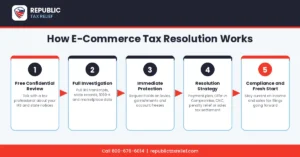
- Free confidential review. We talk through your notices, sales channels, and goals.
- Full investigation. We pull IRS transcripts and state records and compare them to your 1099-K and marketplace data.
- Immediate protection. Where possible, we request holds on levies, garnishments, and account freezes.
- Resolution strategy. We negotiate the best fit: a payment plan, an offer, hardship status, penalty relief, or a state settlement.
- Compliance and fresh start. We help you stay current going forward so relief does not unravel.
For a deeper look at how resolution works for any taxpayer, visit our complete guide to tax resolution services.
What Our Representation Includes
When you hire Republic Tax Relief, you get more than a single phone call to the IRS. Your case includes:
| Service | What It Means for You |
|---|---|
| Power of attorney | We speak to the IRS and states for you |
| Transcript and account review | We confirm what you owe and spot errors |
| Notice responses | Deadlines are met, and nothing slips through |
| Collection protection | Holds and releases requested where available |
| Negotiation | The best relief option is presented and argued |
| Compliance follow-up | Your agreement stays in good standing |
Tax attorneys, CPAs, and enrolled agents are the professionals allowed full representation rights before the IRS. Ask any firm you consider which credentialed person will actually handle your case.
Why Online Sellers Choose Republic Tax Relief
A bookkeeper or CPA keeps your books clean. When the IRS or a state is already collecting, you need a team built to negotiate.
- We understand marketplace data. Settlement reports, payout schedules, and 1099-K forms are part of every case we build.
- Federal and state help in one place. We coordinate IRS relief with state tax resolution so one agreement does not sink the other.
- Authorized representation. Our credentialed professionals can speak to the IRS for you, so you can focus on running your store.
- Upfront, affordable pricing. You get a clear fee before work begins, with installment options for our fees.
- Honest answers. If a program will not work for your situation, we tell you on the first call.
Need help beyond e-commerce? Explore our business tax resolution services and IRS collections defense.
What Our Clients Say
★★★★★ Google Review
“As of today, June 23rd, Republic Tax Relief has been awesome. I have always been skeptical of using these tax companies. But, I decided to take a chance because of I couldn’t get anywhere with the IRS by myself. I had 3 companies on my list, Republic Tax Relief, TRA Tax Relief and Optima Tax Relief. I was about to go with TRA but they were tremendously high, so I decided to call Republic and gave me an affordable price based upon my situation. I never got a chance to call Optima because I was impressed with the communication and cost with RTR. I started off with Ken at RTR, then I spoke to Chris, and now I’m working with Rebekah. All three have been great communicating and answering my very thorough questions. They gave me a level of comfort to trust them. Now, it is just a waiting game and in 3 years I will be able to come back and provide an update. Also, RTR has allowed me to pay my fees to them in 6 installments making it very worthy to use them. Thank you Ken, Chris, and Rebekah!”
Alwynn VanBuren
Questions to Ask Before You Hire a Tax Firm
Not every tax relief company is the right fit for an online business. Before you sign, ask:
- Who will actually work my case, and are they an attorney, CPA, or enrolled agent?
- Have you handled 1099-K mismatches and marketplace sales data before?
- Can you help with both my IRS balance and my state sales tax issues?
- What is the total fee, and can I pay it in installments?
- How will you keep me updated, and how fast do you return calls?
To make your free review faster, have these ready:
- Every IRS and state letter you have received
- Your last filed tax returns and any 1099-K forms
- Marketplace settlement or payout reports
- Recent business and personal bank statements
Common Questions About Working With Us
Here are the questions online sellers ask most before starting a case with Republic Tax Relief.
Can you stop a levy on my business bank account or marketplace payouts?
Often, yes. Once we have your authorization, we can contact the IRS or the state right away to request a levy release, especially when the levy is causing economic hardship. A release usually requires a plan for the balance, such as a payment plan or hardship status, so we work on both at the same time to protect your cash flow.
Will my store stay open while you resolve my tax debt?
In most cases, yes. Our goal is to resolve the debt without shutting down your sales. We request holds on collection where the law allows and build a plan around your real monthly cash flow, including slow seasons, so you can keep buying inventory and filling orders while your case moves forward.
Can you help if I sell on Amazon, Shopify, and other platforms at the same time?
Yes. Many of our clients sell through several channels. We gather settlement reports and 1099-K forms from each platform, match them against your filed returns, and separate marketplace sales from website sales. That full picture lets us correct overstated balances and choose the right relief option for your whole business.
Do I have to file all my missing returns before you can help?
No. You can call us before your filings are current. Most relief programs do require recent returns to be filed, so bringing them up to date becomes part of your case. We handle the missing years alongside the negotiation, so you are not trying to catch up on your own first.
Can you work with my current bookkeeper or CPA?
Yes. We often work side by side with a client’s bookkeeper or CPA. They keep handling your day-to-day books and future tax returns, while our team focuses on negotiating the old debt with the IRS and state agencies. Sharing records between us usually makes your case move faster.
Will the IRS still call me once you represent me?
Usually not. After you sign a power of attorney, the IRS generally contacts your representative instead of you about the matters covered. You will still receive copies of letters by mail. We review each notice with you, respond on your behalf, and tell you if any action is needed from you.
How quickly can you start working on my case?
We can usually begin right after your free review and signed agreement. The first steps are pulling your IRS transcripts and state records and, if collection is active, requesting a hold. If you have a levy, garnishment, or deadline on a notice, tell us on the first call so we can act on it first.
More Questions and Answers
Have a quick question about 1099-K forms, sales tax notices, or whether an IRS call is real? Browse our quick answers for online sellers. You can also read back tax help for general guidance, or our article on bankruptcy and tax debt.
Speak With a Tax Relief Professional
Every week you wait, penalties and interest grow and collection options shrink. Whether you sell on Amazon, run a Shopify store, or manage a dropshipping business, E-Commerce Tax Resolution starts with one honest, confidential conversation.
Speak With a Tax Relief Professional
Or call 800-676-6014 for a free, confidential review.
About Republic Tax Relief
Republic Tax Relief helps individuals, online sellers, and business owners resolve IRS and state back taxes. Our licensed tax professionals handle installment agreements, Offers in Compromise, penalty abatement, lien and levy releases, payroll tax problems, and audit representation. For tax relief services from a team that answers your questions and keeps you informed, call 800-676-6014 or contact us online.
Sources
- Internal Revenue Service, Understanding Your Form 1099-K
- Internal Revenue Service, Payment Plans and Installment Agreements
- Internal Revenue Service, Offer in Compromise
This page provides general information, not legal or tax advice. Every tax situation is different, and results depend on your specific facts and eligibility. Past results do not guarantee future outcomes.