
When the IRS wants more than you have, every question feels urgent. Can they take my paycheck, and is there a form I can fill out?
This page answers the questions taxpayers search for most about the IRS hardship program, in plain language. For the full picture of how hardship relief works, read our complete IRS hardship guide.
On this page:
- Who Can Qualify for IRS Hardship Status
- IRS Hardship Forms and Online Requests
- What Happens at Each IRS Tax Debt Amount
- IRS Time Rules and Settlement Questions
- 401(k) Hardship Withdrawals and Finding Money When You Are Struggling
- Related IRS Tax Relief Questions
- Speak With a Tax Relief Professional
This page gives general information, not legal or tax advice. Your options depend on your facts.
Who Can Qualify for IRS Hardship Status
What qualifies you for hardship with the IRS?
You qualify for hardship with the IRS when your monthly income, after IRS-allowed living expenses, leaves little or nothing to pay your tax debt. The IRS also checks whether you have assets you could sell or borrow against, and whether all your tax returns are filed.
Think of it as three quick checks the IRS runs on your financial situation:
| What the IRS checks | What helps you qualify |
|---|---|
| Monthly cash flow | Income barely covers basic living expenses under IRS standards |
| Assets and equity | Little home equity, savings, or retirement money available |
| Compliance | All required tax returns filed and current-year taxes being paid |
Meeting all three is what usually opens the door to Currently Not Collectible status or a very low payment arrangement.
What are valid reasons for financial hardship?
Common valid reasons for financial hardship include job loss, a serious illness or disability, a sharp drop in business income, divorce, caring for a family member, or living on a small fixed income like Social Security. A natural disaster or a large uninsured loss can also qualify.
Here is the part many taxpayers miss. The IRS cares less about the story and more about the numbers behind it. A hardship event matters because of what it did to your income, expenses, and assets.
- Helps your case: pay stubs showing reduced hours, medical bills, termination letters, a profit and loss statement showing losses
- Hurts your case: large unexplained bank deposits, spending well above IRS standards, assets left off your forms
Does the IRS count credit card and medical debt payments as expenses?
Usually not. The IRS generally does not allow payments on unsecured debts, such as credit cards, personal loans, or old medical bills, when it measures your ability to pay. It treats your federal tax debt as a higher priority than those creditors.
Some payments do count. Ongoing out-of-pocket health care costs, health insurance premiums, court-ordered child support, and secured debts like a car loan (up to IRS limits) are typically allowed. Payments on federally guaranteed student loans may also count in many cases.
This is one reason so many people are surprised by IRS math. A budget that feels stretched to the limit can still show money left over once credit card payments are removed.
Can self-employed taxpayers get IRS hardship relief?
Yes. Self-employed taxpayers can qualify for hardship relief, but the IRS takes a closer look. You will usually complete Form 433-A, which asks for business income, expenses, accounts receivable, and equipment, not just your household budget.
Timing matters for people with uneven income. Submitting numbers from your best month can make you look able to pay, while an average over 6 to 12 months shows a truer picture. You also need to stay current on estimated tax payments, or the IRS may treat you as falling further behind.
If you have employees, unpaid payroll taxes add another layer. See our page on payroll tax debt relief for how those cases differ.
IRS Hardship Forms and Online Requests
What is the IRS hardship form for individuals?
There is no single IRS hardship form. Most individuals prove hardship with a Collection Information Statement, usually Form 433-F or Form 433-A, along with bank statements, pay stubs, and bills. The right form depends on your balance and who at the IRS is handling your case.
| Form | What it is used for |
|---|---|
| Form 433-F | Shorter financial statement used by most individuals working with IRS phone collections |
| Form 433-A | Detailed statement for wage earners and self-employed people, often with a revenue officer |
| Form 433-H | Combined payment plan request and financial statement for individuals |
| Form 656 | Offer in compromise application, filed with financial forms |
| Form 911 | Request for help from the Taxpayer Advocate Service when an IRS problem causes significant hardship |
Every one of these forms is signed under penalty of perjury. That is why many people have a tax professional prepare them.
Can I apply for a hardship payment plan online?
Partly. Individuals can apply online for a long-term payment plan if they owe $50,000 or less and have filed all required returns, or for a short-term plan if they owe less than $100,000. There is no online application for Currently Not Collectible hardship status.
Here is how the main options compare:
- Payment plan: available online for many individuals through an IRS online account
- Hardship (CNC) status: requested by phone, in person, or through a representative, with financial proof
- Offer in compromise: the IRS has an online eligibility tool, but the offer itself is filed as a paper package
- Businesses: generally need to call the IRS rather than apply online
Before you click “agree” on an online plan, make sure the monthly amount is one you can keep up with. A plan that defaults can restart collection. Our team handles IRS payment plan requests when the numbers are tight.
When should you contact the Taxpayer Advocate Service for hardship?
Contact the Taxpayer Advocate Service when an IRS problem is causing significant hardship and normal channels have not fixed it. Examples include a levy that leaves you unable to pay rent, an urgent deadline, or an IRS delay of more than 30 days on your case.
The Taxpayer Advocate Service is an independent office within the IRS, and its help is free. You can request assistance with Form 911.
- You face an immediate threat of adverse action, such as a pending levy
- You will face significant costs, such as fees for professional help, if the problem is not fixed
- You will suffer lasting harm, such as losing housing or transportation needed for work
The Advocate cannot erase what you owe. It can push a stuck case forward, which is sometimes exactly what a hardship case needs.
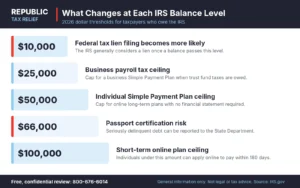
What Happens at Each IRS Tax Debt Amount
What should you do first if you owe the IRS and can’t afford to pay?
First, file your tax return on time even if you cannot pay, because the failure-to-file penalty is much larger than the late payment penalty. Then contact the IRS or a tax professional before the balance reaches collection, and ask which relief options fit your financial situation.
- Open every IRS letter and note the deadline in the top corner
- Pay what you can now to slow penalties and interest
- Gather recent pay stubs, bank statements, and monthly bills
- Do not ignore a final notice of intent to levy, which starts a 30-day window to request a hearing
If letters are already piling up, our guide to IRS notices explains which ones are urgent.
What happens when you owe the IRS over $10,000?
Once you owe the IRS more than $10,000, a federal tax lien becomes more likely. A lien is a public legal claim against your property that can make selling, refinancing, or borrowing harder. The IRS can file a lien at lower amounts, but $10,000 is a common dividing line.
A balance at this level still has workable options. Individuals who owe $50,000 or less can often set up a Simple Payment Plan, which the IRS says does not require a lien determination. Penalties and interest keep growing until the balance is paid, so waiting rarely helps.
If a lien is already filed, see our tax lien help page for release and withdrawal options.
What happens if you owe the IRS more than $25,000?
For most individuals, owing more than $25,000 does not change much anymore, because Simple Payment Plans now cover balances up to $50,000. For businesses that owe payroll (trust fund) taxes, $25,000 is still a key ceiling. Above it, the IRS usually wants a full financial statement.
Many people still hear about the $25,000 mark because older IRS payment rules used it. Today, the bigger question is whether you owe personal income tax or business payroll tax.
- Individuals up to $50,000: streamlined plan, no financial statement required in most cases
- Businesses with payroll taxes over $25,000: financial disclosure and possible personal liability review
- Owners of unpaid payroll tax: may face the Trust Fund Recovery Penalty personally
Business owners in this range should read our business tax debt relief page before calling the IRS.
What happens if you owe the IRS more than $66,000?
If you owe more than $66,000 in 2026, including penalties and interest, the IRS can certify your debt as seriously delinquent to the State Department. That can block a new passport, stop a renewal, or lead to revocation. The threshold is adjusted for inflation each year.
Certification only happens after the IRS has filed a lien or issued a levy and your appeal rights have run out. The IRS sends a CP508C notice when it certifies a debt.
You are generally protected from certification if you are in an approved payment plan, have a pending or accepted offer in compromise, have a Collection Due Process hearing pending, or have requested innocent spouse relief.
How long does the IRS give you to pay owed taxes?
The IRS gives you up to 180 days to pay through a short-term payment plan with no setup fee. If you need longer, a long-term payment plan lets you pay monthly, and many taxpayers can stretch payments across the remaining collection period, which is generally up to 10 years from the date the tax was assessed.
| Option | Time to pay | Online setup fee |
|---|---|---|
| Short-term plan | Up to 180 days | $0 |
| Long-term plan with automatic debit | Monthly payments | $29 |
| Long-term plan without automatic debit | Monthly payments | $69 |
Fees are higher when you apply by phone or mail, and low-income taxpayers may qualify for a waiver. Penalties and interest continue until the balance is paid in full.
IRS Time Rules and Settlement Questions
What is the IRS 6 year rule?
The IRS 6 year rule usually refers to IRS policy that taxpayers who have not filed should generally file the last six years of returns to be considered back in compliance. It can also mean the six-year audit window that applies when someone leaves out more than 25% of their income.
The six-year filing guideline matters for hardship relief. The IRS generally will not approve hardship status, a payment plan, or a settlement until required returns are filed.
The IRS can ask for older returns in some cases, so the right number of years depends on your situation. Our team helps clients with unfiled tax returns before requesting relief.
What is the 3 year rule for IRS?
The IRS 3 year rule usually refers to two deadlines. The IRS generally has three years after you file a return to audit it and assess more tax. You generally have three years from the filing date to claim a refund, or it is lost for good.
The refund deadline matters when you are struggling. If you skipped filing a year when you were owed money, that refund may still be claimable, and the IRS can apply it to your tax balance.
You may also hear about a three-year rule in bankruptcy discussions about older income taxes. That area has strict tests, so speak with a qualified attorney before relying on it.
How much will the IRS usually settle for?
There is no usual percentage. The IRS settles for roughly what it calculates it could collect from you, called your reasonable collection potential. That figure adds your equity in assets to a set number of months of future disposable income.
Settlements are possible but not common. According to the IRS Data Book, taxpayers proposed 38,797 offers in compromise in fiscal year 2025 and the IRS accepted 5,464, totaling $98.1 million. That works out to about one accepted offer for every seven submitted.
When the numbers line up, results can be dramatic. Read how one taxpayer who owed $46,192 settled for $2,620, or see how our offer in compromise review works.
Can I legally opt out of paying federal taxes?
No. There is no legal way to opt out of federal income tax if you have taxable income. Arguments that taxes are voluntary or that wages are not income have been rejected by the courts, and the IRS can charge a $5,000 penalty for frivolous tax submissions.
What you can do legally is reduce, pause, or spread out what you owe. Options include:
- Currently Not Collectible status when you cannot afford basic living expenses
- A payment plan sized to your budget
- An offer in compromise when you can never pay the full tax
- Penalty abatement for reasonable cause or a clean history
401(k) Hardship Withdrawals and Finding Money When You Are Struggling
What are the new 401(k) hardship withdrawal rules for 2026?
In 2026, 401(k) hardship withdrawals are still limited to an immediate and heavy financial need, such as medical bills, preventing eviction or foreclosure, tuition, funeral costs, or home repairs after a casualty. The most recent changes came from the SECURE 2.0 law, which many plans have now adopted.
- Self-certification: plans may let you certify your hardship in writing instead of sending proof up front
- Emergency withdrawal: plans may allow one withdrawal of up to $1,000 a year for personal emergencies, free of the 10% early withdrawal tax and repayable within three years
- Disaster relief: special withdrawal rules can apply after federally declared disasters
Paying back taxes is not a hardship category by itself, and a voluntary withdrawal is taxed as income. Talk to a tax professional first, because the IRS also counts retirement money as an asset when it reviews a hardship request.
Does the IRS ask for proof of hardship withdrawal?
Not up front. Your plan administrator approves a 401(k) hardship withdrawal, not the IRS, and many plans now let you self-certify. However, you should keep receipts, bills, and notices, because the IRS can ask for proof if your plan or your return is audited.
Do not confuse this with IRS hardship status for tax debt. When you ask the IRS to pause collection, it does require proof, usually a financial statement plus bank records, pay stubs, and bills.
How can I get money if I’m struggling with tax debt?
Start with money the IRS may already owe you. Check whether you have unclaimed refunds or credits from the last three years, such as the Earned Income Tax Credit, and adjust your paycheck withholding so you stop adding to the balance.
- Ask for a levy release if the IRS is taking money you need for rent, food, or utilities
- Look for a free Low Income Taxpayer Clinic if your income qualifies
- Call 211 for local help with housing, food, and utility bills
- Avoid high-interest loans to pay the IRS until you compare relief options
If a garnishment is already hitting your paycheck, our wage garnishment relief team can review whether a hardship release applies.
Can state tax agencies offer hardship relief too?
Yes, many states have their own hardship options, such as payment plans, temporary collection holds, and settlement programs. California’s Franchise Tax Board and other state agencies run these separately from the IRS, with their own forms and rules.
Federal relief does not settle state tax debt. You can be in IRS hardship status and still face a state bank levy or wage garnishment, which is why it helps to plan both at once.
Republic Tax Relief helps with both IRS and state back taxes.
Related IRS Tax Relief Questions
Looking for answers about forgiveness or Currently Not Collectible status? These pages go deeper:
- IRS Debt Forgiveness: Who Qualifies and What the IRS Will Really Forgive
- IRS Currently Not Collectible Status FAQs
- Frequently Asked Questions About Hiring a Tax Relief Company
Speak With a Tax Relief Professional
You do not have to figure out IRS hardship rules alone. Republic Tax Relief helps individuals and business owners resolve IRS and state back taxes through hardship status, payment plans, offers in compromise, penalty relief, and levy defense.
Our tax professionals, including tax attorneys, review your full financial picture and handle the IRS for you. Learn more about our team.
Your financial records are safe with us. Every tax return, bank statement, and Social Security number you share is protected by 256-bit encryption and strict tax professional confidentiality.
Call 800-676-6014 or request your free, confidential consultation today.
About Republic Tax Relief
Republic Tax Relief helps individuals and businesses resolve IRS and state tax debt, including back taxes, bank levies, wage garnishments, tax liens, and unfiled returns. Call 800-676-6014 or contact us online to get started.
Sources
- Internal Revenue Service, Simple Payment Plans for Individuals and Businesses
- Internal Revenue Service, Revocation or Denial of Passport in Cases of Certain Unpaid Taxes
- Internal Revenue Service, IRS Data Book
Disclaimer: This page provides general information and is not legal or tax advice. Reading it does not create an attorney-client relationship. Results depend on each taxpayer’s facts, and no outcome is guaranteed.