
Oct
You open the mail and find a final notice of intent to levy. Your paycheck already goes to rent, groceries, and the car payment you need to get to work. There is nothing left for a $28,000 tax bill, and you are worried the IRS will take what little you have.
If that sounds familiar, you still have options. Federal tax law recognizes that some taxpayers truly cannot pay, and the IRS has tools to pause or reduce collection when paying would leave you unable to cover basic living costs. People often call these tools the IRS hardship program, even though there is no single application with that name.
This guide explains how the IRS defines financial hardship, what Currently Not Collectible status does and does not do, how to prove your situation on Form 433, and how a hardship claim can stop a levy. You will also see how to pick a long-term strategy and when professional help makes the biggest difference.
Table of Contents
- What IRS hardship relief really means
- How the IRS defines financial hardship
- Currently Not Collectible status guidelines
- Proving hardship with Form 433 financial disclosure
- Stopping wage garnishments and bank levies legally
- Offer in compromise, payment plans, and penalty relief
- Long-term tax hardship strategy and expiration timelines
- Risks of handling IRS hardship yourself or with AI
- Frequently asked questions
- Key takeaways
What the IRS Hardship Program Really Means for Taxpayers
The IRS does not run a program with a sign-up form called “hardship.” Instead, economic hardship is a legal standard written into federal tax regulations. When a taxpayer meets that standard, the IRS can use several relief tools depending on the facts.
- Currently Not Collectible (CNC) status: The IRS pauses most active collection because you cannot pay anything right now.
- Levy release for economic hardship: The IRS releases a wage or bank levy that leaves you unable to meet basic needs.
- Partial payment installment agreement: You pay a small monthly amount you can afford, even if it will never cover the full balance.
- Offer in compromise: You settle for less when your ability to pay is lower than what you owe.
Practical takeaway: If a company promises to “enroll” you in a hardship program, ask which specific IRS procedure it plans to use and why. A legitimate firm offering tax resolution services can name the tool and explain how your numbers support it.
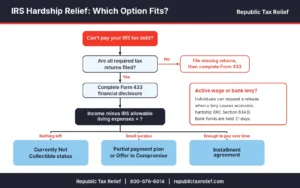
How the IRS Defines Financial Hardship
Under Treasury Regulation 301.6343-1(b)(4), economic hardship means you cannot pay your reasonable basic living expenses. To decide whether that is true, the IRS compares your income to allowable expenses set by its Collection Financial Standards.
What the IRS counts as allowable expenses
- National Standards: Food, clothing, housekeeping supplies, personal care, and miscellaneous costs, based on household size.
- Out-of-pocket health care: A set monthly amount per person, with higher figures for people 65 and older.
- Local Standards: Housing, utilities, and transportation costs that vary by county and region.
- Other necessary expenses: Current tax payments, court-ordered child support, health insurance, and required child care.
Here is the part that surprises most people. The IRS often uses its standard amounts rather than what you actually spend. If your rent is $2,800 but the county allowance is $2,300, the IRS may only count $2,300 unless you show the higher cost is necessary, such as a larger family or a medical need.
Example: Dan takes home $4,100 a month. His allowable expenses under IRS standards add up to $4,050, leaving $50. With a $40,000 balance, that small surplus makes him a strong candidate for CNC or a very low payment arrangement, not a standard payment plan.
Currently Not Collectible Status: The Core Hardship Relief Option
According to the Taxpayer Advocate Service, the IRS may place an account in CNC status when it agrees you cannot pay both your taxes and your basic living expenses. The debt is not erased; collection is put on hold. Our Currently Not Collectible status service page covers how we request it on your behalf.
| What CNC status does | What CNC status does not do |
|---|---|
| Pauses most levies and wage garnishments | Forgive or cancel the tax debt |
| Requires no monthly payment for now | Stop penalties and interest from growing |
| Lets the 10-year collection clock keep running | Prevent the IRS from filing a federal tax lien |
| Gives you room to stabilize your finances | Protect future federal tax refunds, which the IRS may keep |
Business owners face a tougher review. An operating business, especially one with unpaid payroll taxes, is usually expected to stay current on new deposits before the IRS will pause anything. If that is your situation, see our guide to payroll tax debt relief or business tax debt relief.
Practical takeaway: Even while in CNC, set aside money for current-year taxes. A new unpaid balance is one of the fastest ways to lose hardship status. For a deeper look at day-to-day rules, read our Currently Not Collectible blog.
Proving Financial Hardship to the IRS: Form 433 Disclosure
The IRS does not take your word for it. Before approving hardship relief, it usually asks for a Collection Information Statement and documents that back up every number. The IRS explains that it may request proof of your assets, monthly income, and expenses before delaying collection.
| Form | Who usually uses it | Level of detail |
|---|---|---|
| Form 433-F | Most individuals working with IRS phone or automated collection | Shorter, summary-level financial picture |
| Form 433-A | Wage earners and self-employed taxpayers, often with a revenue officer | Detailed income, expenses, assets, and business data |
| Form 433-B | Corporations, partnerships, and LLCs | Business assets, receivables, and cash flow |
Documents to gather before you contact the IRS
- Recent pay stubs or a year-to-date profit and loss statement
- Several months of bank statements for every account
- Rent or mortgage statements, utility bills, and car loan statements
- Medical bills, health insurance premiums, and child support orders
- Statements for retirement accounts, investments, and life insurance with cash value
Common mistakes that sink hardship requests
- Listing actual expenses that exceed IRS standards without proof they are necessary
- Leaving out assets such as retirement accounts, which the IRS counts
- Large deposits in bank statements with no explanation
- Unfiled returns. The IRS generally requires all required tax returns to be filed first, so start with catching up on unfiled tax returns if any are missing.
Example: A self-employed contractor submits a form during his busiest month. His income looks strong, so the IRS proposes a $1,200 monthly payment. Using a 12-month average instead would have shown a true picture of seasonal income and a much lower ability to pay.
Stopping Wage Garnishments and Bank Levies Legally
Federal tax law gives individuals real protection here. Under Internal Revenue Code Section 6343, the IRS must release a levy if it is creating an economic hardship. That rule applies to individuals, not business entities.
- Bank levies: Your bank holds the frozen funds for 21 days before sending them to the IRS. That window is your chance to act. Learn more about bank levy help.
- Wage garnishments: A wage levy continues every pay period until it is released. Your employer may only keep a small exempt amount for you. See our wage garnishment relief services.
- Final notice deadlines: A final notice of intent to levy (such as LT11 or Letter 1058) gives you 30 days to request a Collection Due Process hearing, where you can propose hardship status or another alternative.
Steps to request a hardship levy release
- Call the number on the levy notice right away, or have your representative call.
- Submit your financial information showing you cannot cover basic living expenses.
- Ask for a manager conference if the request is denied, and consider the Collection Appeals Program.
Example: A warehouse worker supporting a family of four sees her take-home pay drop to $900 a month after a wage levy. Documenting rent, food, and child care under IRS standards can show the levy causes economic hardship, which supports a release. For a full view of how levies and liens work, visit our IRS collections defense and tax lien help pages.
Offer in Compromise, Payment Plan, and Penalty Relief Options
Hardship status is not always the best long-term answer. Sometimes a small monthly surplus or a strong legal argument points to a different path. The IRS Fresh Start program, launched in 2011, widened access to several of these options. Learn more on our IRS Fresh Start program page.
| Relief option | Best fit | Key trade-off |
|---|---|---|
| Currently Not Collectible | Nothing left after basic expenses | Debt, penalties, and interest remain |
| Partial payment installment agreement | Small monthly surplus | Periodic financial reviews |
| Installment agreement | Can pay the full balance over time | Interest and penalties until paid |
| Offer in compromise | Cannot pay in full before the collection deadline | Strict review; pauses the collection clock while pending |
| Penalty abatement | Reasonable cause or a clean penalty history | Removes penalties, not the tax itself |
| Innocent spouse relief | Debt caused by a spouse or former spouse on a joint return | Separate qualifying tests and deadlines |
Practical takeaway: These options can work together. Removing penalties first can shrink the balance, which may make an offer or payment plan more realistic later.
Long-Term Tax Hardship Strategy and Expiration Timelines
The IRS generally has 10 years from the date a tax is assessed to collect it. This deadline is called the Collection Statute Expiration Date (CSED). Time spent in CNC status counts toward those 10 years, and if the deadline passes, the remaining balance is generally no longer collectible.
Actions that can pause the collection clock
- A pending offer in compromise, plus 30 days after a rejection
- A pending installment agreement request
- A Collection Due Process hearing
- Living outside the United States for six months or more
How to keep hardship status in place
- File every tax return on time, even if you cannot pay
- Stay current on withholding or estimated payments
- Expect the IRS may review your account if your filed returns show higher income
Example: Ellen owes $60,000 assessed in 2019, so her collection deadline falls around 2029. A $300 monthly plan would never pay it off. Staying in CNC may let the statute run out, while filing an offer would pause the clock. The right move depends on her numbers and how long the IRS has left, which is why timing matters as much as eligibility.
Speak With a Tax Relief Professional
Every week you wait, penalties and interest keep growing. Find out which Fresh Start options fit your situation in a free, confidential consultation.
Why Handling IRS Hardship Yourself or With AI Is Risky
Many taxpayers try to call the IRS on their own or ask an AI chatbot to fill out Form 433. Here is what our team sees go wrong most often.
- Your numbers become the permanent record. Form 433 is signed under penalty of perjury. The IRS may compare future returns against it for years, so a rushed estimate can come back to hurt you.
- The phone call is a negotiation. Which months of income count, which expenses are “necessary,” and how assets are valued are all open to discussion. Most taxpayers accept the first number they hear.
- Picking the wrong option costs time and money. Agreeing to a payment you cannot keep often leads to default. Filing an offer late in the statute period can give the IRS more time to collect.
- AI tools do not know your file. Chatbots may cite outdated expense standards, mix federal and state rules, or invent deadlines. They cannot call the IRS or represent you, and uploading Social Security numbers and bank statements to a public tool creates privacy risk. We explore this further in Can AI Get a Better Settlement Than a Tax Attorney?
Practical takeaway: Use technology to organize your paperwork. Use a licensed tax professional, such as a tax attorney, CPA, or enrolled agent, to present it and negotiate with the IRS.
What Our Clients Say
“I had the pleasure of working with Emily during my intake process, and she made the experience easygoing. She was thorough, communicative, and incredibly supportive, ensuring I had all the information I needed and answering any questions with patience and clarity. Her professionalism and kindness made what could have been a stressful process feel much more manageable. I truly appreciate her attention to detail and genuine care. Thank you, Emily, for making this such a positive experience!”
~ Mierra Strickland, Google Review
IRS Financial Hardship FAQs
Is there an official IRS hardship program?
Not by that exact name. The phrase is a common label for several tools based on the legal standard of economic hardship, including Currently Not Collectible status, hardship levy releases, partial payment installment agreements, and offers in compromise.
How do I qualify for IRS hardship status?
You generally need to show that, after paying IRS-allowed basic living expenses, you have little or no money left to pay your tax debt. You must also have all required tax returns filed and provide a Collection Information Statement, usually Form 433-F or Form 433-A, with supporting documents.
How long does Currently Not Collectible status last?
There is no fixed end date. CNC status can last until your financial situation improves, the IRS reviews your account, or the 10-year collection statute expires. Penalties and interest continue to grow during that time.
Will hardship status stop a wage garnishment or bank levy?
It can. Federal law requires the IRS to release a levy that creates an economic hardship for an individual. With a bank levy, you generally have 21 days before the bank sends the funds to the IRS, so acting quickly matters.
Does the IRS forgive tax debt in hardship status?
No. Hardship status pauses collection but does not forgive the debt. Only an accepted offer in compromise, certain penalty relief, or the expiration of the collection statute can reduce or end what you owe.
Can a business get IRS hardship relief?
The economic hardship levy release rule applies to individuals, not business entities. Businesses can still seek relief through payment plans, an offer in compromise, or in some cases CNC status, but operating businesses face stricter review, especially with unpaid payroll taxes.
Do I need a tax attorney to request hardship status?
You are not required to hire one, but representation often helps. A tax attorney, CPA, or enrolled agent can calculate your allowable expenses, present your financial information accurately, and choose the option that fits your collection timeline.
Have more questions? Visit our Currently Not Collectible FAQs or IRS collections defense questions.
Key Takeaways on IRS Hardship Relief
- Hardship relief is a group of IRS tools, not a single program you sign up for.
- The IRS measures hardship with its own expense standards, not your actual budget.
- CNC status pauses collection but does not stop penalties, interest, liens, or refund offsets.
- Strong Form 433 documentation is the foundation of every successful hardship request.
- Individuals can demand a levy release when a levy creates economic hardship.
- The 10-year collection deadline should shape your long-term strategy.
Speak With a Tax Relief Professional
If the IRS is threatening your paycheck, your bank account, or your peace of mind, you do not have to face it alone. Republic Tax Relief helps individuals and business owners resolve IRS and state back taxes through hardship status, payment plans, offers in compromise, penalty relief, and levy defense. Our team reviews your full financial picture, explains your options in plain language, and handles communication with the IRS for you. See why clients trust us on our awards and recognition page.
Your privacy is protected from the first call. Every document you share is secured with bank-grade 256-bit encryption and handled under strict client confidentiality standards.
Call 800-676-6014 or request your confidential consultation today.
Sources
- Internal Revenue Service, Temporarily Delay the Collection Process
- Taxpayer Advocate Service, Currently Not Collectible
- Internal Revenue Service, Collection Financial Standards
This article provides general information and is not legal or tax advice. Results depend on each taxpayer’s facts. Speak with a qualified tax professional about your situation.