
Oct
You’ve been juggling payroll, vendors, and rent, and the IRS kept slipping to the bottom of the pile. Now the notices are getting louder. Maybe a revenue officer left a card at your shop, or your bank called about a levy. You’re not alone, and you’re not out of options.
Business tax debt feels overwhelming because it touches everything: your cash flow, your employees, and sometimes your personal finances. The good news is that the IRS has a defined process for resolving it, and businesses work through it every day. This guide walks you through that process stage by stage, so you know what happens, in what order, and where professional help makes the biggest difference.
Table of Contents
- Signs Your Business Tax Problems Need Attention Now
- Why Business Tax Debt Is Different
- The Business Tax Resolution Process, Step by Step
- Business Tax Debt Relief Options Compared
- Choosing the Right Tax Resolution Specialist
- FAQs: Resolving Business Tax Debt
Signs Your Business Tax Problems Need Attention Now
Some IRS notices can wait a few days. Others can’t. Here are the signals that your business back taxes are moving toward enforced collection:
- Repeated balance-due notices that keep growing because penalties and interest are added every month.
- A “final notice” of intent to levy, such as Letter 1058 or LT11. These usually give you 30 days to request a hearing.
- A visit or call from a revenue officer, an IRS employee assigned to collect larger or more complex balances in person.
- Missed payroll tax deposits on Form 941, even for one or two quarters.
- A federal tax lien filing that shows up when you apply for a loan or line of credit.
- Past-due returns that the IRS has started asking about.
Example: A restaurant owner ignored three balance-due notices while she rebuilt after a slow season. The fourth letter was a final notice of intent to levy. Because she called a tax professional within that 30-day window, her representative was able to request a hearing and pause the levy while they built a resolution plan.
Takeaway: The date on your most recent IRS notice matters more than the balance. Deadlines protect your appeal rights, so act before they pass.
Why Business Tax Debt Is Different
Owing the IRS as a business isn’t the same as owing on a personal return. A few rules raise the stakes:
- Payroll taxes can become personal. Income tax and the employee share of Social Security and Medicare withheld from paychecks are “trust fund” taxes. If they aren’t paid, the IRS can assess the Trust Fund Recovery Penalty against owners, officers, or anyone responsible for paying them, even if the business is an LLC or corporation (IRS: Trust Fund Recovery Penalty).
- Debt grows quickly. Failure-to-deposit, failure-to-file, and failure-to-pay penalties stack on top of daily interest.
- Business assets are exposed. The IRS can levy business bank accounts and accounts receivable, and a tax lien can follow equipment, vehicles, and property.
- The clock is long. The IRS generally has 10 years from the date of assessment to collect.
Takeaway: If your business owes payroll taxes, treat it as your top priority. Our guide to payroll tax debt relief explains what owners face and how those balances are resolved.
The Business Tax Resolution Process, Step by Step
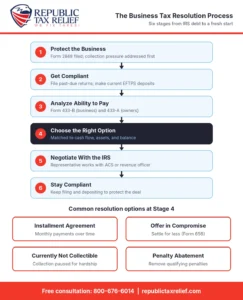
Every case is different, but most business tax debt resolution follows the same order. Skipping a step is the most common reason a business’s request gets rejected.
Stage 1: Protect the Business
Your tax professional files Form 2848 (Power of Attorney) so the IRS deals with them instead of you. Their first job is to reduce immediate risk: requesting a collection hearing, asking for a short collection delay, or responding to an active levy. If a levy has already hit, see our pages on bank levy help and IRS collections defense.
Stage 2: Get Compliant
The IRS generally won’t approve a payment plan or settlement until required returns are filed and current-quarter payroll deposits are being made through EFTPS. Think of compliance as the entry ticket. If returns are missing, our unfiled tax returns team can help bring them current.
Stage 3: Analyze Your Ability to Pay
Next comes a full financial picture, usually on a collection information statement. Businesses use Form 433-B, and owners of sole proprietorships or those facing personal liability often complete Form 433-A too. This shows the IRS your business income, business expenses, assets, and cash flow.
Practical tip: Gather six to twelve months of bank statements, a current profit and loss statement, a list of business assets, and accounts receivable before this stage starts. Organized numbers speed everything up.
Stage 4: Choose the Right Option
Once your ability to pay is clear, your representative matches it to the option you’re most likely to qualify for. The table in the next section compares the main choices.
Stage 5: Negotiate With the IRS
Your representative presents the proposal to the IRS, whether that’s the Automated Collection System or an assigned revenue officer. Expect follow-up questions and document requests. This is where experience with IRS negotiation and allowable expense standards pays off.
Stage 6: Stay Compliant
An installment agreement or accepted Offer in Compromise can default if the business misses future filings or deposits. Staying current is what keeps the resolution in place.
Business Tax Debt Relief Options Compared
| Option | Often a Fit When | Key Form(s) | What to Know |
|---|---|---|---|
| Installment agreement | The business can pay over time from cash flow | Form 9465 or Form 433-B | Penalties and interest keep accruing until paid in full |
| Offer in Compromise | The debt is more than the business can realistically pay | Form 656, Form 433-B (OIC) | Based on reasonable collection potential; strict compliance rules apply |
| Currently Not Collectible | Paying would cause financial hardship | Collection information statement | Collection pauses, but the debt remains |
| Penalty abatement | Clean history or a reasonable cause for falling behind | Written request or Form 843 | Can lower the balance before or alongside another option |
A few details matter here. Businesses that owe a smaller combined balance may qualify for a simpler payment plan, sometimes applied for online (IRS: Payment Plans). For an Offer in Compromise, the IRS’s Form 656-B booklet requires a business with employees to be current on its federal tax deposits before the offer is considered.
Example: A small construction company owed $92,000 in payroll and income taxes. Its financial analysis showed steady but thin cash flow and few assets with equity. Rather than a settlement it wouldn’t qualify for, its representative first secured first-time penalty relief on one quarter, then negotiated an affordable installment agreement. Results vary by case, but the right order of steps can lower what a business pays overall. Contractors can learn more on our construction tax resolution page.
Choosing the Right Tax Resolution Specialist
Only certain professionals can represent your business before the IRS: enrolled agents, CPAs, and tax attorneys. When you compare firms, look for:
- Credentialed staff who handle your case in-house, not a sales team that hands it off.
- Experience with revenue officers and business collection cases, not only individual returns.
- A clear explanation of your options after reviewing your IRS transcripts and finances.
- Transparent fees and a written engagement agreement.
Red flags: anyone who guarantees you’ll settle for “pennies on the dollar” before seeing your financials, or who tells you to stop filing or stop making payroll deposits. Those promises can make your situation worse.
To see how we handle these cases from start to finish, visit our business tax resolution services page. Owners exploring settlement-focused options can also read about business tax debt relief.
“Republic Tax Relief was a lifesaver. They handled my tax issues with professionalism and calm guidance….” ~Everett Lane, Google Review
FAQs: Resolving Business Tax Debt
How long does business tax resolution take?
It depends on the option and your compliance status. A simple installment agreement can be set up in weeks, while an Offer in Compromise often takes several months or longer. Getting past-due returns filed early usually shortens the timeline.
Can the IRS come after me personally for my business’s taxes?
Yes, in some cases. Sole proprietors are personally liable for business tax debt. For payroll taxes, the IRS can assess the Trust Fund Recovery Penalty against owners or officers responsible for paying them, even if the business is a corporation or LLC.
Can a business settle its tax debt for less than it owes?
Some can, through an Offer in Compromise. The IRS looks at the business’s reasonable collection potential, which is based on its assets and future income. If the business can pay the full amount over time, the IRS will usually expect a payment plan instead.
Will the IRS shut down my business?
The IRS’s goal is to collect, and it generally prefers that businesses keep operating and paying. However, repeated failure to make payroll deposits can lead to aggressive collection action. Acting early and getting current on deposits protects your options.
What if my business has already closed?
The tax debt doesn’t disappear when the doors close. Depending on the business structure, the balance may remain collectible from the owners, especially for payroll taxes. A tax professional can review whether relief options apply to the remaining balance.
Summary
- Final notices, revenue officer contact, and missed payroll deposits mean it’s time to act.
- Payroll tax debt can become a personal liability through the Trust Fund Recovery Penalty.
- Resolution follows a clear order: protect, get compliant, analyze, choose, negotiate, and stay compliant.
- Installment agreements, Offers in Compromise, Currently Not Collectible status, and penalty abatement each fit different situations.
- A credentialed, experienced representative helps you pick the right option and avoid costly missteps.
Speak With a Tax Relief Professional
Republic Tax Relief has helped individuals and businesses resolve IRS and state tax problems since 2005, with more than 18,000 cases resolved. Our in-house enrolled agents, CPAs, and tax attorneys handle business tax debt from the first notice to the final agreement. See our awards and recognition.
Your business records stay protected. Payroll reports, bank statements, and tax returns you share are secured with bank-grade 256-bit encryption and reviewed only under strict tax professional confidentiality standards.
Your business deserves a plan, not more notices. Call 800-676-6014 or request your free, confidential consultation today.
Sources
- Internal Revenue Service, “Employment Taxes and the Trust Fund Recovery Penalty (TFRP)”
- Internal Revenue Service, “Payment Plans; Installment Agreements”
- Internal Revenue Service, “Offer in Compromise” (Form 656-B booklet)
This article is for general information and is not legal or tax advice for your specific situation. Results vary based on individual facts.