
If your business owes the IRS, you are not alone, and you still have options. Many small business owners fall behind after a slow season, a cash crunch, or a bookkeeper who missed a deposit. Penalties pile up quickly, and every new letter gets harder to open.
Small business tax relief is about taking back control. With the right plan, you can stop collection actions, reduce penalties, and set up a payment plan or settlement your business can afford.
This guide explains your resolution options, how payroll and entity type change your situation, and when to bring in a tax professional. When you’re ready to talk, our team is one call away at 800-676-6014.
Reviewed by the Republic Tax Relief resolution team | Last updated: October 2026
Table of Contents
- Why Small Business Tax Debt Grows So Fast
- Warning Signs You Need IRS Small Business Tax Help
- Small Business Payroll Tax Debt and IRS Form 941 Tax Relief
- Business Tax Debt by Entity: LLC and S-Corp Tax Debt Resolution
- IRS Business Tax Relief Options
- How to Stop IRS Levies, Liens, and Garnishments
- Unfiled Returns and Business Tax Audits
- IRS and State Tax Issues for Small Businesses
- Why Hire Small Business Tax Resolution Services
- How Republic Tax Relief Resolves Business Tax Problems
- Small Business Tax Relief FAQs
- Speak With a Tax Relief Professional
Why Small Business Tax Debt Grows So Fast
Unpaid business taxes rarely stay the same size. The IRS adds penalties for filing late, paying late, and missing payroll deposits. Then interest compounds daily on both the tax and the penalties.
Here is how the main federal penalties stack up:
| Penalty | How It Works | Maximum |
|---|---|---|
| Failure to file | 5% of unpaid tax per month the return is late | 25% |
| Failure to pay | 0.5% of unpaid tax per month | 25% |
| Failure to deposit (payroll) | 2% to 15%, based on how late the deposit is | 15% |
| Interest | Charged daily on tax and penalties | No cap |
A balance that looks manageable today can grow by thousands in a year. That is why acting early is one of the most effective tax moves a business owner can make.
Warning Signs You Need IRS Small Business Tax Help
Some tax problems can wait a few weeks. Others need attention right away. Watch for these signs:
- CP14 notice: The IRS says you have a balance due.
- CP504 notice: The IRS warns it intends to levy your property or rights to property.
- Letter 1058 or LT11: A final notice of intent to levy, plus your right to a hearing.
- Letter 1153: The IRS proposes holding you personally liable for unpaid payroll taxes.
- A revenue officer visit: An IRS agent shows up at your business or calls you directly.
- A filed tax lien: A public claim against your business or personal property.
- Frozen business bank accounts: Money disappears from your account without warning.
- Missed Form 941 deposits: Two or more quarters behind on payroll taxes.
After a final notice of intent to levy, you generally have 30 days to request a Collection Due Process hearing. Missing that window can limit your options, so call a professional before the deadline passes.
Small Business Payroll Tax Debt and IRS Form 941 Tax Relief
Payroll tax issues are the most serious type of business tax debt. When you withhold income tax and Social Security and Medicare from employee paychecks, that money belongs to the government. The IRS calls these “trust fund” taxes because you hold them in trust.
What Counts as Small Business Payroll Tax Debt
Payroll taxes reported on Form 941 include several parts:
- Federal income tax withheld from employee wages
- The employee share of Social Security and Medicare
- The employer’s matching share of Social Security and Medicare
- Federal unemployment tax (reported separately on Form 940)
The first two items are trust fund taxes. The IRS treats them very differently from the employer’s own share.
The Trust Fund Recovery Penalty
If trust fund taxes go unpaid, the IRS can hold owners and other “responsible persons” personally liable. This is called the trust fund recovery penalty. It equals the full amount of unpaid trust fund taxes, and the IRS can collect it from your personal assets (IRS: Employment Taxes and the Trust Fund Recovery Penalty).
A responsible person can be an owner, officer, or even a bookkeeper who signs checks. If you receive Letter 1153, you typically have 60 days to appeal. This is a critical moment to have a representative on your side.
How IRS Form 941 Tax Relief Works
Resolving payroll tax debt usually follows a clear order:
- Stop the bleeding. The IRS expects you to stay current on new deposits before it agrees to any deal.
- Confirm the numbers. We pull your IRS transcripts to check every quarter and penalty.
- Challenge personal liability. Where the facts support it, we contest the trust fund recovery penalty.
- Negotiate the balance. Options include an installment agreement, penalty abatement, or an offer in compromise.
Learn more on our page about payroll tax debt relief for business owners.
Business Tax Debt by Entity: LLC and S-Corp Tax Debt Resolution
Your business structure decides who owes the tax and how much personal risk you carry. Many business owners assume an LLC or corporation fully shields them. For income taxes that may be partly true, but payroll taxes are a different story.
| Entity Type | Who Owes Income Tax | Who Owes Payroll Tax | Owner’s Personal Risk |
|---|---|---|---|
| Sole proprietor | Owner, on personal return | Owner | Full personal liability |
| Single-member LLC | Usually the owner, on personal return | The LLC | Income tax plus trust fund recovery penalty |
| Multi-member LLC or partnership | Partners, through K-1s | The business | Trust fund recovery penalty; general partners may face more |
| S-Corp | Shareholders, through K-1s | The corporation | Personal income tax plus trust fund recovery penalty |
| C-Corp | The corporation (corporate income tax) | The corporation | Mainly the trust fund recovery penalty |
S-Corp Tax Debt Resolution
S-Corp owners often face tax debt on two fronts at once. The corporation may owe payroll taxes, while the owner owes personal tax on pass-through income they never set aside money to pay.
Common S-Corp problems include:
- Paying yourself too little salary, which can trigger IRS reclassification
- Skipping estimated tax payments on K-1 income
- Mixing personal and business expenses in the same account
A good resolution plan addresses both the corporate and personal tax balance together. Fixing only one side often leaves the IRS with a reason to keep collecting.
LLC Tax Relief Services
LLC tax relief depends on how your LLC is taxed. A single-member LLC is usually treated like a sole proprietor for income tax, but as a separate business for payroll. An LLC that elects S-Corp status follows the S-Corp rules above.
Our business tax debt relief services look at your entity setup first, so the strategy fits how the IRS actually views your company.
IRS Business Tax Relief Options
The IRS offers several relief programs for businesses and their owners. The right one depends on your income, assets, expenses, and whether your business is still running.
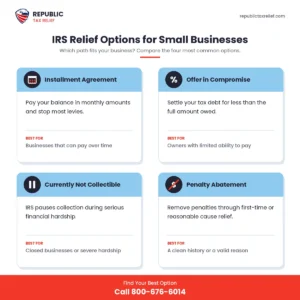
Installment Agreement (IRS Payment Plan)
An installment agreement lets your business pay its tax bill in monthly amounts. It is the most common resolution, and it can stop most collection actions while you pay.
For smaller payroll balances, an in-business trust fund express installment agreement may be available for balances of $25,000 or less, with up to 24 months to pay. Larger balances usually require full financial disclosure (IRS: Payment Plans and Installment Agreements). See our guide to IRS payment plans.
Offer in Compromise
An offer in compromise lets you settle your tax debt for less than the full amount owed. The IRS looks at your ability to pay, income, expenses, and asset equity to decide what it can reasonably collect (IRS: Offer in Compromise).
It is not a fit for everyone, and many offers are rejected when they are poorly prepared. Read more about how the OIC program works and the history of the IRS Fresh Start program.
Currently Not Collectible Status
If paying anything would leave you unable to cover basic living costs, the IRS may mark your account currently not collectible. Collection pauses, though interest still grows. This option is most common for owners whose business has closed.
Learn more about IRS Currently Not Collectible status.
Penalty Relief
Penalties can make up a large share of what a business owes. The IRS may remove them through first-time abatement or reasonable cause, such as a serious illness, natural disaster, or reliance on bad professional advice.
See how IRS penalty abatement works.
Comparing Your Resolution Options
| Option | Best For | What It Does | Keep in Mind |
|---|---|---|---|
| Installment agreement | Businesses that can pay over time | Spreads payments, stops most levies | Interest and some penalties continue |
| Offer in compromise | Owners with limited ability to pay | Settles for less than the full balance | Strict review; must stay compliant 5 years |
| Currently not collectible | Severe financial hardship | Pauses collection | Debt remains; IRS reviews later |
| Penalty abatement | Clean history or reasonable cause | Removes penalties | Does not reduce the tax itself |
If a spouse’s business created a joint tax bill you didn’t know about, innocent spouse relief may also apply.
How to Stop IRS Levies, Liens, and Garnishments
When a business owes back taxes for too long, the IRS can take money and property. A levy can empty your business bank accounts, seize payments from customers, or take equipment. The IRS can also garnish an owner’s personal wages.
Here is what each action means and how we respond:
- Bank levy: The bank freezes funds for 21 days before sending them to the IRS. Quick action can sometimes get the levy released. See our bank levy help.
- Wage garnishment: Part of every paycheck goes to the IRS until the debt is resolved. Learn about wage garnishment relief.
- Federal tax liens: A lien can hurt your credit and block financing. Read about tax lien release and removal.
The fastest path to stopping collection is usually a hearing request or a negotiated agreement. Our IRS collections defense team acts quickly to protect your operations.
Unfiled Returns and Business Tax Audits
The IRS will not approve most relief programs until all required tax filings are in. That includes business income tax returns, payroll returns, and the owner’s personal tax returns. In most cases, the IRS wants the last six years filed.
If you have missing returns, our team can help you file them correctly and limit added penalties. See our page on unfiled tax returns.
An open tax audit adds another layer of risk. An audit result can create new tax debt, so having a representative handle IRS questions protects you. Learn more about business IRS audits.
IRS and State Tax Issues for Small Businesses
State tax agencies can be just as aggressive as the IRS, and sometimes faster. In California, a business may deal with several agencies at once:
- Franchise Tax Board (FTB): State income and franchise taxes. The FTB can suspend a corporation or LLC.
- CDTFA: Sales and use taxes collected from customers.
- EDD: State payroll taxes and withholding.
Unpaid sales tax and state payroll tax are often treated like trust fund taxes, so owners can face personal liability. When both federal and state taxes are involved, the plan has to work for every agency. Our business tax resolution services cover IRS and state tax debt together.
Why Hire Small Business Tax Resolution Services
You can call the IRS yourself. But the agent on the phone works for the government, not for you. A qualified representative knows the tax laws, IRS procedures, and the financial standards the IRS uses to judge what you can pay.
Who Can Represent Your Business
Not every tax preparer or accountant can speak for you in collections. Here is how common credentials compare:
| Professional | Can Represent You Before the IRS | Best For |
|---|---|---|
| Enrolled agent | Yes, in all IRS matters | Collections, payment plans, offers, audits |
| CPA | Yes | Complex financials and accounting cleanup |
| Tax attorney | Yes | Legal disputes, appeals, serious exposure |
| Unenrolled tax preparer | Very limited | Preparing returns only |
Once you sign IRS Form 2848, your representative can talk to the IRS for you. In many cases, you never have to speak with a revenue officer directly.
How to Spot Trustworthy Tax Relief Companies
Some tax relief companies make promises no one can keep. Watch for these red flags:
- Guarantees of settling for “pennies on the dollar” before reviewing your finances
- Large upfront fees with no clear plan
- Pressure to sign the same day
- No licensed enrolled agent, CPA, or tax attorney on staff
The best tax relief firm will review your IRS records first, explain your realistic options, and tell you plainly if you don’t qualify for relief. For a broader look at choosing help, see our complete guide to tax resolution services and our overview of tax relief services.
How Republic Tax Relief Resolves Business Tax Problems
Our team of tax experts follows a clear process built around your business. You will know what is happening at every stage.
- Free consultation. We listen to your situation and review the notices you’ve received.
- Investigation. We pull IRS and state transcripts to confirm exactly what your business owes.
- Protection. We step in to request holds on levies and garnishments where possible.
- Compliance. We help bring missing returns and current deposits up to date.
- Negotiation. We present the strongest case for the resolution option that fits.
- Resolution. Your plan is approved, and we help you stay compliant going forward.
We compare every resolution option side by side so you can choose the best path forward with confidence. Learn more about tax debt relief options and back tax help.
What Our Clients Say
“Rebekah Huffman was a wonderful associate to have worked with. She was very knowledgeable and always available to assist and advise. I would highly recommend her and this service to anyone in need.”
⭐⭐⭐⭐⭐ Alvin Barbour, Google Review
Your Information Is Protected
Your tax debt is stressful enough. Your data won’t be. Every file you share is protected by bank-grade 256-bit encryption, strict client confidentiality, and full compliance with federal data protection standards.
Small Business Tax Relief FAQs
Can the IRS go after my personal assets for business taxes?
Yes, in some cases. Sole proprietors are personally liable for all business taxes. For LLCs and corporations, the IRS can assess the trust fund recovery penalty against owners and other responsible persons for unpaid payroll taxes.
What is IRS Form 941 tax relief?
Form 941 tax relief refers to the ways a business can resolve unpaid quarterly payroll taxes. Common options include an installment agreement, penalty abatement, and in some cases an offer in compromise. The business must stay current on new deposits to qualify.
Can a small business settle tax debt for less than it owes?
Sometimes. An offer in compromise may let you settle for less than the full balance if the IRS agrees you cannot pay it in full. The IRS reviews your income, expenses, and assets closely, so a well-prepared application matters.
How long does the tax resolution process take?
It depends on the option. A simple payment plan may be set up in weeks. An offer in compromise or an appeal can take six months or longer.
Will the IRS work with me if my business is still operating?
Yes. The IRS often prefers that a business keep operating so it can keep paying. The key is staying current on new tax deposits while the old balance is resolved.
Does bankruptcy wipe out business tax debt?
Bankruptcy usually does not erase payroll trust fund taxes, and the rules for other taxes are strict. Most business owners do better exploring IRS relief programs first. Read our article on whether bankruptcy gets rid of tax debts.
Do I need a tax attorney, CPA, or enrolled agent?
Any of the three can represent you before the IRS. Enrolled agents and CPAs handle most collection cases, while a tax attorney is helpful for appeals or legal exposure. What matters most is choosing someone with real experience in IRS collections.
Speak With a Tax Relief Professional
Your business deserves a plan, not more penalties. Whether you owe payroll taxes, income taxes, or state taxes, our experts can help you find a resolution that protects your company and your personal finances.
Call 800-676-6014 or request your free consultation today.
About Republic Tax Relief
Republic Tax Relief helps individuals and businesses resolve IRS and state tax debt. Our tax resolution specialists handle payment plans, offers in compromise, penalty relief, payroll tax issues, and collection defense with honest guidance and clear communication. Call 800-676-6014 or contact us online to start your free, confidential review.
Disclaimer: This page is for general information only and is not legal or tax advice. Every situation is different, and results depend on your specific facts. Speak with a qualified tax professional before making decisions about your tax debt.
Sources