
Running a restaurant means long hours, thin margins, and a stack of bills due before the doors open. When cash gets tight, payroll deposits and sales tax payments are often the first things pushed to “next week.” Then a notice arrives from the IRS or your state, and next week becomes a crisis.
You are not the first restaurant owner in this spot, and you have real options. This guide explains how tax resolution for restaurants works, which IRS and state relief programs fit food service businesses, and when it makes sense to bring in a tax attorney. Our goal is simple: protect your business, your staff, and your personal assets.
On this page:
- Why Restaurant Owners Fall Behind on Taxes
- Common Restaurant Tax Problems and What They Cost
- Form 941 Payroll Tax Debt and the Trust Fund Recovery Penalty
- Restaurant Sales Tax Errors and State Tax Issues
- Tip Reporting, Allocated Tips, and IRS Audit Defense
- Tax Relief Options for Restaurant Owners
- How Our Restaurant Tax Resolution Process Works
- Why Hire a Restaurant Tax Attorney
- Restaurant Tax Help FAQ
- Speak With a Tax Relief Professional
Why Restaurant Owners Fall Behind on Taxes
The restaurant industry runs on cash flow, and tax money often sits in the same bank account as rent and food costs. That makes it easy to cover today’s bills with tomorrow’s tax payment. Most owners never plan to skip a tax bill. They simply run out of room.
Here is why food service businesses get into trouble more often than most:
- You collect money that is not yours. Every guest check includes sales tax, and every paycheck includes withholding. Both belong to the government the moment you collect them.
- Payroll is complicated. Tipped staff, overtime, split shifts, and high turnover make payroll filings easy to get wrong.
- Margins are thin. Many restaurants keep only a few cents of profit on each dollar of food and beverage sales. One slow season can wipe out the cushion.
- Tax rules change by item. How you prepare food and where guests eat it can change whether a sale is taxable. Hot, dine-in, and to-go items may follow different sales tax rules.
- Owners wear every hat. Between staffing, suppliers, and the dinner rush, bookkeeping often happens late at night or not at all.
When tax obligations slip for even one or two quarters, penalties and interest stack up fast. The good news is that federal and state agencies offer programs for businesses that want to get back on track, and our business tax resolution services are built around them.
Common Restaurant Tax Problems and What They Cost
Most restaurant tax problems fall into a handful of patterns. Each one carries its own risks, and some can follow you personally even if the business closes.
| Tax problem | Agency involved | What can happen if ignored | How a tax professional helps |
|---|---|---|---|
| Unpaid Form 941 payroll taxes | IRS | Trust Fund Recovery Penalty, levies on bank and merchant accounts | Negotiates terms, defends you in the IRS interview |
| Unfiled payroll or sales tax returns | IRS and state | Estimated bills that often overstate what you owe | Rebuilds records and files missing returns |
| Restaurant sales tax underpayment | State tax agency | Audit assessment, permit revoked, owner liability | Challenges the audit, sets up a payment plan |
| Underreported tip income | IRS | Employer share of Social Security and Medicare assessed on unreported tips | Reconciles POS and payroll records |
| Unpaid business income tax | IRS and state | Federal tax lien, levies, wage garnishment | Payment plans, settlement, or hardship status |
| Federal tax lien filed | IRS | Hurts credit, loans, lease renewals, and vendor terms | Requests lien release or withdrawal |
How collections escalate
The IRS rarely jumps straight to seizing property. It sends a series of letters first, ending with a final notice of intent to levy. After that notice, you generally have 30 days to request a hearing before enforced collection begins.
Once that window closes, the IRS can:
- Levy your business bank account, often right before payroll
- Levy credit card processor payments and other money owed to you
- Garnish an owner’s wages or other income
- Seize equipment or assets in serious cases
State agencies can move even faster. Some can revoke your seller’s permit or take cash straight from the register. In California, this is called a till tap. If you have received a final notice, our IRS collections defense team can often step in within days.
Form 941 Payroll Tax Debt and the Trust Fund Recovery Penalty
Form 941 payroll tax debt for restaurants is the most serious tax problem an owner can face. Each quarter, Form 941 reports the income tax you withheld from paychecks, plus Social Security and Medicare taxes. The employee portion of that money is held “in trust” for the government, and the IRS treats it that way.
What the Trust Fund Recovery Penalty means for you
When trust fund taxes go unpaid, the IRS can turn a business debt into a personal one. According to the IRS, the penalty equals the full unpaid trust fund balance, and the business does not have to stop operating before it is assessed. Once assessed, the IRS can pursue your personal assets.
An IRS Trust Fund Recovery Penalty restaurant owner case usually turns on two questions:
- Were you a “responsible person”? This can include owners, officers, partners, and even managers or bookkeepers who sign checks or decide which bills get paid.
- Did you act “willfully”? Paying vendors, rent, or staff instead of the IRS can count as willful, even when you did it to keep the doors open.
The IRS interview and Letter 1153
A revenue officer will often ask to interview owners and key staff using IRS Form 4180. Your answers help the IRS decide who should be held personally liable. After that, the IRS may send Letter 1153 proposing the penalty, which starts a short window to appeal.
Please do not sit for this interview alone. A single loose answer about who signed checks can make you liable for years of payroll tax liability.
How penalties grow
Late payroll deposits trigger a failure-to-deposit penalty that rises the longer you wait:
- 2% if the deposit is 1 to 5 days late
- 5% if it is 6 to 15 days late
- 10% if it is more than 15 days late
- 15% if the tax is still unpaid 10 days after an IRS demand notice
Failure-to-file penalties, failure-to-pay penalties, and interest come on top of that. An experienced team can also make sure any voluntary payments are applied to the trust fund portion first, which can shrink your personal exposure. Learn more about payroll tax debt relief for business owners.
Restaurant Sales Tax Errors and State Tax Issues
Sales tax works like payroll withholding. When you collect sales tax from a guest, you are holding the state’s money until you remit it. If that money gets spent on payroll or produce, the state treats it as a serious breach, not a simple late bill.
Common sales tax mistakes in restaurants
State audits of restaurants tend to find the same handful of sales tax errors:
- The wrong sales tax rate. Combined state and local sales tax rates can change from one city, county, or special district to the next.
- Misclassified food. Food tax rules often depend on whether an item is hot, eaten on site, or sold to go. In California, for example, hot prepared restaurant food is taxable, and the “80/80 rule” can make some cold to-go items subject to sales tax too.
- Service charges and fees. Mandatory gratuities, delivery fees, and corkage can get different tax treatment than the meal itself.
- Missed use tax. Equipment or supplies bought from out-of-state sellers without tax may still owe use tax.
- Records that do not match. Auditors compare each sales tax return to POS reports, card deposits, and food or beverage purchases.
- Delivery app confusion. Many states require delivery platforms to collect tax on their orders, so your reports must separate those sales correctly.
What happens when you cannot pay sales tax
Falling behind on collecting and remitting sales tax can lead to penalties, liens, and a revoked seller’s permit. In many states, including California, officers and LLC members can be held personally responsible for unpaid sales and use tax if the business closes or dissolves.
Restaurants often face other state tax problems at the same time. Unpaid state payroll taxes and state income tax balances can trigger separate collection actions, and state agencies frequently share data with the IRS.
How we resolve state sales tax debt
A tax professional can step in and:
- Review the audit method and challenge estimates based on markups or sample periods
- Request penalty relief when you had a reasonable cause for the problem
- Negotiate a state payment plan or, where available, a settlement
- Help you stay compliant going forward so the same issue does not come back
If you owe both federal and state balances, our back tax help team coordinates both so one agency’s deal does not sink the other.
Tip Reporting, Allocated Tips, and IRS Audit Defense
Tips are one of the first things an IRS examiner looks at in a restaurant. Employees must report tips of $20 or more in a month to their employer. The IRS requires employers to keep those tip reports, withhold taxes on reported tips, and pay the employer share of Social Security and Medicare on them.
Tip income and allocated tips
Larger restaurants where tipping is customary generally file Form 8027 each year to report tip income and allocated tips. If the tips your staff report fall below 8% of gross receipts, you must allocate the difference to tipped employees on their W-2s. A big gap between card tips and tips received in cash is a classic audit trigger.
The IRS has also added new reporting rules for tips and worker occupations tied to the federal tip deduction for workers. That makes clean, matching records more important than ever.
There is good news here, too. Many owners qualify for the FICA tip tax credit, which offsets part of the employer taxes paid on tips. When we review a case, we look for missed credits that can lower what you owe.
IRS audit defense for restaurant owners
Restaurant audits follow a familiar pattern. Examiners usually compare:
- Cash sales reported versus bank deposits
- Cost of goods sold versus sales, to see if food costs look out of line
- Card tips versus tips your staff reported
- Business expenses and deductions, such as vehicles, meals, and family on payroll
- Who is treated as an employee versus an independent contractor
Tax deductions for restaurant owners, like food costs, smallwares, repairs, and equipment, are legitimate when they are documented. The trouble starts when records are thin and the examiner fills the gaps with estimates of your business income.
If you disagree with the result, you have options. You can request a review by the IRS Independent Office of Appeals, and after a notice of deficiency you generally have 90 days to petition the U.S. Tax Court. Our business IRS audit team handles each stage for you, so you never face the examiner alone.
Tax Relief Options for Restaurant Owners
There is no single fix for every restaurant. The right path depends on what you owe, which agency you owe, whether the doors are still open, and what your cash flow can truly support. Here are the main forms of IRS debt relief for restaurants and their owners.
| Relief option | Best fit for | What it does |
|---|---|---|
| Installment agreement | Restaurants that can pay over time | Spreads the balance into monthly payments and generally stops levies |
| Offer in Compromise | Owners who cannot pay the full balance | Settles the debt for less, based on your ability to pay |
| Currently Not Collectible status | Owners with no money left over after basic expenses | Pauses active collection while your finances recover |
| Penalty abatement | First-time issues or problems outside your control | Removes or reduces penalties, which can be a large part of the bill |
| Trust Fund Recovery Penalty defense | Owners and managers facing personal assessment | Challenges who was responsible and whether the failure was willful |
| Innocent spouse relief | Spouses who filed jointly but did not know about unreported restaurant income | Can remove a spouse from a joint tax bill |
A few points matter for restaurants in particular:
- You must be current to settle. The IRS usually will not approve a payment plan or settlement for an open business that is still missing payroll deposits.
- Some plans move faster. Smaller business balances may qualify for a streamlined in-business payment plan with less paperwork.
- Settlement is real, but not automatic. Our guide to the Fresh Start program explains who tends to qualify.
- Bankruptcy is rarely the answer for trust fund taxes. Payroll withholding and sales tax generally survive bankruptcy, as our tax lawyer explains in this article.
For a deeper look at company-level strategies, see our business tax debt relief options.
How Our Restaurant Tax Resolution Process Works
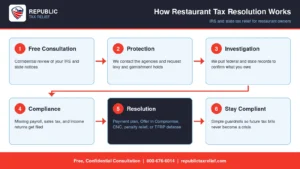
Our restaurant tax resolution services follow a clear, proven path. You will always know what step you are on and what comes next.
- Free, confidential consultation. We listen, review your notices, and give you an honest read on your options.
- Protection. We file authorization forms with the IRS and your state so agents talk to us, not you. Where possible, we request a hold on levies and garnishments.
- Investigation. We pull your federal and state records, often going back up to 15 years, to see exactly what is owed and why.
- Compliance. We help get missing payroll, sales tax, and income tax returns filed so you qualify for relief.
- Resolution. We negotiate the option that fits your numbers, from a payment plan to a settlement or penalty relief.
- Stay compliant. We help you set up simple guardrails, so your next tax bill never turns into a crisis.
To get started, it helps to have recent IRS or state notices, your last few payroll and sales tax filings, and recent bank statements. Do not worry if your records are a mess. Sorting that out is part of our job.
Why Hire a Restaurant Tax Attorney Instead of Going It Alone
You can call the IRS yourself. But a restaurant tax situation usually involves several tax years, more than one agency, and personal liability, all at once. That is where experienced representation pays for itself.
| Handling it alone | Working with Republic Tax Relief |
|---|---|
| Hours on hold during service hours | We deal with the IRS and state agents for you |
| Risky answers in a trust fund interview | A restaurant payroll tax attorney or enrolled agent prepares you or attends with you |
| Guessing which program fits | We compare every option against your real numbers |
| Penalties keep growing while you sort it out | We push for collection holds and penalty relief early |
| Federal and state deals that conflict | One team coordinates federal tax and state agencies together |
Experience you can verify
Republic Tax Relief has helped individuals and business owners since 2005. Our in-house team includes tax attorneys, CPAs, and enrolled agents who know tax law and how collection really works.
- 18,000+ cases resolved
- $220M+ in tax debt settled
- 20+ years of experience
- 4.9/5 average client rating and an A+ rating with the BBB
Whether you need restaurant back tax help for one location or a multi-unit group, we treat your business like it is our own. You can explore our full range of tax resolution services, tax relief services, and tax debt relief options.
What our clients say
“Amazing service! Republic Tax Relief helped me reduce my tax debt and made a stressful situation manageable. They were patient, knowledgeable, and always available to answer my question.”
Lucas Bean, Google Review ★★★★★
Your information stays protected
Your tax records are protected by strict attorney-client confidentiality and bank-grade 256-bit encryption, so you can share returns, Social Security numbers, and bank statements with complete peace of mind.
Results vary based on individual circumstances. Past results do not guarantee a similar outcome.
Restaurant Tax Help FAQ
What is tax resolution for restaurants?
It is the process of settling or managing unpaid federal and state taxes owed by a restaurant or its owners. That can include payroll taxes, sales tax, income tax, and penalties. A tax professional negotiates with each agency to stop collections and reach an affordable outcome.
Can the IRS hold me personally responsible for my restaurant’s payroll taxes?
Yes. If withheld payroll taxes go unpaid, the IRS can assess the Trust Fund Recovery Penalty against owners, officers, or managers who controlled the money. This applies even to corporations and LLCs, and even while the restaurant is still open.
Can the IRS levy my restaurant’s bank account or credit card sales?
Yes. After a final notice and a 30-day window, the IRS can levy business bank accounts and payments owed to you, including credit card processor deposits. Acting before that deadline gives you the most options.
Will I lose my seller’s permit if I owe sales tax?
It can happen. State agencies can revoke a seller’s permit when sales tax goes unpaid, which means you cannot legally sell food. A payment plan or other arrangement can often prevent that.
Can I settle my restaurant’s tax debt for less than I owe?
Sometimes. An Offer in Compromise lets qualifying taxpayers settle for less based on their ability to pay. Penalty abatement can also cut the balance, even when a full settlement is not possible.
What if I already closed my restaurant but still owe taxes?
The debt does not go away when the doors close. Owners may still owe trust fund taxes personally, and some states can pursue officers for unpaid sales tax. Options such as payment plans, settlement, or Currently Not Collectible status are still available.
How long does the process take?
It depends on the option. A payment plan can often be set up in a few weeks, while a settlement offer may take several months to review. We give you a realistic timeline after reviewing your records.
Is my financial information kept confidential?
Yes. We follow strict confidentiality standards and protect every uploaded document with 256-bit encryption. Your information is used only to resolve your case.
Sources
- Employment Taxes and the Trust Fund Recovery Penalty (TFRP), Internal Revenue Service
- Tip Recordkeeping and Reporting, Internal Revenue Service
This page is for general information and is not legal or tax advice. Your situation may differ, so speak with a qualified tax professional before acting.
Speak With a Tax Relief Professional
About Republic Tax Relief: Since 2005, Republic Tax Relief has helped individuals and business owners resolve IRS and state tax debt. Our in-house tax attorneys, CPAs, and enrolled agents have resolved more than 18,000 cases and settled over $220 million in tax debt. Call us at 800-676-6014 for a free, confidential consultation.
Every week you wait, penalties and interest grow, and the risk of a levy gets closer. Tax resolution for restaurants works best when you act early, before the IRS or your state takes your bank account or your permit.
You kept your restaurant running through tough times. Let us help you protect it now.
Speak With a Tax Relief Professional or call 800-676-6014 today. The consultation is free, and every conversation is 100% confidential.