
Oct
That envelope from the IRS is sitting on your counter, and you already know what’s inside. Maybe it’s the third one this year. Maybe you just opened a letter that says “Final Notice,” and your stomach dropped. You’re not alone, and you’re not out of options.
The IRS follows a predictable path when a taxpayer owes. Once you understand the steps, you can see where you stand, what comes next, and how to act before things get worse. This IRS Collections Blog explains each stage of the collections process in plain English, including who handles your case, what rights you have, and how professionals help taxpayers resolve their IRS debt.
Table of Contents
- How the IRS Collection Process Starts
- IRS Collection Notices and Timeline
- Revenue Officer vs. Automated Collection System
- Your Appeal Rights: CDP Hearings and CAP
- How to Stop IRS Collection Actions
- The 10-Year Collection Statute (CSED)
- When to Get IRS Representation
- Key Takeaways
- IRS Collections FAQ
How the IRS Collection Process Starts
Collection begins when the IRS records a balance you haven’t paid. That can happen when you file a tax return without full payment, or when the IRS assesses additional tax after reviewing your account. From that point, the IRS sends a series of letters, and penalties and interest keep growing on the unpaid tax.
According to IRS Tax Topic 201, The Collection Process, the agency gives you several notices and chances to pay before it moves to enforced collection. That gap between the first letter and the first levy is your best window to act.
Practical takeaway: Open every letter from the IRS and note the notice number in the top or bottom right corner (for example, CP14 or LT11). That number tells you exactly where you are in the process.
IRS Collection Notices and Timeline
The IRS collection process timeline usually runs several months, but it can move faster for larger balances or repeat issues. Here’s what the most common IRS notices mean:
| Notice | What it means | Your best move |
|---|---|---|
| CP14 | First bill for a balance due | Confirm the amount is correct |
| CP501 / CP503 | Reminders that the balance is still unpaid | Start exploring a payment arrangement |
| CP504 | Notice of intent to levy; the IRS can take your state tax refund | Get help now, before rights narrow |
| LT11 / Letter 1058 | Final notice of intent to levy and your right to a hearing | Request a hearing within 30 days |
| Letter 3172 | The IRS has filed a lien and you may request a hearing | Review lien and appeal options |
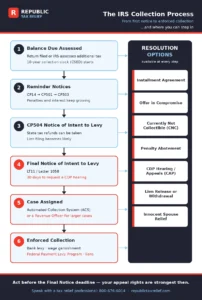
The Final Notice of Intent to Levy
This is the most important deadline in the entire process. The LT11 or Letter 1058 gives you 30 days to request a Collection Due Process hearing. After that window closes, the IRS can levy bank accounts, wages, and other assets. It can also use the Federal Payment Levy Program to take part of certain federal payments, including Social Security benefits.
The Notice of Federal Tax Lien
When the IRS files a notice of federal tax lien, it publicly claims an interest in your property. A lien isn’t a seizure, but it can hurt your ability to borrow, refinance, or sell. Learn more about releasing or removing a federal tax lien.
Practical takeaway: If you’re holding an LT11 or Letter 1058, circle the date on the letter and count 30 days. Missing that date costs you your strongest appeal rights.
Who Handles Your Case: Revenue Officer vs. Automated Collection System
Most cases go to the IRS’s Automated Collection System (ACS), a phone-and-mail unit staffed by call-center employees. Larger or more complex balances, including many business and payroll tax cases, may be assigned to a revenue officer who works in the field.
| Automated Collection System (ACS) | Revenue Officer | |
|---|---|---|
| Contact method | Letters and phone calls | Phone, letters, and in-person visits |
| Typical cases | Smaller individual balances | Larger balances, businesses, payroll taxes |
| Pace | Can stall, then move quickly | Firm deadlines set by one assigned officer |
| What they’ll ask for | Basic financial details | A full collection information statement (Form 433-A or 433-B) and records |
What About a Private Collection Agency?
The IRS may assign certain older, inactive accounts to a private collection agency. Under the IRS private debt collection program, you’ll get a letter from the IRS first, followed by one from the agency. A legitimate agency will never ask you to pay it directly. All payments to the IRS go to the U.S. Treasury, and private collection agencies can’t levy or seize property.
Practical takeaway: If a revenue officer contacts you, take it seriously. Revenue officers have broad authority, and their deadlines matter. This is usually the point where professional help pays off most.
Your Appeal Rights: Collection Due Process Hearing and CAP
You have the right to challenge IRS collection actions. Two main paths exist, and IRS Publication 1660, Collection Appeal Rights explains both in detail.
| Collection Due Process (CDP) Hearing | Collection Appeals Program (CAP) | |
|---|---|---|
| When you can use it | Within 30 days of a final levy notice or lien hearing notice | Before or after a levy, lien, or seizure, or after an installment agreement is rejected |
| Who decides | IRS Independent Office of Appeals | IRS Independent Office of Appeals |
| Court review | Yes, you can petition the U.S. Tax Court | No, the decision is final |
| Effect on levies | Levy action generally pauses while the hearing is pending | Depends on the situation |
If you miss the 30-day window, you may still request an “equivalent hearing” within one year, but you lose the right to go to Tax Court.
Practical takeaway: When you request a collection due process hearing, you can propose an alternative, like an installment agreement or offer in compromise. A hearing isn’t just a delay tactic; it’s a chance to put a real solution on the table.
How to Stop IRS Collection Actions and Resolve Your Tax Debt
The right fix depends on your income, assets, and the size of your tax debt. Common options include:
- Installment agreement: A monthly payment plan based on what you can afford. See how IRS payment plans work.
- Offer in compromise: In some cases, the IRS accepts a tax debt for less than the full amount. Learn how the OIC program weighs your ability to pay.
- Currently not collectible status: If paying would leave you unable to cover basic living expenses, the IRS may pause collection. Explore IRS Currently Not Collectible status.
- Penalty abatement: Reasonable cause or a clean history can reduce penalties. Read about IRS penalty abatement.
If a levy or garnishment is already in place, get help right away with IRS collections defense, bank levy help, or IRS wage garnishment relief.
How to Negotiate With IRS Collections
- Get compliant first. The IRS usually won’t approve an agreement if returns are missing. Start with unfiled tax returns help.
- Know your numbers. The IRS uses national and local expense standards, not your actual budget, to decide what you can pay.
- Respond on time. Ignoring deadlines invites the IRS to resume collections.
- Keep records of every call. Write down the date, the employee’s name, and ID number.
Example: A self-employed contractor owes $48,000 and receives a CP504. By filing two missing returns and submitting accurate financials, they qualify for a monthly payment they can actually afford, and the threat of levy goes away.
The 10-Year Collection Statute (CSED)
The IRS has 10 years from the date of assessment to collect a tax debt. This deadline is called the Collection Statute Expiration Date (CSED), and once it passes, the remaining balance generally can’t be collected.
Certain actions pause that clock, including:
- A pending offer in compromise
- A pending installment agreement request
- A Collection Due Process hearing
- Time spent living outside the U.S. for six months or more
Each tax year has its own CSED, so one person can have several. IRS Publication 594 covers how the collection statute works.
Practical takeaway: Before choosing a resolution strategy, have a professional pull your IRS transcripts and calculate each CSED. Sometimes waiting in currently not collectible status makes more sense than a long payment plan.
When to Get IRS Representation From a Tax Attorney
You can communicate with the IRS on your own, but dealing with the IRS gets harder once a revenue officer is involved, a levy is pending, or you owe payroll or state tax. A tax attorney or enrolled agent can contact the IRS on your behalf, request holds on collection activities, and negotiate terms you may not know to ask for.
Business owners should look at business tax debt relief and payroll tax debt relief. For a broader view, see our guide to tax resolution services.
“Great experience! They were nice, listened and helpful. I spent 10,000 with Optima Tax Relief and after 3 years nothing got done. Republic was so affordable and quick! They saved my life.”
— Beth Downey, Google Review
Your privacy is protected at every step. Every document you share is secured with bank-grade 256-bit encryption and handled under strict tax professional confidentiality standards.
Key Takeaways
- The IRS sends several notices before enforced collection actions begin.
- The final notice of intent to levy starts a 30-day clock for your strongest appeal rights.
- ACS handles most cases; revenue officers handle larger or complex ones.
- CDP hearings and CAP let you challenge collection and propose solutions.
- Payment plans, offers, CNC status, and penalty relief can all stop the pressure.
- The 10-year collection statute shapes which strategy makes sense.
Whatever stage you’re in, you have options, and the earlier you act, the more of them you keep. Bookmark this IRS Collections Blog and come back whenever a new letter arrives.
IRS Collections FAQ
How do I stop IRS collection actions?
You can stop most IRS collection actions by setting up a payment plan, submitting an offer in compromise, qualifying for currently not collectible status, or requesting a Collection Due Process hearing within 30 days of a final notice. The right option depends on your income, assets, and balance.
How long does the IRS collection process take?
It usually takes several months to move from the first bill (CP14) to the final notice of intent to levy. Larger balances or cases assigned to a revenue officer can move faster.
What is the difference between a revenue officer and the Automated Collection System?
The Automated Collection System handles most cases by phone and mail. A revenue officer is assigned to larger or more complex cases and may visit your home or business in person.
What happens if I miss the 30-day deadline for a CDP hearing?
You may still request an equivalent hearing within one year of the notice. However, you lose the right to petition the U.S. Tax Court, and the IRS isn’t required to pause levy action.
Does currently not collectible status erase my tax debt?
No. Currently not collectible status pauses active collection, but interest and penalties continue, and the IRS may keep future tax refunds. The 10-year collection clock generally keeps running during this time.
Speak With a Tax Relief Professional
You don’t have to face the IRS alone. Republic Tax Relief helps individuals and business owners resolve IRS and state tax debt, stop collection actions, and find a realistic path forward. Our team reviews your notices, explains your options in plain language, and handles communication with the IRS for you.
Call 800-676-6014 or request your confidential consultation today.
Sources