
Oct
You go to pay rent or make payroll, and the bank declines it. Your balance shows zero, or a “hold” you didn’t place. If your bank account is suddenly frozen, a levy is the most likely reason, and the clock is already running.
The good news is that a frozen account does not always mean the money is gone. Banks are required to hold levied funds for a set period before sending them to the IRS, the state, or a creditor. What you do during that window often decides whether you get the money back. This bank levy blog explains how bank levies work, which money may be protected, and the realistic ways to stop a bank levy or keep it from happening again.
Table of Contents
- How the Bank Levy Process Works
- Bank Levy Freeze Rules: Why Your Account Is Frozen
- What to Do When You Receive a Notice of Levy
- Ways to Stop an IRS Bank Levy
- Bank Levy in California: FTB and Creditor Levies
- Joint Account Levies
- How to Prevent a Bank Levy
- When to Get Legal Help From a Bank Levy Lawyer
- Bank Levy FAQs
- Key Takeaways
How the Bank Levy Process Works (and How It Differs From Wage Garnishment)
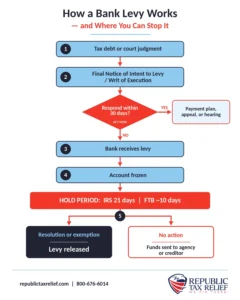
A bank levy is a legal seizure of money in your account to pay a debt. The IRS calls a levy a legal seizure of property to satisfy a tax debt, and it can take funds directly from your bank account without going to court first (IRS: What Is a Levy?). A private creditor, by contrast, must sue you and win a judgment before it can levy your account.
A bank levy is usually a one-time snapshot. It grabs the money in the account on the day the bank receives the levy, not future deposits. That’s different from wage garnishment, which keeps taking a portion of every paycheck until it’s released. The catch: the IRS or a creditor can send another levy later.
| IRS Levy | California FTB Levy | Private Creditor Levy | |
|---|---|---|---|
| Court judgment needed? | No | No | Yes |
| Advance warning | Final Notice of Intent to Levy, at least 30 days prior | Final notice before levy | Lawsuit, judgment, then writ of execution |
| Bank holding period | 21 days | About 10 days | Held while the exemption window runs |
| Main defense tools | Payment plan, hardship release, appeal | Payment plan, hardship review | Claim of exemption |
Practical takeaway: Find out who levied your account first. Your bank can tell you, and the answer decides which defenses apply.
Bank Levy Freeze Rules: Why Your Account Is Frozen
When a bank receives an IRS levy, federal law requires it to hold the funds for 21 days before sending them to the IRS (26 U.S.C. § 6332). That holding period exists so you have time to sort out errors or work out a resolution. Once the funds are sent, getting them back is much harder.
Here’s what the freeze typically means:
- You may be unable to access your money up to the amount owed, even for bills.
- Deposits made after the levy usually aren’t caught by that same levy.
- Checks may bounce during the freeze, so warn landlords, vendors, or payroll services.
- Business accounts can be levied the same way as personal ones.
Example: A contractor owes $18,000 in back taxes. The IRS levy hits on a Monday when the business account holds $11,000. The bank freezes the $11,000. Money deposited Wednesday is not part of that levy, but the original $11,000 is at risk if nothing happens within 21 days.
What to Do When You Receive a Notice of Levy
Most bank levies don’t come out of nowhere. The IRS must send a Final Notice of Intent to Levy and Notice of Your Right to a Hearing (Letter LT11 or Letter 1058) at least 30 days before levying. Filing a Collection Due Process hearing request within that 30-day window can pause the levy while your case is reviewed (IRS Publication 594).
If a notice is on your counter right now, take these steps:
- Check the date. Count 30 days from the letter date to see if you still have hearing rights.
- Confirm the balance. Penalties and interest add up, and IRS records can contain errors.
- Gather your bank statements and recent income records. You’ll need them for almost any resolution.
- Don’t ignore it. Silence is what turns a notice into an active bank levy.
To understand every stage that leads to a levy, see our guide to the IRS collection process and levy defense.
Ways to Stop an IRS Bank Levy
If the levy has already hit, the 21-day window is your best chance to act. The IRS must release a levy in certain situations, including when it causes economic hardship or when you enter an installment agreement. These are the most common ways to stop a bank levy from the IRS.
Set Up a Resolution That Qualifies for Release
- Installment agreement: A formal IRS payment plan is often the fastest route to a release.
- Currently Not Collectible status: If you can’t cover basic living expenses, CNC status can pause collection.
- Offer in Compromise: If you can’t realistically pay the full debt, learn how the OIC program evaluates ability to pay.
Request a Hardship Release or Appeal
If the levy leaves you unable to pay rent, utilities, or food, you can ask the IRS to release it based on economic hardship. You can also use the Collection Appeals Program, or contact the Taxpayer Advocate Service if you’re stuck.
Fix What Triggered the Levy
Missing tax returns often block every resolution option. If that’s your situation, catching up on unfiled returns comes first.
Example: A medical practice owner calls on day 6 of a levy. Her representative submits current financial information and negotiates an installment agreement. The IRS releases the levy before the funds leave the bank.
Bank Levy in California: FTB and Creditor Levies
California adds its own layer. The Franchise Tax Board (FTB) can issue an Order to Withhold to your bank for unpaid state taxes, and the bank holds the funds for roughly 10 days before sending them. That’s less than half the IRS window, so speed matters even more with a California bank levy.
When a Creditor Can Levy Your Account
A creditor, such as a credit card company or lender, needs a court judgment first. The usual path is a notice of the lawsuit, a judgment, a writ of execution, and then the levying officer serves your bank. Once the bank receives the writ, it freezes the money in the account.
Your Money May Be Protected: Filing a Claim of Exemption
Under California law, some funds are exempt from creditor levies:
- An automatic exempt amount set by statute and adjusted each year
- Social Security and SSI deposits, with federal rules protecting up to two months of directly deposited federal benefits
- Certain other public benefits and funds needed for basic support
If the bank didn’t protect exempt money automatically, you can file a claim of exemption with the levying officer. The deadline is short, generally 15 days from when the notice of levy was served (a bit longer if mailed). Missing it can mean losing the right to challenge the levy.
Important: Creditor exemption rules don’t work the same way against IRS tax levies. That’s why identifying the levying party comes first. For hands-on help with any of these, see our bank levy attorney services for IRS, California, and creditor levies.
Joint Account Levies
A levy on a joint account can freeze money that belongs to someone who doesn’t owe the debt. The IRS and creditors can generally levy joint accounts, but the non-liable co-owner may be able to recover their share.
- For IRS levies: The co-owner can file a wrongful levy claim with proof the funds are theirs.
- For creditor levies: The co-owner can file a claim showing their contribution to the account.
- Proof matters: Pay stubs and deposit records tracing the money are the strongest evidence.
If the tax debt came from a spouse’s or former spouse’s return, innocent spouse relief may also be worth exploring.
How to Prevent a Bank Levy
Releasing one levy doesn’t stop another levy from coming if the underlying debt is still unresolved. Long-term protection comes from a settled plan.
- Open every IRS and FTB letter. Notices carry deadlines that protect your rights.
- Respond before the Final Notice of Intent to Levy expires. That’s when you have the most options.
- Keep filings current. The IRS won’t approve most agreements with missing returns.
- Stay current on new taxes. Missing a payment can default your agreement and restart collection.
- Ask about penalty relief. Penalty abatement can lower the balance you’re paying down.
Don’t try to protect your money by moving it to other people’s accounts. Transfers designed to avoid collection can create new legal problems and make resolution harder.
When to Get Legal Help From a Bank Levy Lawyer
You can call the IRS yourself, but bank levy cases move fast and mistakes are costly. A wrong financial statement or a missed deadline can cost you the funds in your account. Legal help is worth considering if:
- The levy hit a business account and threatens payroll or vendor payments
- You owe unpaid payroll taxes, which the IRS pursues aggressively
- You face a levy plus wage garnishment at the same time
- Both the IRS and the FTB are collecting
- You have unfiled returns or large penalties
A tax professional can review the levy, confirm the balance, contact the agency directly, and negotiate the right resolution while the hold period is still open. Republic Tax Relief helps individuals and businesses with IRS and state collection problems, and our work has been recognized in the industry.
“Republic Tax Relief is reliable, efficient, and trustworthy. I would definitely recommend them to anyone needing tax help.” — Marina Mele, Google Review
Your information is protected by strict tax client confidentiality and bank-grade 256-bit encryption, so you can share your documents with complete peace of mind.
Bank Levy FAQs
How long does a bank levy freeze last?
For IRS levies, the bank holds the funds for 21 days before sending them. California FTB levies have a shorter hold of about 10 days. Creditor levies are held while the exemption deadline runs.
Can the IRS take money from my account without warning?
Generally, no. The IRS must send a Final Notice of Intent to Levy at least 30 days before levying a bank account. Some exceptions exist, such as levies on state tax refunds or cases where collection is in jeopardy.
Does a bank levy take future deposits?
Usually not. A bank levy typically captures only the funds in your account when the bank receives it. However, the IRS or a creditor can issue another levy later if the debt remains unpaid.
Can I get money back after a levy is paid to the IRS?
It’s possible in limited cases, such as a wrongful levy or a procedural error, but it’s much harder. Acting during the hold period gives you the best chance to release the levy.
Is Social Security protected from a bank levy?
Against private creditors, directly deposited Social Security benefits are generally protected for up to two months of payments. IRS tax levies follow different rules, so get professional advice if federal benefits are involved.
Key Takeaways
- A frozen bank account usually means a levy has already reached your bank.
- IRS levies give you a 21-day window; California FTB levies give you about 10 days.
- Payment plans, CNC status, hardship releases, and appeals can release an IRS levy.
- For creditor levies in California, a claim of exemption can protect certain funds, but deadlines are short.
- Long-term protection comes from resolving the underlying debt.
Speak With a Tax Relief Professional
If your account has been frozen or you’ve received a notice of intent to levy, the hold period won’t wait. Republic Tax Relief can review your levy, explain your options, and work to release your funds and resolve the debt behind it.
Call 800-676-6014 or request a confidential consultation today.
About Republic Tax Relief: Republic Tax Relief helps individuals and businesses resolve IRS and state tax debt, including bank levies, wage garnishments, tax liens, payroll tax problems, and unfiled returns. Our team handles communication with the IRS and California tax agencies so you can focus on your family and your business. Call 800-676-6014 for a free, confidential review.
This article is general information, not legal or tax advice. Outcomes depend on your specific facts.