
A missed call about “back taxes.” A voicemail from a “tax resolution team.” A letter that looks official but feels off. If you sell, broker, or invest in property and you owe the IRS or your state, moments like these can be scary.
This page answers the questions agents, brokers, and investors ask Google most about tax resolution for real estate, from spotting scam calls to protecting your property and license. Every answer is short, plain, and reviewed by our team.
Reviewed for accuracy by: Mark Ladd, CEO, Republic Tax Relief | Last updated: October 2026
On This Page
- Tax Calls, Voicemails, and Letters: Real or Scam?
- How the IRS and State Tax Agencies Contact You
- Back Taxes: Deadlines and What Happens Over Time
- Protecting Your Property and License From Tax Debt
- How Tax Resolution Works With Professional Help
- Speak With a Tax Relief Professional
This page is general information, not legal or tax advice. Your options depend on your facts.
Tax Calls, Voicemails, and Letters: Real or Scam?
Why do I keep getting calls from a tax resolution team?
Most of these calls are marketing, not the IRS. When the IRS files a Notice of Federal Tax Lien, your name and address become public record, and many companies buy those lists to cold call people who owe.
Property owners get these calls often because liens are recorded with the county where your property sits. You may also get calls if you filled out an online form for tax help, even once.
Repeated calls usually mean one of these things:
- A tax lien was recently recorded in your county
- A lead website sold your contact information
- A scammer is posing as a tax firm or as the IRS
A real firm can explain how it got your number and will never claim to be the IRS. If you do owe, the calls are still a sign to act. Learn what a federal tax lien means for your property.
How do I know if a tax call is legit?
A real IRS call almost always follows letters you already got in the mail. A real agent will never demand instant payment by gift card, wire, or crypto. When in doubt, hang up and call the IRS back using the number on IRS.gov or on your notice.
| What to check | Real IRS or state agent | Likely scam |
|---|---|---|
| Before the call | You received letters first | No letters, call out of the blue |
| How to pay | To the “United States Treasury” through IRS.gov or by check | Gift cards, wire transfer, crypto, or a payment app |
| Tone | Explains your rights and options | Threatens arrest, deportation, or license loss |
| Verifying | Fine with you calling back an official number | Pressures you to stay on the line |
| In person | Shows two forms of federal ID | Refuses to show ID or shows a badge only |
If a tax professional holds your power of attorney, the IRS will often contact them instead of you. That alone removes a lot of guesswork (IRS: How the IRS Contacts Taxpayers).
Is it safe to receive a voicemail about back taxes?
Yes, simply listening to a voicemail is safe. The risk comes from calling back the number in the message or giving personal details to the caller.
- Do not call the number left in the message. Look up the official number yourself.
- Do not press any keys or share your Social Security number.
- Save threatening messages and report them to the Treasury Inspector General for Tax Administration (TIGTA).
Prerecorded messages that threaten arrest or a lawsuit “today” are classic scams. If you worry the message ties to a real balance, check your IRS online account before doing anything else.
What are some signs that a phone call is actually a scammer?
The biggest warning signs are pressure and unusual payment demands. Hang up if the caller does any of the following:
- Demands payment right now, especially by gift card, prepaid card, wire, or crypto
- Threatens arrest, deportation, or seizure of your home that same day
- Says the IRS will revoke your driver’s license or real estate license
- Asks for your credit or debit card number over the phone
- Refuses to let you question or appeal the amount
- Shows “IRS” or a Washington, DC number on caller ID, which can be faked
- Knows part of your Social Security number, which may come from stolen data
Real estate professionals are easy targets because names, offices, and property records are public. Scammers may even mention a real address you own to sound believable.
How can I tell if a tax letter is real?
A real IRS letter shows a notice or letter number, such as CP14 or LT11, usually in the top or bottom right corner. It lists the tax year and amount due, and it arrives by U.S. Mail. You can confirm it by logging in to your IRS online account.
Look for these signs of a genuine notice:
- A notice number you can look up on IRS.gov
- Your correct name, address, and a partial match of your Social Security or tax ID number
- Payment made out to the “United States Treasury,” never to a person or private company
- A clear explanation of your appeal rights and deadlines
Watch for official-looking letters from private companies about a “final notice” on a property lien. Many are ads with fine print saying they are not a government agency. Our IRS notices guide explains what real letters mean.
How the IRS and State Tax Agencies Contact You
Will the IRS call you if you owe back taxes?
Sometimes, but not first. The IRS starts with letters by mail. It may call later, usually after several notices, if you owe a balance, have unfiled returns, or owe payroll taxes from a brokerage.
Revenue officers handle larger cases and may call or visit. In 2023, the IRS ended most unannounced revenue officer visits, so a visit is now usually set up by letter first.
Private debt collectors working for the IRS may also call about older balances. Before they do, the IRS mails you a letter naming the agency, and the collector sends its own letter too (IRS: Private Debt Collection).
So, will you ever get a phone call about your taxes? You might. But a surprise call should never be the first sign of a problem.
Does the state income tax department make phone calls?
Yes. State agencies, such as California’s Franchise Tax Board (FTB), can call about unpaid balances or missing returns, usually after mailing notices. Verify any call by contacting the agency through the number on its official website.
In California, real estate professionals may hear from several agencies:
- Franchise Tax Board (FTB): state income tax
- Employment Development Department (EDD): payroll taxes for brokerage staff
- CDTFA: sales and use tax
- County tax collector: property tax, which is local, not state
State agencies can collect as firmly as the IRS, with bank levies, wage garnishments, and liens on real property. See how we handle IRS and state back taxes.
How does the IRS contact you if there is a problem?
By U.S. Mail first, in almost every case. The IRS does not start contact through email, text messages, or social media.
| How the IRS reaches you | When it usually happens |
|---|---|
| Mailed notice | First contact for balances, unfiled returns, and audits |
| Phone call | After notices, for collection, audits, or to set a meeting |
| In-person visit | Revenue officer or auditor, usually scheduled by letter |
| Private debt collector | Older balances, only after the IRS mails you a letter |
| Your representative | Anytime, if a power of attorney is on file |
Agents and investors should also watch for letters about income mismatches. These come when the IRS sees 1099 commissions or rents that don’t match your return.
Back Taxes: Deadlines and What Happens Over Time
How do I know if I owe back taxes?
The fastest way is to log in to your IRS online account at IRS.gov, which shows balances by tax year. You can also request account transcripts or call the IRS.
- Federal: IRS online account or account transcripts
- California: your MyFTB account
- Property tax: your county tax collector’s website, searched by parcel number
- Mail: any unopened IRS or state envelopes, which often hold the answer
Transcripts can be hard to read. With your permission, a tax professional can pull every year at once and spot filing gaps, penalties, and collection deadlines. Our back tax help page explains what comes next.
How long do I have to pay back taxes?
Your first IRS bill asks for payment within 21 days, but you have more options than that deadline suggests. The IRS offers short-term plans of up to 180 days, monthly payment plans, and generally has 10 years from assessment to collect.
| Option | Time to pay |
|---|---|
| Pay in full | By the due date on your notice |
| Short-term payment plan | Up to 180 days |
| Long-term installment agreement | Monthly payments, often up to 72 months for balances of $50,000 or less |
| IRS collection period | Generally 10 years from assessment, though the clock can pause |
Interest and penalties keep growing until the balance is paid. Since commission income swings, a plan should fit your average month, not your best one. Read about IRS payment plans.
What happens after 4 years of not paying taxes?
After about four years, the failure-to-pay penalty usually reaches its 25% cap, but interest keeps growing daily. By then, most people have received final notices and may face a tax lien, levies on bank accounts or commissions, and seized refunds.
By year four, many taxpayers have seen:
- A final notice of intent to levy
- A Notice of Federal Tax Lien recorded with their county
- Federal refunds kept and applied to the debt
- Levies on bank accounts, wages, rents, or commissions
- Passport problems if the debt counts as “seriously delinquent”
If returns were never filed, the picture can be worse. The IRS may file a substitute return that ignores your expenses and depreciation. Catching up on unfiled tax returns often lowers the balance.
Four years in still leaves room to act. Penalty relief, a payment plan, or a settlement may still fit your situation.
At what point will the IRS come after you?
The IRS can begin levies after it sends a Final Notice of Intent to Levy and 30 days pass. That usually happens several months after the first bill, often within a year if notices are ignored.
- Months 1 to 6: balance-due notices and reminders arrive by mail
- Next: a notice of intent to levy, then a final notice with hearing rights
- After 30 days: levies on accounts, wages, rents, or commissions can begin
- Larger balances: the IRS often records a lien, commonly once you owe more than $10,000
Unpaid payroll taxes from a brokerage tend to move faster and bring a revenue officer sooner. Learn how IRS collections defense works.
Does an IRS tax lien on my property go away after 10 years?
Usually, yes. A federal tax lien generally becomes unenforceable when the 10-year collection period ends, and most recorded lien notices release themselves on that date. But the clock can pause, so your real end date may be later.
The collection clock can stop running during:
- A pending offer in compromise
- A pending payment plan request or appeal
- A Collection Due Process hearing
- Bankruptcy
- Time spent living outside the U.S. for six months or more
If the date has passed but the lien still shows on a title report, you can ask the IRS for a certificate of release (IRS: Time IRS Can Collect Tax). That matters when a buyer’s title company flags an old lien.
Protecting Your Property and License From Tax Debt
How can I protect my property from the IRS?
The best protection is getting into an approved resolution before the IRS levies. An active payment plan, a pending offer in compromise, or hardship status generally keeps the IRS from seizing property while it is in place.
- Respond to every notice, and request a hearing within 30 days of a final notice
- Set up a payment plan, offer in compromise, or currently not collectible status
- Ask about lien withdrawal, discharge, or subordination before a sale or refinance
- Stay current on this year’s estimated taxes
- Get help before a revenue officer is assigned
Do not move property to a relative or a new LLC to hide it. The IRS can treat the new owner as a “nominee” and file a lien in their name, which makes your case harder.
Can the IRS take my home for back taxes?
It can, but it is rare. Before the IRS seizes your main home, it must get written approval from a federal judge, and it cannot seize a primary residence for a debt of $5,000 or less.
The IRS usually tries other steps first, such as payment plans or levies on bank accounts, rents, or commissions. Rental and investment properties do not get the same court protection as your primary home.
If a revenue officer mentions seizure, call a professional right away. There are almost always steps to take first.
What should I do if an IRS revenue officer contacts me?
Stay calm, confirm the officer’s identity, and avoid making promises on the spot. Write down their name, badge number, phone number, and any deadline they give you.
- Ask to see two forms of federal ID if they visit in person
- Verify the officer by calling the IRS through the number on IRS.gov
- Do not sign forms or agree to a payment amount during the first contact
- Ask for time to get representation, then hire a licensed professional
Revenue officers often ask for a detailed financial statement within a short window. For investors, how your property equity is shown on that form can shape the whole outcome.
Can unpaid taxes put my real estate license at risk?
The IRS cannot suspend your real estate license, but some states can. In California, people on the state’s lists of the top 500 delinquent tax accounts can have state-issued licenses, including real estate licenses, suspended.
Entering a payment plan with the state can take you off those lists. Other states have their own rules, so check with your licensing agency if you owe state taxes.
The IRS can, however, ask the State Department to deny or revoke a passport for seriously delinquent tax debt. That matters if you travel for investment deals.
Does Trump want to eliminate property taxes?
No federal law ends property taxes, and a president does not have the power to abolish them. Property taxes are set and collected by state and local governments, so any change would have to come from your state or county.
What Washington does control is the federal deduction for state and local taxes (SALT), which includes property tax. The 2025 federal tax law raised that cap from $10,000 to $40,000 for many filers, with limits for higher incomes.
Several states, including Florida and Texas, have debated cutting or ending property taxes on homes. Either way, past-due property tax bills stay due, and if you also owe the IRS, both debts need one plan.
How Tax Resolution Works With Professional Help
How does tax resolution work for agents, brokers, and investors?
Tax resolution works by reviewing your full IRS and state record, protecting you from collection, and then negotiating the option that fits your income and property equity. A licensed professional handles the IRS for you under a power of attorney.
- Review. Pull transcripts, find unfiled years, and confirm how long the IRS has left to collect.
- Protect. Respond to notices and request holds or hearings to pause levies.
- Catch up. File any missing returns so relief is possible.
- Choose. Compare payment plans, settlements, hardship status, penalty relief, and lien relief.
- Negotiate and stay current. Present your case, then plan estimated payments so the cycle doesn’t repeat.
Who you hire matters. Enrolled agents, CPAs, and tax attorneys can represent you before the IRS, and a good firm reviews your records before promising anything. For the full picture, see our page on resolving IRS debt as a real estate professional, our investor and landlord tax guide, and our questions about hiring a tax relief company.
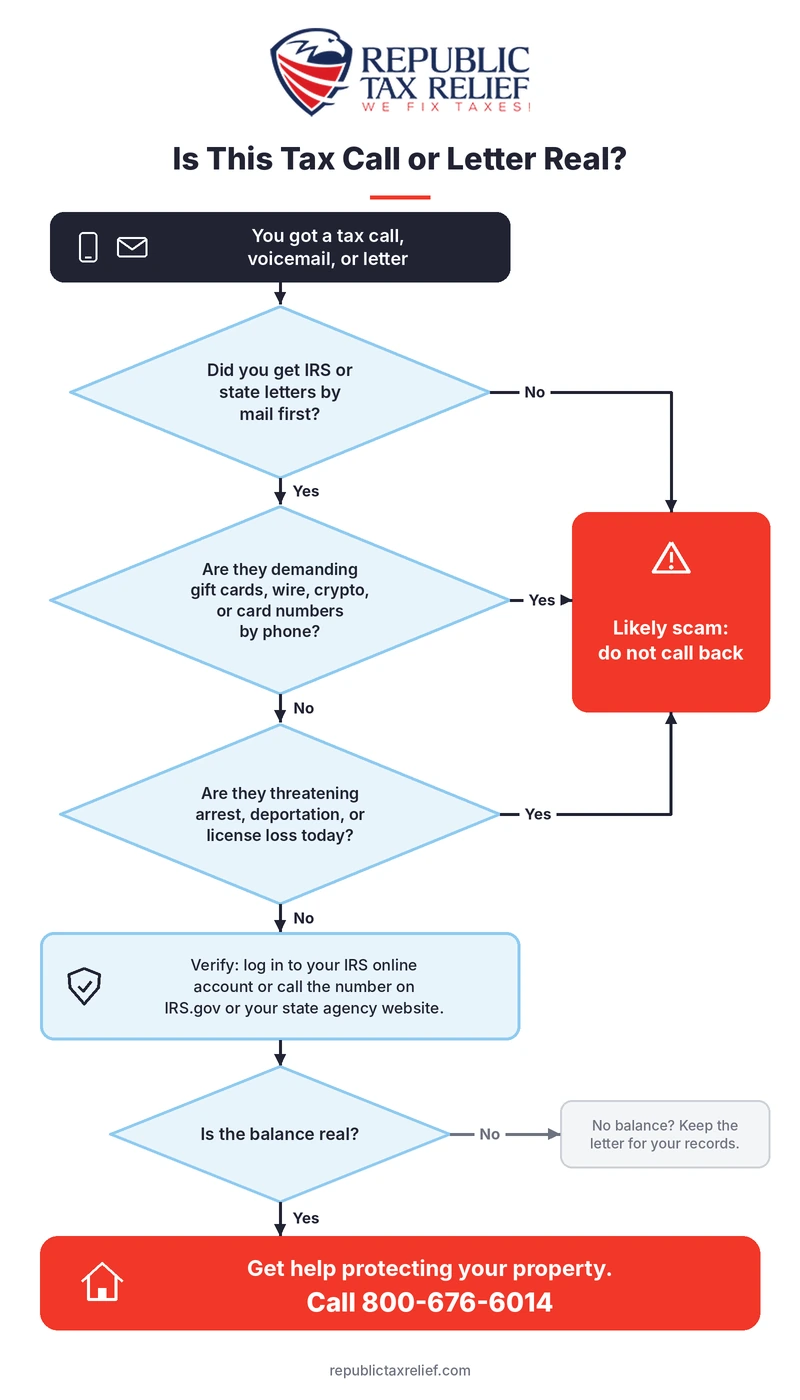
A quick way to check whether a tax call, voicemail, or letter is real before you respond.
Speak With a Tax Relief Professional
Not sure if that call was real? Already holding a final notice? You don’t have to figure it out alone. Our team can review your IRS and state records and tell you where you stand.
Call 800-676-6014 or schedule your free, confidential consultation today.
Every tax return, Social Security number, and bank statement you share is locked behind 256-bit encryption and seen only by your assigned tax team, under strict privilege standards.
Sources
- IRS: Understanding How the IRS Contacts Taxpayers
- IRS: Private Debt Collection
- IRS: Time IRS Can Collect Tax
About Republic Tax Relief
Republic Tax Relief helps individuals and businesses resolve IRS and state tax problems, including back taxes, unfiled returns, levies, liens, and audits. Since 2005, our in-house team of enrolled agents, tax attorneys, and CPAs has offered tax resolution for real estate agents, brokers, investors, and other professionals across California and beyond. Call 800-676-6014 or contact us online to speak with our team.
This content is for general information only and is not legal or tax advice. Results depend on each taxpayer’s facts and circumstances.