
Reviewed for accuracy by: Mark Ladd, CEO | Last updated: October 2026
Doctors, nurses, and dentists search for the same tax questions as everyone else. Will I get a big refund? Do I owe tax on Social Security? Which deductions am I missing?
When you already owe back taxes, the answers change. This FAQ covers how refunds, retirement benefits, and popular new deductions work for healthcare workers with IRS or state tax debt, and when it makes sense to bring in a professional.
In This FAQ
- Tax Refunds When You Owe Back Taxes
- Social Security, Retirement, and the $6,000 Senior Deduction
- Healthcare Worker Deductions and Back Taxes
- Medical Bills, Home Spending, and IRS Payment Amounts
- State Tax Debt, Credit Reports, and Forgiveness Myths
- Speak With a Tax Relief Professional
Questions about this page that are not covered here may be answered on our main tax relief FAQ page, our medical professional tax resolution service page, or our guide to choosing the right IRS relief option as a doctor.
Tax Refunds When You Owe Back Taxes
Many people expect a large refund every spring. If you owe the IRS or a state agency, that refund is often the first money collected.
Will the IRS keep my tax refund if I owe back taxes from my practice?
Yes. The IRS applies any refund to your unpaid federal tax balance before sending you money, and this continues while you are on a payment plan (IRS Tax Topic 203).
Only the amount left after your balance is covered is released to you. If you were counting on a refund to make payroll or a quarterly payment, plan around losing it.
Can my state take my federal refund for unpaid state taxes?
Yes. Through the Treasury Offset Program, a federal refund can be reduced to pay past-due state income tax, child support, and certain other government debts.
States such as California also use their own collection tools on top of this. Our IRS and state back tax relief services address both agencies at once.
Can a tax professional stop the IRS from taking my refund?
Sometimes. If losing the refund would cause economic hardship, such as being unable to pay rent or utilities, a representative may be able to request an offset bypass refund.
The request must usually be made before the offset happens, so timing matters. This is one reason to get help before you file, not after the refund disappears.
My spouse owes back taxes from a medical practice. Can the IRS take my share of our joint refund?
It can, unless you file Form 8379, Injured Spouse Allocation. This form asks the IRS to return the portion of a joint refund that belongs to the spouse who does not owe the debt.
Injured spouse relief only protects your refund share. If you need to get out from under the tax itself, look at innocent spouse relief instead.
| Who Can Take Your Refund | What Debts Qualify | Can It Be Avoided? |
|---|---|---|
| IRS | Unpaid federal income, payroll, and penalty balances | Possibly, through an offset bypass refund for hardship |
| Treasury Offset Program | State income tax, child support, some federal agency debts | Depends on the agency owed |
| Joint return offset | One spouse’s separate debt | Injured spouse claim on Form 8379 |
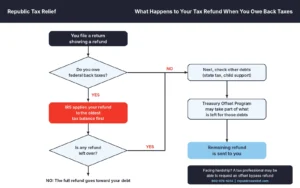
How a refund moves through IRS and Treasury offsets before any money reaches you, with a hardship option for taxpayers who need the funds.
Social Security, Retirement, and the $6,000 Senior Deduction
Many physicians keep practicing into their late 60s and 70s. An old tax balance does not retire when you do, and it can reach benefits you planned to live on.
Can a doctor over 65 claim the new $6,000 senior deduction while owing the IRS?
Owing back taxes does not block the deduction, but income limits often do. The $6,000 deduction for people 65 and older runs from 2025 through 2028 and phases out once modified adjusted gross income passes $75,000 for single filers or $150,000 for joint filers (IRS.gov).
Many practicing physicians earn too much to benefit. Retired doctors with lower income may qualify, but any refund it creates can still be applied to an existing balance.
Can the IRS take my Social Security if I still owe taxes from my practice?
Yes. Under the Federal Payment Levy Program, the IRS can take up to 15% of each Social Security payment for unpaid federal taxes.
Supplemental Security Income is not subject to this levy. An approved IRS payment plan or currently not collectible status can often stop or prevent it.
Can the IRS levy my 401(k) or retirement account for back taxes?
Yes, although IRS procedures call for extra review before it levies retirement funds. Agents are expected to weigh your conduct and whether you need that money for basic living costs.
If the IRS does levy a retirement account, the 10% early withdrawal penalty does not apply to the levied amount. A voluntary withdrawal to pay the IRS does not get that same break, so talk to a professional before you cash out.
Healthcare Worker Deductions and Back Taxes
Overlooked write-offs can shrink a tax bill, but the rules depend on how you are paid. Here is how deductions fit into resolving a balance you already owe.
Can nurses use the no tax on overtime deduction if they owe the IRS?
Yes, if they qualify. From 2025 through 2028, eligible workers can deduct qualified overtime pay up to $12,500, or $25,000 on a joint return, with phase-outs at higher incomes.
Hourly nurses and techs are the most likely to benefit. Many salaried physicians are exempt from overtime rules, and any resulting refund can still be offset against old debt.
Can employed doctors and nurses deduct unreimbursed work expenses to lower what they owe?
Usually not. Most W-2 employees cannot deduct unreimbursed job costs such as scrubs, licensing fees, or continuing education under current federal law.
Self-employed and 1099 healthcare workers are different. They can still deduct ordinary and necessary business expenses, which is why how you are classified matters.
| How You Are Paid | Work Expense Deductions | Overtime Deduction |
|---|---|---|
| W-2 hourly (nurses, techs) | Generally not allowed | Often eligible |
| W-2 salaried physician | Generally not allowed | Often not eligible |
| 1099 contractor or practice owner | Allowed if ordinary and necessary | Not applicable |
Can missed deductions on old returns lower my IRS balance?
They can. An amended return can reduce a balance you still owe, and audit reconsideration can reopen a substitute return the IRS prepared for you.
Refunds of money already paid are limited by time, usually 3 years from filing or 2 years from payment. Our back tax help team reviews prior years for errors before negotiating.
What if I lost receipts and practice records for the years I owe?
You may still be able to support many expenses. Records can often be rebuilt from bank and credit card statements, payroll reports, vendor invoices, and IRS transcripts.
Some expenses, such as travel, meals, and vehicles, require stricter proof. A representative can tell you which costs are worth rebuilding and which are unlikely to hold up.
Medical Bills, Home Spending, and IRS Payment Amounts
The IRS looks closely at how you spend money when deciding what you can afford. Some costs help your case, while others can work against you.
Do my family’s medical bills count when the IRS decides what I can pay?
Yes. Health insurance premiums and out-of-pocket medical costs are part of the expense review the IRS uses for payment plans and settlements.
Costs above the standard allowance can often be allowed when they are documented and necessary. This matters for families dealing with a chronic illness or a disability.
Can spending on home improvements hurt my chances of IRS tax relief?
It can. When reviewing an offer in compromise, the IRS may add back money spent on non-essential items after the tax debt arose.
Improvements also raise home equity, which the IRS counts when deciding what you can pay. Before a remodel or a large purchase, get advice on how it could affect your options.
State Tax Debt, Credit Reports, and Forgiveness Myths
A few common beliefs lead healthcare workers to wait too long. These answers clear up the most frequent ones we hear.
If I move to a state with no income tax, does my old state tax debt go away?
No. Your former state can keep collecting after you move, and some states have long collection periods.
California, for example, generally has 20 years to collect income tax debt. Moving for a new hospital job will not erase a balance with your old state.
Will IRS back taxes show up on my credit report?
Generally no. The three major credit bureaus stopped including tax liens on credit reports in 2018.
A federal tax lien is still a public record, though, and lenders and reviewers can find it. Learn how to release or remove a federal tax lien.
Is there an IRS forgiveness program for doctors who work in underserved areas?
No. Programs like the National Health Service Corps help with student loans, not IRS tax debt.
Healthcare workers resolve tax debt through the same programs as everyone else, such as payment plans, penalty abatement, hardship status, or a settlement. See all tax debt relief options.
Speak With a Tax Relief Professional
Refund offsets, benefit levies, and new deduction rules all affect what you owe and what you keep. A tax professional can review every year and every agency, then build a plan that protects your income and your practice.
Republic Tax Relief provides tax resolution for medical professionals, including physicians, dentists, nurses, therapists, and practice owners. We handle the IRS and state agencies so you can stay focused on patients.
Your sensitive records stay under strict tax professional confidentiality and bank-grade 256-bit encryption, fully compliant with federal data protection standards. Share your returns and statements knowing they are locked down from upload to resolution.
Call 800-676-6014 or schedule your free, confidential consultation today.
About Republic Tax Relief
Republic Tax Relief helps individuals, medical professionals, and business owners resolve IRS and state tax problems, including back taxes, unfiled returns, levies, liens, wage garnishments, and payroll tax debt. Our team of tax professionals negotiates directly with tax agencies to find a realistic path to resolution for each client. Call 800-676-6014 or visit our contact page to get started.
Disclaimer: This page is for general educational purposes and is not legal or tax advice for your specific situation. Tax laws change, and results depend on each taxpayer’s facts. Speak with a qualified tax professional before making decisions about your tax debt.
Sources
- Internal Revenue Service, Topic No. 203, Reduced Refund
- Internal Revenue Service, One Big Beautiful Bill Act: Tax Deductions for Working Americans and Seniors
- Internal Revenue Service, Federal Payment Levy Program