
In Florida, the sales tax you collect from customers is never really your money. Florida law says it becomes state funds the moment you collect it. That one rule explains why the Florida Department of Revenue moves faster, and with more tools, against unpaid sales tax than most business owners expect. When a return or payment is missed and the bills go unanswered, the Department can issue a tax warrant, record it with the clerk of court, and turn it into a lien on your business assets.
This guide explains what a Florida tax warrant is, how the Florida Department of Revenue collections process works from the first notice to a bank levy, when an owner or officer can be held personally liable for Florida sales tax, and what it takes to resolve a tax warrant. It focuses on state sales and use tax, which Florida handles under its own statutes, not the IRS.
In this guide:
- What is a Florida tax warrant?
- Flowchart: how a Florida sales tax warrant works
- The Florida tax collection process, step by step
- When a warrant is filed: lien, public record, and levy
- Certificate of registration revoked in Florida
- Personal liability for Florida sales tax
- A real court case: VMOB, LLC v. Department of Revenue
- How to resolve a tax warrant with the Department of Revenue
- How to avoid becoming delinquent again
- Example scenarios: common Florida sales tax problems
- FAQs
What Is a Florida Tax Warrant Under Florida Statutes?
A Florida tax warrant is a legal document the Department of Revenue issues when a tax becomes delinquent. Under Florida Statutes section 212.15(4), the Department issues a warrant “for the full amount of the tax due or estimated to be due,” with interest, penalties, and cost of collection, and mails it to the clerk of the circuit court in any county where the taxpayer has property (Fla. Stat. § 212.15). Once the clerk of court records it, the warrant becomes a lien on the real and personal property of the taxpayer, in the same manner as a recorded judgment.
In plain terms, a tax warrant is a legal claim against the assets and property the business owns in that county. The same process applies to other taxes the Department administers, so a business can have tax warrants and liens for both sales tax and reemployment tax. It is not an arrest warrant. It does not mean you are being charged with a crime. But it is a public record, it can show up in lien searches by lenders and buyers, and it gives the Department the right to move on to stronger collection tools.
If you receive a tax warrant notice or find one in a lien search, here are the key facts:
- It covers more than the tax. The warrant includes the unpaid tax, interest, penalties, and collection costs.
- It can be filed in more than one county. The Department can send it to the clerk in every county where you own property.
- It can lead to a seizure. Section 213.69 lets a warrant direct a county sheriff, or an authorized Department agent, to levy on and sell the taxpayer’s goods, with any surplus returned to the taxpayer (Fla. Stat. § 213.69).
- It ends with payment. After the warrant is paid, the Department must satisfy the lien of record within 30 days.
Florida tax warrant vs. an IRS tax lien vs. a county tax collector warrant
Florida business owners often get three different “tax warrant or lien” notices confused. Each comes from a different agency under different law:
| Notice | Who issues it | What tax it covers | Where it is recorded |
|---|---|---|---|
| Florida tax warrant | Florida Department of Revenue | Sales and use tax and other state taxes the Department administers | Clerk of the circuit court; acts like a recorded judgment |
| Notice of federal tax lien | IRS | Federal income, payroll, and other federal tax | County clerk; created by federal law |
| Delinquent personal property tax warrant | County tax collector | Tangible personal property tax on business equipment | Confirmed by circuit court order before seizure |
The third one is a property tax matter, not sales tax. Under section 197.413, a county tax collector prepares warrants for delinquent personal property taxes and asks the circuit court for an order to seize the tangible personal property of the delinquent taxpayer (Fla. Stat. § 197.413). Many county tax collectors also offer a payment program for delinquent personal property taxes. This guide is about the Department of Revenue sales tax warrant.
The difference from the IRS matters for one big reason: your home. Because a Department of Revenue warrant works like a recorded judgment, Florida’s constitutional homestead protection generally applies to it. A federal tax lien plays by different rules. We explain that in our guide to how an IRS tax lien reaches a Florida homestead.
Flowchart: How a Florida Sales Tax Warrant Works
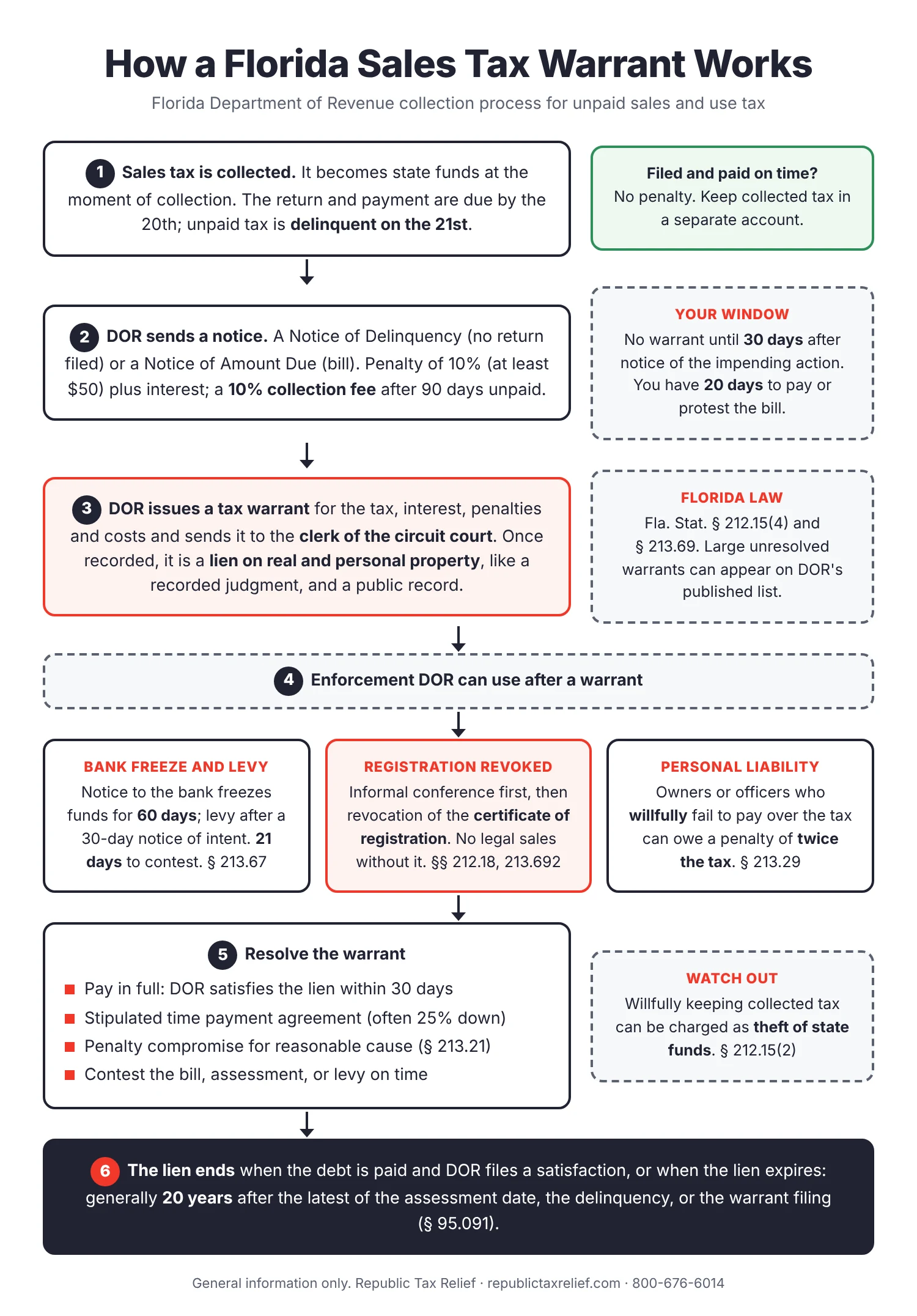
The Florida Tax Collection Process: What Happens Before a Tax Lien
Florida sales tax is due to the Department on the first day of the month after it is collected and becomes delinquent on the 21st day of that month. Returns are due by the 20th. Every registered dealer has to file a return for each period, even when no tax is due (Fla. Stat. § 212.11). Most collection cases start with a missed return or a short payment, or with additional tax found in a sales tax audit. Because of the nature of the tax, which is the customer’s money held for the state, the Department treats unpaid sales differently from an ordinary business debt.
The notices you will receive
- Notice of Delinquency. The Department believes a return was not filed.
- Notice of Amount Due. A bill. The notice indicates a return was filed late, paid short, or that more money is due after review.
- Notice of the impending collection action. In the absence of jeopardy, the Department cannot issue a warrant or take other collection action until 30 days after it notifies you that the action is coming. You get 20 days after that notice to pay or protest (Fla. Stat. § 213.731).
How the balance grows
| Charge | Florida rule | Source |
|---|---|---|
| Late filing or late payment penalty | 10% of the tax not timely filed or paid, at least $50 | Fla. Stat. § 212.12(2)(a) |
| Failure to disclose tax on a return | 10% for each 30 days, up to 50% of the unpaid tax | Fla. Stat. § 212.12(2)(b) |
| Interest | Adjusted rate set twice a year (prime plus 4 percentage points) | Fla. Stat. § 213.235 |
| Collection processing fee | 10% if the debt stays unpaid for 90 days | Florida Department of Revenue collection process |
| Lost collection allowance | The dealer’s allowance can be denied when a return or payment is late | Fla. Stat. § 212.12(1)(b) |
If the tax due still isn’t resolved, the Department can also send the account to a private collection agency, and the unpaid tax keeps growing until it is paid.
Sales tax audits and how far back the Department can go
A sales tax audit can create a tax warrant just as easily as a missed return. In most cases, the Department has 3 years from the date the tax or return was due, or the return was filed, to assess more tax. That limit does not apply if no return was filed, a required payment wasn’t made, or a return was fraudulent (Fla. Stat. § 95.091(3)). After an assessment becomes final, you have 60 days to challenge it in circuit court or through an administrative hearing (Fla. Stat. § 72.011). That deadline is one reason many owners bring in a sales tax audit lawyer or other tax professional before the audit closes, not after.
When a Warrant Is Filed: Lien, Public Record, and Levy
Once a warrant is filed, the Department has several ways to collect, starting from the issuance of the warrant. They can be used one at a time or together.
The lien and the public record
The recorded warrant is a lien on the property of the taxpayer in that county, including real property and business personal property such as equipment, vehicles, and inventory. It shows up in the county’s official records. A lender, landlord, or buyer who searches for liens against property will see it, and it can hold up the sale of the property or a new loan until the tax liabilities are paid.
Florida law also lets the Department publish the names of taxpayers against whom it has filed a warrant, notice of lien, or judgment lien certificate (Fla. Stat. § 213.053(19)). The Department’s published list of delinquent taxpayers is updated monthly and generally includes taxpayers with unsatisfied warrants or liens of $100,000 or more. Taxpayers who are current on a stipulated payment agreement, have a payment agreement, or are in bankruptcy are left off the list.
Florida DOR bank levy and freeze
Section 213.67 is the tool that hurts most businesses first. The Department can send a notice to your bank, or anyone else holding money or property that belongs to you, and that freezes the funds (Fla. Stat. § 213.67). Here is how it works:
- Notice of intent to levy. At least 30 days before a levy, the Department must send you a notice explaining the levy, your appeal rights, and alternatives that could prevent it.
- Freeze. The bank or other holder can’t release the frozen funds for up to 60 days unless the Department consents.
- Levy. During the last 30 days of that 60-day period, the Department can levy, and the bank must send the money to the Department.
- Your deadline to contest. You have 21 days after receiving the notice of intent to levy to contest it in circuit court or through an administrative petition.
- What’s covered. Bank accounts, receivables, and other credits or personal property. Wages are excluded from this section.
- State contracts. If you sell to or build for the state, the Chief Financial Officer can be told to withhold your state payments while a warrant is outstanding.
Sheriff’s levy, garnishment, and jeopardy
The Department can also issue a tax execution to the sheriff, who can seize and sell property the same way a judgment creditor’s execution works, and it can garnish money a third person owes the delinquent dealer. If the Department believes collection is in jeopardy, for example because assets are being moved, it can issue a warrant together with a jeopardy assessment. You then have a right to a fast conference and, if the freeze or seizure isn’t released, a hearing in circuit court (Fla. Stat. § 213.732).
| Collection tool | What it does | Notice or deadline | Florida statute |
|---|---|---|---|
| Tax warrant | Lien on real and personal property in the county | 30 days’ notice of the impending action | §§ 212.15(4), 213.731 |
| Bank freeze and levy | Freezes and then takes account funds and receivables | Notice of intent 30 days before levy; 21 days to contest | § 213.67 |
| Sheriff’s levy and sale | Seizes and sells the taxpayer’s goods | After a warrant is issued | § 213.69 |
| Registration revocation | Stops the business from legally making taxable sales | Informal conference first | §§ 212.18(3)(f), 213.692 |
| Personal liability assessment | Penalty against the responsible person | Notice and hearing rights | § 213.29 |
Certificate of Registration Revoked in Florida
A Florida business that sells taxable goods or services needs a sales tax registration, called a certificate of registration, for each location. You apply through the Department, and the Department can appoint the county tax collector as its agent to accept applications. Without a valid certificate, a business can’t legally keep making taxable sales (Fla. Stat. § 212.18).
Two Florida statutes let the Department take that certificate away:
- Section 212.18(3)(f) allows revocation when a dealer fails to comply with the sales tax law.
- Section 213.692 allows the Department to revoke all certificates of registration, permits, and licenses it issued once it has filed a warrant, notice of lien, or judgment lien certificate (Fla. Stat. § 213.692).
Before revoking, the Department must schedule an informal conference and send written notice. You are required to attend. At the conference you can present evidence or sign a compliance agreement. If you skip the conference, don’t sign an agreement, or break the agreement, the Department issues an administrative complaint to revoke. After revocation, a new certificate is issued only after the liabilities are paid or a written agreement is in place, and the Department will require a cash deposit, bond, or other security.
The informal conference is often the best chance to keep a business open. Treat that notice as urgent.
Personal Liability for Florida Sales Tax Under Florida Tax Law
Forming an LLC or corporation does not always protect the people who run it from unpaid sales tax. Florida law reaches individuals in three ways.
1. The penalty of twice the tax (section 213.29)
Any person required to collect, account for, and pay over sales tax who willfully fails to do it, and any corporate officer or director with administrative control who willfully directs employees not to pay it, can be liable for a penalty equal to twice the total amount of the tax not paid over (Fla. Stat. § 213.29). The Department calls this a personal liability assessment. Three details matter:
- Willfulness is required. Filing a protest based on doubt about the liability is not treated as evasion.
- The penalty is reduced as the tax is paid. The statute says the penalty is abated to the extent the tax is paid.
- It can be compromised. The executive director can compromise the penalty under section 213.21.
2. Theft of state funds (section 212.15)
A person who, with intent to unlawfully deprive the state of its money, fails to remit sales tax collected commits theft of state funds. The grade depends on the amount:
| Unremitted sales tax | Offense under § 212.15(2) |
|---|---|
| Less than $1,000 | Second-degree misdemeanor (higher for repeat convictions) |
| $1,000 to less than $20,000 | Third-degree felony |
| $20,000 to less than $100,000 | Second-degree felony |
| $100,000 or more | First-degree felony |
Criminal cases are reserved for intentional conduct, and most collection cases never get there. Still, the statute is the reason collected sales tax should never be used as working capital.
3. Buying or closing a business (section 213.758)
If you buy more than 50% of a business, its assets, or its stock of goods, you can become liable for the seller’s unpaid Florida tax unless the seller provides a certificate of compliance from the Department (and there are no insiders in common) or the Department audits and clears the seller (Fla. Stat. § 213.758). An owner who quits or sells a business must file a final return and pay all tax within 15 days.
Unpaid federal payroll tax creates a separate personal liability called the Trust Fund Recovery Penalty, which the IRS enforces. Many Florida owners face a federal tax problem and a state tax debt at once. Our guide to payroll tax debt relief covers the IRS side, and our business tax debt relief guide explains federal settlement options for companies.
A Real Court Case: VMOB, LLC v. Department of Revenue
A Tampa case shows how these tools come together. In VMOB, LLC d/b/a Cheap on Howard v. Department of Revenue, No. 2D18-2723 (Fla. 2d DCA Feb. 19, 2020), a Tampa business stopped making its sales tax payments.
- The facts: The Department revoked the business’s certificate of registration, made jeopardy findings, issued notices of final assessment, and assessed a personal liability penalty under section 213.29 against the person found to have administrative control over collecting and remitting the tax. The unpaid tax for July 2015 through October 2016 was $40,530.02, so the penalty was set at double that: $81,060.04.
- What the administrative judge found: She was personally responsible for collecting and remitting the sales tax, willfully failed to pay some of it, and submitted worthless checks for other periods.
- The twist: Before the hearing, the business paid $31,779.06 of the tax. The Department still kept the full $81,060.04 penalty.
- The holding: The Second District Court of Appeal affirmed the revocation and the jeopardy findings and assessments. But it reversed the penalty amount, because section 213.29 says the penalty “shall be abated to the extent that the tax is paid.” By the court’s math, the penalty should drop to $49,280.98.
- What the court rejected: The court also rejected the argument that the penalty could only be double the tax still unpaid at the time of the hearing. Paying late reduces the penalty dollar for dollar, but it does not erase the doubling.
What VMOB means for Florida business owners
- The Department can and does use several tools at once: registration revocation, jeopardy assessments, and a personal penalty.
- Every dollar of sales tax paid reduces a section 213.29 penalty by a dollar, so paying down the tax early matters.
- Bounced checks to the Department are strong evidence of willfulness.
- The amount the Department assesses is not always the amount the law allows. Check the math.
How to Resolve a Tax Warrant With the Florida Department of Revenue
The Department’s own guidance lists three ways to resolve a warrant: pay it in full, enter a stipulated payment agreement, or show that the amount on the warrant isn’t due. In practice, the options look like this:
| Option | When it fits | What to know |
|---|---|---|
| Pay in full | You can cover the balance now or soon | The Department must satisfy the lien of record within 30 days after payment |
| Stipulated time payment agreement (Florida DOR payment plan) | You can’t pay in full but can make a down payment | Expect to provide financial records; the Department’s guidance says to be ready for at least 25% down and the balance within a year |
| Penalty compromise | The delinquency had reasonable cause, not willful neglect | Penalties over 25% of the tax must be compromised when reasonable cause is shown (§ 213.21(3)) |
| Compromise of tax or interest | Real doubt about the liability or about collectibility | Allowed on grounds of doubt as to liability or collectibility; interest can be reduced for Department delay |
| Protest or court challenge | The bill or assessment is wrong | 20 days to protest a collection notice; 60 days after an assessment is final; 21 days to contest a levy notice |
| Voluntary disclosure | You never registered and the Department hasn’t contacted you | Tax and interest can be limited to the prior 3 years (§ 213.21(7)) |
Florida DOR payment plan: what to expect
- Stay current. A payment agreement only works if every new return is filed and paid on time. Missing a current return is the fastest way to default.
- The warrant usually stays until paid. An agreement can keep you off the published delinquent list and stop new enforcement, but the lien is generally satisfied only after the balance is paid.
- Get it in writing. Florida law authorizes agreements for scheduling payments of tax, interest, and penalties (§ 213.21(4)). Keep the signed agreement and the payment schedule.
- Ask for penalty relief at the same time. A reasonable cause request, such as a serious illness, a disaster, or reliance on written Department advice, can shrink the balance you’re financing.
If you’ve run into a hardship that normal channels haven’t fixed, Florida has a Taxpayers’ Rights Advocate who can, in extraordinary cases, issue an order staying a collection action (Fla. Stat. § 213.018).
For a single missed return with a small bill, you can often fix it yourself by filing and paying online or calling a Department service center.
How to Avoid Becoming Delinquent on Florida Sales Tax Again
The Department’s own advice for how to avoid becoming delinquent lines up with what we see in practice:
- Use a separate bank account for collected tax. Deposit sales tax as you collect it and withdraw it only to pay the Department.
- File every period. File a return even when you owe nothing. A missing zero return still triggers a Notice of Delinquency.
- Know the date. Returns are due by the 20th and late on the 21st.
- File and pay electronically and sign up for the Department’s due date reminders.
- Watch storm extensions. When the Governor declares a state of emergency close to the due date, dealers in the covered counties may get an automatic 10-day extension under § 212.11. Check the declaration rather than assuming.
- Read every letter. Address changes and closed accounts that were never updated cause many surprise warrants.
Example Scenarios: Common Florida Sales Tax Warrant Situations
The examples below are illustrative, based on situations Florida business owners commonly face. They are not specific client cases, and names and numbers are hypothetical.
Example 1: “The bank froze our restaurant’s operating account.”
A Miami restaurant fell four months behind on sales tax during a slow summer. The owner set the notices aside, and the Department sent a notice of intent to levy, then a freeze notice to the bank. Because the 21-day window to contest had passed, the practical path was to file every missing return, pay the current month, and negotiate a stipulated payment agreement so the Department would release the freeze. Our tax resolution guide for restaurants covers how sales tax and payroll tax problems tend to stack up together.
Example 2: “We got a letter about revoking our sales tax registration.”
An Orlando retail shop had a warrant recorded with the Orange County clerk and received notice of an informal conference to revoke its certificate of registration. The owner attended with records, signed a compliance agreement with a payment schedule, and kept the store open. Skipping that conference would have led to an administrative complaint.
Example 3: “DOR says I’m personally liable for double the tax.”
A Jacksonville contractor’s LLC stopped remitting sales tax on materials it sold to customers after a large client paid late. The Department issued a personal liability assessment for twice the unpaid tax. Paying down the underlying tax reduced the penalty dollar for dollar, as in VMOB, and a reasonable cause request addressed the separate late penalties.
Example 4: “We bought a business and inherited its tax warrant.”
A buyer purchased a Fort Lauderdale convenience store’s inventory and equipment without getting a certificate of compliance from the seller. Months later, the Department sought the seller’s unpaid sales tax from the buyer under section 213.758. The fix was a payment arrangement and a claim against the seller, but the lesson is simpler: get the certificate before closing.
Next Steps: When to Bring in a Tax Attorney or Tax Professional
- Find every warrant. Check the official records in each county where the business has property.
- Get the account history. Confirm which periods are unfiled, which are billed, and how much is tax versus penalty and interest.
- Watch the deadlines. 20 days to protest a collection notice, 21 days to contest a levy notice, 60 days after an assessment is final, and the date of any informal conference.
- File and pay current returns. Nothing else holds without this.
- Choose the resolution. Payment in full, a stipulated time payment agreement, a penalty compromise, or a challenge to the amount.
Complex tax issues like a personal liability assessment or a jeopardy finding are tax controversy work, and that is where a tax lawyer or an experienced Florida sales tax attorney is worth having on your side. If a Florida tax warrant, bank freeze, or personal liability assessment is threatening your business, our team of enrolled agents, CPAs, and tax attorneys can review the Department’s notices, deal with the Department for you with your written authorization, and coordinate any IRS payroll issues at the same time. Learn more about our Florida tax relief services or request a free consultation. You can also read what clients say about our 5.0-star rated Laguna Hills office and our 4.6-star rated Corona, CA office on Google.
Our offices are in California, and we represent Florida businesses remotely.
Florida Tax Guides From Republic Tax Relief
| Page | What it covers | Read it if |
|---|---|---|
| Florida IRS Tax Relief (main Florida page) | Florida hub: IRS tax relief services, IRS deadlines and penalties, wage levies, and Florida Department of Revenue help | You want help with IRS or Florida tax debt, or want to talk to our team |
| IRS Tax Lien on a Florida Homestead | Federal tax liens on a Florida home, tenancy by the entirety, and selling or refinancing with an IRS lien | The IRS filed a lien and you own a home in Florida |
| Florida Sales Tax Warrant (you are here) |
Florida Department of Revenue tax warrants, bank levies, registration revocation, and personal liability for unpaid sales tax | Your business owes Florida sales tax or received a tax warrant |
Frequently Asked Questions
How long does a Florida tax warrant stay on record?
Until it is paid or the lien expires. When the warrant is paid, the Department must satisfy the lien of record within 30 days. If it isn’t paid, a state lien for sales tax generally expires 20 years after the latest of the last date the tax could be assessed, the date it became delinquent, or the date the tax warrant was filed.
Can the Florida Department of Revenue freeze my bank account without going to court?
Yes. Under section 213.67, the Department can send a notice to your bank that freezes your funds for up to 60 days and then levy them. It must send you a notice of intent to levy at least 30 days before the levy, and you have 21 days after receiving it to contest it in circuit court or through an administrative petition.
Can I be personally liable for my company’s unpaid Florida sales tax?
Yes, if you were responsible for collecting and paying over the tax and willfully failed to do it, or you were an officer or director who willfully directed employees not to pay it. The penalty under section 213.29 is twice the unpaid tax, and it is reduced as the tax is paid.
Does a payment plan remove a Florida tax warrant?
Usually not right away. A stipulated time payment agreement can keep you off the Department’s published delinquent taxpayer list and stop further enforcement while you stay current, but the warrant is generally satisfied only after the balance is paid.
Can Florida sales tax penalties be waived?
They can be compromised. The Department may settle penalties when the delinquency was due to reasonable cause and not willful negligence, willful neglect, or fraud. Penalties above 25% of the tax must be compromised if reasonable cause is shown. Interest is reduced only in limited cases, such as Department delay.
Is a Florida sales tax warrant the same as an IRS tax lien?
No. A Florida tax warrant comes from the Florida Department of Revenue for state taxes like sales and use tax, and it acts like a recorded judgment. An IRS tax lien comes from federal law for federal taxes such as income or payroll tax. A business can have both at once, and each has to be resolved with its own agency.
This article is general information, not legal or tax advice for your specific situation.