
Florida homestead protection is famous for a reason. There is no dollar cap on the value of the home, a judgment lien from a private creditor can’t attach to it, and a credit card company or a medical provider generally can’t force the sale of your Florida home. So when Florida homeowners fall behind on federal taxes, many assume the house is off-limits to the IRS too.
It isn’t. A federal tax lien attaches to your Florida homestead the same way it attaches to everything else you own, and the Florida homestead exemption does not stop it. That lien shows up in the county records, sits on the title, and has to be dealt with before you can sell or refinance. What Florida law does change is the question of how the house is owned, especially for married couples who hold their home as tenants by the entirety. This guide explains where Florida homestead law ends and federal law takes over, and what Florida homeowners can do about an IRS lien.
In this guide:
- Does Florida homestead protect you from the IRS? The short answer
- Flowchart: how an IRS lien reaches a Florida homestead
- Florida homestead law vs. a federal tax lien
- Florida’s two homestead exemptions and property tax
- When the federal tax lien arises and attaches
- Tenancy by the entirety and the IRS lien
- A real court case: United States v. Craft
- Can the IRS force a sale of a Florida homestead?
- Selling or refinancing a Florida home with an IRS lien
- How long the lien lasts: the collection statute expiration date
- Example scenarios: common Florida situations
- What Florida homeowners can do now
- FAQs
Does Florida Homestead Protect You From the IRS? The Short Answer
No, not from an IRS lien. Florida’s homestead exemption protects your home from forced sale by most creditors, but the federal tax lien is created by federal law, and federal law controls. Here is how the two fit together:
- The IRS lien attaches to your homestead. Once the IRS assesses federal taxes, bills you, and the bill goes unpaid, a lien arises by operation of law on all of your property, including your Florida home.
- The IRS is not required to go to court to create the lien. No lawsuit or judgment is needed. The lien exists whether or not a notice is ever filed.
- A forced sale is possible but rare. To take a principal residence, the IRS needs written approval from a federal court judge or magistrate, or the Justice Department must bring a lien foreclosure suit.
- How you hold title matters. If only one spouse owes and the home is held as tenants by the entirety, the lien still attaches to that spouse’s interest in the property, which the IRS generally values at one-half.
- Property tax comes first. Your county’s property tax lien can have priority over the federal tax lien.
For how liens are released, withdrawn, or discharged nationwide, see our federal tax lien help guide. This article focuses on what is different in Florida.
Flowchart: How an IRS Lien Reaches a Florida Homestead
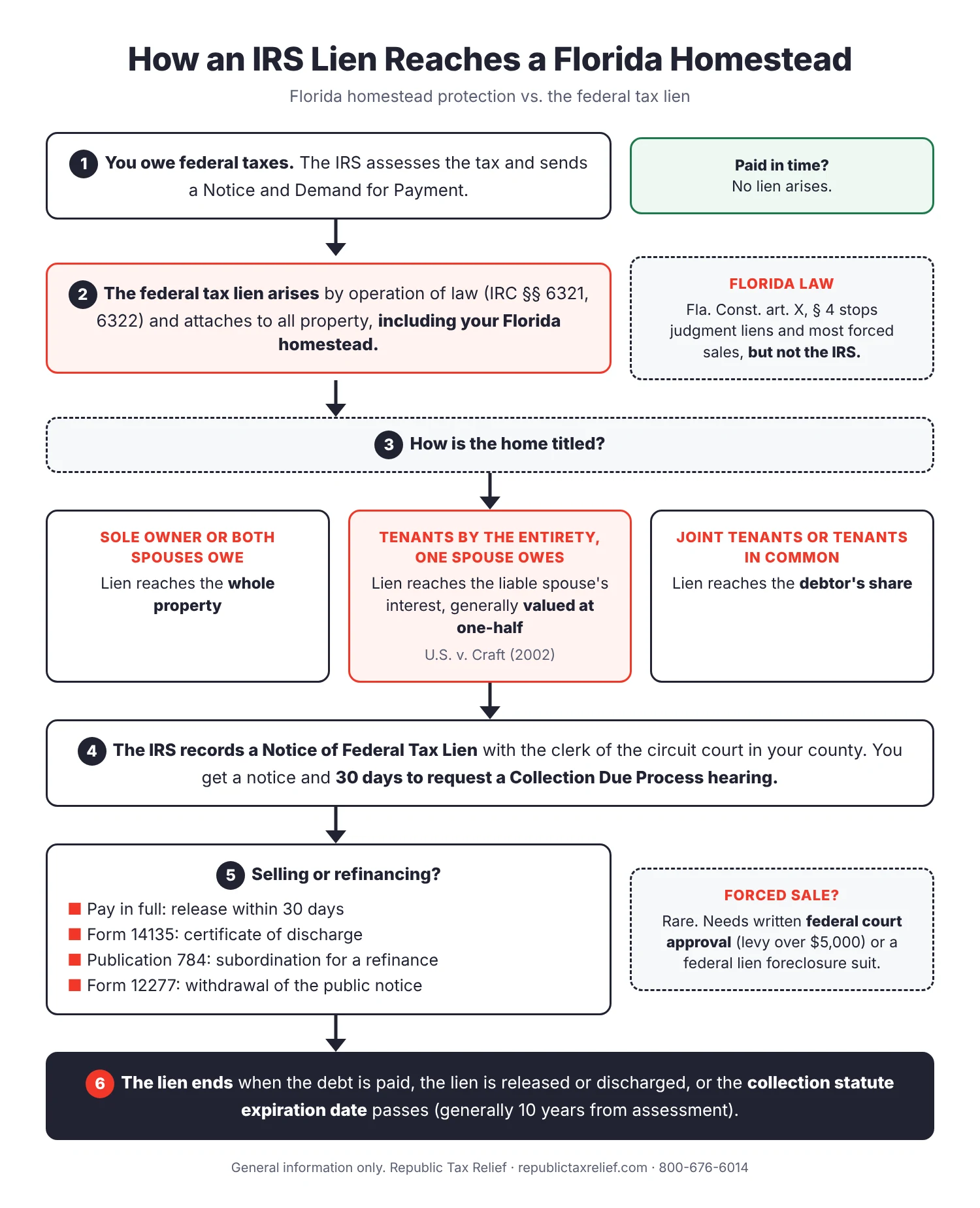
Florida Homestead Law vs. a Federal Tax Lien
Article X, Section 4 of the Florida Constitution says a qualifying homestead “shall be exempt from forced sale under process of any court, and no judgment, decree or execution shall be a lien thereon,” with a short list of exceptions (Fla. Const. art. X, § 4). Those exceptions are:
- Taxes and assessments on the property itself, such as county property tax.
- Obligations for the purchase, improvement, or repair of the home, such as the mortgage.
- Obligations for labor performed on the property.
The protection covers up to one-half acre inside a city or town and up to 160 acres outside one. It has no dollar limit, which is why Florida homestead law is one of the strongest in the country against a judgment lien or other creditor claim.
Federal taxes are not on that list, but they don’t need to be. Section 4 of the Florida Constitution limits state courts and state-law creditors. Federal law creates the federal tax lien. The Internal Revenue Code provides, in section 6321, that unpaid tax “shall be a lien in favor of the United States upon all property and rights to property, whether real or personal,” belonging to the taxpayer (26 U.S.C. § 6321). Under the Supremacy Clause, federal law wins when the two conflict. State law may protect a home from other creditors, but the IRS’s own manual says state laws exempting a debtor’s property from creditors do not affect the reach of the federal tax lien (IRM 5.17.2).
The Supreme Court confirmed this for homesteads in United States v. Rodgers, 461 U.S. 677 (1983), a Texas case holding that a federal court can order the sale of a homestead to satisfy a federal tax lien, as long as anyone else with an interest in the property is paid for it. We cover Rodgers in detail in our guide on whether the IRS can take your house in Texas. The same rule applies in Florida.
Judgment lien vs. IRS lien on Florida homestead property
| Question | Private creditor’s judgment lien | Federal tax lien (IRS lien) |
|---|---|---|
| Can it attach to Florida homestead property? | No. The Florida Constitution says no judgment shall be a lien on the homestead. | Yes. It is a lien on all real and personal property, including the homestead. |
| Does it need a lawsuit first? | Yes. The creditor must sue and win a judgment. | No. It arises from the assessment, a bill, and nonpayment. |
| Can it force a sale of the home? | No, unless the debt fits one of the listed exceptions | Only with federal court approval or a federal lien foreclosure suit |
| Does it reach a home held by the entirety when one spouse owes? | Generally no | Yes, as to the liable spouse’s interest (United States v. Craft) |
| Does it block a sale or refinance? | Usually not on the homestead | Yes, once a notice of lien is recorded in the county |
Florida’s other creditor shields work the same way. The state’s head-of-family wage exemption (Fla. Stat. § 222.11) protects paychecks from many private garnishments, but not from an IRS wage levy. Our Florida tax relief page covers wage levies and other Florida collection questions.
Florida’s Two Homestead Exemptions and Your Property Tax Bill
Part of the confusion comes from the fact that Florida has two different “homestead exemptions,” and Florida homeowners often hear about only one:
- The property tax homestead exemption (Article VII, Section 6 of the Florida Constitution). You apply for it with your county property appraiser, and it lowers the taxable value of your home for property tax.
- Homestead protection from creditors (Article X, Section 4). It applies automatically to a qualifying home and limits forced sales and judgment liens.
Neither one protects your home from a federal tax lien. Having the property tax exemption on your bill does not mean the IRS can’t lien the house, and qualifying for creditor protection does not stop the IRS either.
There is one place where property tax matters a great deal: priority. Federal law gives a local real property tax or special assessment lien priority over the federal tax lien when state law ranks that tax lien ahead of earlier security interests (26 U.S.C. § 6323(b)(6)). In plain terms, unpaid county property tax on your home generally gets paid before the IRS.
| Florida protection | Where it comes from | What it does | Effect on an IRS lien |
|---|---|---|---|
| Property tax homestead exemption | Fla. Const. art. VII, § 6 | Reduces the taxable value of your home | None |
| Homestead protection from forced sale | Fla. Const. art. X, § 4 | Blocks most creditor liens and forced sales | None. Federal law overrides it. |
| Tenancy by the entirety | Florida property law; Fla. Const. art. X, § 4(c) | Protects a married couple’s home from one spouse’s creditors | Limited. The lien reaches the liable spouse’s interest. |
| Head-of-family wage exemption | Fla. Stat. § 222.11 | Protects wages from many garnishments | None for an IRS wage levy |
When the Federal Tax Lien Arises and Attaches to Your Florida Homestead
The federal tax lien arises at the time the tax is assessed, and it covers the full balance of your tax liabilities for that period, including interest and penalties. The federal tax lien continues until the underlying tax liability is paid or “becomes unenforceable by reason of lapse of time” (26 U.S.C. § 6322). The Internal Revenue Service explains it in three steps: the IRS must assess the tax, send you a Notice and Demand for Payment, and you neglect or refuse to pay (IRS: Understanding a federal tax lien).
The federal tax lien only attaches to property and rights that belong to the taxpayer, but that reaches almost everything: real estate, personal property, and anything acquired while the lien exists. That includes the homestead, a rental condo, a boat, bank accounts, and business assets. The lien attaches to property in Florida no matter how long you have owned it.
The notice of federal tax lien in Florida county records
The lien exists from the start, but the lien is not valid against a buyer, a lender, or a judgment lien creditor until the IRS files a public notice (26 U.S.C. § 6323(a)). Federal law lets each state choose the filing office for real property, and Florida’s Uniform Federal Lien Registration Act sends notices of federal liens on real property to the clerk of the circuit court of the county where the real property is located (Fla. Stat. § 713.901).
Once a federal tax lien is filed, it shows up in the official records of your county, from Miami-Dade to Duval, along with the date the lien was filed and the tax periods it covers. That is why title companies find it right away. After the IRS files the notice, it must send you a notice of your right to a hearing within 5 business days, and you then have 30 days to ask for a Collection Due Process hearing with the IRS Independent Office of Appeals (26 U.S.C. § 6320). If Appeals rules against you, you can generally take the case to the U.S. Tax Court.
| Stage | What happens | What it means for your Florida home |
|---|---|---|
| Tax is assessed and billed | The IRS records the tax and sends a Notice and Demand for Payment | The lien arises if you don’t pay the tax |
| Federal tax lien exists | A silent lien on all property and rights to property | The lien attaches to the homestead even before anything is filed |
| Notice of lien is filed | The IRS records it with the county clerk of the circuit court | Public record; blocks a clean sale or refinance; may affect credit decisions |
| Lien hearing window | 30 days to request a Collection Due Process hearing | Your chance to propose an alternative or challenge the filing |
| Lien release | The IRS must release within 30 days after the debt is paid or becomes unenforceable | Record the certificate of release so the title is clear |
Tenancy by the Entirety: Can an IRS Lien Reach a Florida Home Owned With Your Spouse?
Many Florida married couples own their home as tenants by the entirety. The Florida Constitution even mentions it, allowing a married homestead owner to transfer title “to an estate by the entirety with the spouse.” Under this form of ownership, the couple owns the property together as a single unit, and a private creditor of only one spouse generally can’t reach it.
That protection is a big part of Florida asset planning, and it is why so many people are surprised when an IRS lien shows up for one spouse’s tax debt. When only one spouse owes, for example from a premarital tax debt, a separate return, or business payroll taxes assessed against one spouse, the federal tax lien still attaches to that spouse’s interest in the property. The IRS manual puts it this way: the federal tax lien may attach to the tenancy by the entirety when only one spouse has a federal tax liability (IRM 5.17.2).
A Real Court Case: United States v. Craft
The case that settled this is United States v. Craft, 535 U.S. 274 (2002). It came from Michigan, but Michigan’s tenancy by the entirety rules are much like Florida’s, so it applies directly to Florida homeowners.
- The facts: The IRS assessed about $482,446 in income tax against Don Craft for not filing returns for 1979 through 1986. He and his wife owned their Grand Rapids home as tenants by the entirety. After the IRS filed notice of its lien, the couple signed a quitclaim deed transferring his interest to her for one dollar.
- The sale: When the wife later sold the home, the IRS agreed to release its lien to let the sale close, on the condition that half of the net proceeds be held in escrow until the courts decided who was entitled to them.
- The holding: In a 6-3 decision, the Supreme Court held that the husband’s interest in the entireties property was “property” or “rights to property” under section 6321, so the federal tax lien attached to it.
The Court used the familiar “bundle of sticks” idea of property. State law decides which rights a spouse holds, such as the right to live in the home, to share in its income, and to keep it if the other spouse dies. Federal law decides whether those rights are property that a federal tax lien can reach. The Court said they were.
What Craft means for Florida homeowners
The IRS explained how it applies Craft in Notice 2003-60. The key points for a Florida couple when only one spouse owes:
- Half the value: As a general rule, the IRS treats the liable spouse’s interest in entireties property as one-half of the value of the property, including when it decides how much to accept for a certificate of discharge of property.
- If the liable spouse dies first: The surviving spouse who did not owe the tax takes the property free of the federal tax lien.
- If the non-liable spouse dies first: The home stops being entireties property, and the lien can reach the whole property the taxpayer now owns.
- Administrative sale is disfavored: The IRS says an administrative sale is not a preferable way to collect from entireties property. A court can still order a sale in a lien foreclosure suit.
| How the Florida home is owned | Who owes the IRS | What the lien reaches |
|---|---|---|
| One spouse or a single owner | The owner | The owner’s full interest in the property |
| Tenants by the entirety | Both spouses (joint return) | The whole property |
| Tenants by the entirety | One spouse only | The liable spouse’s interest, generally valued at one-half |
| Joint tenants or tenants in common | One co-owner | That co-owner’s share of the property |
If the debt came from a joint return but was caused by the other spouse’s income or errors, innocent spouse relief may be worth reviewing. It can change who is liable, and therefore whether the lien reaches the whole home or just one spouse’s interest.
Can the IRS Take My House in Florida? Forced Sale Rules
A lien is a claim, not a seizure. For the IRS to actually force a sale of a Florida homestead, it has two federal routes, and both involve a federal court:
- Levy and seizure: The IRS cannot levy a residence if the levy is $5,000 or less, and the IRS may levy a principal residence only if a federal district court judge or magistrate approves in writing (26 U.S.C. § 6334(a)(13) and (e)).
- Lien foreclosure suit: The Justice Department can sue in federal court to foreclose the federal tax lien and have the property sold, as in Rodgers. The IRS requires Area Director approval before recommending a foreclosure against a principal residence (IRM 5.17.4).
Both are uncommon and are usually reserved for larger balances where the taxpayer has stopped responding. The full seizure process, including the court approval steps and the redemption period, is the same in every state and is covered in our IRS house seizure guide. For most Florida homeowners, the lien is the real problem, because it ties up the equity and blocks a sale or refinance.
Selling or Refinancing a Florida Home With an IRS Lien
If the IRS filed a notice of federal tax lien in your county, the title company will not close until the lien on the property is paid, discharged, or subordinated. Federal law gives you several tools under section 6325 of the Internal Revenue Code (26 U.S.C. § 6325). In Florida, the main questions are how much equity there is, and whether both spouses or only one owes.
| Florida situation | Usual tool | Form or guide |
|---|---|---|
| Sale proceeds will pay the full balance | Payoff at closing, then release of a federal tax lien within 30 days | IRS payoff letter; record the certificate of release with the county clerk |
| Sale proceeds won’t cover the whole debt | Certificate of discharge of property, with the IRS’s share paid from the sale | IRS Form 14135 and Publication 783 |
| Home held by the entirety, only one spouse owes | Discharge, generally based on one-half of the equity | Form 14135, citing Notice 2003-60 |
| The IRS’s interest has no value (no equity after the mortgage) | Discharge with no payment | Form 14135 under section 6325(b)(2)(B) |
| Refinance the property to lower payments or pay the IRS | Certificate of subordination, so the new lender goes ahead of the IRS | Publication 784 |
| You’re paying under a qualifying payment plan | Withdrawal of notice of federal tax lien from the public record | Form 12277 |
A discharge removes the lien from one specific property. The IRS asks for the application at least 45 days before the closing date, so if you plan to sell the property, start early, and make sure the title company and the IRS are using the same payoff figures. A discharge of the lien from the home does not erase the debt. Any balance left over stays with you, and the federal tax lien continues on your other property.
How Long a Federal Tax Lien Lasts: The Collection Statute Expiration Date
The IRS generally has 10 years from the date the tax is assessed to collect it (26 U.S.C. § 6502). That deadline is called the collection statute expiration date, or CSED. When it passes, the lien becomes unenforceable, and the IRS must release it within 30 days.
A few points Florida homeowners often miss:
- Each tax year has its own CSED. A lien for an older year can expire while a newer one is still active.
- The clock can pause. Events such as a pending offer in compromise, a pending installment agreement request, a Collection Due Process hearing, or a bankruptcy can extend the CSED.
- The notice must be refiled to stay effective. If the IRS does not refile within the period set by law, the notice is treated as released, but it can still appear in county records until a certificate of release is recorded.
- Don’t count on running out the clock. If the IRS sues before the deadline, a court judgment can extend collection well beyond 10 years.
Example Scenarios: Common Florida IRS Lien Situations
The examples below are illustrative, based on situations Florida homeowners commonly face. They are not specific client cases, and names and numbers are hypothetical.
Example 1: “My husband’s old payroll taxes are holding up our condo sale in Naples.”
A retired couple owns a Naples condo as tenants by the entirety. Years ago, the husband ran a small business and was assessed the trust fund recovery penalty for unpaid payroll taxes. The wife never owed anything. At closing, the title search found a notice of federal tax lien in the Collier County records. The usual path is a certificate of discharge with Form 14135, valuing the IRS’s interest at the husband’s one-half of the net equity, so the sale can close and the wife keeps her half.
Example 2: “We want to refinance our Tampa home to pay the IRS.”
A Tampa couple owes about $60,000 from joint returns after a business slowdown. They have plenty of equity, but their lender won’t refinance behind the IRS lien. A certificate of subordination lets the new loan go ahead of the federal tax lien, and the cash-out from the refinance goes toward the tax debt. They also set up a payment plan for the balance, which opened the door to asking for a withdrawal of the notice later.
Example 3: “I thought Florida homestead protected me from everyone.”
An Orlando contractor had a judgment from a supplier that never touched his house, so he assumed the IRS couldn’t either. After three years of unfiled returns, the IRS assessed the tax and filed a notice of lien with the Orange County clerk. The supplier’s judgment lien couldn’t attach to the homestead under Florida law, but the IRS lien did. Filing the missing returns, requesting a Collection Due Process hearing within the 30-day window, and proposing an installment agreement kept the case from moving toward enforcement.
Example 4: “The lien is from 2013. Is it still valid?”
A Jacksonville homeowner found an old IRS lien on her title while applying for a home equity loan. The tax was assessed more than 10 years earlier, and nothing had extended the collection statute expiration date. Once the dates were confirmed, the next step was asking the IRS for a certificate of release and recording it with the Duval County clerk so the title would show the lien was no longer in force.
What Florida Homeowners Can Do About an IRS Lien Now
- Check the county records. Search your county clerk’s official records for a notice of federal tax lien, and note the tax years and filing dates.
- Pull your IRS account transcripts. Confirm the balance, assessment dates, and collection statute expiration date for each year.
- Use the 30-day hearing window. If you just received a lien filing notice, a Collection Due Process request is your strongest chance to propose an alternative.
- Get a resolution in place. An installment agreement, currently not collectible status, or an offer in compromise addresses the debt behind the lien.
- Plan the title fix before you list or refinance. Decide early whether you need a payoff, discharge, subordination, or withdrawal.
If you owe a smaller amount and can pay over time, you can often set up a payment plan yourself through the IRS online payment agreement.
If an IRS lien is holding up a sale, a refinance, or a spouse’s share of your Florida home, our team of enrolled agents, CPAs, and tax attorneys can review your county records and IRS transcripts and work with the IRS for you. Learn more about our IRS tax relief services in Florida or request a free consultation. You can also read what clients say about our 5.0-star rated Laguna Hills office and our 4.6-star rated Corona, CA office on Google.
Florida Tax Guides From Republic Tax Relief
| Page | What it covers | Read it if |
|---|---|---|
| Florida IRS Tax Relief (main Florida page) | Florida hub: IRS tax relief services, IRS deadlines and penalties, wage levies, and Florida Department of Revenue help | You want help with IRS or Florida tax debt, or want to talk to our team |
| IRS Tax Lien on a Florida Homestead (you are here) |
Federal tax liens on a Florida home, tenancy by the entirety, and selling or refinancing with an IRS lien | The IRS filed a lien and you own a home in Florida |
| Florida Sales Tax Warrant | Florida Department of Revenue tax warrants, bank levies, registration revocation, and personal liability for unpaid sales tax | Your business owes Florida sales tax or received a tax warrant |
Our offices are in California, and we represent Florida clients remotely.
Frequently Asked Questions
Does a federal tax lien attach to my Florida homestead if the IRS never files a notice?
Yes. The federal tax lien arises by operation of law once the IRS assesses the tax, bills you, and the bill goes unpaid. It attaches to your homestead right away. Until the IRS records a notice of federal tax lien with your county clerk, though, the lien is not valid against a buyer, a lender, or a judgment lien creditor.
Can the IRS put a lien on a Florida home owned as tenants by the entirety when only one spouse owes?
Yes. Under United States v. Craft, the federal tax lien attaches to the liable spouse’s interest in entireties property. The IRS generally values that interest at one-half of the property. If the liable spouse dies first, the surviving spouse takes the home free of the lien.
Why can’t a judgment lien attach to my Florida homestead when an IRS lien can?
The Florida Constitution says no judgment shall be a lien on a homestead, and that rule binds private creditors. A federal tax lien is created by the Internal Revenue Code, and federal law overrides state homestead law under the Supremacy Clause.
Do Florida property taxes get paid before an IRS lien?
Usually, yes. Federal law gives a local real property tax or special assessment lien priority over the federal tax lien when state law ranks it ahead of earlier security interests. Unpaid county property tax on your home is generally paid first at a sale.
When do Florida homeowners need IRS Form 14135?
Form 14135 is the application for a certificate of discharge. It removes the federal tax lien from one property, usually so a sale can close when the proceeds won’t pay the whole debt. The IRS asks for it at least 45 days before closing.
How long does an IRS lien stay on a Florida home?
Until the debt is paid or the collection statute expiration date passes, generally 10 years from the date the tax was assessed. Some events can extend that date. Once the lien is released, record the certificate of release with your county clerk so your title is clear.
This article is general information, not legal advice for your specific situation.