
Texas has some of the strongest homestead protections in the country. A credit card company, a medical provider, or a lender holding a personal judgment generally cannot force the sale of your Texas home. That is why so many Texans who owe back taxes assume the IRS can’t touch their house either.
That assumption is where people get hurt. The IRS collects under federal law, and the Texas homestead exemption does not block a federal tax lien. The good news is that federal law adds its own protections for a primary residence, and actual home seizures are uncommon. Here is how the two sets of rules really fit together, and what you can do before a lien or levy notice turns into a real threat to your home.
In this guide:
- The short answer for Texas homeowners
- Does the Texas homestead exemption protect against the IRS?
- How a federal tax lien attaches to a Texas homestead
- Flowchart: how IRS debt can reach a Texas home
- Can the IRS seize your primary residence?
- A real Texas court case: United States v. Rodgers
- Selling or refinancing a Texas home with an IRS lien
- Texas community property and a spouse’s tax debt
- Example scenarios: common Texas situations
- How to stop the IRS from seizing your house
- FAQs
Can the IRS Take Your House in Texas? The Short Answer
Yes, the IRS can take your house in Texas, but it is rare, and it is never the first step. Before the IRS can seize a primary residence, federal law requires it to:
- Assess the tax and send you a bill (Notice and Demand for Payment).
- Send a Final Notice of Intent to Levy and notice of your right to a hearing, at least 30 days before any levy.
- Owe more than $5,000 on the levy. The Internal Revenue Code exempts a residence from levy when the amount is $5,000 or less.
- Get written approval from a federal district court judge or magistrate before seizing a principal residence.
What the Texas homestead exemption does not do is stop the IRS from filing a federal tax lien against your home. In practice, the lien is what most Texas homeowners with IRS debt actually run into. It sits on the property, shows up in public records, and gets paid when you sell or refinance.
For the full step-by-step federal process, from the first balance-due notice to the final notice of intent to levy, see our guide to how the IRS collection process works.
Flowchart: How an IRS Debt Can Reach a Texas Home
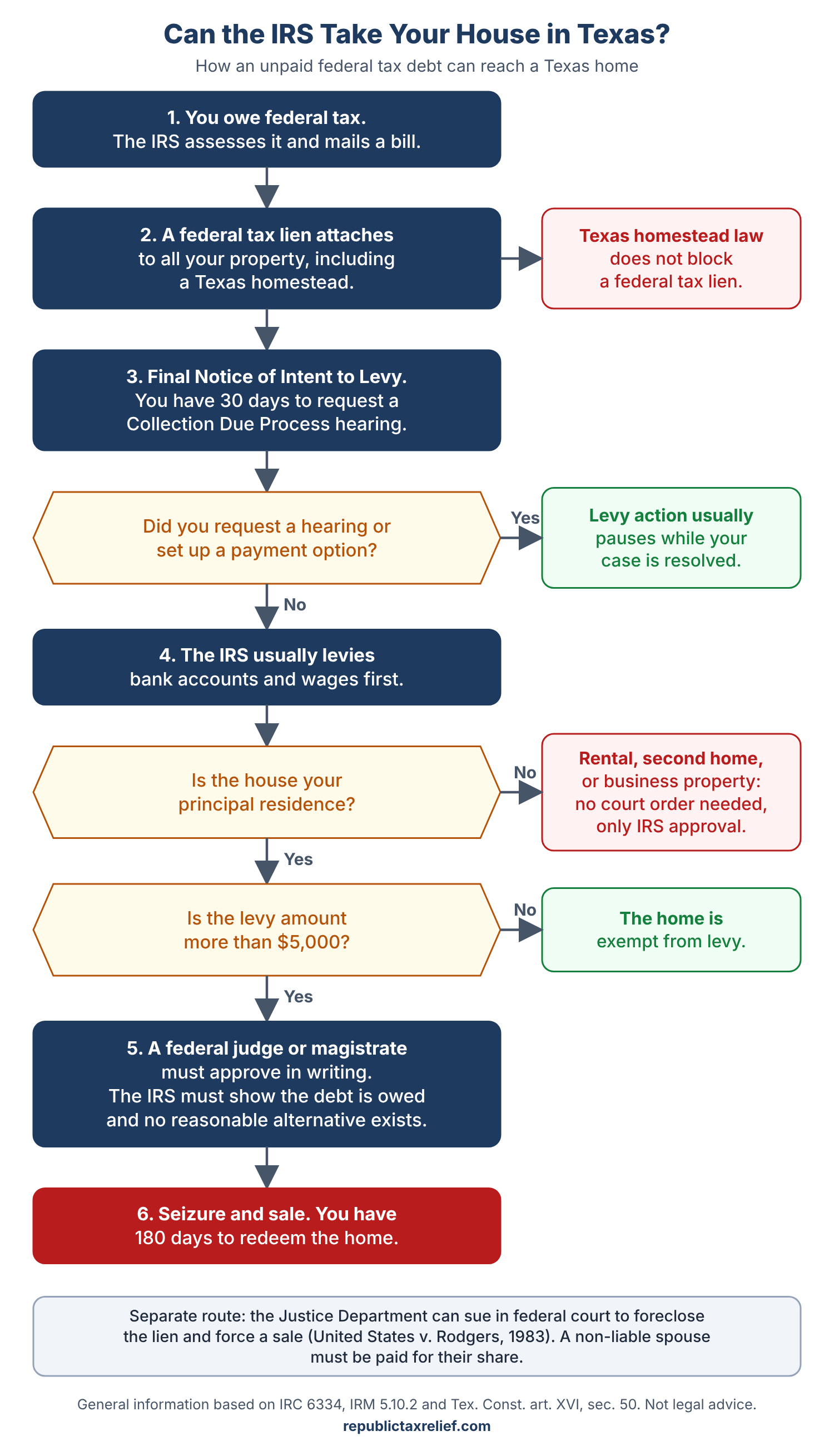
Does the Texas Homestead Exemption Protect Against the IRS?
Not against the IRS. The Texas Constitution protects a homestead “from forced sale, for the payment of all debts” except a short list of exceptions, such as purchase-money loans, property taxes owed on the home, home improvement liens, and home equity loans that meet strict rules (Tex. Const. art. XVI, § 50).
That list controls private creditors and state-law collection. It does not control the federal government. The Internal Revenue Manual is direct about it: no state law can exempt property from levy for the collection of a federal tax (IRM 5.17.3). Under the Constitution’s Supremacy Clause, federal tax collection law wins when the two conflict, and the U.S. Supreme Court confirmed in United States v. Rodgers (1983) that a federal court can order the sale of a Texas homestead to satisfy a federal tax lien.
Texas law itself recognizes this. Section 50(a)(4) of the homestead provision lets you refinance “a lien against a homestead, including a federal tax lien.” In other words, the Texas Constitution assumes a federal tax lien can sit on a homestead, and gives you a way to pay it off with a new loan.
Texas homestead law vs. the IRS at a glance
| Collection action | Private creditor (Texas law) | IRS (federal law) |
|---|---|---|
| Lien on your homestead | Generally cannot reach a homestead | Yes. A federal tax lien attaches to your homestead. |
| Forced sale of your homestead | Blocked, except for listed debts such as the mortgage and property taxes on the home | Possible, but only with federal court approval or a federal lien foreclosure suit |
| Wage garnishment | Not allowed for most debts (exceptions include child support) | Allowed. Texas wage limits do not apply to an IRS wage levy. |
| What protects a primary home | The Texas homestead exemption | Federal rules: no levy for $5,000 or less, and written court approval to seize |
What Texas protections still matter
Texas homestead law is not useless when you owe the IRS. It still:
- Keeps most private creditors from forcing a sale, so the IRS is usually the only creditor in a position to threaten the house.
- Shapes who owns what interest in the home, which matters when a spouse who does not owe the tax also has a homestead right (more on that below).
- Allows a regulated refinance or home equity loan to pay off a federal tax lien under § 50(a)(4) and (a)(6).
How a Federal Tax Lien Attaches to a Texas Homestead
A federal tax lien is the government’s legal claim against your property when you neglect or fail to pay a tax debt. It arises automatically once the IRS assesses the tax, sends a bill, and the balance goes unpaid (IRS: Understanding a Federal Tax Lien).
The lien attaches to everything you own and anything you acquire while it is in place, including real estate, your homestead, vehicles, and business assets. To put other creditors on notice, the IRS files a Notice of Federal Tax Lien. In Texas, a lien against real property is generally filed in the real property records of the county where the home sits, which is why title companies find it as soon as you try to sell or borrow.
Many homeowners mix up a lien, a levy, and a seizure. They are three different steps:
| IRS action | What it means | What it does to your home | Notice you get first |
|---|---|---|---|
| Federal tax lien | The government’s legal claim against your property | You keep the home, but the lien must be paid or cleared when you sell or refinance | Notice and Demand for Payment; after a Notice of Federal Tax Lien is filed, a notice of your right to a hearing |
| Levy | The legal taking of property to pay the debt | Usually hits bank accounts and wages first, not the house | Final Notice of Intent to Levy, at least 30 days before |
| Seizure and sale of a primary home | A levy on the home itself, followed by a sale | The IRS takes and sells the home; you have 180 days to redeem it | Levy notices plus a federal court order to show cause |
A lien on your homestead does not mean the IRS is about to take it. After the IRS files a Notice of Federal Tax Lien, it must notify you, and you generally have a limited window to request a Collection Due Process hearing with the IRS Office of Appeals.
Our tax lien help page covers release, withdrawal, and discharge in more detail.
Can the IRS Seize Your Primary Residence?
It can, but federal law makes the IRS jump through more hoops for a principal residence than for almost any other asset. The IRS’s own procedures say it “must secure judicial approval prior to seizing a principal residence” (IRM 5.10.2). The rule also covers a home used as the principal residence of your spouse, former spouse, or minor child.
To get that approval, the IRS works through the Department of Justice and must show a federal judge or magistrate that:
- The tax liability is owed.
- The required notices were properly given.
- There is no reasonable alternative for collecting the debt, such as other assets or a payment arrangement.
You are served with an order to show cause and get a chance to respond. Before a case ever reaches that point, a revenue officer must document the equity in the home, compare a seizure against other collection options, and get internal approvals.
Because of all that, the IRS generally treats seizure of a primary home as a last resort. In practice, the IRS is far more likely to levy bank accounts and wages first. That is also why the Texas homestead exemption creates a false sense of safety. Texas wage protections do not stop an IRS wage levy either, so a Texan who ignores the notices often loses paychecks and bank balances long before the house is in play.
What if the house is a rental, vacation home, or business property?
The court-approval rule protects a principal residence. A rental house, a lake home, raw land, or a building used in your business does not get that same protection. Texas homestead status follows where you actually live, so owning a second property in Texas does not extend the homestead shield to it for IRS purposes. If you own more than one property and owe the IRS, the non-homestead property is the more likely target.
If the IRS does sell the home
After an IRS sale of real estate, federal law gives the owner 180 days to redeem the property by paying the buyer the purchase price plus interest (Taxpayer Advocate Service: Levy/Seizure of Assets). It is a real right, but an expensive one. The time to act is before a sale.
A Real Texas Court Case: United States v. Rodgers
Levy and seizure is not the only way the government can reach a home. The Department of Justice can also file a suit in federal district court to foreclose the federal tax lien and ask the court to order the property sold (IRM 5.17.4). The leading case on how that works against a Texas homestead came from Texas.
In United States v. Rodgers, 461 U.S. 677 (1983), the U.S. Supreme Court decided two Texas cases together. In each, the government sought to sell a Texas home to collect a federal tax debt, and a family member who did not personally owe the tax claimed a Texas homestead right to keep living there. The Court held that:
- A federal court can order the sale of the entire homestead property to satisfy a federal tax lien, not just the share owned by the person who owes the tax.
- The person who does not owe the tax must be paid for the value of their interest, including the homestead right, out of the sale proceeds.
- The court has limited discretion to refuse a sale after weighing the government’s interest against the harm to the owner who does not owe the tax.
Why it matters for Texas homeowners today: Rodgers is the clearest proof that Texas homestead law does not make a home untouchable by the IRS. It also shows that federal law still protects the innocent spouse’s financial interest. Lien foreclosure suits are uncommon and usually reserved for larger balances where other collection has failed, but when the IRS refers a case for suit, getting a representative involved early is critical.
Selling or Refinancing a Texas Home With an IRS Lien
For most Texas homeowners, the lien matters most at closing. A filed Notice of Federal Tax Lien will show up in the title search, and the title company will not close a sale or refinance without dealing with it. These are the main options:
| Option | What it does | IRS form or guide | Usually fits when |
|---|---|---|---|
| Payoff at closing | The lien is paid from the sale or loan proceeds. The IRS releases the lien within 30 days after the debt is paid. | Request a payoff amount from the IRS | There is enough equity to pay the full balance |
| Certificate of discharge | Removes the lien from this one property so the sale can close | Form 14135, Publication 783 | The proceeds cover only part of the debt, or the IRS’s interest in the home has no value |
| Subordination | The lien stays, but a new lender moves ahead of the IRS | Publication 784 | A refinance will help you pay the IRS |
| Texas refinance of the tax lien | A new voluntary loan pays off the federal tax lien on the homestead under Tex. Const. art. XVI, § 50(a)(4) | Lender handles it under Texas rules | You have equity and qualify for the loan |
| Withdrawal | Removes the public Notice of Federal Tax Lien; you still owe the tax | Form 12277 | You are in a qualifying direct debit installment agreement or meet other IRS withdrawal criteria |
Start these requests well before your closing date. Discharge and subordination applications take time for the IRS to process, and a lien surprise in the last week is how many Texas home sales fall apart.
Texas Community Property and a Spouse’s Tax Debt
Texas is a community property state, which complicates IRS home cases in a way that separate property states do not see as often. Whether the IRS can reach your home when only one spouse owes depends on how and when the home was acquired, whose debt it is, and whether the tax came from a joint or separate return.
The Texas Constitution’s refinance provision even spells out the two situations, referring to a federal tax lien “resulting from the tax debt of both spouses” or “from the tax debt of the owner.” If only one spouse owes, or the debt came from before the marriage, get the ownership and liability questions reviewed before assuming the house is safe or lost. Relief such as innocent spouse relief may also be worth looking at when the debt came from a joint return.
Example Scenarios: Common Texas Home and IRS Situations
The examples below are illustrative, based on situations Texas homeowners commonly face. They are not specific client cases, and names and numbers are hypothetical.
Example 1: “I owe the IRS, but I’m current on my mortgage.”
A Fort Worth homeowner owes about $40,000 from two years of self-employment tax and has never missed a mortgage payment. The IRS has filed a Notice of Federal Tax Lien. Because the mortgage was recorded first, the lender keeps its priority, and the IRS lien sits behind it against the owner’s equity. With a payment plan in place, this is a credit and closing problem, not a foreclosure problem. The real risk is ignoring the levy notices, which usually leads to bank and wage levies long before the house is in play.
Example 2: “The title company found an IRS lien on my Dallas house.”
A couple under contract to sell their home learns at the title search that a federal tax lien was filed for one spouse’s old business taxes. The sale price covers the mortgage and most, but not all, of the tax debt. The usual fix is to request an IRS payoff, apply for a certificate of discharge with Form 14135 so the IRS takes the net proceeds and releases the home, and handle the remaining balance with a payment plan. Starting this the week the lien is found, not the week of closing, is what keeps the sale on track.
Example 3: “A revenue officer asked about my home equity.”
A San Antonio business owner with a large balance has stopped answering IRS letters, and a revenue officer has now asked for a Collection Information Statement and details on the home’s value. That is the signal to take seriously. Revenue officers document equity when they are weighing enforcement. It does not mean seizure is coming, but it does mean a collection alternative needs to be on the table, backed by current financial information, before the case moves further.
Example 4: “I have a rental house in Houston and my homestead in Katy.”
A taxpayer owes the IRS and owns two properties. The homestead in Katy has the federal protections for a principal residence: no levy at $5,000 or less, and no seizure without a federal court order. The Houston rental does not. If enforcement escalates, the rental is the far more likely target, which makes it worth deciding early whether selling or borrowing against it to resolve the debt is the better move.
How to Stop the IRS From Seizing Your House
Every seizure case starts with unanswered notices. The most effective protection for your Texas home is to resolve the debt before the IRS concludes it has no reasonable alternative. In practice, that means:
- Respond to the Final Notice of Intent to Levy. You generally have 30 days to request a Collection Due Process hearing using Form 12153. A timely request usually pauses levy action while Appeals reviews your case (TAS: Collection Due Process).
- File any missing returns. The IRS will not approve most payment options until you are compliant.
- Put a realistic alternative in front of the IRS. An installment agreement, an offer in compromise, or currently not collectible status removes the main reason the IRS would ever seek court approval to take a home.
- Deal with the lien separately. Once a plan is in place, look at withdrawal, discharge, or subordination so the lien does not block a future sale or refinance.
- Ask for help if you are facing hardship. The Taxpayer Advocate Service can step in when IRS action is causing significant hardship.
If you owe a smaller balance and can pay over time, you can often set up a payment plan yourself through the IRS online payment agreement before the IRS escalates.
If you are dealing with an IRS lien or levy threat on a Texas home, our team can review your notices, check your appeal deadlines, and work with the IRS for you. Learn more about our IRS tax relief services in Texas or request a free consultation.
Our offices are in California, and we represent Texas clients remotely.
Frequently Asked Questions
Can the IRS put a lien on my homestead in Texas?
Yes. A federal tax lien attaches to all of your property, including your Texas homestead, once you owe an assessed tax and don’t pay after the IRS bills you. The Texas homestead exemption limits private creditors, not the federal government.
Does the Texas homestead exemption protect against the IRS?
No. Texas homestead protection does not stop a federal tax lien or IRS levy, because federal tax collection law overrides state exemptions. What protects a primary home from IRS seizure is federal law, mainly the requirement of written approval from a federal judge or magistrate.
How much do you have to owe the IRS before they take your house?
By law, the IRS cannot levy on a residence for $5,000 or less. Above that, there is no published dollar figure. The IRS weighs your equity, your other assets, and whether a payment plan or other alternative is available, and it must convince a federal court there is no reasonable alternative before seizing a primary residence.
Can I sell my Texas home if I have an IRS lien?
Yes. The lien is usually paid from the sale proceeds at closing. If the proceeds won’t cover it, you can apply for a certificate of discharge with Form 14135 so the sale can close. Start early, because the IRS needs time to process the application.
How do I stop the IRS from seizing my house?
Respond to the Final Notice of Intent to Levy within 30 days and request a Collection Due Process hearing, file any missing returns, and put a payment option such as an installment agreement or offer in compromise in front of the IRS. Seizure of a primary home requires court approval, and an active, realistic resolution plan is the strongest argument against it.
Can the IRS take my house if my spouse owes the taxes, not me?
Possibly. Texas is a community property state, and the answer depends on how the home is owned and how the debt arose. In a federal lien foreclosure suit, a court can order the sale of the whole homestead, but a non-liable spouse must be compensated for their interest.
This article is general information, not legal advice for your specific situation.