
A missed call about “back taxes” can stop a contractor cold. Is it the IRS, a scam, or a sales call?
And if the debt is real, what happens to your crew, your equipment, and your next job?
This page answers the questions contractors, subcontractors, and builders type into Google most often. You will learn how to tell a real IRS contact from a fake one, what professional help costs, and how resolution works when you truly owe.
Table of Contents
- How Tax Resolution Works for Contractors
- Is That Back Tax Call Real or a Scam?
- How to Spot a Fake IRS Letter
- Construction Labor Tax and 1099 Rules
- How to Talk to the IRS Safely
- Speak With a Tax Relief Professional
How Tax Resolution Works for Contractors
What is tax resolution and why are they calling me?
Tax resolution is the work of settling a tax debt you already owe, such as setting up a payment plan, asking for penalty relief, or stopping a levy. It is different from tax preparation, which is simply filing a return.
If a company is calling you, it is usually a private firm, not the IRS. Many firms buy public tax lien records and cold call business owners whose names appear on them. Some of these calls are honest sales pitches, while others are scams that use the word “IRS” to scare you.
- A legitimate firm will never claim to be the government.
- It will not demand payment before it reviews your IRS records.
- You can always hang up and verify your balance on your own first.
How does tax resolution work for a construction business?
The process follows a set order. A licensed professional gets permission to speak for you, pulls your IRS records, protects you from collection, and then negotiates the best fit for your cash flow.
| Stage | What Happens | Why It Matters for Contractors |
|---|---|---|
| 1. Authorization | You sign IRS Form 2848 so a professional can represent you | The IRS stops calling you and talks to your representative |
| 2. Investigation | Your representative pulls IRS transcripts and state records | Shows every quarter of unpaid payroll tax, not just the latest bill |
| 3. Protection | Requests a collection hold on levies and garnishments | Keeps your operating account open so payroll can go out |
| 4. Compliance | Missing returns are filed and new deposits stay current | The IRS will not approve most plans until you are current |
| 5. Resolution | A plan, settlement, hardship status, or penalty relief is negotiated | Terms are built around slow pays and retainage |
The IRS explains how representation works on its About Form 2848 page. For the full picture of what we do for builders, see our construction tax resolution services page.
How much does tax resolution cost for a contractor?
Fees depend on how much work your case needs, not on a flat price for everyone. A contractor with one year of income tax owed will pay far less than a company with three years of unpaid Form 941 payroll taxes and a revenue officer assigned.
These factors drive the cost most:
- Number of tax periods and quarters involved
- Whether payroll tax and the Trust Fund Recovery Penalty are in play
- Unfiled business or personal returns that must be prepared
- Active levies, liens, or a revenue officer on the case
- Whether a state tax agency is also collecting
Always ask for a written fee agreement before you pay anything. You can read more about fees and what a good firm should disclose on our main tax relief FAQ page.
How long does tax resolution take for a construction company?
Some steps move in days, while others take months. Stopping a bank levy can happen fast, but a settlement offer goes through a long IRS review.
| Goal | Typical Time Frame |
|---|---|
| Releasing a bank levy | Days to a few weeks, if acted on inside the bank’s hold period |
| Installment agreement | A few weeks to a few months |
| Currently Not Collectible status | Several weeks to a few months |
| Offer in Compromise | Often six months to a year or more |
| Trust Fund Recovery Penalty appeal | Several months, depending on IRS Appeals |
Missing returns and messy job cost records add time. Organized books, bank statements, and equipment lists help your case move faster.
Is That Back Tax Call Real or a Scam?
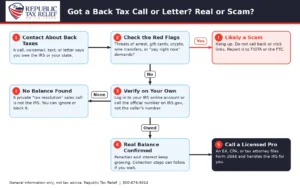
How do I know if a tax call is legit?
Do not trust the caller ID or the caller’s story. Hang up and check your balance yourself through your IRS online account or by calling the number listed on IRS.gov.
A real IRS call almost always comes after you have received letters in the mail. If the caller cannot point to a notice you already have, treat the call as suspect.
Does the IRS ever contact you by telephone?
Yes, but rarely as the first contact. The IRS usually starts with a mailed notice. A phone call may follow in certain cases, such as when a revenue officer is assigned to unpaid payroll taxes or when you are already in an audit.
The IRS says it will not demand immediate payment through gift cards, prepaid debit cards, or wire transfers, and it will not threaten to have you arrested. You can read the IRS’s own guide on how to know it is really the IRS calling or knocking.
Will the IRS call you if you owe back taxes?
Owing money does not mean you will get a call. Most people with a balance only receive letters, starting with a bill and moving toward a final notice of intent to levy.
Contractors with large or growing payroll tax debt are the exception. The IRS may assign a revenue officer who calls, visits the business, or sets meetings. A real revenue officer will give you a name, badge number, and a way to verify them.
What are signs that a phone call is actually a scammer?
- Threats of arrest, deportation, or losing your contractor’s license today
- Demands for gift cards, crypto, wire transfers, or payment apps
- Pressure to stay on the line and not talk to anyone else
- Requests for your Social Security number or bank login
- A robocall that says a “case” or “warrant” has been filed in your name
- A caller who refuses to let you call back through IRS.gov
If any of these show up, hang up. You lose nothing by verifying first.
Is it safe to receive a voicemail about back taxes?
Listening to a voicemail is safe. The risk comes from what you do next, like calling back the number left in the message or pressing a key to “speak to an agent.”
Write down the number, then check your account through IRS.gov. If you do owe, a licensed professional can call the IRS for you so you never have to dial a number you cannot trust.
How do I get rid of tax resolution spam calls?
You can cut them down, though scammers ignore most rules. Try these steps:
- Add your business and cell numbers to the National Do Not Call Registry
- Turn on your carrier’s spam filter or call blocking
- Tell honest firms to place you on their internal do not call list
- Block numbers that call repeatedly with the same script
- Report IRS impersonation calls to TIGTA and the FTC
Calls often spike after a federal tax lien is filed, because lien records are public. Resolving the debt and getting the lien released is the most lasting fix. Our tax lien help page explains how release works.
How do you check if a phone number belongs to a scammer?
Search the full number online in quotes, and check your carrier’s spam app or a reverse lookup tool. Many scam numbers already have public complaints attached.
Remember that scammers can fake caller ID to show “IRS” or a real IRS number. A clean search does not prove a call is real, so always verify through IRS.gov rather than the number on your screen.
How to Spot a Fake IRS Letter
How can I tell if a tax letter is real?
Real IRS letters have a notice or letter number, usually in the top or bottom right corner, such as CP14, CP504, or LT11. They list your tax period, the amount owed, and a reply deadline.
Match the notice to your IRS online account. If the balance and tax period show up there, the letter is almost certainly real. Our IRS notices guide explains what each common notice means.
How do I spot a fake IRS notice?
| Real IRS Notice | Warning Signs of a Fake |
|---|---|
| Arrives by U.S. mail | Arrives by email, text, or social media |
| Shows a notice number and tax period | No notice number, or one that does not exist |
| Payment goes to the “United States Treasury” | Asks for gift cards, crypto, or payment to a person or company |
| Explains your appeal rights | Says you have no right to appeal or question the amount |
| Matches your IRS online account | Balance does not appear anywhere in your account |
Some private firms also mail “final notice” letters that look official. Read the fine print, since many say in small type that they are not affiliated with the government.
Construction Labor Tax and 1099 Rules
Do you pay tax on construction labor?
It depends on which tax you mean. Wages you pay your crew are always subject to federal payroll taxes, including withheld income tax, Social Security, Medicare, and federal unemployment tax.
Sales tax on construction labor is set by each state. Many states do not tax labor to build or improve real property, but contractors often owe sales or use tax on the materials they buy. A few states tax a wide range of construction services, so rules where you work matter.
When payroll taxes go unpaid, the IRS treats it as a serious matter. Learn more about payroll tax debt relief for business owners.
What is the $600 rule?
For many years, businesses had to send a Form 1099-NEC to any independent contractor they paid $600 or more in a year. That is the “$600 rule” most contractors know.
Under the One Big Beautiful Bill Act, that threshold rose to $2,000 for payments made starting in 2026, with inflation adjustments in later years. The $600 rule still applies to payments made in 2025 and earlier, and some states may keep their own lower limits.
- The threshold only decides who gets a form.
- All income is still taxable, form or no form.
- Missing or wrong 1099s from past years can still bring penalties.
How do I know if my construction business owes back taxes?
Check these sources before you trust any phone call:
- Your IRS business online account or IRS account transcripts, which show balances by tax period
- Mailed notices for Form 941, Form 940, or business income tax
- Your payroll provider’s deposit history, compared against what the IRS shows
- State tax agency accounts for state payroll, sales, and use tax
- Public lien records in your county
Many contractors find out about a problem only when a general contractor’s payment is levied or a bonding company runs a lien search. A tax professional can pull your full IRS history with your permission. If years are missing, see our page on unfiled tax returns.
How to Talk to the IRS Safely
How do I call the IRS and talk to a real person?
Use only the phone numbers listed on IRS.gov or printed on your IRS notice. As a general guide:
- The number on your notice usually reaches the team handling that account.
- Business and payroll tax questions go to the IRS Business and Specialty Tax Line.
- Individual questions go to the main IRS help line.
- Calling early in the morning and early in the week often means shorter waits.
Hold times can run long during filing season. Once you sign Form 2848, your tax professional can make these calls for you and often reaches the right IRS unit faster.
What should you not say to the IRS?
Honesty always comes first. Never lie to the IRS or hide income or assets. Beyond that, a few common mistakes can hurt a contractor’s case:
- Do not guess. Say you will check your records and follow up in writing.
- Do not agree to a payment you cannot afford. A plan that fails can restart collection.
- Do not casually discuss who decided which bills to pay. These facts decide personal liability under the Trust Fund Recovery Penalty.
- Do not volunteer opinions about worker classification without understanding the rules.
- Do not ignore deadlines while you wait for help.
The safest move is to let a licensed representative handle the conversation. Our IRS collections defense team speaks with revenue officers every day. If you are being audited, see our business IRS audit representation page.
Your documents are safe with us. Every tax return, Social Security number, and bank statement you send is locked with bank-grade 256-bit encryption and protected by strict tax professional confidentiality, fully compliant with federal data security standards.
Speak With a Tax Relief Professional
You should not have to wonder whether a phone call is a scam or a threat to your business. If you owe the IRS or your state, our team will tell you the truth about your options and handle the IRS for you.
Start with a free, confidential review of your construction tax debt. Call 800-676-6014 or request your free consultation today.
Related Reading
- Construction Tax Resolution Services for Contractors
- Tax Resolution Questions Answered
- Tax Resolution Blog
- Stop an IRS Bank Levy
- Business Tax Resolution Services
About Republic Tax Relief
Republic Tax Relief helps individuals and businesses resolve IRS and state tax debt. Our team of tax attorneys, enrolled agents, and CPAs handles payroll tax debt, liens, levies, wage garnishments, unfiled returns, audits, and settlements for clients nationwide. Call 800-676-6014 or visit our contact page to get started.
Sources
- Internal Revenue Service: How to know it’s really the IRS calling or knocking on your door
- Internal Revenue Service: About Form 2848, Power of Attorney and Declaration of Representative
- Internal Revenue Service: Your Online Account