

Oct
The letter usually shows up on a busy day. You are packing orders, answering customer emails, and checking ad spend, and then an envelope from the IRS or your state tax agency says you owe money you did not plan for. For many online sellers, that first notice is the moment eCommerce tax problems stop being a “later” issue.
Here is the good news: a notice is the start of a process, not the end of your business. The IRS and state agencies follow predictable steps, and you have rights and options at almost every one of them. This guide explains the warning signs, how collection escalates for online sellers, what to do in your first 30 days, and when to bring in a professional so you can protect your store and your payouts.
Early Warning Signs of eCommerce Tax Problems
Most online business tax debt builds quietly. Sales grow, payouts land from Amazon, Shopify Payments, Etsy, eBay, PayPal, or Stripe, and the tax side falls behind without anyone noticing. Catching the signs early gives you far more options than waiting for a levy.
| Warning Sign | What It Usually Means | How Urgent |
|---|---|---|
| You received a Form 1099-K but never matched it to your return | The IRS may see more income than you reported | Moderate: a mismatch notice may follow |
| You skipped quarterly estimated taxes | A balance due plus underpayment penalties at filing time | Moderate |
| One or more years of returns are not filed | The IRS may file a substitute return that ignores your expenses | High |
| You sell on your own site in many states and never registered for sales tax | Possible uncollected sales tax liability in those states | High |
| You have employees and missed payroll deposits | Trust fund taxes that can follow you personally | Very high |
| A letter mentions “intent to levy” or “final notice” | Enforced collection is close | Act now |
Practical takeaway: If you checked even one box, pull your IRS account transcripts and gather your platform reports before the next letter arrives. Payment platforms generally issue Form 1099-K when a seller receives more than $20,000 across more than 200 transactions, but all business income is taxable whether or not you get the form.1
How IRS Collection Escalates for Online Sellers
The IRS rarely jumps straight to seizing money. It sends a series of notices, and each one narrows your choices a little more. Knowing where you are on this path tells you how much time you have.2
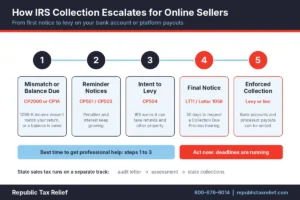
Stage 1: A Mismatch or Balance Due Notice
For online sellers, this is often a CP2000, which proposes extra tax because your return did not match what Amazon, Etsy, or a payment processor reported. It can also be a CP14 balance due notice after you filed without paying. A CP2000 is a proposal, not a final bill, so you can agree, partly agree, or dispute it with records like fees, refunds, and cost of goods sold.
Stage 2: Reminder Notices
CP501 and CP503 notices remind you of the unpaid balance. Penalties and interest keep adding up the whole time. This is still a calm, flexible stage to set up an IRS payment plan or request penalty abatement.
Stage 3: Notice of Intent to Levy (CP504)
The CP504 warns that the IRS can take your state tax refund and move toward other property. It is a strong signal to get help, because the next step removes much of your breathing room.
Stage 4: Final Notice (LT11 or Letter 1058)
This letter gives you 30 days to request a Collection Due Process hearing. That hearing is one of your most valuable rights, because it can pause levy action while your options are reviewed. Missing the deadline does not end your options, but it does limit them.
Stage 5: Levy or Lien
The IRS can levy bank accounts and money owed to you by third parties, which may include marketplace and processor payouts. It may also file a federal tax lien that affects your credit and financing. Our IRS collections defense, bank levy help, and tax lien help teams handle these situations.
When the Problem Is State Sales Tax, Not the IRS
The IRS does not collect sales tax. State agencies do, and they run on their own track with their own audits, assessments, and collection tools. Since the Supreme Court’s decision in South Dakota v. Wayfair, states can require remote sellers to collect sales tax even without a physical presence there.3
| IRS (Federal) | State Tax Agency | |
|---|---|---|
| Taxes involved | Income tax, self-employment tax, payroll taxes | Sales and use tax, state income tax |
| How problems start | 1099-K mismatches, unpaid balances, unfiled returns | Economic nexus without registration, audits using marketplace data |
| Personal exposure | Trust fund recovery penalty for unpaid payroll taxes | Many states hold owners responsible for unpaid sales tax |
| Resolution paths | Payment plans, Offer in Compromise, hardship status, penalty relief | Audit defense, voluntary disclosure, state payment plans, penalty relief |
Practical takeaway: Sales made through a marketplace facilitator like Amazon or Walmart Marketplace are often covered, but sales on your own Shopify, WooCommerce, or BigCommerce store usually are not. For a full breakdown of nexus rules and multi-state exposure, see our tax resolution for eCommerce businesses service page.
Three eCommerce Tax Debt Examples and How They Get Resolved
The examples below are simplified illustrations of common situations, not specific client cases. Your results depend on your own facts and eligibility.
Example 1: The Etsy Side Seller With a CP2000
Dana sells handmade goods on Etsy and reported only what she thought was “profit.” The IRS proposed tax on her full 1099-K gross amount. A tax professional rebuilt her real numbers from platform fees, shipping costs, and materials, and the response cut the proposed balance down to what she actually owed. The remaining amount went on a short payment plan.
Example 2: The Shopify Brand With Sales Tax and Payroll Gaps
A direct-to-consumer brand grew quickly, hired three employees, and missed several payroll deposits during a slow quarter. It also passed sales thresholds in four states without registering. The plan addressed the payroll balance first through payroll tax debt relief, because of personal liability, then used voluntary disclosure to settle the past sales tax with reduced penalties.
Example 3: The Amazon FBA Seller With a Frozen Account
Marcus had two years of unfiled tax returns and ignored several letters until the IRS levied his business checking account. His representative filed the missing returns, documented his business expenses, and negotiated a levy release tied to an installment agreement so he could restock inventory. Because his income was limited, an Offer in Compromise was reviewed as a later option.
Your First 30 Days: An Action Plan for Online Sellers
What you do in the first month after a notice often shapes the whole case. Focus on protecting cash flow and getting accurate numbers in front of the right people.
Do This Now
- Open every letter and note the notice number and response date.
- Gather your records: Forms 1099-K, marketplace settlement reports, payment processor statements, bank statements, payroll filings, and any state sales tax returns.
- List your sales channels and the states you ship to most.
- Keep filing and paying current taxes where you can, since most relief programs require it.
- Talk to a tax resolution professional before you reply to anything you do not fully understand.
Avoid These Common eCommerce Tax Mistakes
- Ignoring a notice because the amount looks wrong. Wrong amounts still become final if you do not respond.
- Moving money between accounts to dodge a levy, which can create bigger problems.
- Agreeing to a payment plan you cannot afford, which often defaults within months.
- Hiring any company that guarantees a specific settlement before reviewing your finances.
When to Hire an eCommerce Tax Resolution Professional
You can handle a simple balance due on your own. Professional help makes sense when the stakes or the complexity rise, because tax relief for online businesses often means dealing with the IRS and several states at once.
Consider bringing in help if:
- You received a CP504, LT11, or Letter 1058
- A bank account or payout has already been levied
- You owe payroll taxes or have years of unfiled returns
- You face a sales tax audit or owe tax in more than one state
- Your balance is too large to pay within a few months
Questions to Ask Before You Hire
- Who will actually represent me before the IRS and state agencies?
- Have you handled 1099-K mismatches and multi-state sales tax for online sellers?
- What will this cost, and can fees be paid in installments?
- What happens if the program you recommend does not work?
A trustworthy firm reviews your finances first, then explains which programs you realistically qualify for. Learn how the full process works in our complete guide to tax resolution services, or see our small business tax relief page if you run other business lines too.
What Our Clients Say
★★★★★ Google Review
“I just Started so sounds like they stand by There Customers and Heplful Very Professional My Agent is very Good Travis Young is really he take his time and explains it an tells u wat they do for i recommend them to anyone”
~Mark Underwood
eCommerce Tax Debt FAQs
Why did I get a CP2000 notice as an online seller?
A CP2000 means the income on your return did not match what third parties, such as marketplaces or payment processors, reported to the IRS. It is a proposed change, not a final bill. You can respond with records like platform fees, refunds, and cost of goods sold to show your true income.
Can the IRS take my Amazon, Shopify, or PayPal payouts?
Yes, the IRS can levy bank accounts and money owed to you by third parties, which may include platform and processor payouts. This usually happens only after a final notice of intent to levy. Acting before that point gives you the best chance to set up a resolution and avoid frozen funds.
How long do I have to respond to a final notice of intent to levy?
An LT11 or Letter 1058 generally gives you 30 days from the date of the letter to request a Collection Due Process hearing. Requesting the hearing on time can pause levy action while your case is reviewed. Check the exact date printed on your notice.
Does the IRS collect sales tax from online sellers?
No. Sales tax is collected and enforced by state and local tax agencies, not the IRS. Online sellers can face IRS problems and state sales tax problems at the same time, and each needs its own resolution plan.
Can I keep running my online store while I resolve tax debt?
In most cases, yes. Payment plans and other resolution options are designed to let you keep earning so you can pay what you owe. Staying current on new tax filings and payments is usually a condition of keeping that agreement in place.
Is it too late to get help if I ignored IRS letters?
Usually not. Even after a levy or lien, there are often ways to request a release and set up a resolution. The longer you wait, though, the fewer options you have and the more penalties and interest you pay.
Key Takeaways
- Most eCommerce tax debt starts with 1099-K mismatches, missed estimated taxes, unfiled returns, or uncollected sales tax.
- IRS collection follows predictable stages, and the best time to get help is before a final notice.
- State sales tax is a separate track with its own audits and personal liability rules.
- Accurate platform records are your strongest tool for reducing what you owe.
- The right professional reviews your finances first and never promises a result in advance.
Speak With a Tax Relief Professional
Whether you sell on Amazon, Etsy, eBay, or your own Shopify store, you do not have to answer the IRS or your state alone. Our team will review your notices, explain your options in plain language, and build a plan that protects your business and your payouts.
Speak With a Tax Relief Professional or call 800-676-6014 for a free, confidential consultation.
About Republic Tax Relief
Republic Tax Relief helps individuals, online sellers, and business owners resolve IRS and state back taxes. Our team handles installment agreements, Offers in Compromise, penalty abatement, lien and levy releases, payroll tax problems, sales tax issues, and audit representation, with a focus on clear communication from the first call to the final resolution. Explore our business tax debt relief options, call 800-676-6014, or contact us online to get started.
This article provides general information and is not legal or tax advice. Every tax situation is different, and results depend on your specific facts and eligibility. Past results do not guarantee future outcomes.
Sources
- Internal Revenue Service, “IRS issues FAQs on Form 1099-K threshold under the One, Big, Beautiful Bill; dollar limit reverts to $20,000,” IR-2025-107, irs.gov
- Internal Revenue Service, Publication 594, “The IRS Collection Process,” irs.gov
- Supreme Court of the United States, South Dakota v. Wayfair, Inc., 585 U.S. 162 (2018), supremecourt.gov