
Oct
When your business owes the IRS, the letters don’t just stress you out. They can threaten your bank account, your payroll, and in some cases your personal assets. Many owners wait, hoping next quarter will be better. Meanwhile, penalties and interest keep stacking up every single month.
The good news: the IRS has several ways to resolve business back taxes, and most businesses have more options than they realize. The key is knowing two things first: who is legally on the hook for the debt, and which resolution path fits your company’s real financial picture. This guide walks you through both, step by step so that you can make a clear decision instead of a panicked one.
In This Guide
- Why Business Back Taxes Grow So Fast
- Who Is Liable for Business Back Taxes?
- How the IRS Collection Process Works for Businesses
- Ways to Resolve IRS Debt for Businesses
- How to Choose the Right Business Tax Relief Path
- First Steps When Your Business Owes the IRS
- Why Professional Help Matters for Business Tax Problems
- Frequently Asked Questions
Why Business Back Taxes Grow So Fast
Business tax problems often start small. A slow season leads to a missed payroll deposit. One missed deposit turns into a missed quarter. Before long, a business owes back taxes across several periods, and each one carries its own penalties.
Payroll taxes are usually the most serious piece. When you file Form 941, you report money withheld from employees’ paychecks for income tax, Social Security, and Medicare. The IRS treats that withheld money as held “in trust” for the government. That’s why Form 941 tax debt draws faster, tougher collection action than most other balances.
Here’s how the most common business tax penalties add up:
| Penalty | How It’s Charged | Maximum |
|---|---|---|
| Failure to file | 5% of unpaid tax per month (or part of a month) | 25% |
| Failure to pay | 0.5% of unpaid tax per month | 25% |
| Failure to deposit (payroll) | 2% to 15%, depending on how late the deposit is | 15% |
| Interest | Compounds daily on tax and penalties | No cap |
Practical takeaway: Stopping new debt matters as much as fixing old debt. If you can, make every current payroll deposit on time, even while older balances are unresolved. The IRS rarely approves relief for a business that keeps adding new balances.
Who Is Liable for Business Back Taxes?
Before you can pick a solution, you need to know whose debt it really is. The answer depends on how your business is set up and what kind of tax is owed.
| Business Type | Who Owes Income Tax | Personal Risk for Payroll Tax |
|---|---|---|
| Sole proprietor / single-member LLC | The owner, on a personal return | High: the business and owner are treated as one for most purposes |
| Partnership / multi-member LLC | Partners, based on their share | Partners can face personal liability |
| S corporation / C corporation | The corporation (C corp) or shareholders (S corp) | Responsible officers can be personally assessed |
The Trust Fund Recovery Penalty
Even with a corporation or LLC, owners and managers aren’t always protected. Under the Trust Fund Recovery Penalty (TFRP), the IRS can hold a “responsible person” personally liable for 100% of the unpaid trust fund taxes. A responsible person is anyone who had the duty and authority to pay those taxes and willfully didn’t. That can include owners, officers, bookkeepers, or anyone with check-signing authority (IRS: Trust Fund Recovery Penalty).
Example: A restaurant owner runs her business as an S corp. It falls $60,000 behind on payroll taxes. The IRS interviews her and her office manager, who signed checks. Both could be assessed the TFRP personally, which means the IRS could pursue their personal bank accounts, not just the company’s.
If you’ve received a Letter 1153 or been asked to sit for a Form 4180 interview, get representation before you answer questions. Learn more about how payroll tax debt relief works for owners in this position.
How the IRS Collection Process Works for Businesses
IRS collection against a business usually follows a predictable path, but it can move faster than it does for individuals, especially with payroll taxes.
- Balance due notices: The IRS sends bills for each tax period it believes is unpaid.
- Revenue officer assignment: Larger or payroll-related balances are often assigned to a field agent who may visit your business.
- IRS tax lien: A public Notice of Federal Tax Lien can hurt your credit, your ability to get financing, and vendor relationships. See our guide to tax lien help.
- IRS levy: After a final notice, the IRS can seize business bank accounts, accounts receivable, and even equipment. Our bank levy help page explains how that can be stopped.
Practical takeaway: A Final Notice of Intent to Levy usually gives you 30 days to request a Collection Due Process hearing. That deadline is one of your strongest tools, so don’t let it pass. For a deeper look, see IRS collections defense.
Ways to Resolve IRS Debt for Businesses
There isn’t one “best” program. The right fit depends on how much you owe, whether the business is still operating, and what it can realistically pay. Here’s a side-by-side view:
| Option | Best For | Key Requirement |
|---|---|---|
| Business installment agreement | Businesses that can pay over time | Current on filings and deposits |
| Business Offer in Compromise | Businesses that truly can’t pay the full balance | Strong financial documentation |
| Currently not collectible | Closed businesses or severe hardship | Proof of no ability to pay |
| Penalty abatement | Good history or a valid reason for falling behind | Reasonable cause or first-time eligibility |
IRS Payment Plan for Businesses
An IRS payment plan is the most common path. Operating businesses that owe $25,000 or less in payroll taxes may qualify for a streamlined “in-business trust fund” agreement, generally paid off within 24 months. Larger balances usually require full financial disclosure. Read more about setting up an installment agreement.
Offer in Compromise for Businesses
An Offer in Compromise lets a business settle tax debt for less than the full amount when it can’t reasonably pay in full (IRS: Offer in Compromise). The IRS looks at assets, income, and future earning potential. It’s a powerful option, but not every business qualifies, and a weak application can waste months. Our page on how the OIC program works explains the ability-to-pay formula.
Currently Not Collectible Status
If a business has closed and has no assets or income, the IRS may pause collection. It’s rarely granted to operating businesses with ongoing payroll debt, but it can protect owners after a business winds down. See currently not collectible status.
Business Tax Penalty Relief
Penalties can make up a large share of what a business owes. The IRS may remove them through first-time abatement or reasonable cause, such as a serious illness, natural disaster, or records lost through no fault of your own (IRS: Penalty Relief). Learn how penalty abatement requests are built.
How to Choose the Right Business Tax Relief Path
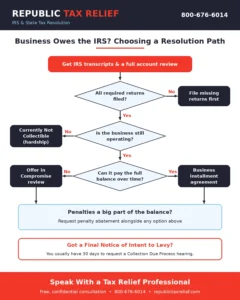
Start with these four questions:
- Is the business still operating? Open businesses usually need a payment plan or an offer. Closed businesses may qualify for hardship status.
- Are all returns filed? The IRS won’t approve most agreements until every required return is on file. If you’re behind, start with unfiled tax returns help.
- Can the business pay the full balance over time? If yes, a business installment agreement often makes sense. If not, an offer may be worth exploring.
- Are penalties a big part of the balance? Penalty relief can be paired with almost any other option.
Example: A contractor owes $48,000, including $11,000 in penalties. He’s still working and caught up on current deposits. A professional might request penalty abatement first, then set up a payment plan on the lower balance.
First Steps When Your Business Owes the IRS
If your business cannot pay the IRS right now, you can still take smart action this week:
- Open every IRS letter and note any deadlines, especially levy notices.
- Stay current on new payroll deposits so the debt stops growing.
- Gather key documents: recent bank statements, profit and loss statements, payroll reports, and IRS notices.
- Don’t talk to a revenue officer unprepared. A licensed representative can speak to the IRS for you with a power of attorney (Form 2848).
- Avoid paying the “wrong” debt first. Payroll taxes usually deserve priority because of personal liability.
Why Professional Help Matters for Business Tax Problems
Business cases involve more moving parts than personal ones: multiple tax periods, entity rules, revenue officers, and personal liability for owners. A small mistake on a financial statement can lead to a denied offer or an unaffordable payment plan.
Republic Tax Relief has helped individuals and business owners since 2005. Our in-house team of tax attorneys, CPAs, and enrolled agents has resolved more than 18,000 cases. We start by pulling your IRS transcripts, so every recommendation is based on your real account, not guesswork. Explore our full business tax resolution services or our small business tax relief page.
“Joeclin has provided great customer service and support with tax situation, I’m thankful for the work she has done with my case, Happy client.”
— Felix Guerrero, Google Review ★★★★★
Results vary based on each client’s individual facts and financial situation.
Frequently Asked Questions
Can the IRS come after me personally for my business’s unpaid taxes?
Yes, in some cases. Sole proprietors are personally liable for most business taxes. For corporations and LLCs, the IRS can use the Trust Fund Recovery Penalty to hold owners or managers personally responsible for unpaid payroll taxes that were withheld from employees.
Can a business settle tax debt for less than it owes?
Sometimes. A business Offer in Compromise may be accepted if the business can’t reasonably pay the full balance based on its assets and income. The business generally must be current on filings and recent tax deposits to qualify.
What happens if my business can’t pay the IRS?
The IRS will continue sending notices and may file a tax lien or levy business bank accounts and receivables. Options such as a payment plan, an Offer in Compromise, or hardship status may stop or prevent collection action.
Can business tax penalties be removed?
Often, yes. The IRS may remove penalties through first-time abatement if the business has a clean compliance history, or through reasonable cause if events outside your control caused the problem.
How long does the IRS have to collect business back taxes?
The IRS generally has 10 years from the date a tax is assessed to collect it. Certain actions, like submitting an Offer in Compromise or requesting a hearing, can pause that clock.
Do I need a professional to resolve IRS business tax debt?
It isn’t required, but it’s strongly recommended when payroll taxes, revenue officers, or personal liability are involved. A licensed professional can protect your rights, communicate with the IRS for you, and build a stronger case.
Summary
- Business back taxes grow quickly because penalties and daily interest stack on every unpaid period.
- Payroll (Form 941) debt is the most urgent, since owners and managers can be held personally liable.
- Main options include a payment plan, an Offer in Compromise, hardship status, and penalty relief.
- The right choice depends on whether your business is operating, filed up to date, and able to pay over time.
- Acting before a levy deadline gives you far more control over the outcome.
Speak With a Tax Relief Professional
Your business doesn’t have to face the IRS alone. Republic Tax Relief helps business owners stop collections, reduce penalties, and choose a resolution plan they can actually afford. Your consultation is free, confidential, and comes with no pressure.
Your privacy is protected: every document you share is secured with bank-grade 256-bit encryption and handled under strict tax client confidentiality standards.
Call 800-676-6014 or request your free consultation today.
About Republic Tax Relief: Since 2005, Republic Tax Relief has helped individuals and businesses resolve IRS and state tax debt. Our in-house team of tax attorneys, CPAs, and enrolled agents handles payment plans, Offers in Compromise, penalty abatement, levy and lien release, and collections defense. Call 800-676-6014 or visit our Contact page to get started.