
Opening a letter that says the IRS wants to examine your business can make your stomach drop. You may start wondering what you did wrong, how much it will cost, and whether your business can handle it.
Take a breath. An audit is a review of your records, not an accusation of fraud, and many audits close with little or no change. Business IRS audits are stressful, but with good records and the right people in your corner, they are manageable.
This guide explains how the audit process works, what tends to draw the IRS’s attention, the rights you have as a taxpayer, and how professional representation protects your business from the first letter to the final report.
Table of Contents
- What an IRS Audit Means for Your Small Business
- Types of IRS Tax Audits Businesses Face
- IRS Audit Red Flags and Common Triggers
- How to Handle a Business IRS Audit, Step by Step
- Your Rights During an IRS Tax Audit
- Tax Attorney, CPA, or Enrolled Agent: Who Should Represent You
- After the Audit Findings: Appeals and Payment Options
- IRS Audit Defense for Businesses
- Frequently Asked Questions
- Speak With a Tax Relief Professional
What an IRS Audit Means for Your Small Business
An IRS audit, also called an IRS examination, is a review of a business tax return and the records behind it. The IRS wants to confirm that your income and expenses were reported correctly under current tax laws and regulations.
Being selected does not mean the IRS thinks you cheated. The IRS explains that returns may be picked through random sampling, through computer screening that compares your return to similar returns, or because they are linked to another taxpayer’s audit, such as a business partner or supplier (IRS: IRS Audits).
Audits reach every kind of business, from sole proprietors and partnerships to S corporations and C corporations. Businesses and startups with fast growth, heavy cash sales, or large losses tend to get a closer look. State agencies, such as California’s Franchise Tax Board, also audit businesses, and many of the same principles apply.
How Far Back Can the IRS Look?
In most cases, an audit covers returns filed within the last three tax years. If the IRS finds a substantial error, it may add more years, but it usually does not go back further than six.
What Is at Stake
When an audit uncovers a discrepancy, the result can include more tax, penalties and interest, and sometimes a review of other years. For small business owners, a poorly handled audit can turn into a balance that strains cash flow and payroll.
That is why many owners look for help with business IRS audit issues before they ever speak to the auditor. Early guidance often keeps a narrow review from growing into a bigger problem.
Types of IRS Tax Audits Businesses Face
The IRS uses three main audit formats. The type listed in your letter is a good clue about how detailed the review will be.
| Audit Type | Where It Happens | What It Usually Covers | Complexity |
|---|---|---|---|
| Correspondence audit | By mail | One or two items, such as a missing 1099 or a single deduction | Usually the simplest |
| Office audit | At a local IRS office | Several items, reviewed in an in-person interview | Moderate |
| Field audit | At your business or your representative’s office | A full review of books, records, and daily operations | Most detailed |
Correspondence Audits
Correspondence audits are the most common type. The IRS mails a letter asking you to explain or document specific items, and you respond in writing by the deadline.
Office Audit
An office audit requires a meeting at an IRS office. The letter lists what to bring, which often includes receipts, invoices, and bank statements for the years under review.
Field Audit
A field audit is the most in-depth review. A revenue agent visits your place of business to examine records, ask questions, and see how the operation runs. With a power of attorney on file, your representative can often ask to hold the meeting at their office instead.
Red Flags Triggering an Audit: W-2, 1099, and Other Common Triggers
Some returns are randomly selected, but many audits start because something on the return looks out of line. Knowing the red flags for the IRS can help you understand why your business was chosen.
Income That Does Not Match IRS Records
The IRS matches the income you report against forms that others file, such as 1099s and W-2s. If a client sends a 1099-NEC showing $40,000 and your return shows less, the system will likely flag it.
Unreported income is one of the fastest ways to receive an audit notice. Even honest mistakes that underreport income can lead to extra tax and penalties.
Worker Classification Problems
Treating employees as independent contractors is a common issue. When workers get a 1099 but should receive a W-2, the IRS may review payroll taxes, missed tax payments, and related penalties.
Other Audit Red Flags
- Deductions that look high compared to your income or industry
- Several years of business losses in a row, especially for side businesses
- Large cash revenue, common for restaurants, salons, and contractors
- Home office deductions that do not meet the IRS’s strict rules
- Vehicle, travel, and meal expenses claimed at or near 100% business use
- Round numbers that look estimated rather than tracked
- Personal and business-related spending mixed in the same account
A red flag does not prove you did anything wrong. It simply raises your audit risk, and proper documentation is usually what settles the question.
How to Handle a Business IRS Audit: A Step-by-Step Guide
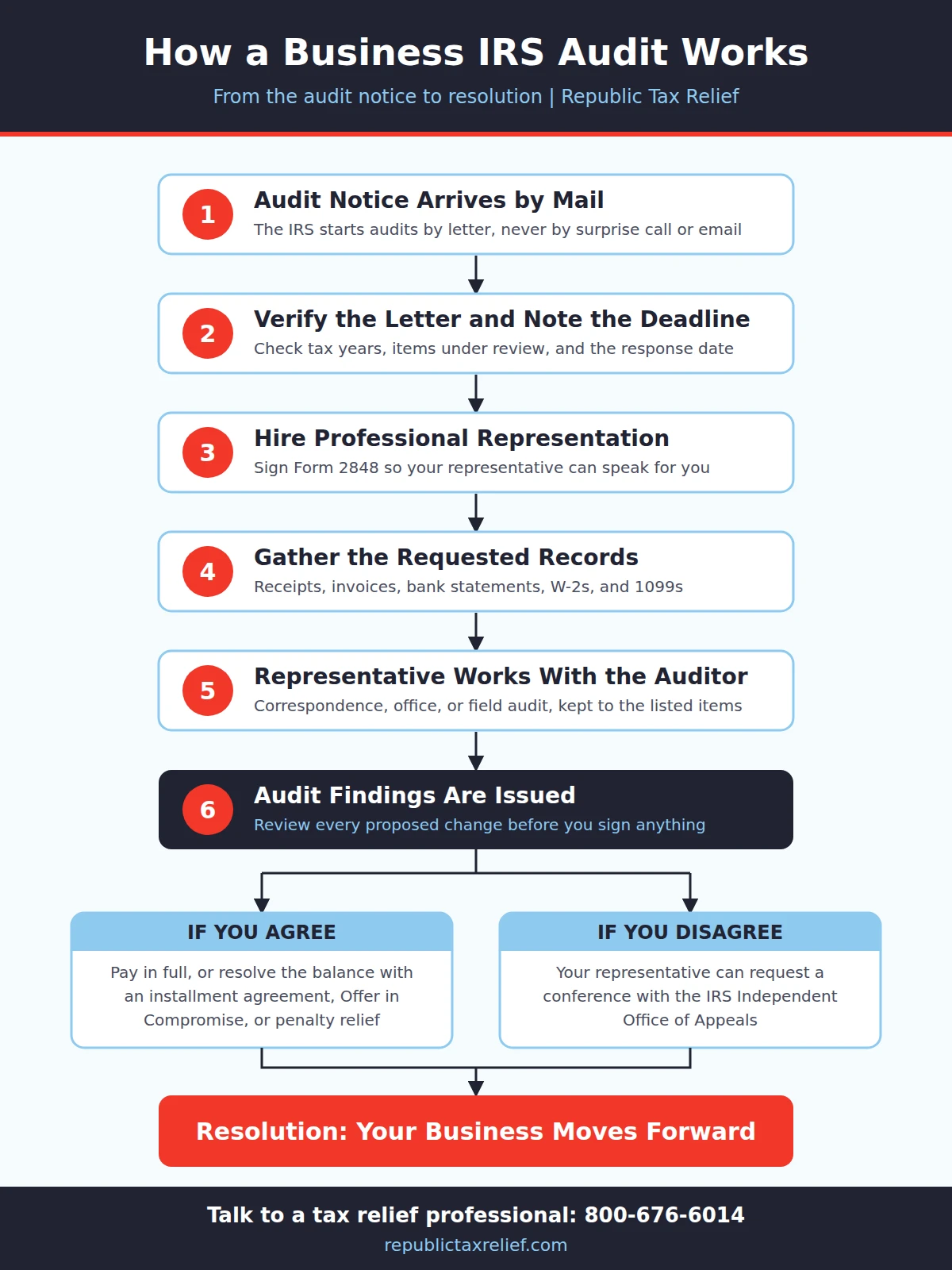
Knowing how to handle a business IRS audit starts the moment the letter arrives. This step-by-step guide walks through the process from the first notice to the final report.
Step 1: Confirm the Audit Notice Is Real
The IRS starts audits by mail. It does not open an audit with a surprise phone call, text, or email demanding payment. Check the letter number, the tax years listed, and the response date, or visit the IRS website to confirm the notice type.
Step 2: Do Not Ignore the Deadline
Missing a deadline can lead the IRS to decide the case without your side of the story. If you need more time, you or your representative can usually request an extension from the auditor before the due date.
Step 3: Bring In Professional Help Early
Before you call the IRS, speak with a tax professional. Once you sign IRS Form 2848, a qualified representative can talk with the auditor for you. In most cases, you do not have to attend meetings yourself.
Step 4: Gather and Organize Your Records
Pull together the requested documentation, and only what was requested. Common records include:
- Bank statements and credit card statements
- Receipts and invoices for business expenses
- Payroll records, W-2s, and 1099s
- Mileage logs, leases, and loan documents
- Prior tax filing records and depreciation schedules
Step 5: Let Your Representative Work With the Auditor
Your representative answers questions, explains entries, and keeps the review focused on the items in the letter. This limits the chance that one small issue turns into a review of other years.
Step 6: Review the Audit Findings Before You Sign
At the end, the auditor proposes changes, or confirms that none are needed. Do not sign anything until you understand how it affects your tax liabilities and what options you have.
Your Rights During an IRS Tax Audit
Every taxpayer is protected by the Taxpayer Bill of Rights, a set of 10 rights the IRS must respect (IRS: Taxpayer Bill of Rights). Several of them apply directly during an audit:
- The right to be informed: clear explanations of what the IRS needs and why
- The right to challenge the IRS’s position and be heard: you can present your side and your evidence
- The right to appeal in an independent forum: most decisions can be reviewed by IRS Appeals
- The right to privacy and confidentiality: your information is protected
- The right to retain representation: you can choose someone to speak for you
The right to retain representation matters more than most owners realize. In most cases, you can pause an interview to speak with your representative, which means you never have to face an auditor alone.
Tax Attorney, CPA, or Accountant: Choosing the Right Tax Expert
Three types of professionals have unlimited rights to represent you before the IRS: tax attorneys, certified public accountants (CPAs), and enrolled agents. A bookkeeper or an accountant who is not a CPA can help organize records but has limited or no right to represent you in an audit.
| Tax Expert | Best Fit | IRS Representation Rights | Confidentiality Protection |
|---|---|---|---|
| Tax attorney | Possible fraud concerns, large balances, or legal exposure | Unlimited | Attorney-client privilege |
| CPA | Accounting-heavy audits, complex books, and financial statements | Unlimited | Limited federal tax practitioner privilege in civil matters |
| Enrolled agent | IRS-focused audits, collections, and tax issues | Unlimited | Limited federal tax practitioner privilege in civil matters |
When to Hire a Tax Attorney for Business IRS Audit Cases
If the audit touches unreported income, missing records across several years, or anything the auditor describes as possible fraud, talk to a tax attorney for business IRS audit protection right away. Attorney-client privilege offers protection that other professionals cannot.
When a CPA for Business Tax Audit Representation Fits
A CPA for business tax audit representation is a strong choice when the case turns on detailed accounting, inventory, or depreciation. Many firms pair a CPA’s numbers work with an attorney’s legal guidance for the best outcome.
After the Audit Findings: Appeals, Payment Options, and Compliance With Tax Laws
When the audit ends, you will receive a report showing any proposed changes. From there, you generally have a few paths.
If You Agree With the Findings
Signing the agreement closes the audit. If you owe more tax, the next step is choosing how to pay it, and you have more options than most people think:
- An IRS installment agreement to pay over time
- An Offer in Compromise if you cannot pay the full amount (see also What Is an Offer in Compromise or Fresh Start Program?)
- IRS penalty abatement for first-time or reasonable-cause penalties
- Currently Not Collectible status if paying would cause real financial hardship
You can compare these choices in our guide to tax debt relief options. Some owners also ask whether bankruptcy affects audit-related tax debt, which we cover in Does Bankruptcy Get Rid of Your Tax Debts?
If You Disagree With the Findings
You can request a conference with the IRS Independent Office of Appeals, usually within 30 days of the letter explaining the proposed changes (IRS Publication 556). If Appeals does not resolve the case, you may receive a notice of deficiency, which gives you 90 days to petition the U.S. Tax Court.
If the Balance Goes Unpaid
An unpaid audit bill can move into collections. That may lead to a federal tax lien, a bank levy, or wage garnishment. Our IRS collections defense team can step in to stop these actions.
If an audit of a joint return changes the tax because of a spouse’s business, you may qualify for innocent spouse relief.
Staying Compliant Going Forward
Good tax planning and steady tax compliance lower the odds of a repeat audit. Keep records for at least three years, use separate business and personal accounts, and catch up on any unfiled tax returns before the IRS finds them first.
IRS Audit Defense for Businesses: Why Owners Choose Republic Tax Relief
Business IRS audit representation from Republic Tax Relief puts an experienced tax team between you and the IRS. You focus on running your business while we handle the letters, calls, and meetings.
Our IRS audit representation for small business clients includes:
- Plain-English review: we explain what the IRS is asking for and what it could mean
- Direct communication: we file your power of attorney and deal with the auditor for you
- Organized evidence: we build a clear record to support each deduction and expense
- Pushback when it counts: we challenge findings that the facts and law do not support
- A plan if tax is owed: we review every resolution option, from payment plans to an Offer in Compromise
The potential benefits of professional representation can include fewer meetings, a narrower audit scope, and a final result built on accurate numbers. Learn how our broader tax resolution services, tax relief services, and back tax help support individuals and business owners alike.
What Our Clients Say
⭐⭐⭐⭐⭐ “Ryan from Republic Tax definitely deserves a gold metal! I had came in with a garnishment from the IRS I was dealing with and they were able to stop it! Now I don’t owe them anything!” Alvin Pham, Google Review
Results depend on each client’s facts and are not guaranteed.
Your Documents Are Safe With Us
Sharing records during an IRS audit should never feel risky. Bank-grade 256-bit encryption and strict confidentiality standards keep your Social Security number, tax returns, and bank statements protected at every step.
Frequently Asked Questions About Business IRS Audits
How does the IRS notify a business of an audit?
The IRS notifies businesses of an audit by mail. It does not start an audit with an unexpected phone call, text, or email, so treat those contacts as possible scams.
How long does a business IRS audit take?
A simple correspondence audit may wrap up in a few months. A field audit of a larger business can take a year or longer, depending on how complex the records are and how quickly documents are provided.
Do I have to meet with the auditor myself?
Usually not. Once you sign Form 2848, a tax attorney, CPA, or enrolled agent can meet with the auditor for you, unless the IRS formally summons you to appear.
What records should I keep in case of a potential audit?
Keep receipts, invoices, bank statements, payroll records, mileage logs, and copies of filed returns. Hold most records for at least three years, and employment tax records for at least four years.
Can I ask for more time to respond to an audit letter?
Yes. Contact the auditor before the deadline and ask for an extension. Requests made early are usually granted, while missed deadlines can lead to a decision without your input.
What happens if the audit says my business owes money?
You can agree and pay, or set up a resolution such as an installment agreement, an Offer in Compromise, or penalty relief. If you disagree, you can request a review by the IRS Independent Office of Appeals.
Should I hire a tax attorney, CPA, or enrolled agent for an audit?
All three can represent you before the IRS. A tax attorney is the best fit when there is any risk of fraud claims, while a CPA or enrolled agent works well for accounting-focused audits.
Speak With a Tax Relief Professional
You do not have to face an IRS audit alone. The sooner a professional reviews your letter, the more options you keep, and the better your chances of a fair result.
Call 800-676-6014 now or request your confidential consultation to speak with a tax relief professional today.
About Republic Tax Relief
Republic Tax Relief helps individuals and business owners resolve IRS and state tax problems, including audits, back taxes, tax liens, bank levies, wage garnishments, and unfiled returns. Our team works directly with the IRS and state tax agencies to find the best available resolution for each client. Call 800-676-6014 or contact us online to get started.
Sources
- Internal Revenue Service, IRS Audits
- Internal Revenue Service, Taxpayer Bill of Rights
- Internal Revenue Service, Publication 556, Examination of Returns, Appeal Rights, and Claims for Refund
This page provides general information and is not legal or tax advice. Every situation is different, so speak with a qualified tax professional about your specific case.