
Oct
You open the mail and find a final notice of intent to levy. Your paycheck already goes to rent, groceries, and the car payment you need to get to work. There is nothing left for a $28,000 tax bill, and you are worried the IRS will take what little you have.
If that sounds familiar, you still have options. Federal tax law recognizes that some taxpayers truly cannot pay, and the IRS has tools to pause or reduce collection when paying would leave you unable to cover basic living costs. People often call these tools the IRS hardship program, even though there is no single application with that name.
So what does the IRS consider a financial hardship? This guide explains the legal test, which expenses count, which life events usually qualify, what “undue hardship” means, and when a levy legally counts as causing hardship.
Table of Contents
- What financial hardship means to the IRS
- The reasonable basic living expenses test
- What the IRS counts as allowable expenses
- What qualifies as an IRS hardship: real-life examples
- What undue hardship means
- When an IRS levy causes economic hardship
- How the IRS checks a hardship claim
- What happens once the IRS agrees
- Risks of proving hardship yourself or with AI
- Financial hardship FAQs
- Speak with a tax relief professional
What Financial Hardship Means to the IRS
The IRS does not run a program with a sign-up form called “hardship.” Instead, economic hardship is a legal standard written into federal tax regulations. When your finances meet that standard, the IRS has to treat your case differently.
In everyday terms, the IRS considers you to be in financial hardship when paying your tax debt would leave you unable to cover the basics: housing, food, utilities, transportation, and medical care. Feeling stretched thin is not enough. The IRS wants to see that the math does not work.
Practical takeaway: If a company promises to “enroll” you in a hardship program, ask which specific IRS procedure it plans to use and why. A legitimate firm offering tax resolution services can name the tool and explain how your numbers support it.
The Legal Test: Reasonable Basic Living Expenses
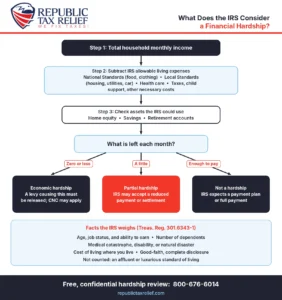
Treasury Regulation 301.6343-1(b)(4) defines economic hardship in one sentence. It exists when collection would leave an individual taxpayer “unable to pay his or her reasonable basic living expenses” (Treas. Reg. § 301.6343-1).
What counts as “reasonable” depends on your circumstances. The regulation is clear, though, that it does not include keeping up an affluent or luxurious standard of living.
Facts the IRS must weigh
When deciding whether your living expenses are reasonable, the IRS considers any information you provide, including:
- Your age, employment status and history, and ability to earn
- The number of people who depend on you, or whether someone else claims you as a dependent
- Reasonable costs for food, clothing, housing, utilities, medical care, transportation, and current taxes
- Alimony, child support, and other court-ordered payments
- Expenses you must pay to earn income
- The cost of living where you live
- Property that is exempt from levy and could help cover expenses
- Extraordinary circumstances, such as a medical catastrophe or natural disaster
The good-faith requirement
The regulation also expects you to act in good faith. Inflating expenses, falsifying numbers, or failing to disclose assets can sink a hardship claim, even when the underlying hardship is real.
What the IRS Counts as Allowable Expenses
To test your budget, the IRS compares your income to allowable expenses set by its Collection Financial Standards. These standards turn the legal test into real numbers.
- National Standards: Food, clothing, housekeeping supplies, personal care, and miscellaneous costs, based on household size.
- Out-of-pocket health care: A set monthly amount per person, with higher figures for people 65 and older.
- Local Standards: Housing, utilities, and transportation costs that vary by county and region.
- Other necessary expenses: Current tax payments, court-ordered child support, health insurance, and required child care.
Here is the part that surprises most people. The IRS often uses its standard amounts rather than what you actually spend. If your rent is $2,800 but the county allowance is $2,300, the IRS may only count $2,300 unless you show the higher cost is necessary, such as a larger family or a medical need.
Example: Dan takes home $4,100 a month. His allowable expenses under IRS standards add up to $4,050, leaving $50. With a $40,000 balance, that small surplus makes him a strong candidate for a hardship finding or a very low payment arrangement, not a standard payment plan.
Expenses the IRS usually does not count
- Credit card and other unsecured debt payments
- Voluntary retirement contributions, in most cases
- Private school tuition, unless tied to a special need
- Charitable giving, unless it is a condition of your job
- Car or housing costs above the local allowance without a clear reason
What Qualifies as an IRS Hardship: Real-Life Examples
No single event automatically qualifies you. What matters is how the event changes the gap between your income and your allowable expenses. These are the situations we see most often.
| Situation | Why it can qualify | What can work against you |
|---|---|---|
| Job loss or cut hours | Income falls below allowable expenses | Severance, savings, or a spouse’s income |
| Serious illness or large medical bills | Medical costs count as necessary, and illness can limit your ability to earn | Health savings or other assets that could cover the bills |
| Disability | Ability to earn is a factor the IRS must weigh | Other household income |
| Fixed income in retirement | Social Security or a pension leaves little room above basic costs | Home equity or retirement savings |
| Natural disaster | Listed in the regulation as an extraordinary circumstance | Insurance payouts or disaster aid |
| Supporting dependents | Larger households receive higher expense allowances | Dependents with their own income |
Medical hardship is one of the strongest cases when it is well documented. In one case we handled, a taxpayer facing a serious medical hardship resolved a $72,796 IRS debt for $500. Results depend on each taxpayer’s facts.
What “Undue Hardship” Means
You may also see the phrase “undue hardship” in IRS rules. It is a different and narrower test than economic hardship. It comes from the rules for asking for more time to pay a tax.
Under Treasury Regulation 1.6161-1(b), undue hardship “means more than an inconvenience to the taxpayer” (Treas. Reg. § 1.6161-1). You must show that paying on the due date would cause a substantial financial loss, such as having to sell property at a sacrifice price.
| Term | Where it applies | The test |
|---|---|---|
| Economic hardship | Levy releases and most collection decisions | Collection would leave you unable to pay reasonable basic living expenses |
| Undue hardship | Requests for more time to pay a tax | Paying on time would cause a substantial financial loss, not just inconvenience |
| Significant hardship | Taxpayer Advocate Service help | An IRS action or delay is causing, or is about to cause, serious harm |
Mixing up these terms is common. If an IRS letter mentions hardship and you are not sure which test applies, that is a good moment to talk with a tax professional.
When an IRS Levy Legally Counts as Causing Hardship
Under Internal Revenue Code Section 6343, the IRS must release a levy that is creating an economic hardship due to an individual’s financial condition. A levy meets that test when what it takes, in whole or in part, leaves you unable to pay reasonable basic living expenses.
Signs that a levy may be causing hardship:
- Wage garnishment hardship: After the garnishment, your take-home pay falls below the IRS allowance for your household.
- Bank levy hardship: The levy freezes money you set aside for rent, utilities, or medicine.
- Income you live on: The levy reaches Social Security or a pension, leaving nothing for basic costs.
Keep two limits in mind. The release rule protects individuals, not business entities, so owners with company debt should look at payroll tax debt relief instead. A release also does not erase the debt, so the IRS will usually move the account into another status or arrangement.
Example: A warehouse worker supporting a family of four sees her take-home pay drop to $900 a month after a wage levy. Her rent, food, and child care under IRS standards far exceed that, so the levy is causing economic hardship and should be released.
Speed matters, because a bank generally holds levied funds for 21 days before sending them to the IRS. See how our team handles hardship levy releases for clients, or visit our wage garnishment relief and bank levy help pages.
How the IRS Checks a Hardship Claim
The IRS does not take your word for it. Before it agrees you are in hardship, it usually asks for a Collection Information Statement and documents that back up every number.
| Form | Who usually uses it | Level of detail |
|---|---|---|
| Form 433-F | Most individuals working with IRS phone or automated collection | Shorter, summary-level financial picture |
| Form 433-A | Wage earners and self-employed taxpayers, often with a revenue officer | Detailed income, expenses, assets, and business data |
| Form 433-B | Corporations, partnerships, and LLCs | Business assets, receivables, and cash flow |
What the IRS looks at closely
- Pay stubs or a profit and loss statement that shows your real income
- Several months of statements for every bank account
- Proof of housing, utility, car, and medical costs
- Retirement accounts, investments, and life insurance with cash value
- Whether all required tax returns are filed. If any are missing, start with catching up on unfiled tax returns.
Example: A self-employed contractor reports income from his busiest month. His income looks strong, so the IRS proposes a $1,200 monthly payment. A 12-month average would have shown his seasonal income and a much lower ability to pay.
What Happens Once the IRS Agrees You Have a Hardship
A hardship finding opens doors, but it does not erase what you owe. Most often the IRS places the account in Currently Not Collectible status, which pauses collection while penalties and interest keep growing. If you have a small surplus, a partial payment plan, offer in compromise, or penalty relief may fit better, and our guide to hardship relief options compares each one side by side.
Hardship status is not permanent. The IRS can review your finances again, and higher income or a new unpaid balance can end it. Our Currently Not Collectible FAQs explain how reviews and the 10-year collection clock work.
Not Sure Your Situation Counts as a Hardship?
Every week you wait, penalties and interest keep growing. Get a free, confidential review of your income, expenses, and options.
Risks of Proving Hardship Yourself or With AI
Hardship is decided on numbers, and the IRS sets the rules for which numbers count. Form 433 is signed under penalty of perjury, while an AI chatbot cannot see your IRS file, may quote outdated expense standards, and puts your Social Security number and bank records at risk. Read more in Can AI Get a Better Settlement Than a Tax Attorney?, or see how our team presents hardship cases to the IRS.
What Our Clients Say
“I had the pleasure of working with Emily during my intake process, and she made the experience easygoing. She was thorough, communicative, and incredibly supportive, ensuring I had all the information I needed and answering any questions with patience and clarity. Her professionalism and kindness made what could have been a stressful process feel much more manageable. I truly appreciate her attention to detail and genuine care. Thank you, Emily, for making this such a positive experience!”
~ Mierra Strickland, Google Review
Financial Hardship FAQs
What does the IRS consider a financial hardship?
The IRS considers you to be in financial hardship when paying your tax debt would leave you unable to cover reasonable basic living expenses. It measures this with its Collection Financial Standards, not your actual budget, and it also looks at assets you could use.
Is job loss a financial hardship for the IRS?
It often is, when the lost income drops your household below its allowable expenses. The IRS will still look at severance, unemployment benefits, savings, and a spouse’s income. It may review your account again once you are working.
Is a serious illness a financial hardship?
It can be. Medical costs count as necessary expenses, and the regulation lists a medical catastrophe as an extraordinary circumstance. An illness that limits your ability to work also weighs in your favor.
What is undue hardship in IRS terms?
Undue hardship is a narrower test used when asking for more time to pay a tax. It means more than an inconvenience: paying on the due date would cause a substantial financial loss, such as selling property at a sacrifice price.
When does an IRS levy cause economic hardship?
A levy causes economic hardship when what it takes leaves an individual unable to pay reasonable basic living expenses. When that is shown, federal law requires the IRS to release the levy. This rule does not apply to business entities.
Can owning a home or having savings disqualify me?
It can. The IRS looks at home equity, savings, and retirement accounts you could reasonably tap. If those funds are needed for basic living costs or cannot realistically be reached, the IRS may still find a hardship.
Does a natural disaster count as a financial hardship?
Yes, it can. The regulation names natural disasters as an extraordinary circumstance. The IRS also often postpones deadlines for people in federally declared disaster areas.
Have questions about applying? See our IRS hardship FAQ, our Currently Not Collectible FAQs, or our IRS collections defense questions.
Key Takeaways on IRS Financial Hardship
- Economic hardship is a legal standard, not a program you sign up for.
- The test is whether paying would leave you unable to cover reasonable basic living expenses.
- The IRS measures hardship with its own expense standards, not your actual budget.
- Job loss, serious illness, disability, fixed income, and disasters often support a hardship finding.
- Undue hardship is a narrower test tied to requests for more time to pay.
- The IRS must release a levy that causes economic hardship for an individual.
Speak With a Tax Relief Professional
If the IRS is threatening your paycheck, your bank account, or your peace of mind, you do not have to face it alone. Republic Tax Relief reviews your full financial picture, tells you in plain language whether your situation meets the IRS hardship standard, and handles communication with the IRS for you. Meet with us at our Corona or Laguna Hills offices, or by phone from anywhere in the country. See why clients trust us on our awards and recognition page.
Your privacy is protected from the first call. Every document you share is secured with bank-grade 256-bit encryption and handled under strict client confidentiality standards.
Call 800-676-6014 or request your confidential consultation today.
Sources
- Treasury Regulation § 301.6343-1, Requirement to release levy and notice of release
- Treasury Regulation § 1.6161-1, Extension of time for paying tax
- Internal Revenue Service, Collection Financial Standards
This article provides general information and is not legal or tax advice. Results depend on each taxpayer’s facts. Speak with a qualified tax professional about your situation.