
Oct
That envelope from the Internal Revenue Service is sitting on your counter, and you haven’t opened it yet. You’re not alone. The IRS sends millions of letters every year, and most can be handled if you act before the deadline. The real danger isn’t the letter itself. It’s waiting too long to deal with it.
This IRS Notices Blog breaks down the most common notices, what each one means, and the response options you have. Whether you’re an individual taxpayer or a business owner, you’ll know exactly what to do next.
Table of Contents
- What to Do When You Get an IRS Letter
- Quick Reference: List of Common IRS Notices
- Common IRS Notices Explained
- How to Respond to an IRS Notice the Right Way
- How to Stop an IRS Levy or Lien After a Notice
- When to Bring In a Tax Professional
- IRS Notice FAQs
What to Do When You Get an IRS Letter
Before you call anyone or pay anything, take five minutes to review the notice carefully. Every notice from the IRS follows a similar layout, and a few details tell you almost everything.
- Find the notice number. Look for the CP or LTR number in the top or bottom right corner (for example, CP14 or LTR 1058).
- Check the date of the notice and the response deadline. Many deadlines run 21 to 30 days from the date printed on the letter.
- Confirm the tax year and the amount due. Compare them to the tax return you filed.
- Verify it’s real. The IRS usually makes first contact by mail and never demands payment by gift card or crypto. You can confirm any balance through your IRS online account or by calling the number listed on the letter.
Practical takeaway: A taxpayer named Maria got a letter showing her Social Security number and a balance she didn’t recognize. Instead of panicking, she logged into her IRS online account, confirmed the balance was posted to her account, and called for help before the deadline. That one step kept her options open.
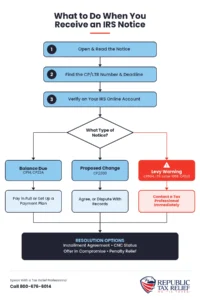
Quick Reference: List of Common IRS Notices
The IRS issues hundreds of notices, but a small group accounts for most of the letters taxpayers receive. Here’s a quick list of common IRS notices and the first move for each.
| Notice | What the Notice Means | Typical Deadline | Your First Move |
|---|---|---|---|
| CP14 | First notice of a balance due | 21 days | Pay, or set up a payment plan |
| CP22A / CP22E | The IRS made changes to your tax return | Date shown on the notice | Review the changes and respond if you disagree |
| CP23 | Difference in the amount of estimated tax payments claimed vs. posted | Date shown on the notice | Match your payment records |
| CP2000 | Income on your return doesn’t match IRS records | Usually 30 days | Agree, partly agree, or disagree in writing |
| CP504 | Final notice before intent to levy | Date shown on the notice | Act now to prevent a levy |
| LT11 / Letter 1058 | Notice of intent to levy and right to a hearing | 30 days | Request a hearing or resolve the debt |
| CP523 | Intent to terminate your installment agreement | Date shown on the notice | Contact the IRS immediately |
Common IRS Notices Explained
IRS Notice CP14 (First Notice of Balance Due)
A CP14 means you owe money on one of your tax accounts. It often shows up when a tax payment wasn’t made in full with your federal tax return. Interest and penalties keep growing until the balance is paid.
- If you can pay the full amount, do so by the deadline to limit interest.
- If you can’t, you may qualify for an IRS payment plan.
- If penalties are large, ask whether penalty abatement applies.
Example: A freelancer owed $6,200 after skipping one estimated tax payment. Setting up an installment agreement early stopped the notices from escalating.
IRS Notice CP22A / CP22E (Changes to Tax Return)
A CP22A means the IRS made changes to your tax return, usually at your request, and you now owe. A CP22E means the changes came from an audit. Either way, the notice will explain the adjustment and the new amount you owe.
- If you agree with the changes, pay or arrange a plan.
- If the changes came from an exam you disagree with, act quickly. Business owners facing exam adjustments can learn more about business IRS audits.
IRS Notice CP2000 (Unreported Income)
A CP2000 isn’t a bill. It’s a proposal. The IRS found a difference between income reported on your tax return and what employers, banks, or brokers reported using your taxpayer identification number or individual taxpayer identification number.
If you disagree with IRS notice CP2000, you can:
- Sign the response form and attach documents showing why the income is wrong or already reported.
- Partly agree and explain the items you dispute.
- Request more time if you need records.
Example: A real estate agent received a CP2000 for a 1099 that was also reported on her Schedule C. One letter with her records cleared the proposed $4,800 balance.
IRS Notice CP504 (Final Notice Before Intent to Levy)
A CP504 is serious. It tells you the IRS intends to levy your state tax refund and may move toward your property or rights to property. Your IRS CP504 response options include:
- Paying the balance in full
- Setting up an installment agreement
- Requesting Currently Not Collectible status if you can’t afford to pay
- Exploring whether you qualify for the Offer in Compromise program
IRS Notice LT11 / Letter 1058 (Notice of Intent to Levy and Right to a Hearing)
This is your final notice of levy before the IRS can seize wages, bank accounts, and other assets. You generally have 30 days to request a Collection Due Process hearing using Form 12153 (IRS Publication 594). Missing that window limits your appeal rights.
IRS Notice CP523 (Intent to Terminate Your Installment Agreement)
A CP523 means you missed payments or fell behind on a new balance. If you don’t respond, the IRS can terminate your installment agreement and resume collection. Call before the date shown on the notice to reinstate or revise the plan.
How to Respond to an IRS Notice the Right Way
Knowing how to respond to an IRS notice can save you thousands. Follow the instructions in the notice, and keep these rules in mind:
- Respond in writing when disputing. Send copies, never originals, and use certified mail.
- Keep a log. Write down every date, call, and name when you communicate with the IRS.
- Don’t ignore a notice, even if you can’t pay. Silence is what triggers levies.
- Catch up on missing filings. The IRS won’t approve most relief if you have unfiled tax returns.
You also have rights. The Taxpayer Bill of Rights includes the right to challenge the IRS’s position and to retain representation (IRS: Understanding Your Notice or Letter).
How to Stop an IRS Levy or Lien After a Notice
If your letters have reached CP504 or LT11, the focus shifts to protecting your income and assets. Here’s how to stop an IRS levy or lien:
- Already being levied? See our IRS collections defense services, plus help for bank levies and wage garnishment.
- Federal tax lien filed? Learn about options to release or remove a federal tax lien.
- Business owner? Payroll notices escalate fast. Review payroll tax debt relief.
- Joint return problem caused by a spouse? You may qualify for innocent spouse relief.
When to Bring In a Tax Professional
You don’t need help with every letter. A simple math correction or refund adjustment is often easy to handle. But consider a tax professional when:
- You owe more than you can pay within a few months
- You received a CP504, LT11, Letter 1058, or CP523
- You have several years of tax debt or unfiled returns
- Your business received payroll tax notices
A licensed representative can contact the IRS on your behalf, request collection holds, and negotiate the right resolution. Learn how our tax resolution services work.
⭐⭐⭐⭐⭐ “I felt confident working with Republic Tax Relief. They handled my case with great care.”
— Christopher Hall, Google Review
Key Takeaways
- Find the notice number and deadline first.
- CP14 and CP22A are early warnings. CP504, LT11, and Letter 1058 mean collection is close.
- A CP2000 is a proposal you can dispute with records.
- Responding on time keeps payment plans, hearings, and settlement options available.
Use this IRS Notices Blog as your reference whenever a new letter arrives.
IRS Notice FAQs
What should I do if I receive an IRS notice I don’t understand?
Find the CP or LTR number, check the deadline, and confirm the balance in your IRS online account. If the notice involves a balance you can’t pay or a levy warning, speak with a tax professional before the deadline.
Can I ignore an IRS notice if I can’t pay?
No. Ignoring notices leads to levies, liens, and lost appeal rights. Options like installment agreements or Currently Not Collectible status exist for taxpayers who can’t pay right away.
How long do I have to respond to a CP2000?
The response date is printed on the notice, usually about 30 days from the date of the notice. You can request more time if you need to gather records.
Is a CP504 the same as a levy?
Not quite. A CP504 warns that the IRS intends to levy. The LT11 or Letter 1058 is the final notice that gives you 30 days to request a hearing before a broader levy.
Can someone talk to the IRS for me?
Yes. With a signed power of attorney (Form 2848), a licensed representative can speak with the IRS on your behalf and handle your notices.
Speak With a Tax Relief Professional
An IRS notice has a deadline, and your options shrink the longer it sits. Republic Tax Relief helps individuals and business owners respond to IRS and state notices, stop collection, and find a resolution that fits their finances.
Your information stays protected. We follow strict client confidentiality standards and secure every uploaded document with bank-grade 256-bit encryption.
Call 800-676-6014 or request your confidential consultation today.
Republic Tax Relief provides IRS and state tax resolution services for individuals and businesses. Results depend on each taxpayer’s facts and IRS approval. Call 800-676-6014 to speak with our team.