
Oct
Say you owe the IRS $22,000. Your paycheck covers rent, groceries, the car payment, and the electric bill, and then it’s gone. Signing up for a payment plan you can’t keep won’t fix that, and ignoring the letters only lets interest and penalties pile up.
This is the situation the IRS created currently not collectible status for. It’s a hardship designation that pauses most collection action when paying would leave you unable to cover necessary living expenses. This guide walks through the math the IRS actually uses, a worked example, the mistakes that get requests denied, and how to keep the status once you have it. For the full program overview, see our IRS Currently Not Collectible service page.
Table of Contents
- How to Qualify for IRS Currently Not Collectible Status
- A Worked Example: CNC Status vs. a Payment Plan
- Does Currently Not Collectible Stop Bank Levies?
- Mistakes That Sink a CNC Request
- How Long Does CNC Status Last?
- IRS CNC Status vs. Offer in Compromise
- When to Get Tax Resolution Help
- Currently Not Collectible FAQs
- Speak With a Tax Relief Professional
How to Qualify for IRS Currently Not Collectible Status
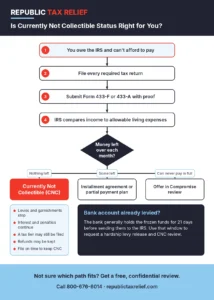
The IRS doesn’t grant hardship status because a taxpayer says money is tight. It runs the numbers. You list your income, expenses, and assets on an IRS form called a collection information statement, and the IRS compares your spending to its own limits, known as the Collection Financial Standards.
Which form you use depends on your case:
- Form 433-F: The shorter statement used in many phone and mail cases.
- Form 433-A: The detailed version, often required by a revenue officer or for self-employed taxpayers.
- Form 433-B: The business version, used when a company owes the IRS.
What the IRS Counts as an Allowable Living Expense
The IRS allows set amounts for food, clothing, and personal care, plus capped amounts for housing, utilities, transportation, and out-of-pocket health care. It also allows other necessary costs you can prove, such as health insurance, child care, court-ordered support, and current-year taxes.
Some common bills usually don’t count:
- Credit card and unsecured loan payments
- Private school tuition
- Charitable donations
- Voluntary retirement contributions
Assets Matter, Too
Even with no monthly leftover, the IRS looks at what you own. Equity in a home, a paid-off second vehicle, or a retirement account balance may lead the IRS to expect you to sell or borrow against that asset first.
What to Gather Before You Apply
| What the IRS Asks About | Proof to Have Ready |
|---|---|
| Income | Recent pay stubs, Social Security or pension statements, 1099s, profit and loss for self-employed work |
| Bank activity | Usually the last three months of statements for every account |
| Housing and utilities | Lease or mortgage statement, utility bills |
| Transportation | Car loan or lease statement, insurance bill |
| Health and child care | Insurance premiums, medical bills, daycare invoices |
| Assets | Vehicle values, retirement and investment account statements |
Takeaway: Your bank statements are how the IRS checks your form. If the two don’t match, expect follow-up questions.
A Worked Example: CNC Status vs. a Payment Plan
Here’s how the math plays out. Maria is a single parent with two kids. She owes about $22,000 from two years of 1099 contract work with no tax withheld. The figures below are simplified for illustration and are not actual IRS standard amounts.
| Monthly Item | Scenario A: Current Job | Scenario B: New Job |
|---|---|---|
| Net monthly income | $4,200 | $5,300 |
| Housing and utilities (capped) | $2,050 | $2,050 |
| Food, clothing, personal care | $1,150 | $1,150 |
| Transportation | $780 | $780 |
| Out-of-pocket health care | $250 | $250 |
| Child care | $400 | $400 |
| Total allowable expenses | $4,630 | $4,630 |
| Left over each month | -$430 | $670 |
| Likely path | Strong CNC candidate | Installment agreement near $670/month |
In Scenario A, Maria has nothing left to pay, so CNC is a realistic request. In Scenario B, the IRS would likely expect a payment plan with the IRS instead. Learn how those work in our guide to setting up an IRS installment agreement.
Takeaway: One bottom-line number drives the decision. Every legitimate expense you document, and every one you forget, moves that number.
Does Currently Not Collectible Stop Bank Levies?
For most people, this is the real question. Once your account is in CNC status, the IRS generally stops new levies, wage garnishments, and property seizures. The IRS describes this as delaying collection until your finances improve (IRS: Temporarily Delay the Collection Process).
If Your Bank Account Was Already Levied
When the IRS levies a bank account, the bank generally holds the frozen funds for 21 days before sending them to the IRS. That window matters. Federal law requires the IRS to release a levy that creates an economic hardship, so a fast, well-documented hardship request can support both a levy release and a CNC review.
Example: John’s checking account is frozen on a Monday. His representative files a signed power of attorney, submits his financials that week, and asks for a hardship release while the funds are still on hold. Waiting a month would likely have meant losing that money.
A wage garnishment works differently because it continues every payday until released. See our pages on bank levy help and wage garnishment relief.
What CNC Doesn’t Stop
- Interest and penalties keep adding to your IRS tax debt.
- A federal tax lien may still be filed, especially on larger balances. Here’s how tax lien help works.
- Future refunds can be kept and applied to the balance.
- State tax agencies run their own collection, so IRS hardship status doesn’t protect you from a state levy.
★★★★★ Google Review
“From the first call, Republic Tax Relief made me feel confident. The staff was knowledgeable and kept me updated at every step.” ~David Clark
Mistakes That Sink a CNC Request
Most denied hardship requests don’t fail because the taxpayer could afford to pay. They fail on paperwork and timing. Watch for these:
- Applying with unfiled tax returns. The IRS expects all required tax returns to be filed first. Get help with unfiled tax returns before you request CNC status.
- Claiming expenses you can’t prove. No receipt or statement often means no credit.
- Leaving out income. Side gigs, rental income, and regular deposits from a partner show up on bank statements.
- Ignoring assets. The IRS sees interest and investment income reported on 1099s.
- Missing a final notice deadline. A final notice of intent to levy usually gives you 30 days to request a Collection Due Process hearing. Miss it, and you lose an important layer of protection.
- Giving inconsistent answers by phone. What you say on a call becomes part of your file.
Takeaway: Treat the request like a loan application in reverse. Every number needs a document behind it.
How Long Does CNC Status Last?
There’s no fixed end date. An account stays in CNC as long as the hardship continues. The IRS may review your case periodically, often when a later tax return shows higher income.
The IRS generally has 10 years from the date a tax is assessed to collect it (26 U.S.C. § 6502). CNC doesn’t pause that clock, so a balance that stays uncollectible until the deadline generally expires. Results depend on your account history, so this is something to confirm with your transcripts rather than assume.
How to Keep Your Status
- File every new tax return on time, even if you can’t pay.
- Adjust withholding or make estimated payments so you don’t create a new balance.
- Keep copies of your financial statement and supporting documents.
- Plan ahead before a raise, inheritance, or new job changes your numbers.
IRS CNC Status vs. Offer in Compromise
Both options rely on your ability to pay, but they solve different problems.
| Currently Not Collectible | Offer in Compromise | |
|---|---|---|
| Main purpose | Pauses collection | Settles the debt for less |
| Monthly payment | None | Lump sum or short-term payments |
| Reduces the balance? | No | Yes, if accepted |
| 10-year collection clock | Keeps running | Paused while the offer is pending |
| Best fit | Temporary or ongoing hardship | Can’t pay in full, now or later, and can fund an offer |
Some taxpayers start in CNC while life settles down, then move to an offer once their finances are clear. Read how the OIC program works or our explainer on the IRS Fresh Start Program.
When to Get Tax Resolution Help
Simple cases can sometimes be handled with one phone call. Bring in a professional if any of these apply:
- Your bank account or paycheck has already been hit
- You received a final notice of intent to levy
- You have several years of back taxes or unfiled returns
- You’re self-employed, or your business owes payroll taxes
- You owe both the IRS and a state tax agency
A representative signs on with IRS Form 2848, pulls your account transcripts, prepares your financial statement against IRS guidance, and handles the calls. If CNC isn’t the right fit, a good firm tells you so and explains what is. If the IRS isn’t responding while a levy causes real harm, the free Taxpayer Advocate Service is another resource worth knowing about.
Your documents are safe with us. Every tax return, bank statement, and Social Security number you share is protected by 256-bit encryption and strict client confidentiality standards, and seen only by your case team.
Currently Not Collectible FAQs
Does Currently Not Collectible stop bank levies?
It generally stops new bank levies once your account is in CNC. If a levy is already in place, you typically need to request a release based on economic hardship, ideally during the 21 days the bank holds the funds.
How long does Currently Not Collectible status last?
There’s no set end date. It lasts while your hardship continues, up to the end of the IRS’s 10-year collection period, though the IRS may review your finances if your income rises.
Do I have to tell the IRS if my income goes up?
The IRS will usually learn about it through your next tax return. Talk with your representative before a big change so you can plan your next step, such as moving to a payment plan, instead of being surprised by a new collection notice.
Can self-employed people get CNC status?
Yes, but the review is more detailed. Expect to provide a profit and loss statement, business bank records, and often Form 433-A instead of the shorter Form 433-F.
Does IRS hardship status cover my state tax debt?
No. State tax agencies make their own collection decisions, so you may need a separate hardship request or payment arrangement with your state.
Speak With a Tax Relief Professional
Key takeaways:
- CNC pauses most IRS collection when you can’t cover necessary living expenses and pay the IRS.
- The IRS decides with Form 433-F or 433-A and its Collection Financial Standards.
- It generally stops new bank levies, but interest, penalties, and liens can continue.
- Filing on time is the key to keeping your status.
You shouldn’t have to choose between paying the IRS and keeping the lights on. We’ll review your numbers, tell you honestly whether CNC fits, and handle the IRS for you if it does.
Call 800-676-6014 or request your free, confidential consultation today.
About Republic Tax Relief
Republic Tax Relief helps individuals and businesses resolve IRS and state tax debt, including back taxes, bank levies, wage garnishments, tax liens, and unfiled returns. Our team of tax professionals, including tax attorneys, handles every case with honesty, discretion, and a clear plan. Call 800-676-6014 or contact us online to get started.
Sources
- IRS: Temporarily Delay the Collection Process
- IRS: Collection Financial Standards
- 26 U.S.C. § 6502: Collection After Assessment
Disclaimer: This article provides general information, not legal or tax advice. Reading it does not create an attorney-client relationship. Results depend on the facts of each case.