
If you own a small business and owe the IRS, your inbox and voicemail probably fill up fast. Some calls are real offers of help. Others are scams. And somewhere in the middle is the question you actually need answered: what should I do next?
This page answers the questions business owners ask Google most about small business tax relief, IRS settlements, 2026 tax law changes, and how to tell a trusted firm from a bad one. Each answer is short, plain, and reviewed by our team of tax attorneys, CPAs, and enrolled agents, who have resolved more than 18,000 cases since 2005.
Jump to a topic:
- Tax Relief Calls, Scams, and Legitimacy
- What Tax Resolution Costs and Whether It Is Worth It
- IRS Settlements, Negotiation, and Tax Forgiveness
- 2026 Small Business Tax Laws, Breaks, and Write-Offs
- Federal Tax Brackets and Income Questions
- IRS Debt After Death and Credit Score Questions
- Speak With a Tax Relief Professional
Tax Relief Calls, Scams, and Legitimacy
Why am I getting calls from tax resolution services?
You are likely getting calls because a federal or state tax lien was filed in your name. Tax liens are public records, and some companies buy lists of new liens to market their services. The calls do not come from the IRS, and they do not mean your situation just got worse.
A flood of calls is still a signal worth acting on. A filed lien means the IRS has moved past simple reminder letters. A trusted professional can explain what the lien means and whether lien release or withdrawal is possible.
What is tax relief, and why are they calling me?
Tax relief is any legal way to lower, pause, or spread out what you owe the IRS or your state. It includes payment plans, penalty removal, settlements, and hardship status. Companies call because public lien records show you may need that help.
The call itself is a sales pitch. Treat it the way you would any sales call: get the company name, look up its credentials, and never pay or share account numbers on that first call.
Is tax relief a legitimate business?
Yes, tax relief is a legitimate business when it is run by licensed professionals. Enrolled agents, CPAs, and tax attorneys are authorized to represent taxpayers before the IRS. The relief programs they use, such as installment agreements and Offers in Compromise, are official IRS programs.
The industry does have bad actors. Before you hire anyone, check that:
- The firm has enrolled agents, CPAs, or tax attorneys on staff
- It reviews your IRS records before promising any result
- Its fees and scope of work are in writing
- It has a real address, reviews, and a track record you can verify
Our guide to tax resolution services explains what a good firm should do for you.
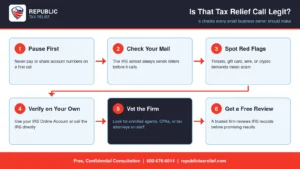
How do I know if a tax call is legit?
The IRS almost always contacts you by mail first, so a surprise call demanding payment is a warning sign. A real IRS employee will not demand immediate payment, threaten arrest, or ask for gift cards, wire transfers, or crypto.
To check, hang up and verify on your own:
- Log in to your IRS Online Account to see your real balance and notices
- Call the IRS directly at 800-829-1040 (individuals) or 800-829-4933 (businesses)
- Compare any caller’s claims to the letters you have received in the mail
If you are unsure about a letter itself, see our guide to IRS notices.
What are some signs that a phone call is actually a scammer?
Scam callers rely on fear and speed. Watch for these red flags:
- Threats of arrest, deportation, or a suspended license
- Demands to pay right now, often by gift card, prepaid card, wire, or crypto
- A caller ID that shows “IRS” or a government office (this is easy to fake)
- Requests for your Social Security number, bank login, or card number
- Promises to settle for “pennies on the dollar” before anyone sees your file
- Pressure to sign or pay the same day
If you get a call like this, hang up. You can report IRS impersonation to the Treasury Inspector General for Tax Administration (TIGTA) at 800-366-4484.
What Tax Resolution Costs and Whether It Is Worth It
How much do tax resolution services cost?
Cost depends on how complex your case is, not just how much you owe. A simple payment plan for one tax year usually costs far less than an Offer in Compromise or a payroll case covering several years and agencies.
| Type of case | What usually drives the fee |
|---|---|
| Simple payment plan | One agency, few tax years, records in order |
| Penalty abatement | Number of years and the strength of your reasonable-cause facts |
| Offer in Compromise | Full financial review, document gathering, and IRS negotiation |
| Payroll tax or Trust Fund Recovery Penalty case | Multiple quarters, personal liability defense, revenue officer contact |
| Unfiled returns plus resolution | Number of years that must be prepared and filed first |
The IRS also charges its own fees, such as setup fees for installment agreements and an application fee for an Offer in Compromise, though low-income waivers exist. A trustworthy firm gives you a free review and a written fee agreement before any work starts.
Is it worth it to use a tax relief service?
It is usually worth it when you owe a large balance, face a levy or lien, owe payroll taxes, or have several unfiled years. In those cases, a professional can stop collections faster, find penalty relief you may miss, and keep you from agreeing to a payment you cannot afford.
It may not be worth it if you owe a small amount and can set up a simple online payment plan yourself. A good firm will tell you that honestly during the consultation. Learn more about our small business tax relief and resolution services.
Does tax relief hurt your credit?
No, working out a deal with the IRS does not show up on your credit report. The IRS does not report payment plans, settlements, or balances to the credit bureaus, and the three major bureaus stopped including tax liens on credit reports in 2018.
That said, a filed tax lien is still a public record. Lenders, landlords, and vendors can find it in their own searches. Resolving the debt, and getting the lien released or withdrawn, helps protect your ability to borrow.
IRS Settlements, Negotiation, and Tax Forgiveness
How much does the IRS usually settle for?
There is no standard percentage. The IRS settles for what it calculates it can reasonably collect from you, based on the equity in your assets plus your future disposable income. In fiscal year 2025, the average accepted offer was about $18,000, according to CNBC’s review of IRS data.
Settlements are also harder to win than many ads suggest. The same IRS data shows the agency received about 38,800 offers that year and accepted about 5,500. That is why a well-prepared offer, built on accurate numbers, matters so much.
Does the IRS ever negotiate settlements?
Yes. The IRS negotiates through official programs, mainly the Offer in Compromise, installment agreements, penalty abatement, and Currently Not Collectible status. It will not negotiate just because you ask for a discount. Every deal must fit IRS rules and your actual finances.
The IRS also negotiates more than most people realize on payment amounts, penalty removal, and timing. Many business cases end with a combination, such as penalty relief plus an affordable payment plan. See how the Offer in Compromise program measures your ability to pay.
Can I negotiate with the IRS myself?
Yes, you have the right to deal with the IRS on your own, and many people set up simple payment plans online. Doing it yourself makes the most sense when the balance is small, your returns are all filed, and no collection action is underway.
It gets riskier when your business owes payroll taxes, a revenue officer is involved, or you are considering a settlement. One wrong answer in an interview or on a financial statement can raise your payment or expose you to personal liability. A representative with IRS Form 2848 can handle every call for you.
Is there still tax forgiveness available in 2026?
There is no blanket tax forgiveness program in 2026. The “Fresh Start” name you see in ads refers to IRS rule changes from 2011 that made existing programs easier to use. Those programs are still available.
Real ways to reduce or end tax debt include:
- Offer in Compromise: settle for less when you cannot pay in full
- Penalty abatement: remove penalties for a clean history or reasonable cause
- Currently Not Collectible status: pause collection during financial hardship
- The collection statute: the IRS generally has 10 years from assessment to collect, after which the balance can expire
Our article on whether the IRS Fresh Start program is legit walks through real examples and real limits.
What happens when you owe the IRS over $10,000?
Owing more than $10,000 does not trigger jail or instant seizure, but it does raise the stakes. At this level, the IRS is more likely to file a federal tax lien, and continued nonpayment can lead to levies on bank accounts, wages, and business receivables.
You still have good options:
- Individuals who owe up to $50,000 can often get a streamlined payment plan without a full financial statement
- Businesses that owe $25,000 or less in payroll taxes may qualify for an in-business express plan with up to 24 months to pay
- Larger balances can still be resolved, but the IRS will ask for detailed financial information
If a final notice has already arrived, our IRS collections defense team can step in quickly. You can also review your IRS payment plan options.
2026 Small Business Tax Laws, Breaks, and Write-Offs
What are the new tax laws for small businesses in 2026?
Most 2026 changes come from the One Big Beautiful Bill Act, signed in July 2025, which the IRS now calls the Working Families Tax Cuts. It made several business tax breaks permanent and changed some reporting rules.
| 2026 change | What it means for your business |
|---|---|
| 100% bonus depreciation, now permanent | Deduct the full cost of qualifying equipment in the year you place it in service |
| Section 179 limit of $2,560,000 | Expense large equipment and software purchases right away |
| 20% QBI deduction, now permanent | Owners of sole proprietorships, partnerships, LLCs, and S-corps keep this deduction long term |
| Form 1099-NEC and 1099-MISC threshold rises to $2,000 | Fewer contractor forms to file, up from the old $600 rule |
| Form 1099-K threshold back to $20,000 and 200 transactions | Fewer payment app forms for low-volume sellers |
| Domestic research costs deductible right away again | Businesses that develop products or software can deduct those costs sooner |
New laws only help if your filings are current. If you are behind, catching up on unfiled tax returns comes first.
What tax breaks are available for small businesses in 2026?
The biggest 2026 tax breaks for small businesses are the 20% qualified business income (QBI) deduction, 100% bonus depreciation, and Section 179 expensing. Many owners also qualify for tax credits, such as the retirement plan startup credit, the research credit, and the FICA tip credit for restaurants and similar businesses.
Credits are especially valuable because they reduce your tax dollar for dollar. A deduction only lowers the income that gets taxed.
What can I write off as a small business owner?
You can write off expenses that are ordinary and necessary for your business. Common examples include:
- Rent, utilities, and a qualifying home office
- Employee wages, benefits, and payroll taxes you pay as the employer
- Equipment, vehicles, computers, and software
- Business mileage (72.5 cents per mile in 2026) or actual vehicle costs
- Insurance, including health insurance for many self-employed owners
- Marketing, website, and advertising costs
- Professional fees for accountants, attorneys, and tax representatives
- Business meals (generally 50%), travel, and training
- Retirement plan contributions for you and your employees
The key is proof. Keep receipts, mileage logs, and a clear business purpose for each expense, because unsupported write-offs are a common audit target. Our guide to small business IRS audits explains which records matter most.
What is the most overlooked tax break?
For many small business owners, the most overlooked tax break is the self-employed health insurance deduction. If you are self-employed and pay for your own health coverage, you may be able to deduct those premiums even if you do not itemize. Others that often get missed include:
- The retirement plan startup credit for small employers that open a new plan
- The home office deduction for space used only for business
- The research credit, which some small businesses can apply against payroll taxes
- The FICA tip credit for food and beverage businesses
What are some common tax loopholes for small businesses?
The so-called loopholes are really legal tax breaks written into the law. The most common ones small businesses use are:
- Electing S-corp tax status to reduce self-employment tax
- Hiring your children in the family business, within IRS rules
- Funding a SEP IRA, SIMPLE IRA, or solo 401(k)
- Using an accountable plan to reimburse business expenses tax-free
- Timing large purchases to use bonus depreciation or Section 179
The line between smart planning and an audit problem is documentation. Aggressive or poorly supported strategies can turn into tax debt later, which is where our business tax resolution services often begin.
How can an LLC avoid paying high taxes?
An LLC can lower its taxes legally by choosing the right tax classification and using available deductions. Many profitable LLCs elect to be taxed as an S-corp, pay the owner a reasonable salary, and take the rest as distributions, which can reduce self-employment tax.
Other common strategies include:
- Claiming the 20% QBI deduction
- Maxing out retirement plan contributions
- Using a state pass-through entity tax election where available
- Keeping business and personal accounts separate so every deduction holds up
Be careful with S-corp salaries. Paying yourself too little is a known IRS red flag and can lead to back payroll taxes and penalties.
Federal Tax Brackets and Income Questions
How much do you pay in federal taxes if you make $100,000 a year?
A single filer who earns $100,000 in wages in 2026 owes about $13,170 in federal income tax, or roughly 13% of gross pay. That assumes the $16,100 standard deduction and no credits. A married couple filing jointly on the same income would owe about $7,640.
Here is how the single filer’s math works, using the IRS 2026 tax brackets:
| Step | Amount |
|---|---|
| Wages | $100,000 |
| Minus standard deduction | $16,100 |
| Taxable income | $83,900 |
| 10% on the first $12,400 | $1,240 |
| 12% on $12,400 to $50,400 | $4,560 |
| 22% on $50,400 to $83,900 | $7,370 |
| Estimated federal income tax | $13,170 |
Employees also pay 7.65% for Social Security and Medicare, or $7,650 on $100,000. Self-employed owners pay both halves, about 15.3% on most of their net earnings, which is why business owners often feel the tax bite more. State income tax is extra.
How do you avoid the 22% tax bracket?
You cannot avoid a bracket by choice, but you can lower your taxable income so less of it lands there. In 2026, the 22% rate starts at $50,400 of taxable income for single filers and $100,800 for married couples filing jointly.
Remember that the 22% rate applies only to income above that line, not your whole income. Common legal ways to reduce taxable income include:
- Contributing to a 401(k), SEP IRA, or other pre-tax retirement plan
- Funding a health savings account (HSA) if you have a qualifying health plan
- Claiming the 20% QBI deduction on business income
- Timing business purchases and expenses into the right tax year
- Keeping complete records so every legitimate deduction counts
What income is not taxed?
Several types of money are not taxed as federal income. Common examples include:
- Gifts and inheritances you receive
- Life insurance proceeds paid because of a death
- Interest from most municipal bonds
- Qualified withdrawals from a Roth IRA or Roth 401(k)
- HSA withdrawals used for qualified medical costs
- Child support payments
- Up to $250,000 of gain on the sale of your main home ($500,000 for married couples), if you qualify
- Workers’ compensation benefits
Rules have limits and exceptions. Income from a business, side gig, or payment app is generally taxable even if you never receive a Form 1099.
IRS Debt After Death and Credit Score Questions
What happens to IRS debt when someone dies?
IRS debt does not disappear when someone dies, but it usually does not pass to their children or other heirs personally. Instead, the debt becomes a claim against the person’s estate, and the IRS gets paid from estate assets before heirs receive their share.
A few situations change that:
- Joint tax returns: A surviving spouse who filed jointly can still owe the full balance for those years. Innocent spouse relief may help if the debt came from the other spouse’s income or business.
- The executor’s role: An executor who pays other creditors or heirs before paying the IRS can become personally responsible for the shortfall.
- Business payroll taxes: Any Trust Fund Recovery Penalty already assessed against the deceased is collected from the estate like other tax debt.
If you are handling a loved one’s estate and find unpaid taxes, get professional advice before distributing any assets.
What is the biggest killer of credit scores?
Missed or late payments are the biggest credit score killer, because payment history is the largest factor in most scoring models. Accounts sent to collections and high credit card balances compared to your limits do serious damage too.
IRS debt is not reported to the credit bureaus. The real risk is what tax debt does to your cash flow. Owners who drain savings or max out credit cards to cover a tax bill often end up missing other payments, and that is what hurts their score. An affordable IRS payment plan can protect your credit by keeping your monthly budget realistic.
Speak With a Tax Relief Professional
Reading answers online is a good start. Getting a plan built around your actual IRS records is what changes the outcome. Whether you owe payroll taxes, income taxes, or state taxes, our team can tell you where you stand in one free conversation.
Speak With a Tax Relief Professional
Prefer to talk now? Call 800-676-6014 today.
Your information stays private. What you tell us stays with us. Every conversation and file is protected by strict attorney-client and tax professional privilege standards, shared only with the experts working your case.
About Republic Tax Relief: Since 2005, Republic Tax Relief has helped individuals and business owners resolve IRS and state tax problems. Our in-house tax attorneys, CPAs, and enrolled agents have resolved more than 18,000 cases and settled over $220 million in tax debt, from payment plans and penalty relief to payroll tax defense and small business tax relief. Call 800-676-6014 for a free, confidential consultation.
This page is for general information only and is not legal or tax advice. Tax laws change, and results depend on your specific facts. Speak with a qualified tax professional before making decisions about your tax debt.
Sources
- IRS: Working Families Tax Cuts, Individuals and Workers (2026 brackets and standard deduction)
- CNBC: IRS offers in compromise have plummeted (September 2026)