
Reviewed for accuracy by: Mark Ladd, CEO | Last updated: October 2026
A tax question at a restaurant rarely stays small. One sales tax rate set wrong in your POS, or one missed payroll deposit, can turn into a notice, then a levy, then a real threat to your doors.
Below are straight answers to the questions restaurant owners ask Google most, from food tax rules to why tax firms keep calling. Each answer explains what it means for your business and when tax resolution for restaurants can help.
On this page:
- Restaurant Sales Tax on Food: State Rules Explained
- How Restaurant Taxes Work for Owners
- How Restaurant Tax Resolution Works
- Restaurant Profits, Industry Pressure, and Tax Relief
- Restaurant Tax Debt and Big Business Decisions
- Why Restaurant Owners Trust Republic Tax Relief
- Speak With a Tax Relief Professional
Restaurant Sales Tax on Food: State Rules Explained
Sales tax on restaurant food changes from state to state, and even from one menu item to the next. These answers explain the rules owners ask about most and what happens when a mistake slips through.
Are restaurants supposed to charge tax on food?
In most states, yes. Meals prepared and served by a restaurant are usually taxable, even in states that do not tax groceries. The exact rules depend on whether food is hot or cold, eaten on site, or sold to go.
Here is the part that hits your wallet. If your POS charged too little tax, or none at all, the state can still bill the business for what it should have collected. That gap often shows up years later in a sales tax audit.
If an audit says you owe for undercharged sales, a tax professional can review the sample periods, challenge estimates, and set up a payment plan. Our business tax resolution services team handles state balances like these every week.
Do restaurants charge tax on food in California?
Yes, for most meals. In California, hot prepared food is taxable, and so is food served for eating at your tables, hot or cold. Cold food sold to go, like a cold sandwich or salad, is usually not taxable.
That changes if your location falls under the 80/80 rule, explained next. Mixing up these categories in your POS is one of the most common reasons California restaurants end up owing the state after an audit.
What is the 80-80 rule in California?
The 80/80 rule applies when more than 80 percent of a location’s gross receipts come from food, and more than 80 percent of that food is taxable. When both are true, even cold to-go items can become taxable unless you track those sales separately, according to the California Department of Tax and Fee Administration (CDTFA).
The rule is applied location by location. A multi-unit group can have one store inside the rule and another outside it.
Owners get into trouble when they skip tax on to-go items without clear records. An auditor can then treat 100 percent of sales as taxable and add penalties and interest. If that has happened to you, the bill can often be reviewed and negotiated.
Can you be tax-exempt at a restaurant?
Sometimes. Certain buyers, such as some nonprofits, schools, or government agencies, may buy meals without sales tax if they give you a valid exemption certificate. Rules vary by state, and many states limit exemptions on prepared food.
For owners, the risk is the paperwork. If you skip tax on a catering order but cannot produce the certificate during an audit, the state can bill you for the tax. Keep a copy of every certificate with its invoice.
Are restaurants tax exempt in Ohio?
No. Ohio restaurants generally must charge sales tax on prepared food and drinks served to customers. Grocery food sold for use at home is usually exempt, but restaurant meals are not.
Ohio’s state sales tax rate is 5.75 percent, and counties add their own rates on top. That means the tax on a restaurant check can differ from one county to the next.
Ohio can also hold owners and officers personally responsible for sales tax the business collected but did not send in. If your restaurant is behind, getting help early protects both the business and your personal assets.
What state has no sales tax on food?
Five states have no statewide sales tax: Alaska, Delaware, Montana, New Hampshire, and Oregon. Even there, restaurant meals are not always tax free. New Hampshire charges a separate meals tax, and some local areas in Alaska and Montana add their own taxes.
Many other states exempt groceries but still tax restaurant meals. And no matter where you operate, federal payroll and income taxes still apply. A restaurant in a no-sales-tax state can still owe the IRS.
How Restaurant Taxes Work for Owners
Restaurants juggle more tax types than most small businesses. Knowing who you owe, and when, makes it easier to spot a problem before it grows.
How do taxes work for restaurants?
A restaurant typically handles federal payroll tax, sales tax, state payroll tax, and income tax, often in the same week. Each one has its own deadline, its own agency, and its own penalties.
| Tax type | Who you pay | How often | Why it matters |
|---|---|---|---|
| Federal payroll tax (Form 941) | IRS | Deposits monthly or semiweekly; return quarterly | Unpaid withholding can become personal debt |
| Federal unemployment tax (Form 940) | IRS | Yearly | Late filing and payment penalties |
| Sales and use tax | State and local agencies | Monthly, quarterly, or yearly | Collected from guests and held in trust |
| State payroll taxes | State agency | Varies by state | Separate state collection actions |
| Business income tax | IRS and state | Yearly, plus estimated payments | Liens and levies if left unpaid |
Trouble usually starts when one tax slips and the others follow. A professional looks at all of them together, so a fix for one does not create a new problem with another. Learn more about payroll tax debt relief for business owners.
What is the $600 rule?
The $600 rule refers to the old threshold for sending Form 1099-NEC to contractors. For payments made in 2026 and later, the One Big Beautiful Bill Act raised that threshold to $2,000. Payments made in 2025 still follow the $600 rule.
The same law kept the Form 1099-K threshold for card and payment app income at $20,000 and more than 200 transactions.
For restaurants, this matters when you pay a handyman, a DJ, a cleaning crew, or a freelance chef. Missed 1099 filings can bring IRS penalties, and treating workers as contractors when they are really employees can lead to back payroll taxes. Our business IRS audit team defends owners when worker status is questioned.
Who pays sales tax on DoorDash and Uber Eats orders?
In many states, the delivery platform collects and sends in sales tax on orders placed through its app, under marketplace facilitator laws. Rules vary, though, and some states treat restaurant delivery orders differently.
The problem comes when your POS reports and sales tax returns double count those sales or leave them out. App payouts may also be reported on Form 1099-K, which the IRS can compare to your income tax return. Clean records now prevent a mismatch notice later.
How Restaurant Tax Resolution Works
If your restaurant already owes, the next questions are about the process itself: how it starts, what it costs, and how fast it can stop collections.
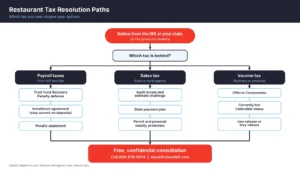
How does a tax resolution work, and what happens first?
Tax resolution means a licensed professional represents you before the IRS and state agencies to stop collections and reach a workable deal. The first steps happen fast, often within days of hiring help.
- Authorization forms are filed, such as IRS Form 2848, so agents contact your representative instead of you.
- Your IRS account transcripts and state records are pulled to confirm every open period.
- A collection hold is requested where possible, especially when a levy is close.
- Missing returns are identified, since most relief options require them. See our help with unfiled tax returns.
After that, your representative compares each option against your real numbers. You can read the full step-by-step approach on our restaurant tax help service page.
How much does tax resolution cost for a restaurant?
Cost depends on how much work your case needs, not just how much you owe. A single missed quarter is simpler than three years of payroll, sales tax, and unfiled returns across two locations.
- The number of tax periods and tax types involved
- Whether returns still need to be prepared and filed
- How many agencies are involved, such as the IRS, the state, and local tax offices
- Whether there is an audit, an appeal, or a Trust Fund Recovery Penalty interview
Ask for fees in writing before you sign anything. Also weigh the cost of waiting, since penalties for late payroll deposits can reach 15 percent, plus interest that grows every month.
What is tax resolution, and why are they calling me?
If you owe back taxes, your debt may be public record through a federal tax lien. Some firms use those records to call or mail restaurant owners. Others who call may be scammers pretending to be the IRS.
The IRS usually reaches out first by mail. It will not demand instant payment by gift card or wire transfer, and it will not threaten to have you arrested, according to the IRS.
A real firm will tell you who will handle your case, put fees in writing, and never guarantee a result before reviewing your records. If a caller pressures you to pay today, hang up and verify first.
How fast can a levy on my restaurant’s bank account be released?
Sometimes within days, if you act quickly. A bank generally holds levied funds for 21 days before sending them to the IRS, which creates a short window to negotiate.
The IRS can release a levy when a payment plan is set up, when the balance is resolved, or in certain hardship situations. Speed matters most when payroll is due. Learn how our bank levy help works.
Levies on credit card processor payments and state cash seizures follow different rules. Call for help the same day you learn about one.
Restaurant Profits, Industry Pressure, and Tax Relief
Revenue and profit are not the same thing, and the IRS knows it. These questions connect how restaurants make money with the relief options owners can qualify for.
Do restaurant owners make a lot of money?
Some do, but most run on thin margins. Many restaurants keep only a few cents of profit from each sales dollar after food, labor, and rent.
That matters for tax relief. The IRS does not decide your options based on sales volume alone. It looks at what you can truly pay after necessary expenses, which is why a busy restaurant can still qualify for a payment plan or, in some cases, an Offer in Compromise.
Are restaurants struggling in 2026?
Many owners report pressure from higher food and labor costs, tighter credit, and uneven customer traffic. Those squeezes leave less cash for every bill, including taxes.
When money gets tight, tax payments are often the first thing pushed back. If that sounds familiar, you are not alone. You have more options before a levy hits than after, so an early professional review keeps the most doors open.
Which types of restaurants get the most IRS attention?
Businesses that handle a lot of cash tend to draw closer review. Bars, nightclubs, food trucks, and cash-heavy counter service spots often face more questions about unreported sales and tips.
Other red flags include reported tips far below normal levels, food costs that do not match sales, and large gaps between card and cash receipts. Strong records and experienced audit defense help you answer those questions with confidence.
Restaurant Tax Debt and Big Business Decisions
Back taxes do not only affect your bank account. They can shape whether you can sell, renew a license, or keep your staff out of the middle of an IRS case.
Can I sell my restaurant if I owe back taxes?
Yes, but tax debt complicates the deal. A federal tax lien attaches to business assets, and most buyers and lenders will want it paid or released at closing.
Sales tax can follow the sale, too. Some states, including California, can hold a buyer responsible for the seller’s unpaid sales tax unless the buyer holds back enough money or the seller gets a tax clearance. Buyers know this and may lower their offer or walk away.
A tax professional can negotiate a lien discharge or a payoff plan so the sale can close. Learn more about tax lien help.
Can unpaid taxes affect my liquor license?
They can. In many states, the liquor control agency checks for unpaid state taxes before it renews or transfers a license. An open state tax balance may delay a renewal or hold up the sale of a license.
In some states, an approved payment plan can help show you are in good standing. Rules differ by state, so address the balance well before your renewal date.
Can a restaurant owner go to jail for not paying sales tax?
It is rare. Most unpaid sales and payroll tax cases are handled as civil debts, with penalties, interest, liens, and levies. Criminal charges usually involve willful evasion, such as hiding cash sales or keeping two sets of books.
Still, the line between a missed payment and willful conduct can blur. If an agent asks for an interview or your records, speak with a tax attorney before you answer questions.
Will the IRS contact my employees or vendors?
It can. A revenue officer may interview managers or bookkeepers to learn who decided which bills got paid. The IRS can also send levies to customers, catering clients, or card processors that owe you money.
When you have a representative, most contact goes through that person. That keeps your staff out of the middle and your business running while the case is worked out. See how IRS collections defense protects owners.
Why Restaurant Owners Trust Republic Tax Relief
Since 2005, our in-house team of tax attorneys, CPAs, and enrolled agents has helped individuals and business owners resolve IRS and state tax debt. Restaurant cases are a regular part of that work.
- 18,000+ cases resolved
- $220M+ in tax debt settled
- 20+ years of experience
- A+ rating with the BBB and a 4.9/5 average client rating
Every tax return, bank statement, and Social Security number you send us is locked behind bank-grade 256-bit encryption and handled under strict tax professional privilege. Your restaurant’s numbers stay between you and us.
Want more detail? Read our guide to restaurant IRS and sales tax debt, browse our general tax relief FAQs, or explore small business tax relief.
Sources
- Tax Guide for Restaurant Owners, California Department of Tax and Fee Administration
- How to know it’s really the IRS calling or knocking on your door, Internal Revenue Service
This page is for general information and is not legal or tax advice. Tax rules change and vary by state, so speak with a qualified tax professional about your situation. Results vary based on individual circumstances.
Speak With a Tax Relief Professional
Every week a restaurant tax problem sits, penalties and interest grow and a levy gets closer. Tax resolution for restaurants works best when you act before the IRS or your state reaches your bank account, your card sales, or your permit.
You have kept your restaurant open through hard seasons. Let us help you protect it now.
Speak With a Tax Relief Professional or call 800-676-6014 today. Your consultation is free and 100% confidential.
About Republic Tax Relief: Republic Tax Relief is a nationwide tax resolution firm that has helped individuals and business owners resolve IRS and state tax debt since 2005. Our tax attorneys, CPAs, and enrolled agents handle payroll tax debt, sales tax balances, bank levies, tax liens, unfiled returns, and settlement negotiations. Call 800-676-6014 or contact us for a free, confidential consultation.