

Oct
Running a restaurant means managing thin margins, rising food costs, staffing gaps, and a POS system that never sleeps. When cash gets tight, taxes are often the bill that slides. A missed payroll deposit turns into two quarters. Sales tax collected from customers gets used to cover rent. Then the IRS or your state tax agency sends a notice, and suddenly your bank account, your equipment, and even your personal assets are on the line.
You are not the first owner in this position, and it is fixable. Tax resolution for restaurants is about stopping collection, sorting out what you really owe, and choosing a realistic path forward. This guide explains the most common restaurant tax problems, why the IRS and state agencies treat them so seriously, and the real resolution options available to food service businesses. You will also learn when it makes sense to bring in a professional, and what that help looks like.
Why Restaurants Face Unique Tax Problems
Few businesses juggle as many tax types at once as a restaurant. You handle federal income tax, employment tax, state and local sales tax, and tip reporting, often all in the same week. Each one has its own filing schedule and its own penalties.
Most restaurant business tax problems start with cash flow, not bad intentions. Common triggers include:
- Seasonal swings: A slow winter or a road closure can cut gross receipts while labor costs stay the same.
- High cash volume: Cash sales and cash tips make bookkeeping harder and raise audit risk when records don’t match.
- Staff turnover: New managers may not know the tip reporting rules or deposit deadlines.
- Using collected taxes as working capital: Payroll withholding and sales tax feel like “available” cash until the deposit is due.
- Outdated restaurant accounting: When the POS system, payroll provider, and books don’t reconcile, returns get filed late or not at all.
Practical takeaway: If you are behind on more than one tax type, treat it as one combined problem. Fixing payroll while ignoring sales tax (or the reverse) usually leads to a second round of notices.
| Common Problem | Who Enforces It | Typical Risk |
|---|---|---|
| Unpaid payroll taxes (Form 941) | IRS | Trust Fund Recovery Penalty, levies |
| Unreported or under-reported tips | IRS | Tip assessments, audits, back FICA |
| Unpaid restaurant sales tax | State and local agencies | Permit suspension, personal liability |
| Unfiled business returns | IRS and state | Estimated assessments, growing penalties |
| Unpaid federal income tax | IRS | Tax liens, bank levies |
Payroll Taxes, Tip Reporting, and the Trust Fund Recovery Penalty
Payroll tax is where restaurant IRS debt becomes most dangerous. When you withhold income tax and the employee share of FICA from paychecks, that money belongs to the government. The IRS calls it “trust fund” money, and it expects you to deposit it on time and report it quarterly on Form 941, with annual federal unemployment tax reported on Form 940.
The Trust Fund Recovery Penalty (TFRP)
If trust fund taxes go unpaid, the IRS can assess the Trust Fund Recovery Penalty against any “responsible person” who willfully failed to pay them. That can include owners, officers, and sometimes managers who sign checks. The penalty equals the full amount of the unpaid trust fund taxes, and it is assessed personally, even if your restaurant is an LLC or corporation (IRS: Trust Fund Recovery Penalty).
For a deeper look at how this works, see our guide to payroll tax debt relief.
Tip Reporting Rules That Trip Up Owners
Tips are wages for tax purposes. Employees who receive $20 or more in tips in a month must report them to you, and you must withhold and pay employment taxes on those reported tips (IRS: Tip Recordkeeping and Reporting). Larger restaurants have extra duties:
- Form 8027: Large food or beverage establishments, generally those where tipping is customary and more than 10 employees work on a typical business day, must file this annual information return on tip income and allocated tips (IRS: About Form 8027).
- Allocated tips: If reported tips fall below 8% of gross receipts, you may need to allocate the difference among tipped employees.
- Form 8846 (FICA Tip Credit): Many restaurants can claim a credit for employer Social Security and Medicare taxes paid on certain tips. Owners who skip it often leave money on the table that could help pay down a balance.
A 2025 federal law also created a deduction for qualified tips on workers’ individual returns. That makes accurate tip reporting on employee W-2s even more important, because errors now affect your staff as well as your business.
Example: A 15-employee bistro reports tips at roughly 5% of gross receipts. An IRS review compares POS credit card tip data to payroll records and finds the gap. The result can be back employer FICA, penalties, and interest across several years. A professional can review the records, claim available credits, and negotiate how the balance gets resolved.
Restaurant Sales Tax Debt and State Tax Problems
Sales tax for restaurants works much like payroll trust fund money. You collect it from customers and hold it for the state. When it is not remitted, state agencies treat it seriously, and in many states, owners and officers can be held personally responsible for unpaid restaurant sales tax.
Common restaurant sales tax problems include:
- Filing sales tax returns late or skipping periods during a slow stretch
- POS settings that apply the wrong state sales tax or local sales tax rate
- Mixing up taxable and non-taxable items, such as to-go food, catering, and delivery fees, which vary by state
- Owing restaurant use tax on equipment or supplies bought out of state without sales tax
- A restaurant sales tax audit that estimates sales from purchase records or credit card data
Unpaid sales tax can lead to state tax liens, bank levies, and in some states, suspension of your sales tax permit, which can effectively shut your doors. If you operate in California, collections may come from both the IRS and state agencies, and our page on bank levy help explains how those levies are stopped.
Practical takeaway: Pull your last 12 months of sales tax returns and compare them to your POS gross receipts. If the numbers don’t line up, address it before the state notices.
What IRS Collection Looks Like for Restaurant Owners
IRS tax problems for restaurants usually follow a predictable path. Knowing the stages helps you act before the most damaging ones:
- Notices: Balance-due letters arrive first. Our guide to IRS notices explains what each one means.
- Federal tax lien: A public claim against your business and personal property that can hurt credit and vendor relationships. Learn about tax lien help.
- Final notice of intent to levy: You have a limited window to request a hearing and protect your rights.
- Levies: The IRS can seize funds in your business bank account, merchant account receivables, and other assets. See how IRS collections defense works.
For a restaurant, a bank levy right before payroll can mean bounced paychecks and lost staff. That is why speed matters once notices start.
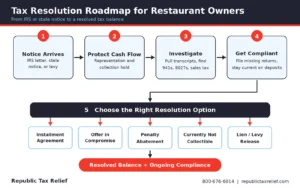
Restaurant Tax Debt Relief Options That Work
The right path depends on what you owe, which taxes are involved, and what your restaurant can realistically pay while staying open. Here are the main options for tax relief for restaurant owners:
Installment Agreement
A monthly payment plan that stops most enforced collection while you pay down the balance. For businesses with current payroll debt, the IRS usually requires you to stay current on new deposits. Learn more about IRS payment plans.
Offer in Compromise
Settling for less than the full amount, based on your ability to pay. It is not available to everyone, and the IRS looks closely at business assets and cash flow. See how the OIC program works.
Penalty Abatement
Penalties can add up to a large share of restaurant back taxes. First-time abatement or reasonable cause relief (for example, a fire, flood, or serious illness) can remove some of them. Read about IRS penalty abatement.
Currently Not Collectible Status
If paying would prevent you from covering basic expenses, collection may be paused. This is more common for owners with personal liability after a restaurant closes. See Currently Not Collectible status.
State Sales Tax Payment Plans and Relief
Most states offer their own payment plans, and some allow penalty relief or settlements. Each state has different rules, so a professional familiar with your state agency can save time.
How Professional Restaurant Tax Resolution Works
Tax Resolution for Restaurants is different from general tax prep. It focuses on negotiating with the IRS and state agencies, protecting your operations, and getting you back in good standing. At Republic Tax Relief, our enrolled agents, tax attorneys, and CPAs follow a clear process:
- Protection: We step in as your representative so the IRS and state agencies contact us, not you or your staff.
- Investigation: We pull your IRS account transcripts and state records to find every open year, unfiled return, and penalty.
- Compliance: We help get missing returns filed, including unfiled tax returns, since most relief options require it.
- Resolution: We build and submit the strongest available option, then negotiate on your behalf.
Signs it is time to get restaurant tax help:
- You received a final notice of intent to levy or a TFRP interview letter
- You owe both payroll and sales tax
- Your business bank account or merchant processor was levied
- You have more than one year of unfiled returns
Every case is different, and results depend on your finances and the agency involved. For a broader view of company-level options, see our business tax resolution services and small business tax relief pages.
Staying Compliant After Your Tax Debt Is Resolved
Most resolution agreements require you to stay current going forward. Missing a deposit can default a payment plan or an accepted offer. A few habits make restaurant tax compliance much easier:
- Separate trust fund money: Move payroll withholding and sales tax into a dedicated account each week.
- Reconcile monthly: Match POS gross receipts, sales tax returns, and bookkeeping records.
- Audit tip reporting: Compare credit card tips to reported tips each pay period.
- Calendar every deadline: Federal deposits, quarterly Form 941, and state sales tax filing dates.
What Our Clients Say
“I just started, so it sounds like they stand by their customers. Helpful, very professional. My agent is very good. Travis Young really takes his time, explains it, and tells you what they do for you. I recommend them to anyone.”
— Mark Underwood, Google Review ★★★★★
Restaurant Tax Help: Frequently Asked Questions
Can I be personally liable for my restaurant’s unpaid payroll taxes?
Yes. The IRS can assess the Trust Fund Recovery Penalty against owners, officers, or others responsible for paying trust fund taxes. This applies even if your restaurant is an LLC or corporation.
Can the IRS shut down my restaurant?
The IRS can levy bank accounts, seize assets, and in serious cases with ongoing unpaid payroll taxes, take steps that can close a business. Acting early and setting up a resolution plan greatly reduces that risk.
What happens if my restaurant didn’t collect or remit sales tax?
The state can assess the unpaid tax plus penalties and interest, file liens, levy accounts, or suspend your sales tax permit. In many states, owners can also be held personally liable.
Can restaurant tax debt be settled for less than I owe?
Sometimes. An Offer in Compromise may be possible if your restaurant cannot pay the full amount based on its income, expenses, and assets. Penalty abatement can also reduce the balance.
Do I need to keep my restaurant open to get tax relief?
No. Relief options exist for both open and closed restaurants. Owners of closed businesses often still owe personal TFRP balances, which can be resolved with a payment plan, offer, or collection hold.
Speak With a Tax Relief Professional
Summary: Restaurant tax debt usually involves payroll taxes, tips, and sales tax at the same time, and each carries real personal risk. The good news is that payment plans, settlements, penalty relief, and collection holds are available. The key is to act before levies hit your bank account or payroll.
Republic Tax Relief has helped individuals and business owners resolve IRS and state tax debt since 2005. Our team handles your case in house, from the first call to the final agreement.
Your financial information stays protected with bank-grade 256-bit encryption and strict client confidentiality, so you can share tax returns and bank statements with complete peace of mind.
Call 800-676-6014 for a free, confidential consultation, or request your consultation online.
About Republic Tax Relief: Republic Tax Relief is a tax resolution firm helping individuals and businesses nationwide resolve IRS and state tax debt. Our certified enrolled agents, tax attorneys, and CPAs handle wage garnishments, bank levies, tax liens, unfiled returns, payroll tax debt, and settlement negotiations. Call 800-676-6014 or contact us to speak with a tax relief professional today.