
Oct
Written by Mark Ladd, Republic Tax Relief | Reviewed by [Reviewer Name, Credential] | Last reviewed: November 19, 2026
That envelope from the IRS is sitting on your counter, and you already know what’s inside. Maybe it’s the third one this year. Maybe you just opened a letter that says “Final Notice,” and your stomach dropped. You’re not alone, and you’re not out of options.
The IRS follows a set path when a taxpayer owes, and every step is written down in law and in IRS guidance. Once you understand that path, you can see where you stand, what comes next, and how much time you have. This guide walks through each stage in plain English: the notices, the timeline, who handles your case, what Publication 594 says, and the appeal rights most people never hear about.
Table of Contents
- What Is IRS Collections?
- How the IRS Collection Process Starts
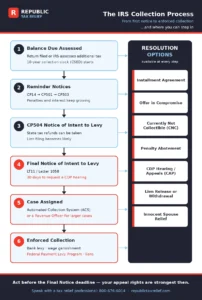
- IRS Collection Process Timeline, Step by Step
- What IRS Publication 594 Says
- Revenue Officer vs. Automated Collection System
- Private Collection Agencies and IRS Debt
- CDP Hearings and the Collection Appeals Program
- The 10-Year Collection Statute (CSED)
- What Happens Next: Your Options
- Key Takeaways
- IRS Collection Process FAQ
What Is IRS Collections?
IRS Collections is the part of the agency that pursues unpaid federal tax after it has been assessed. Its job is to get the balance paid, either voluntarily through a payment arrangement or, if that fails, through enforced collection such as liens and levies.
Collections is separate from an audit. An audit decides how much you owe. Collections deals with getting paid once the amount is on the books. That difference matters, because the rights and deadlines are different in each.
Collections work happens in three places:
- Notice stream: Computer-generated letters mailed on a set schedule.
- Automated Collection System (ACS): IRS call sites that work cases by phone and mail.
- Field collection: Revenue officers assigned to larger or more complex accounts.
Practical takeaway: If you’re unsure whether you’re dealing with an audit or a collection issue, look at the letter. Collection letters ask for payment of a balance. Audit letters ask for records or propose changes to your return.
How the IRS Collection Process Starts
The IRS collection process begins as soon as the IRS assesses a tax you haven’t fully paid and mails you the first bill, usually a CP14 notice. That can happen when you file a tax return without paying in full, or when the IRS assesses additional tax after an audit, a math correction, or a return it prepared for you.
From that point, interest and penalties keep growing on the unpaid tax. According to IRS Tax Topic 201, The Collection Process, the IRS sends a series of notices and gives you chances to pay before it takes enforced collection action. That gap between the first letter and the first levy is your best window to act.
Practical takeaway: Find the notice number in the top or bottom right corner of each letter (for example, CP14 or LT11). That code tells you exactly where you are in the timeline below.
From the IRS Newsroom: The IRS now points taxpayers to its online Tax Debt Help tool and online payment agreements as a first step after a balance-due notice. Individuals who owe $50,000 or less in combined tax, penalties, and interest can often apply for a long-term plan online. Read the IRS update: Options for taxpayers who need help paying their tax bill.
IRS Collection Process Timeline, Step by Step
Most cases follow the same order. The pace varies by balance size, account history, and IRS workload, so treat the gaps below as general guidance, not a promise.
| Step | Notice | What it means | Typical gap (typical, varies by case) |
|---|---|---|---|
| 1 | CP14 | First bill. Lists tax, penalties, interest, and a due date. | Mailed soon after the tax is assessed |
| 2 | CP501 | First reminder that the balance is still unpaid. | About 5 weeks after CP14 |
| 3 | CP503 | Second reminder, with stronger language. | About 5 weeks after CP501 |
| 4 | CP504 | Notice of intent to levy. The IRS can now take your state tax refund. Ten days after this notice, the failure-to-pay penalty rate generally doubles. | About 5 weeks after CP503 |
| 5 | LT11 or Letter 1058 | Final notice of intent to levy and notice of your right to a hearing. Starts a 30-day window to request a Collection Due Process hearing. | Several weeks to several months after CP504 |
| 6 | Letter 3172 | The IRS filed a notice of federal tax lien. You have a separate window to request a hearing. | Can arrive any time after the balance is assessed |
| 7 | Levy or garnishment | Enforced collection begins: bank levies, wage levies, and the Federal Payment Levy Program. | After the 30-day window on the final notice closes |
The Final Notice of Intent to Levy
This is the most important deadline in the entire process. The LT11 or Letter 1058 gives you 30 days to request a collection due process hearing. Once that window closes, the IRS can levy bank accounts, wages, and other assets. It can also use the Federal Payment Levy Program to take part of certain federal payments, including some Social Security benefits.
The Notice of Federal Tax Lien
When the IRS files a notice of federal tax lien, it publicly claims an interest in everything you own, including property you acquire later. A lien isn’t a seizure, but it can make it harder to borrow, refinance, or sell. Learn more about releasing or removing a federal tax lien.
Illustrative example: Dana, a retail manager, got a CP14 for $9,200 after underpaying her withholding. She set it aside. Over the next four months she received a CP501, a CP503, and a CP504, and her state tax refund was applied to the federal balance. Each letter gave her a chance to set up a payment arrangement. She called only after the LT11 arrived, which still left time for a hearing request, but with far fewer days to prepare. (Composite example for illustration, not a specific client.)
Practical takeaway: If you’re holding an LT11 or Letter 1058, find the date on the letter and count 30 days. Missing that date costs you your strongest appeal rights.
What IRS Publication 594 Says About the Collection Process
IRS Publication 594, The IRS Collection Process, is the agency’s own plain-language overview of what happens when you owe. It’s often mailed with collection notices, and it’s worth reading even if you plan to get help.
Publication 594 covers:
- What to do when you receive a bill, including how to dispute an amount you think is wrong
- Payment options, such as installment agreements and offers in compromise
- How a notice of federal tax lien works and how it can be released or withdrawn
- When the IRS can levy wages, bank accounts, and other property
- Your appeal rights, including Collection Due Process and the Collection Appeals Program
- How long the IRS has to collect, and your rights under the Taxpayer Bill of Rights
What Publication 594 doesn’t do is tell you which option fits your situation. It describes the rules, not the strategy. That’s where looking at your full financial picture, including your income, assets, and collection deadlines, makes the difference.
Who Handles Your Case: Revenue Officer vs. Automated Collection System
Most collection cases go to the IRS’s Automated Collection System, a network of call sites that work accounts by phone and mail. Larger or more complex balances, including many business and payroll tax cases, may be assigned to a revenue officer who works in the field.
| Automated Collection System (ACS) | Revenue Officer | |
|---|---|---|
| Contact method | Letters and phone calls | Phone, letters, and in-person visits to your home or business |
| Typical cases | Smaller individual balances | Larger balances, businesses, payroll taxes, repeat cases |
| Who you talk to | Whoever answers the phone that day | One assigned officer who knows your file |
| Pace | Can go quiet, then move quickly | Firm deadlines set by the officer |
| What they’ll ask for | Basic income and expense details | A full collection information statement (Form 433-A or 433-B) with bank statements and records |
| Enforcement tools | Bank levies, wage levies, lien filings | All of those, plus summonses and, in rare cases, asset seizures |
Why the Difference Matters
An ACS case can stay in the phone queue for months. A revenue officer case is personal and moves on the officer’s calendar. Revenue officers often set a deadline to file missing returns or turn in financial forms, and missing it can lead straight to a levy.
Illustrative example: Marcus owns a small landscaping company that fell behind on payroll tax deposits. Instead of more letters, he got a business card on his door from a revenue officer asking for a call within 10 days. The officer asked for six months of bank statements, a list of equipment, and proof that current deposits were being made. Because a revenue officer was involved, the clock was set by her schedule, not the notice stream. (Composite example for illustration, not a specific client.)
Practical takeaway: If a revenue officer contacts you, write down their name, ID number, and every deadline they give you. Business owners in this spot should also read about payroll tax debt relief.
Private Collection Agencies and IRS Debt
The IRS may assign certain older, inactive accounts to a private collection agency under its private debt collection program. These agencies work under contract with the IRS, and they must follow the Fair Debt Collection Practices Act. IRS Publication 4518 explains what to expect.
Before any agency contacts you, the IRS mails you a notice (CP40) saying your account was assigned and naming the agency. The agency then sends its own letter. If you get a call with no IRS letter first, treat it as a red flag.
What a Private Collection Agency Can Do
- Call and write to you about your IRS balance
- Verify your identity and discuss the amount owed
- Help you set up a payment arrangement
- Return your case to the IRS if you ask in writing
What a Private Collection Agency Cannot Do
- Ask you to pay the agency directly. All payments to the IRS go to the U.S. Treasury.
- Demand payment by gift card, prepaid debit card, wire transfer, or cryptocurrency
- Threaten arrest, deportation, or loss of a license
- File a lien, levy a bank account, or seize property. Only the IRS can do that.
From the IRS Newsroom: IRS impersonation by email, text, and AI-enabled phone calls tops the IRS’s 2026 “Dirty Dozen” scam list. The IRS says it generally contacts taxpayers by mail first and won’t call to demand immediate payment or threaten arrest. It also warns taxpayers not to rely on AI-generated answers to complex tax questions. See the IRS’s Dirty Dozen tax scams.
Practical takeaway: If you’re not sure a caller is legitimate, hang up and check your balance through your IRS online account or the phone number printed on your CP40.
Your Appeal Rights: CDP Hearing and the Collection Appeals Program
You have the right to challenge IRS collection actions. Two main paths exist, and IRS Publication 1660, Collection Appeal Rights, explains both. Both are decided by the IRS Independent Office of Appeals, which is separate from the collection employee working your case.
| Collection Due Process (CDP) Hearing | Collection Appeals Program (CAP) | |
|---|---|---|
| When you can use it | Within 30 days of a final levy notice or a lien hearing notice | Before or after a lien, levy, or seizure, or when an installment agreement is rejected, modified, or ended |
| Speed | Often several months | Usually much faster |
| Court review | Yes, you can petition the U.S. Tax Court | No, the Appeals decision is final |
| Effect on levies | Levy action generally pauses while a timely hearing is pending | Collection is generally paused on the appealed issue while Appeals considers it, with exceptions |
| Can you dispute the tax itself? | Sometimes, if you had no earlier chance to dispute it | No |
What a CDP Hearing Covers
A CDP hearing is usually held by phone or correspondence. The Appeals officer checks that the IRS followed the law and its own procedures, and you can propose an alternative such as an installment agreement, an offer in compromise, or currently not collectible status. You can also ask for a lien to be withdrawn or raise spousal defenses. If you miss the 30-day window, you may still request an “equivalent hearing” within one year, but you lose the right to go to Tax Court.
How the Collection Appeals Program Works
CAP is built for speed. It’s a good fit when a specific action is the problem, such as a levy that’s about to hit, a lien that’s blocking a sale, or a payment plan the IRS just rejected. The general steps:
- Ask for a manager conference first. In most cases, you must try to resolve the issue with the collection employee’s manager before going to Appeals.
- File Form 9423 if the conference fails. Deadlines are short. For lien, levy, and seizure issues on revenue officer cases, the request is generally due within a few business days of the manager conference.
- Installment agreement rejections have their own timeline. You generally have 30 days from the rejection notice to appeal through CAP.
- Appeals decides quickly. The decision is binding on you and the IRS, and you can’t take it to court.
Illustrative example: A couple who owned a rental property had a buyer lined up, but a federal tax lien stood in the way of closing. A full CDP hearing could have taken months, and their hearing window had already passed. A CAP appeal focused on one narrow question, whether the IRS should discharge the lien from that property so the sale could go forward with proceeds applied to the debt, was a better fit for their timing. (Composite example for illustration, not a specific client.)
Practical takeaway: A hearing isn’t just a delay tactic. Whether you use CDP or CAP, the strongest requests come with a real proposal and the financial records to back it up.
The 10-Year Collection Statute (CSED)
The IRS has 10 years from the date a tax is assessed to collect it. That deadline is the Collection Statute Expiration Date, or CSED. Once it passes, the remaining balance for that tax year generally can’t be collected, and the IRS writes it off.
A few points people often miss:
- Each tax year has its own clock. If you owe for 2018, 2020, and 2022, you have three different CSEDs.
- Additional assessments start new clocks. If the IRS adds tax for a year after an audit, that new amount gets its own 10-year period.
- Some actions pause the clock. These include a pending offer in compromise, a pending installment agreement request, a timely CDP hearing, and time spent living outside the U.S. for six months or more.
- Currently not collectible status doesn’t pause it. The clock generally keeps running while collection is on hold for hardship.
Illustrative example: Ray, a semi-retired contractor, owed on four tax years. Two of them were assessed more than eight years ago. When his transcripts were reviewed, it was clear a long payment plan would mostly pay down years close to expiring. That changed which options were worth considering for his situation. (Composite example for illustration, not a specific client.)
Practical takeaway: Before choosing any strategy, have your IRS account transcripts pulled and each CSED calculated. Filing for some options can extend the clock, and that trade-off should be a deliberate choice.
What Happens Next: Your Options
Once you know where you are in the timeline, the next question is how to resolve the balance. Most taxpayers qualify for an IRS payment plan, while some can settle through an offer in compromise based on ability to pay. If paying would leave you unable to cover basic living expenses, currently not collectible status can pause collection, and IRS penalty abatement may reduce what you owe. If you’re ready to act or a levy is close, our IRS collections defense team can review your notices and step in.
When to get IRS representation: You can handle a simple balance on your own, but things change once a revenue officer is involved, a final notice has arrived, or you owe payroll or state tax. A licensed professional can contact the IRS for you, request holds on collection, and propose terms you may not know to ask for.
“Great experience! They were nice, listened and helpful. I spent 10,000 with Optima Tax Relief and after 3 years nothing got done. Republic was so affordable and quick! They saved my life.”
— Beth Downey, Google Review
Your privacy is protected at every step. Every document you share is secured with bank-grade 256-bit encryption and handled under strict tax professional confidentiality standards.
Key Takeaways
- The IRS collection process starts with the first bill, usually a CP14, after a tax is assessed.
- Reminder notices typically arrive weeks apart, but timing varies by case.
- The final notice of intent to levy starts a 30-day clock for your strongest appeal rights.
- Publication 594 explains the rules; it doesn’t tell you which option fits you.
- ACS handles most cases by phone and mail; revenue officers handle larger or complex ones in person.
- Private collection agencies can’t levy, file liens, or take payments directly.
- CDP hearings allow Tax Court review; CAP is faster but final.
- Each tax year has its own 10-year collection statute, and that shapes your strategy.
Whatever stage you’re in, the earlier you act, the more options you keep.
IRS Collection Process FAQ
When does the IRS collection process begin?
The IRS collection process begins when the IRS assesses a tax you haven’t fully paid and mails your first bill, usually a CP14 notice. Interest and penalties start adding up from that point, and reminder notices follow if the balance stays unpaid.
How long does the IRS collection process take?
It usually takes several months to move from the first bill (CP14) to the final notice of intent to levy. Larger balances or cases assigned to a revenue officer can move faster.
What is the difference between a revenue officer and the Automated Collection System?
The Automated Collection System handles most cases by phone and mail. A revenue officer is assigned to larger or more complex cases and may visit your home or business in person.
What happens if I miss the 30-day deadline for a CDP hearing?
You may still request an equivalent hearing within one year of the notice. However, you lose the right to petition the U.S. Tax Court, and the IRS isn’t required to pause levy action.
Does Currently Not Collectible status erase my tax debt?
No. Currently Not Collectible status pauses active collection, but interest and penalties continue, and the IRS may keep future tax refunds. The 10-year collection clock generally keeps running during this time.
How long does the IRS have to collect a tax debt?
The IRS generally has 10 years from the date a tax is assessed to collect it. This is called the Collection Statute Expiration Date. Certain actions, such as a pending offer in compromise or a timely Collection Due Process hearing, can pause that clock.
Is a private collection agency calling me about my taxes legitimate?
It may be, but only if the IRS mailed you a CP40 notice first naming the agency. A legitimate agency will never ask you to pay it directly, demand gift cards or wire transfers, or threaten arrest. If you’re unsure, hang up and verify through your IRS online account.
What happens at an IRS Collection Due Process hearing?
An Appeals officer from the IRS Independent Office of Appeals reviews whether the IRS followed proper procedures and considers alternatives you propose, such as a payment plan, offer in compromise, or hardship status. Hearings are usually held by phone or mail. If you disagree with the result, you can generally petition the U.S. Tax Court.
Find More Answers about IRS Collections Defense
Speak With a Tax Relief Professional
You don’t have to face the IRS alone. Republic Tax Relief helps individuals and business owners resolve IRS and state tax debt and find a realistic path forward. Our team reviews your notices, explains your options in plain language, and handles communication with the IRS for you.
Call 800-676-6014 or request your confidential consultation today.
Sources
- IRS, Tax Topic 201: The Collection Process
- IRS, Publication 594: The IRS Collection Process
- IRS, Publication 1660: Collection Appeal Rights
- IRS, Publication 4518: What You Can Expect When the IRS Assigns Your Account to a Private Collection Agency
- IRS Newsroom, Options for taxpayers who need help paying their tax bill
- IRS Newsroom, Dirty Dozen tax scams
Last reviewed: November 19, 2026. This article is for general education and isn’t legal or tax advice for your specific situation.