
Oct
A balance-due notice from the IRS can make your stomach drop. The good news is that owing money you can’t pay today is one of the most common tax problems in the country, and the IRS has a set system for handling it. For most people, that system is a payment plan.
The hard part isn’t finding out that payment plans exist. It’s picking the right one. The type of plan you choose affects your setup fee, your monthly payment, whether the IRS asks for your financial records, and whether a tax lien gets filed. This guide walks through each option in plain English so you can make a smart choice, or know when it’s time to bring in a tax professional.
How Payment Plans Work When You Owe the IRS
An IRS payment plan is an agreement with the IRS that lets you pay your tax debt over time instead of all at once. The formal name for a long-term plan is an installment agreement. Short-term plans give you up to 180 days to pay in full.
A payment plan doesn’t erase what you owe. It does give you something valuable: breathing room. While a request is pending and while the plan is active, the IRS generally can’t levy your wages or bank accounts.
What a Payment Plan Does and Doesn’t Do
- It does: stop most levies, turn one large bill into a predictable monthly payment, and cut the late-payment penalty in half for many taxpayers.
- It doesn’t: stop interest from building, remove existing tax liens on its own, or protect future refunds, which the IRS keeps and applies to your balance.
Practical takeaway: Request a plan before the IRS sends a final notice of intent to levy. It is much easier to set up a plan than to undo a levy after money has left your account.
Types of IRS Payment Plans: Which Installment Agreement Fits You?
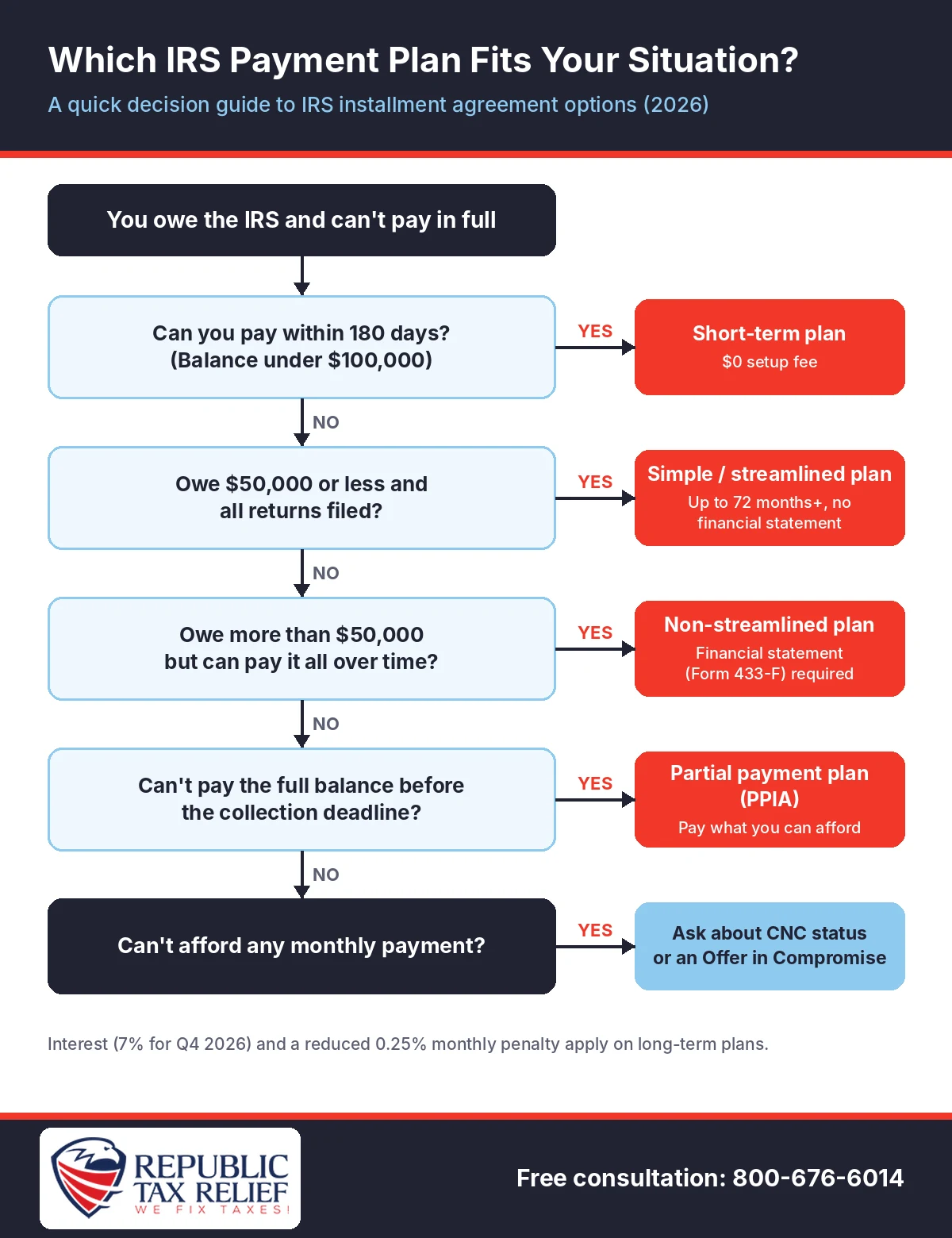
The IRS offers several types of payment plans. The right plan depends mostly on how much you owe and whether you can pay the full balance before the IRS’s collection deadline, which is usually 10 years from the date the tax was assessed.
| Plan type | Who it’s for | Financial disclosure? |
|---|---|---|
| Short-term payment plan | Individuals who owe less than $100,000 and can pay within 180 days | No |
| Guaranteed installment agreement | Individuals who owe $10,000 or less, have a clean five-year filing record, and can pay within three years | No |
| Simple (streamlined) installment agreement | Individuals who owe $50,000 or less; many businesses up to $25,000 or $50,000 | No |
| Non-streamlined installment agreement | Taxpayers who owe more than $50,000 but can pay in full over time | Yes, usually Form 433-F or 433-A |
| Partial payment installment agreement (PPIA) | Taxpayers who can’t pay the full balance before the collection deadline | Yes, full financial review |
Streamlined Installment Agreement: The Most Common Route
The IRS now calls its streamlined option a Simple Payment Plan. Individuals qualify with $50,000 or less in combined tax, penalties, and interest, and businesses qualify with up to $25,000 if trust fund taxes are involved or $50,000 if they are not. The IRS doesn’t require a financial statement or a lien determination for these plans (IRS: Simple Payment Plans).
Partial Payment Installment Agreement (PPIA)
A PPIA lets you pay a monthly amount you can actually afford, even if that amount won’t pay off the full balance before the collection deadline. Whatever is left when the deadline passes is generally no longer collectible. The trade-off is a detailed review of your income, expenses, and assets, and the IRS may review your finances again every two years.
Example: Maria owes $68,000 and can afford $400 a month after basic living costs. That won’t clear the debt in time, so a standard plan doesn’t work. A PPIA built around a carefully documented budget may be her best option.
Business owners with payroll tax balances have extra rules to consider. See our guide to payroll tax debt relief for details.
IRS Payment Plan Fee Schedule and Installment Agreement User Fees (2026)
The IRS charges a one-time user fee to set up a long-term plan. How much you pay depends on two choices: how you apply and how you pay each month. Here are the current fees (IRS: Payment Plans; Installment Agreements):
| Plan and payment method | Apply online | Apply by phone, mail, or in person |
|---|---|---|
| Short-term plan (180 days or less) | $0 | $0 |
| Long-term plan with automatic bank debit | $29 | $107 |
| Long-term plan with other payment methods | $69 | $178 |
| Low-income taxpayers with automatic debit | Waived | Waived |
| Low-income taxpayers, other methods | $43 (may be reimbursed) | $43 (may be reimbursed) |
| Changing an existing plan | $6 | $89 |
Practical takeaway: Applying online and choosing automatic bank debit is the cheapest long-term setup. It also protects you from accidentally missing a payment.
Minimum Monthly Payment on an IRS Installment Agreement
For a streamlined plan, a good starting estimate for the minimum monthly payment is your total balance divided by 72 months. Interest and penalties continue on top of that while the plan is active.
Penalties and Interest Keep Adding Up
- Interest: The IRS charges interest on unpaid tax at 7% per year for the fourth quarter of 2026, compounded daily (IRS Newsroom, IR-2026-98). The rate is reset every quarter.
- Penalty: The failure-to-pay penalty is normally 0.5% per month. If you filed your tax return on time, it generally drops to 0.25% per month while your installment agreement is in effect.
Example: James owes $30,000. Dividing by 72 suggests about $417 a month. Once interest and the reduced penalty are counted, a payment that actually clears the balance in six years is closer to $510 to $560 a month. These are estimates only; your exact figure depends on your balance and how rates change.
Practical takeaway: Pay more than the minimum whenever you can. There is no prepayment penalty, and every extra dollar cuts future interest.
How to Set Up an IRS Payment Plan
You have three main ways to apply. Which one makes sense depends on your balance and how complex your tax situation is.
- IRS Online Payment Agreement tool: Best for individuals who owe $50,000 or less and have filed all required returns. Approval is often immediate.
- Form 9465: The paper Installment Agreement Request. Under the IRS Form 9465 instructions, you list your balance, proposed monthly payment, and payment date, and you attach Form 433-F if you owe more than $50,000.
- By phone or through a representative: Required for many business balances and complex cases.
Before you apply, every required tax return must be filed. If you’re behind, start with our guide to unfiled tax returns. For a step-by-step walkthrough of the application itself, read how to set up an installment agreement.
Mistakes That Can Cancel Your Installment Agreement With the IRS
Getting approved is only half the job. The IRS can end your agreement if you break its terms, and then collection actions can start again.
- Miss a payment: The IRS usually sends Notice CP523 before ending the plan, which gives you about 30 days to respond.
- Owe new tax: A new balance next April can put the whole agreement in default. Adjust your withholding or estimated payments now.
- File late: Every future tax return must be filed on time.
- Ignore IRS notices: Address change letters and balance updates matter. A missed letter can lead to a missed deadline.
What About Tax Liens?
On larger balances, the IRS may file a Notice of Federal Tax Lien even after you agree to a plan. A lien can make it harder to sell property or get financing. Our tax lien help page explains release and withdrawal options.
Practical takeaway: If you get a CP523, call the IRS or your representative right away. Many defaulted plans can be reinstated if you act inside the 30-day window.
When a Payment Plan Isn’t the Right Fit
A payment plan is the right tool when you can make steady monthly payments. It may not be the best tool if your finances can’t support one. Other options to discuss with a professional include:
- Currently Not Collectible status if you can’t cover basic living expenses.
- An Offer in Compromise if you may qualify to settle for less than you owe.
- Penalty abatement to lower your balance before you lock in a monthly payment.
State tax agencies run their own plans with different rules, so an IRS or state balance may need separate agreements. Compare all of your tax debt relief options before you commit.
Why Work With a Tax Relief Professional
You can apply for a simple plan yourself. A tax professional earns their fee when the stakes are higher: balances over $50,000, a PPIA, payroll tax debt, an active levy, or several years of unfiled returns. In those cases, how your financial statement is prepared can change your monthly payment by hundreds of dollars.
Republic Tax Relief has helped taxpayers since 2005. Our in-house team of enrolled agents, tax attorneys, and CPAs has resolved more than 18,000 cases and holds an A+ rating with the BBB. We pull your IRS records, review every option, and negotiate the plan that fits your real budget.
“Republic Tax Relief helped me relieve my Tax debt painlessly, I’m glad that they were able to help me in my situation. If you’re in Tax trouble call Republic Tax Relief 💪🏿”
Paul Bailey, Google Review
Your tax returns, Social Security number, and bank statements stay protected by strict client-privilege confidentiality and bank-grade 256-bit encryption, so you can share what we need with complete peace of mind.
Summary: Choosing the Right Installment Agreement
- Payment plans allow taxpayers to pay over time and generally stop IRS levies while active.
- Short-term plans are free; long-term setup fees run from $0 to $178 depending on how you apply and pay.
- Owe $50,000 or less? A streamlined plan usually requires no financial statement.
- Can’t pay the full balance before the collection deadline? A partial payment installment agreement may help.
- Interest and penalties continue, so pay extra when you can and never miss a payment.
IRS Payment Plan FAQs
How long can an IRS payment plan last?
Short-term plans last up to 180 days. Long-term installment agreements commonly run up to 72 months, and some plans can extend to the end of the 10-year collection period.
Does an IRS installment agreement stop wage garnishment?
Generally, yes. The IRS usually does not levy while a plan request is being considered or while a plan is active. If a garnishment is already in place, you may need help getting it released. Learn more about wage garnishment relief.
What is the minimum monthly payment on an IRS installment agreement?
There is no single fixed minimum. For streamlined plans, a common starting point is your balance divided by 72 months. Non-streamlined plans and PPIAs are based on your documented income and expenses.
Can the IRS reject my payment plan request?
Yes. The IRS must approve every plan and can reject a request if returns are unfiled, the proposed payment is too low, or financial information is incomplete. You can appeal a rejection.
Do I need a tax professional to set up an IRS payment plan?
Not for a simple plan on a smaller balance. A tax professional is worth considering if you owe more than $50,000, need a PPIA, owe payroll taxes, or are already facing levies or liens.
Speak With a Tax Relief Professional
You don’t have to guess which plan fits or worry about picking the wrong one. Our team will review your IRS account, explain every option in plain terms, and handle the negotiation for you.
About Republic Tax Relief
Republic Tax Relief helps individuals and businesses resolve IRS and state tax debt, stop wage garnishments and bank levies, and get back on solid financial ground. Since 2005, our in-house enrolled agents, tax attorneys, and CPAs have resolved more than 18,000 cases. Call 800-676-6014 for a free, confidential consultation or contact us online.
This article is for general information only and is not legal or tax advice. Results vary based on each taxpayer’s situation.