
A letter from the New York State Department of Taxation and Finance is not just a letter. Each NYS DTF letter starts its own clock, and what you can still do depends on which notice you are holding and how many days are left on it. A Request for Information can be answered with a few documents. A Notice of Deficiency gives you 90 days to protest. A Notice and Demand is a bill that is already final, and if it goes unpaid, it can lead to a tax warrant.
This guide is New York tax notices explained in the order they usually arrive: how to identify the letter, what each common New York State tax notice means, the deadline that comes with it, and which ones you can still challenge. It covers letters from the NYS Tax Department about state taxes such as personal income tax, sales tax, and withholding tax. Letters from the IRS follow different rules.
In this guide:
- How to identify the letter from the NYS Tax Department
- NYS DTF letters at a glance: what each notice means and your deadline
- Flowchart: the order New York State tax notices usually arrive
- Request for Information (DTF-948 or DTF-948-O): how to respond
- Refund letters: adjustment notices and uncashed checks
- Statement of Proposed Audit Change: agree or respond before a bill
- Notice of Deficiency: the 90-day deadline for BCMS or Tax Appeals
- A real court case: Ruderman v. Tax Appeals Tribunal
- Notice and Demand: when the tax bill is final
- Notice of Proposed Driver’s License Suspension: 60 days
- Which NYS tax letters can still be challenged?
- Example scenarios: common NYS tax letter situations
- Frequently asked questions
How to Identify the Letter From the NYS Tax Department
The Tax Department’s letters require different responses, so identifying the letter you received comes first. Before you do anything else, read the letter and find its form number. The Tax Department prints the form number of your letter in its bottom-left corner, and on some notices it appears in the upper-right corner. That number tells you what type of letter it is and how to respond online (NYS Tax Department: Respond to your notice or bill online).
- Find the form number in the bottom-left. For example, DTF-948 is a Request for Information, DTF-160 is an account adjustment notice about your refund, and DTF-960-E is a Statement of Proposed Audit Change.
- Check the upper-right corner of a bill. If you receive a bill or notice with an amount due, the amount and the due date appear in the upper-right corner (NYS Tax Department: Did you receive mail from us?).
- Note the ID number. A bill carries an assessment ID that begins with the letter L (L-#########-#). Many audit and review letters carry a case ID that begins with X. You will need that number to respond online.
- Write down the date on your letter. Every deadline runs from the date printed on the notice, not the day it arrives in the mail.
View a copy in your Online Services account
If you have an Individual Online Services account, you can view a copy of most letters in your Online Services Document Summary, along with other documents the Department sent you in the last three years. That means you can often read the letter before the paper copy arrives in the mail, and respond sooner. If you do business with the Tax Department as an owner, a Business Online Services account covers taxes such as sales and use tax, withholding, corporation tax, and the pass-through entity tax, and shows the balance of each tax account.
Is the letter real?
The New York State Tax Department does send letters by mail about real issues. The Department says its informational letters always point to its website or include a QR code that leads there. If a letter asks you to pay by gift card, call an unfamiliar number, or click a link that does not go to tax.ny.gov, compare it with your Online Services account before you act, and report it if it doesn’t match. Keep the letter and the envelope either way. You can also sign up for the Department’s free tax tips emails so you know what it is mailing.
NYS DTF Letters at a Glance: What Each Notice Means and Your Deadline
These are the most common New York State tax notices individuals and small businesses receive. The deadline column is general. The date printed on your letter always controls.
| Letter or notice | Form number | What it means | Your deadline |
|---|---|---|---|
| Request for Information (RFI) | DTF-948 or DTF-948-O | The state needs documentation to support what you claimed on your personal income tax return. Your refund is on hold. | Respond by the date on your letter |
| Return review letters | DTF-973 series (for example DTF-973.52, DTF-973.55, DTF-973.65) | Your return was selected for review of a specific item, such as self-employment income, itemized deductions, or a rental loss | Respond by the date on your letter |
| Account adjustment notice | DTF-160 or DTF-161 | Your refund was adjusted or denied. The Explanation section says why. | No protest needed to respond; send documentation if you disagree |
| Statement of Proposed Audit Change | DTF-960-E (and similar audit statements) | A review found additional tax, penalty, or interest. It asks you to agree or disagree before a bill is issued. | The response date on the statement |
| Notice of Deficiency (income tax) or Notice of Determination (sales and other taxes) | Shown on the notice | A formal assessment notice with protest rights, mailed by certified or registered mail | 90 days to request a conciliation conference or petition the Division of Tax Appeals (150 days if addressed outside the U.S.) |
| Notice and Demand | For example DTF-966-E (estimated tax underpayment) | A tax bill for an amount that is already assessed | Pay or arrange payment by the due date in the upper-right corner |
| Notice of Proposed Driver’s License Suspension | Shown on the notice | You owe $10,000 or more in past-due tax personally assessed against you | 60 days to resolve the debt |
| Uncashed or lost check letters | DTF-32, DTF-33, DTF-36, TD-210 series | The state owes you money, often a tax refund check that was never cashed | Return the form; the online upload PIN expires 30 days after the letter is printed |
Flowchart: The Order New York State Tax Notices Usually Arrive
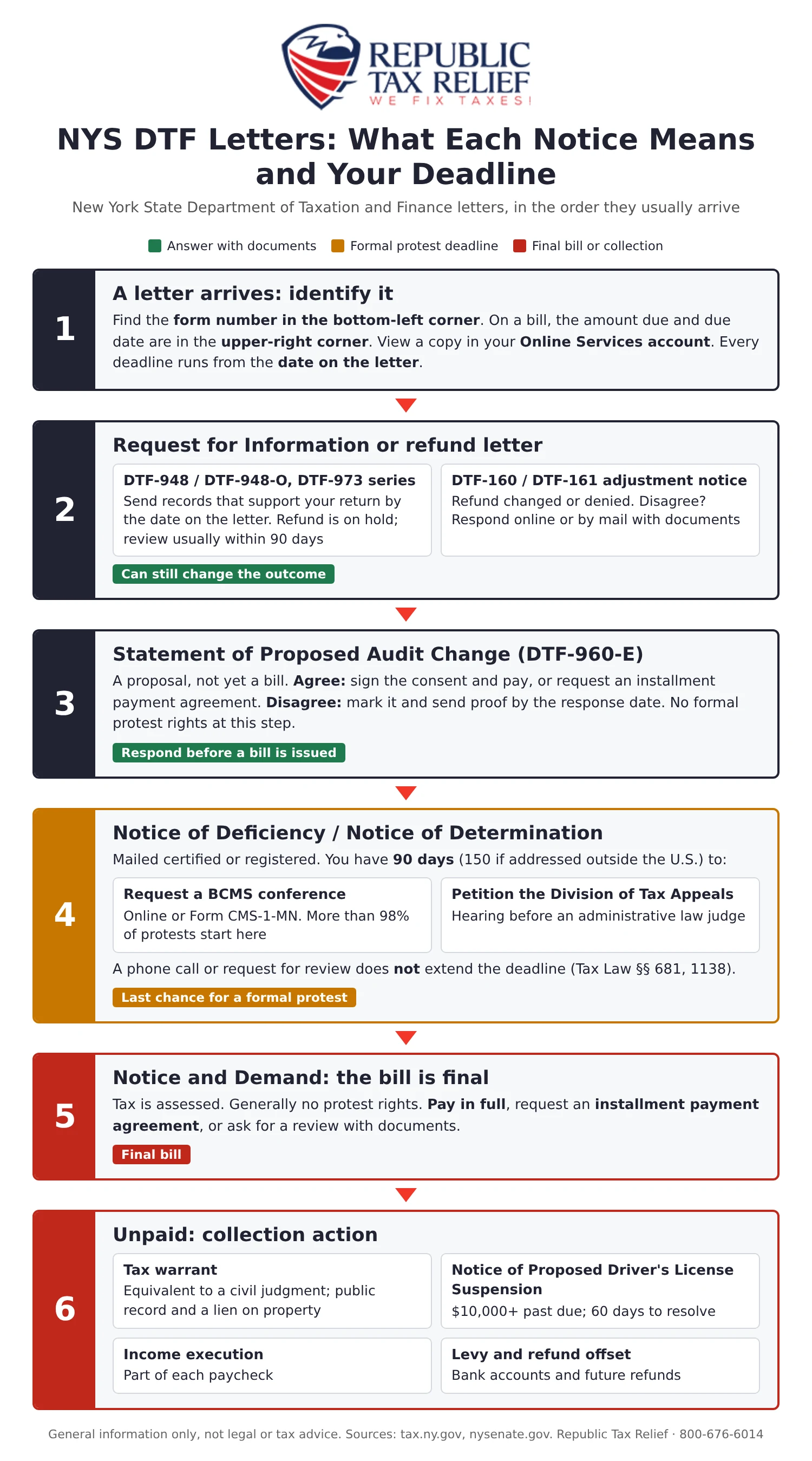
Not every taxpayer sees every letter. Many cases end at the first step when the taxpayer sends the documents. But when letters go unanswered, they tend to arrive in this order, and each step leaves you fewer ways to challenge the tax.
Request for Information: How to Respond to a Letter Requesting DTF-948 or DTF-948-O Documents
The primary letter the NYS tax department uses to request information about a return is Form DTF-948 or DTF-948-O, Request for Information. If your refund status says the Department sent you one of these letters, your return is paused until you respond (NYS Tax Department: Respond to a letter requesting additional information). Receiving one doesn’t mean you did anything wrong. In its May 2026 release, the Department explained that requesting information is a step it takes to make sure returns and refund amounts are accurate, and that you should respond by the date noted on the letter (NYS Tax Department news release, May 7, 2026).
Why you may receive a letter asking for information
If you received this letter, the Department is asking for missing information or documentation about a specific tax year. Common reasons include:
- To verify the wages and withholding you reported for New York State, New York City, or Yonkers.
- To verify that you lived or worked in New York State, New York City, or Yonkers.
- You claimed a credit and the form for it wasn’t included with your income tax return.
- To confirm your eligibility for credits or itemized deductions.
- To verify a dependent’s Social Security number or date of birth.
- To verify rental real estate income or loss, or income from a partnership, S corporation, or trust.
How to respond online
- Read the letter and note what it asks for and the response date.
- Use the Department’s checklists of acceptable proof (wages and withholding, dependents, college tuition, self-employment income, rental loss, and others) so you send documentation to support what you claimed the first time.
- Make digital copies. A clear smartphone photo works. Files can total up to 50 MB in common formats such as PDF and JPG, but not ZIP files.
- Log in to your Online Services account, open the Services menu, and choose Respond to department notice. A DTF-948 or DTF-948-O routes you to its own response screen.
- Keep the confirmation and a copy of the letter with what you sent.
Don’t assume you have 30 days to respond. Some letters give more time and some less, so respond by the date on your letter. If you can’t get the records in time, call the number on the letter before the date passes rather than after.
After you’ve responded to a letter
The Department usually reviews a response within 90 days, and up to 120 days in peak filing season. After that it will issue your refund, a bill, or an account adjustment notice. If you never respond, the Department can only decide on what it has, which often means an adjusted refund or a bill for additional tax.
Refund Letters: Adjustment Notices and Uncashed Checks
Many New York tax notices are about a refund, not a bill:
- Account adjustment notice (Form DTF-160 or DTF-161). The Department changed your personal income tax return, so your tax refund is different from what you claimed, or it was denied. Compare your return to the Explanation section of the notice. If you disagree, respond online (choose “I received a notice about my refund”) or by mail with supporting documents (NYS Tax Department: Changes to your personal income tax refund).
- Refund applied to another debt. The state can apply a refund to a debt owed to the Tax Department, another state agency, the IRS, or another state. If you filed jointly and the debt is only your spouse’s, the Department will notify you, and you then have 10 days from that notice to send Form IT-280.
- Uncashed or lost check letters. If you receive a letter asking you to complete Form DTF-32 (Notification to Owner of an Uncashed Check), DTF-33, DTF-36, or a TD-210 form, the state is trying to get money to you. You can submit the completed form with the QR code or web address on the letter, but the PIN expires once more than 30 days have passed since the letter was printed (NYS Tax Department: Online Document Upload).
Homeowners may also receive letters about STAR or property tax exemptions. Those follow their own instructions and are separate from income tax letters.
Statement of Proposed Audit Change: Agree or Respond Before a Bill
A Statement of Proposed Audit Change, often Form DTF-960-E for personal income tax, means a review of your return resulted in additional tax, penalty, or interest. It is a proposal, not yet a bill. Recent examples on the Department’s site include mismatches between a federal return and the New York return, a college tuition credit claimed for graduate school, and pass-through entity tax credit discrepancies.
You have two choices:
- You agree. Sign the consent and send it with payment, or make a payment online. If you cannot pay in full, request an installment payment agreement. Interest keeps running until the balance is paid.
- You disagree. Follow the instructions on page 2 of the notice, mark your disagreement, and send documentation. The auditor reviews it and may send a revised statement.
Two details matter here. A Statement of Audit Changes does not itself carry protest rights, so a conciliation conference isn’t available yet (NYS Tax Department: Protest a department notice). And if you still disagree after the review, the Department’s next step is usually a Notice of Deficiency or Notice of Determination, which starts the 90-day clock. Even if you already objected in writing to the proposed change, you must file a new written protest by that deadline (NYS Tax Department: Audit).
Notice of Deficiency: The 90-Day Deadline for a BCMS Conference or Tax Appeals Petition
A Notice of Deficiency is the formal notice that the state has assessed additional personal income tax. For sales tax and some other taxes, the same kind of notice is called a Notice of Determination. Under New York’s tax law, it is mailed by certified or registered mail to your last known address, and 90 days after mailing it becomes an assessment of the tax, interest, and penalties it lists, unless you file a protest within that time. If the notice is addressed to someone outside the United States, the period is 150 days (N.Y. Tax Law § 681; § 1138 for sales tax).
Your two ways to protest
| Feature | Conciliation conference (BCMS) | Division of Tax Appeals petition |
|---|---|---|
| Who hears it | An impartial conferee in the Bureau of Conciliation and Mediation Services, which reports directly to the Commissioner | An administrative law judge, with review by the Tax Appeals Tribunal |
| How to file | Online through Respond to department notice, or Form CMS-1-MN by fax, mail, or hand delivery | A written petition stating which Department actions you are protesting |
| Format | By phone, by video, or at a Department office; usually under two hours | A formal hearing on the record |
| Result | A proposed Consent (sign within 15 days) or a Conciliation Order that binds both sides unless you petition for a hearing | A determination by the judge, which either side can take to the Tribunal |
| How often it is used | More than 98% of protests start here, and over 90% of those are resolved in the process | Less common as a first step |
Source: NYS Tax Department: Request for Conciliation Conference.
Mistakes that cost people their protest rights
- Calling or writing instead of protesting. A request for review or a phone call does not extend your time to file a protest. File by the date on the notice, even if your review is still pending (NYS Tax Department: Disagree with a bill or action).
- Waiting for a better time. BCMS cannot accept a request submitted after the deadline.
- Not picking up certified mail. The clock runs from the mailing date, not the day you open the envelope.
- Assuming you must pay first. You don’t, but penalty and interest keep accruing during the appeal. You can pay at any time to stop interest and still continue your protest.
After 90 days without a protest, the tax is generally fixed and final. That is the point where the letters change from “tell us your side” to “pay this bill.”
A Real Court Case: Ruderman v. Tax Appeals Tribunal
Matter of Ruderman v. Tax Appeals Tribunal of the State of New York, 2019 NY Slip Op 02392, 170 A.D.3d 1442 (3d Dep’t Mar. 28, 2019) shows the full path a Notice of Deficiency can take, and why records matter at every step.
- The return: A magazine publishing executive domiciled in Florida kept an apartment and office in New York. On his 2007 New York nonresident return he reported federal adjusted gross income of $2,965,928 and New York State tax of $615.
- The audit: In 2010 the Department audited the return and concluded he was a statutory resident, because he kept a permanent place of abode in New York and spent more than 183 days in the state.
- The notice: The Department issued a Notice of Deficiency for additional 2007 personal income tax, interest, and a late-filing penalty totaling $1,661,746.39.
- The protests: He used every level. BCMS sustained the notice after a conciliation conference. An administrative law judge sustained it after a hearing. The Tax Appeals Tribunal affirmed. The Appellate Division confirmed.
- Why he lost: He had no diary or documents showing where he was each day. His testimony and eight affidavits were too general, and some contradicted each other. The burden was on him to prove he was not in New York more than 183 days, and the late-filing penalty stood too.
What Ruderman means if you receive a letter
- Protest rights only help if you can prove your position. The Tribunal even found his testimony honest, and he still lost for lack of specific records.
- Answer early letters with documents. What you send in response to a Request for Information or a Statement of Proposed Audit Change often decides whether a Notice of Deficiency is ever issued.
- Residency, wages and withholding, and day counts are common audit areas for people who split time between New York and another state.
Notice and Demand: When the Tax Bill Is Final
A Notice and Demand for payment of tax due is a bill for an amount the Department considers assessed. You will see one after a Notice of Deficiency goes unprotested, after you agree to an audit change and don’t pay, or when the tax comes from your own return. The Department’s current mailings include, for example, a Notice and Demand (DTF-966-E) for underpayment of estimated tax when not enough was paid through estimated tax payments or withholding.
You generally don’t have protest or appeal rights if the amount comes from a mathematical or clerical error on your return, a change the IRS made to your federal return, or your failure to pay tax you reported on your return. In those cases, and once a protest deadline has passed, your options are:
- Pay in full online, from your bank account for free or by card for a fee.
- Request an installment payment agreement if you cannot pay in full by the due date (NYS Tax Department: Installment payment agreement).
- Submit a request for review online, by phone, or by mail with documentation if you believe the bill is wrong. It is a review, not a formal protest.
If the bill goes unpaid, the Civil Enforcement Division takes over. The Department says it will contact you by mail before it starts collection, and the tools include a tax warrant, a levy, an income execution on your wages, and a license suspension. A tax warrant is usually the first one people notice, because it is a public record and acts as a lien on property. Our guide to what happens when the Tax Department files a NYS tax warrant explains that step and how to get a warrant satisfied.
NYS notice or IRS notice?
Many New Yorkers receive letters from both the tax department or IRS at the same time, especially after an IRS change flows through to the state return. The IRS uses its own notice numbers, such as CP14 and LT11, and its own deadlines. See our guide to common IRS notices and letters explained for the federal side. Paying one agency does not resolve the other.
Notice of Proposed Driver’s License Suspension: 60 Days
If you have at least $10,000 in past-due tax debt personally assessed against you, the Department can recommend that the DMV suspend your New York State driver’s license. Before it does, it sends a Notice of Proposed Driver’s License Suspension giving you 60 days to resolve the debt. If you don’t respond, the DMV sends an Order of Suspension or Revocation 15 days before the suspension date (NYS Tax Department: Driver’s license suspension).
- Paying in full, or setting up and keeping an installment payment agreement, stops or holds the suspension.
- Commercial driver’s licenses and some taxpayers, such as those whose wages are already being garnished or who receive public assistance, are exempt.
- Filing hardship Forms DTF-5.1 and DTF-5 is not a protest. To keep your protest rights, follow the protest procedures by the deadline too.
Our New York tax relief page covers license suspension and income executions in more detail.
Which NYS Tax Letters Can Still Be Challenged?
This is the question that matters most when a letter arrives. Here is where each one stands:
| Letter | Can you still change the outcome? | How |
|---|---|---|
| Request for Information (DTF-948 or DTF-948-O) | Yes, and this is the easiest point | Send the requested records by the date on the letter |
| Account adjustment notice (DTF-160 or DTF-161) | Yes | Respond online or by mail with documents that support your return |
| Statement of Proposed Audit Change | Yes, informally | Disagree on the statement and send proof; no formal protest yet |
| Notice of Deficiency or Notice of Determination | Yes, formally, within 90 days | BCMS conference request or Division of Tax Appeals petition |
| Notice and Demand | Generally no formal protest | Pay, set up an installment payment agreement, or ask for a review |
| Notice of Proposed Driver’s License Suspension | Limited | Pay, enter a payment plan, or show an exemption or hardship within 60 days |
Example Scenarios: Common NYS Tax Letter Situations
The examples below are illustrative, based on situations our clients commonly face. They are not specific client cases, and names and numbers are hypothetical.
Example 1: “My refund is on hold and I got a DTF-948.”
A Buffalo nurse who worked a few shifts across the state line received a Request for Information asking her to prove the New York wages and withholding on her return. She uploaded her W-2s and final pay stubs through her Online Services account before the date on the letter. About two months later her refund arrived in full.
Example 2: “The state says my New York return doesn’t match my federal one.”
A Long Island consultant received a Statement of Proposed Audit Change after the IRS adjusted his federal return. He agreed with part of the change, but the IRS had since reduced its own adjustment. He disagreed on the statement, sent the IRS’s final letter, and the state revised the amount before any bill was issued.
Example 3: “I wrote back, so I thought I was protected.”
A Brooklyn freelancer received a Notice of Deficiency and mailed a letter explaining her expenses, assuming that was enough. It wasn’t a protest. With about a week left on the 90 days, a conciliation conference request was filed online, which preserved her rights while her documents were reviewed.
Example 4: “We missed the deadline and now we have a bill.”
A Westchester couple ignored a Notice of Deficiency while they were moving, and a Notice and Demand followed. Their protest window had closed, so the realistic plan was an installment payment agreement set up before the account reached a tax warrant or a license suspension notice.
Next Steps: Responding to NYS Tax Letters With Help
- Identify the letter. Find the form number in the bottom-left and the date on your letter.
- Find your deadline. Count from the date on the notice, and put it on a calendar.
- Gather records that support what you claimed on your return.
- Respond online through your Online Services account when you can, and keep the confirmation.
- Protest on time if the notice gives you protest rights. A phone call is not a protest.
- Plan for payment if the bill is final: pay in full or request an installment payment agreement before collection starts.
A single Request for Information with records you already have is something most taxpayers can handle on their own. When a Notice of Deficiency is close to its 90-day deadline, the amount is large, or you have letters from both the state and the IRS, a tax professional can help. Our team of enrolled agents, CPAs, and tax attorneys can review your New York letters, file a protest or conference request, and deal with the New York State Department of Taxation and Finance for you once you sign the state’s authorization form. Learn more about our New York tax relief services or request a free consultation. You can also read what clients say about our 5.0-star rated Laguna Hills office and our 4.6-star rated Corona, CA office on Google.
Our offices are in California, and we represent New York taxpayers remotely.
Related New York Tax Pages
| Page | What it covers | Read it if |
|---|---|---|
| Tax Relief for New York State Taxpayers (main New York page) | New York hub: IRS and NYS tax debt help, income executions, license suspension, payment plans, and offers in compromise | You want help with IRS or New York State tax debt, or want to talk to our team |
| New York State Tax Warrant | How NYS tax warrants are filed, the lien they create, warrant search, and how to get a warrant satisfied, released, or vacated | A bill went unpaid and you have a tax warrant, or a title search found one |
| NYS DTF Letters Explained (you are here) |
The common Tax Department letters, what each one means, the deadline to respond, and which ones can still be challenged | You received a letter from the Tax Department and aren’t sure what it means |
NYS DTF Letters: Frequently Asked Questions
How do I identify which NYS tax letter I received?
Find the form number in the bottom-left corner of the letter (some notices show it in the upper-right corner). For example, DTF-948 or DTF-948-O is a Request for Information, DTF-160 or DTF-161 is a refund adjustment notice, and DTF-960-E is a Statement of Proposed Audit Change. On a bill, the amount due and due date are in the upper-right corner. You can also view a copy of most letters in your Online Services account.
What happens if I don’t respond to a DTF-948 Request for Information?
Your return stays on hold, so any refund is delayed. If the Department doesn’t receive the documentation to support what you claimed, it decides based on the information it has, which often means an adjusted or denied refund or a bill for additional tax. Respond by the date on your letter, and call the number on the letter before that date if you need more time.
Can I respond to a New York State tax notice online?
Yes, for most letters. Log in to your Online Services account, open the Services menu, and choose Respond to department notice. You can type an explanation, upload documents up to 50 MB in total, or request a conciliation conference for a notice with protest rights. Uncashed check letters such as Form DTF-32 use a separate upload with the QR code on the letter.
Is a Statement of Proposed Audit Change a tax bill?
Not yet. It proposes additional tax, penalty, or interest and asks you to agree or disagree. If you agree, you sign the consent and pay or request an installment payment agreement. If you disagree, you send documentation. It has no formal protest rights itself; if the disagreement isn’t resolved, the Department usually issues a Notice of Deficiency or Notice of Determination, which starts a 90-day protest period.
How long do I have to protest a NYS Notice of Deficiency?
Generally 90 days from the date the notice was mailed, or 150 days if it was addressed to you outside the United States. Within that time you can request a conciliation conference with the Bureau of Conciliation and Mediation Services (BCMS) or file a petition with the Division of Tax Appeals. After the deadline, the tax becomes an assessment and BCMS cannot accept a late request.
Does calling the Tax Department extend my deadline to protest?
No. A phone call, a letter explaining your side, or a request for review does not extend the time to file a protest. If your notice has protest rights, file your conciliation conference request or petition by the date on the notice, even if a review is still pending.
Can I still dispute a Notice and Demand?
Usually not through a formal protest. A Notice and Demand is a bill for tax that is already assessed, for example after a protest deadline passed or from a math error, an IRS change, or unpaid tax on your own return. You can still ask for a review with documentation, but to stop collection you generally need to pay in full or set up an installment payment agreement.
This article is general information, not legal or tax advice for your specific situation. Republic Tax Relief is not affiliated with the New York State Department of Taxation and Finance or the IRS.