
California does not forgive tax debt just because time has passed or because the IRS settled with you. What the California Franchise Tax Board (FTB) does offer is its own offer in compromise program, which lets a taxpayer pay a lesser amount when the full balance can’t realistically be collected. It runs on its own forms, its own review, and its own rules, and an accepted IRS offer does not settle a single dollar of your FTB balance.
That matters more in California than almost anywhere else. The state has some of the highest income tax rates in the country, and the FTB generally has 20 years to collect, twice the IRS window. This guide explains how an FTB offer in compromise works for businesses and individuals, how the offer in compromise in California differs from the IRS version, what the Franchise Tax Board reviews, which situations it tends to accept, and how to coordinate offers when you owe the FTB, the IRS, and sometimes the CDTFA or EDD at the same time.
In this guide:
- Does California forgive tax debt? What an FTB offer actually does
- How the FTB offer in compromise differs from the IRS
- FTB offer in compromise requirements: who qualifies
- The FTB 4905 application process and what the FTB reviews
- Flowchart: how an FTB offer in compromise works
- Business entities, CDTFA sales tax, and EDD payroll tax offers
- How to coordinate offers when you owe the FTB and the IRS
- A real case: Appeal of Soll (Office of Tax Appeals)
- FTB offer rejected? What happens next
- Example scenarios: common FTB offer situations
- Frequently asked questions
Does California Forgive Tax Debt? What an FTB Offer in Compromise Really Does
There is no general California tax debt forgiveness program. The closest thing is the FTB offer in compromise. In the FTB’s words, the Offer in Compromise (OIC) program allows you to offer a lesser amount for payment of an undisputed tax liability (FTB: Make an offer on your tax debt). The FTB considers an offer when the taxpayer does not have the income, assets, or means to pay the tax liability now or in the foreseeable future.
The authority comes from California Revenue and Taxation Code section 19443. Under that statute, the FTB can compromise a final tax liability only if the taxpayer shows two things, and the FTB decides a third (California R&TC section 19443):
- The amount offered is the most that can be collected from your present assets or income.
- You have no reasonable prospects of increased income or assets that would let you pay more within a reasonable period of time.
- Accepting the offer is in the best interest of the state. That part is the FTB’s call.
Put simply, the FTB approves an offer when the amount offered represents the most it can expect to collect within a reasonable period of time. An offer is not a discount for people who would rather not pay. It is a way for taxpayers to settle their tax debt when they cannot pay and the full tax can’t be collected anyway.
What an FTB offer cannot do
- It can’t be used to dispute the bill. You must agree with the amount owed. If you think the tax is wrong, that is a protest or appeal, not an offer.
- It can’t be a zero dollar offer. The FTB will not accept $0.
- It can’t be paid over time. An FTB offer must be a lump sum, with no payment plans and no credit for prior payments.
- It stays on file publicly. When the FTB approves a compromise of more than $500 in tax or penalties, R&TC 19443 requires a public record with the taxpayer’s name, the amount owed, the amount offered, and the reason for acceptance, kept on file for at least one year.
How the FTB Offer in Compromise Differs From the IRS Offer in Compromise
The IRS offer in compromise and the FTB’s program look similar on paper. Both ask whether you can pay, both look at income, expenses, and equity in assets, and both settle tax debt for less than the full amount. The details are where taxpayers get caught. If you want the full federal mechanics, including reasonable collection potential and how future income is counted, see our guide on how the IRS offer in compromise program works. Here is how the California version compares, based on the FTB and IRS official pages (IRS: Offer in compromise; IRS Topic 204).
| Feature | California FTB offer in compromise | IRS offer in compromise |
|---|---|---|
| Forms | FTB 4905 PIT (individuals) or FTB 4905 BE (business entities), or online through a MyFTB account | Form 656 with Form 433-A (OIC) or 433-B (OIC), or online through the IRS Individual Account |
| Application fee | None listed on the FTB’s offer pages or the 4905 PIT booklet | $205, unless you meet the low-income qualifications |
| Payment of the offer amount | Lump sum only, paid when the FTB asks for it by letter. Do not send money with the application | Lump sum (20% initial payment, balance in 5 or fewer installments within five months of acceptance) or periodic payments |
| Reasons accepted | Inability to pay, judged on facts and circumstances and the best interest of the state. The liability must be undisputed | Doubt as to collectibility, doubt as to liability, or effective tax administration |
| Collection activity during review | Does not automatically stop. In most cases no new collection actions are taken unless delay puts collection at risk | Most collection activities are suspended while the offer is pending |
| Typical decision time | Generally 4 to 6 months after the account is assigned to a specialist | Automatically accepted if the IRS does not decide within two years |
| If rejected | No formal appeal. A “not in the best interest of the state” decision can’t be appealed or taken to court (R&TC 19443(d)) | Appeal to the IRS Independent Office of Appeals within 30 days |
| Liens after acceptance | State tax liens released on final approval | Federal tax liens released once the offer is paid in full |
| Collection window the offer is measured against | Generally 20 years | Generally 10 years from assessment |
Why an accepted IRS offer doesn’t settle your FTB balance
The FTB states it plainly: it evaluates your FTB offer separately from any offer you make to another state or federal agency, including the CDTFA, the EDD, and the IRS. The individual booklet adds that even when the IRS has accepted your offer, the FTB will make a separate determination about whether to accept yours, independent of the IRS (FTB 4905 PIT booklet). When the IRS accepts your offer, that helps, because the FTB asks for a copy of it, but it is evidence, not a settlement.
Why the 20-year collection window raises the bar
The FTB can generally collect for up to 20 years after the latest liability for a tax year becomes due and payable, and later charges such as a collection cost recovery fee, a lien fee, or an installment agreement fee can restart that period (FTB: Statute of limitations on collection actions; R&TC 19255). An offer has to beat what the FTB can expect to collect within a reasonable period, and a longer collection window gives the FTB more years of future income to count. A 40-year-old with a steady salary may be a strong IRS offer candidate and a weak FTB one.
FTB Offer in Compromise Requirements: Who the Franchise Tax Board Typically Accepts
Before submitting an application, check the FTB’s basic requirements. It won’t process an offer without them:
- Explore payment options first, such as a payment plan with the FTB.
- File all required tax returns. If you have no filing requirement for a year, note it on the application.
- Agree with the amount you owe. Only an undisputed final liability can be compromised.
- Fully complete the application and include every supporting document, signed and dated.
- Not be in an open bankruptcy. The FTB will not accept an application during a current, open bankruptcy.
What the FTB reviews
To decide whether an offer is acceptable, the FTB considers each request based on the facts and circumstances of that case, and its “things you should know” sheet lists the factors it gives strong consideration (FTB 4045: Offer in Compromise, things you should know):
- Ability to pay
- Equity in assets
- Present and future income
- Present and future expenses
- The taxpayer’s age and health
- The potential for changed circumstances
- Whether the offer is in the best interest of the state
Situations the FTB tends to accept, and ones it usually doesn’t
No one can promise an outcome, but the FTB’s own factors point in a clear direction. This is how those factors usually play out:
| Your situation | How the FTB’s factors usually view it |
|---|---|
| Retired or disabled, on a fixed income, little or no equity in assets | Stronger candidate. Low future income, and age and health are listed factors. A collateral agreement is generally not required on a fixed income |
| Serious medical condition that limits work | Stronger candidate, if documented. The FTB requires a physician’s letter when a medical condition is part of the justification |
| Closed business, owner now earning much less | Can be a candidate, once every business return is filed and the income drop is documented |
| Young, employed, with income likely to rise | Weaker candidate. Over a 20-year window, future income usually covers more than the offer. Expect a payment plan or a collateral agreement |
| Home equity or retirement savings that could cover the balance | Weaker candidate. Equity in assets counts toward what the FTB can collect |
| You can pay in monthly installments that exceed the offer | The FTB says it will work with you to set up a payment plan instead |
| You disagree with the tax, or returns are still unfiled | Not eligible yet. File the returns, or resolve the dispute through a protest or appeal first |
The FTB 4905 Application Process: What the Franchise Tax Board Reviews
You can apply online or on paper. Online, log in to your MyFTB account and select “Submit an Offer in Compromise” from the Services menu; the FTB also lets you create a basic account just to submit an offer. On paper, individuals use the Offer in Compromise Booklet and Application for Individuals (FTB 4905 PIT) and business entities use the Application for Business Entities (FTB 4905 BE). Individuals who owe more than one California agency can use the Multi-Agency Form for Offer in Compromise (DE 999CA) instead.
Documents the FTB asks for with an OIC application
The 4905 PIT checklist is specific, and the FTB returns incomplete applications. Include information for you and your spouse or registered domestic partner:
- Pay stubs for the past three months, or financial statements for the past two years if self-employed.
- Bank statements for the last six months for every account, plus closing statements for accounts closed in the past two years. Self-employed taxpayers provide twelve months.
- Mobile payment history (Venmo, PayPal, Zelle) for the last six months, and every account held in the past three years.
- Three months of billing statements for expenses you claim, with proof they are being paid, plus your current rental agreement or mortgage statement.
- Investment and retirement account statements, including virtual currency, and real estate records such as escrow statements for property sold or gifted in the last five years.
- IRS information: a copy of any IRS offer application and determination letter or other IRS arrangement, and IRS adjustments you have not reported to the FTB.
- Legal documents such as marital settlement agreements, divorce decrees, trust documents, and bankruptcy papers.
- A written justification for the offer and the source of the offered funds. The FTB says these sections cannot be left blank.
Disclose everything. The FTB warns that if it finds omitted assets during the evaluation, that alone is grounds to deny the offer.
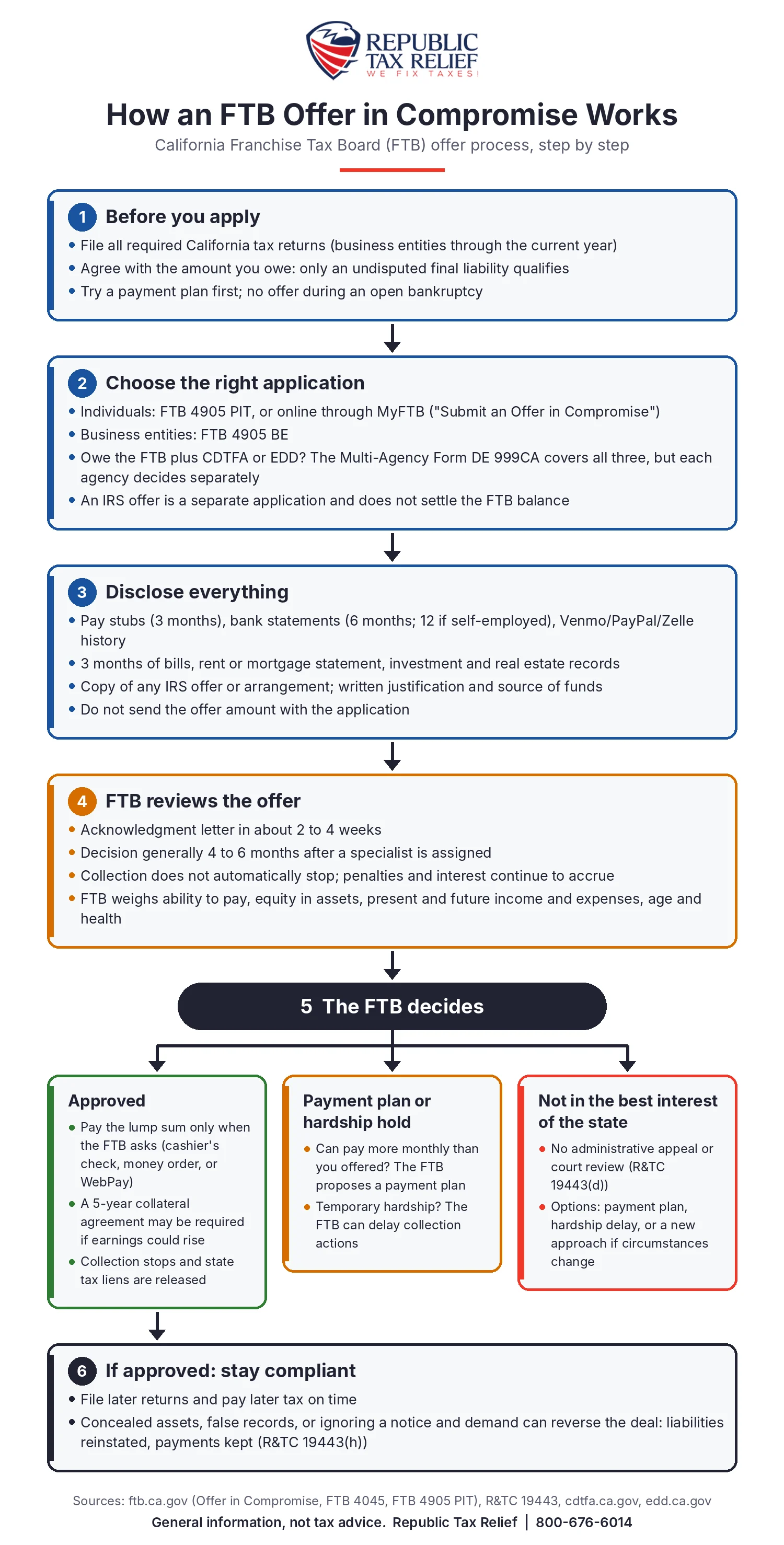
Step by step: how an FTB offer in compromise works after you apply
- Acknowledgment. You should receive an acknowledgment letter within 2 to 4 weeks.
- Assignment and review. A specialist contacts you to review the application. Generally, the FTB decides within 4 to 6 months of the account being assigned; complex accounts take longer. (The 2023 booklet says 120 days; the FTB’s web page, updated in 2025, says 4 to 6 months.)
- Collection during review. Submitting an offer does not automatically suspend collection. In most cases, no new collection actions are taken while the offer is reviewed, but the FTB may continue if delay risks its ability to collect. Penalties and interest continue to accrue.
- The FTB’s answer. It may approve the offer, propose a payment plan if you can pay more monthly than you offered, or delay collection if your financial hardship is temporary. You may withdraw your application at any time.
- Payment. Only when the FTB asks by letter do you send the offer amount, by cashier’s check, money order, or WebPay, as one lump sum payment.
- Collateral agreement, if required. If you have significant potential for higher earnings, the FTB may require a collateral agreement, generally for five years, under which you pay a percentage of future earnings above an agreed threshold.
- Release. Once the offer is approved, all collection actions stop and state tax liens are released.
Flowchart: How an FTB Offer in Compromise Works
Business Entities, CDTFA Sales Tax, and EDD Payroll Tax: Separate Offers for Each Agency
California state government has three taxing agencies, and each runs its own offer in compromise program. An FTB offer does not touch sales tax owed to the California Department of Tax and Fee Administration or payroll tax owed to the Employment Development Department.
| Agency and tax | Application | Key eligibility rules |
|---|---|---|
| FTB: personal income tax and business entity franchise and income tax | FTB 4905 PIT or FTB 4905 BE, or MyFTB | All returns filed (business entities through the current year, including a final return if closed), liability undisputed, lump sum offer |
| CDTFA: sales and use tax and other taxes and fees | CDTFA-490 (individuals) or CDTFA-490-C (other entities) | Generally a final liability on a closed account, no longer associated with the business, amount not disputed. Through January 1, 2028, some open businesses that did not collect the tax from customers, successors, and consumers with use tax can also apply |
| EDD: payroll tax | DE 999A with financial statement DE 999B | Business inactive, or you no longer have a controlling interest or any association with it. Liability final and undisputed. No offers for fraud assessments |
CDTFA sales tax offers
A CDTFA offer is a proposal to pay less than the full balance of a tax or fee liability. The CDTFA says its program is for taxpayers who do not have, and will not have in the foreseeable future, the income, assets, or means to pay in full. It weighs the same factors as the FTB: ability to pay, equity in assets, present and future income and expenses, and the potential for changed circumstances. If a fraud penalty was assessed, the minimum offer is the outstanding tax plus the fraud penalty, and an offer will not be considered after a felony tax evasion conviction (CDTFA: Offer in Compromise).
EDD payroll tax offers
The EDD’s test is stricter and more numeric. Its information sheet says you must not have income sufficient to pay more than the accumulating interest plus 6.7% of the outstanding liability each year, must not have assets that would satisfy the liability if sold, and the amount offered must be more than the EDD could expect to collect through involuntary means within four years (EDD: Offers in Compromise, DE 631C).
The multi-agency form
To cut paperwork, the three agencies created one shared application. Individual taxpayers can use the Multi-Agency Form for Offer in Compromise (DE 999CA) to apply with any or all of the FTB, CDTFA, and EDD (DE 999CA). One form does not mean one deal: the CDTFA notes that you still negotiate separate payment arrangements with each agency.
How to Coordinate Offers When You Owe Both the FTB and the IRS
Most Californians with a large state balance owe the IRS too, often for the same years. Treating the two offers as one project avoids the most expensive mistakes:
- Get both agencies current on filing and payment first. The IRS also requires current estimated payments, and both will return an offer if required returns are missing.
- Report IRS changes to the FTB. The FTB asks for IRS adjustments you have not reported. An unreported federal change can mean a new state bill in the middle of your offer review.
- Use the same numbers on both applications. Your income, expenses, and asset values should match on Form 433-A (OIC) and FTB 4905 PIT. Differences invite questions.
- Share the IRS result with the FTB. Include the IRS offer application and determination letter. An accepted IRS offer can support your case, but the FTB still decides on its own.
- Plan the money for both. The IRS wants an initial payment with a lump sum offer; the FTB wants nothing until it asks. Don’t spend the funds earmarked for the FTB offer on the IRS side.
- Check joint liability. Under R&TC 19443(f), an accepted offer from one spouse on a joint and several liability does not relieve the other spouse; it only reduces the balance by the amount accepted.
A Real Case: Appeal of S. Soll and L. Soll (California Office of Tax Appeals, 2020)
In Appeal of S. Soll and L. Soll, 2020-OTA-362 (nonprecedential), a married couple appealed FTB assessments for 2008 and 2009 that were based on a federal audit. One of their main arguments was that because the IRS had written off their federal tax liabilities for those years, the FTB had to do the same (OTA: Appeal of Soll opinion).
The Office of Tax Appeals rejected that argument. It found that the IRS wrote off the federal debts either because they were uncollectible due to the couple’s finances or because they were discharged in bankruptcy, and that neither reason required it to overturn the state assessments. The FTB’s assessments were sustained, apart from penalties the FTB agreed to drop. In a footnote, the OTA pointed the couple to the FTB’s offer in compromise program, under which the FTB can consider a taxpayer’s ability to pay once liabilities are final.
What Soll means for your FTB balance
- IRS relief does not carry over. A federal write-off, a currently-not-collectible status, or an accepted IRS offer does not erase the California tax.
- An appeal is the wrong tool for “I can’t pay.” The OTA decides whether the tax is correct. In another opinion, Appeal of Kyles, 2021-OTA-249, it said it lacks authority to adjust a valid tax based on inability to pay, and has no jurisdiction over FTB payment plans and programs (OTA: Appeal of Kyles opinion).
- The offer in compromise is the ability-to-pay route. Once the liability is final, that is where hardship and future income get weighed.
FTB Offer Rejected? What Happens Next
Unlike the IRS, the FTB has no appeals office for offers. Under R&TC 19443(d), a determination that accepting an offer would not be in the best interest of the state is not subject to administrative appeal or judicial review. That makes the first application the one that counts. If your offer is denied:
- Ask what fell short. Many denials come down to income that will rise, equity in assets, or missing documents.
- Consider a payment plan. The FTB offers installment agreements for balances up to $25,000 that can be paid in 60 months or less, with a $34 setup fee added to the balance, if you have filed all returns for the past five years (FTB: Payment plans). You may have to submit a financial statement.
- Ask about a hardship delay. If your financial hardship is temporary, the FTB says it will work with you to delay collection actions.
- Know what can undo an accepted offer. Under R&TC 19443(h), the FTB can rescind a compromise, reinstate the full liabilities, and keep what you paid if property was concealed, records were falsified, or you fail to file later returns and pay later tax within 20 days after a notice and demand.
Example Scenarios: Common FTB Offer in Compromise Situations
These scenarios are illustrative. They are based on situations we commonly see in California cases, with details changed. They are not specific client results, and your outcome depends on your own facts.
Example 1: “The IRS accepted my offer, but the FTB is still collecting.”
A retired taxpayer in Riverside County settled several years of federal tax debt through an accepted IRS offer and assumed the state side was done. Months later, the FTB was still sending notices on the California balance for the same years. Because the FTB decides separately, the next step was an FTB 4905 PIT application that included the accepted IRS offer, showed a fixed retirement income and little equity in assets, and explained age and health. Those facts line up with the factors the FTB weighs most.
Example 2: “I’m 34 and my salary keeps going up.”
A software employee owed the FTB after underwithheld stock compensation and could not pay the full amount owed today. On paper, current income barely covered expenses. Over a 20-year collection window, though, rising future income meant the FTB could expect to collect more than any realistic offer. The better plan was a payment plan, with the offer option saved for a real change in circumstances. If an offer is accepted in a case like this, expect the FTB to ask for a collateral agreement.
Example 3: “Our restaurant closed owing three state agencies.”
A couple in Orange County closed their restaurant owing CDTFA sales tax, EDD payroll tax, and FTB income tax, plus IRS payroll tax. They used the multi-agency form to apply with all three state agencies at once, but each agency negotiated its own terms. Because the business was closed and they had no remaining association with it, they met the basic CDTFA and EDD eligibility rules. The IRS payroll balance needed its own federal resolution.
Example 4: “My offer was denied over an account I forgot.”
A self-employed contractor listed their checking and savings accounts but left out a payment app account that received client payments. The FTB found it during review. Omitted assets are grounds to deny an offer, and after acceptance they can lead to rescission. Disclosing every account, including Venmo, PayPal, and Zelle history, is part of the application, not an extra.
Next Steps: Settle Your Tax Debt With the Right Agency, in the Right Order
- Find out who you owe: the FTB, the IRS, the CDTFA, the EDD, or several of them.
- File every required tax return with each agency before you make an offer.
- Gather pay stubs, bank statements, and bills for the past three to six months.
- If you can pay your tax over time, compare a payment plan with an offer, using the FTB’s 20-year window, not the IRS’s 10.
- Disclose every asset and account, and keep the offer funds ready for when the FTB asks.
A taxpayer with a small balance, a fixed income, and simple finances can often prepare an FTB offer on their own. When you owe both the FTB and the IRS, owe the CDTFA or EDD as well, or have assets and income that need careful explanation, a tax attorney, CPA, or enrolled agent can help you avoid a denial you can’t appeal. Our team reviews both the state and federal sides together and deals with the Franchise Tax Board for you once you sign the authorization. See how we help California taxpayers or request a free consultation. You can also read what clients say about our 5.0-star rated Laguna Hills office and our 4.6-star rated Corona, CA office on Google.
Our offices are in Corona and Laguna Hills, and we work with taxpayers across California in person or remotely.
Which California Tax Problem Are You Facing?
| Your situation | What it usually means | Where to start |
|---|---|---|
| You owe the FTB, the IRS, or both and can’t pay in full | Federal and state tax debt that our licensed team can handle with every agency for you | Call 800-676-6014 for a free consultation, or see how we help California taxpayers |
| Your spouse owes back taxes and you’re worried about your wages or home | California’s community property rules can let the FTB or IRS reach shared income and property | Community property and tax debt in California: are you liable for your spouse’s taxes? |
FTB Offer in Compromise: Frequently Asked Questions
Does an accepted IRS offer in compromise settle my FTB balance?
No. The FTB evaluates its offers separately from the IRS, CDTFA, and EDD, and makes its own decision even if the IRS accepted your offer. Include a copy of the accepted IRS offer with your FTB application, because the FTB asks for it, but you still need a separate FTB offer in compromise to reduce the state balance.
Is there an application fee for an FTB offer in compromise?
The FTB’s offer page, its “things you should know” sheet (FTB 4045), and the FTB 4905 PIT booklet do not list an application fee. Do not send the offer amount with the application either; the FTB asks for the funds by letter if it is ready to approve. The IRS charges a $205 application fee unless you meet its low-income qualifications.
Can I pay an FTB offer in compromise in monthly installments?
No. The FTB requires the offer amount as a single lump sum payment, paid by cashier’s check, money order, or WebPay when it asks. It does not accept installments toward an offer or count prior payments toward the offer amount. If the FTB finds you can pay more in monthly payments than you offered, it will propose a payment plan instead.
Does submitting an FTB offer stop collection activity?
Not automatically. In most cases the FTB takes no new collection actions while it reviews an offer, but it may continue if waiting risks its ability to collect. Penalties and interest continue to accrue until the offer is approved, when collection stops and state tax liens are released.
How long does the FTB take to decide an offer in compromise?
You should get an acknowledgment letter within 2 to 4 weeks. The FTB generally decides within 4 to 6 months after your account is assigned to a specialist, and complex accounts can take longer. Missing documents are the most common cause of delay.
Can I appeal if the FTB rejects my offer?
Not in the way you can with the IRS. Under California R&TC section 19443(d), an FTB decision that accepting an offer is not in the best interest of the state is not subject to administrative appeal or judicial review. Your options are usually a payment plan, a hardship delay, or a new approach if your circumstances change.
Do I need a separate offer for CDTFA sales tax or EDD payroll tax?
Yes. The CDTFA and EDD run their own offer programs with their own eligibility rules. Individuals can use the Multi-Agency Form for Offer in Compromise (DE 999CA) to apply with the FTB, CDTFA, and EDD at once, but each agency reviews and negotiates its own offer.
This article is general information, not legal or tax advice for your specific situation. Republic Tax Relief is not affiliated with the California Franchise Tax Board, the CDTFA, the EDD, or the IRS.