
In New York, the state does not need to sue you to get a judgment for unpaid state taxes. When a tax debt becomes final and goes unpaid, the New York State Department of Taxation and Finance can file a tax warrant on its own. That warrant is equivalent to a civil judgment. It becomes a public record, it creates a lien on your real and personal property, and it opens the door to an income execution on your wages, a bank levy, and other collection action.
Many New Yorkers first learn about a New York State tax warrant when a title search turns it up during a home sale or refinance, or when a lender asks about it. This guide explains how a NYS tax warrant is filed, what it does to your property and credit, how to find one with the tax warrant search tool, and the realistic ways to get it satisfied, released, or vacated. It covers state taxes collected by the Tax Department, such as personal income tax, sales tax, and withholding tax, not IRS debt.
In this guide:
- What is a New York State tax warrant?
- Flowchart: how a NYS tax warrant works
- What happens before the Tax Department files a tax warrant
- When a tax warrant is filed: lien, public record, and levy
- How long a New York tax warrant lasts
- NYS tax warrant search: how to find open and satisfied warrants
- New York tax warrants for business sales tax
- A real court case: Dumpling Cove v. Commissioner of Taxation and Finance
- How to get a NYS tax warrant lifted
- Home sale or refinance with a NYS tax warrant
- Example scenarios: common New York tax warrant situations
- Frequently asked questions
What Is a New York State Tax Warrant?
A New York State tax warrant is the official warrant the Tax Department files when a taxpayer has a fixed and final tax debt and has not resolved it. In the Department’s words, a tax warrant is equivalent to a civil judgment and protects New York State’s interests and priority in the collection of outstanding tax debt (NYS Tax Department: Tax warrants). The state does not have to go to court first. Under New York tax law, once the warrant is docketed with the county clerk, the Department is treated as having obtained a judgment against the taxpayer (N.Y. Tax Law § 692 for personal income tax; § 1141(b) for sales tax).
Here is what a tax warrant means in practice:
- It is filed in two places. The Department electronically files the warrant with the New York State Department of State and with the county clerk’s office listed on the warrant.
- It creates a lien. The tax warrant creates a lien on your real and personal property, which includes a house, a co-op or condo interest, business equipment, and vehicles.
- It is a public record. Anyone can look it up, and title companies and lenders routinely find it.
- It allows collection without a lawsuit. A warrant may let the Department seize and sell property, garnish wages, or limit your ability to buy or sell property.
- It is not an arrest warrant. It is a civil collection tool, not a criminal charge.
NYS tax warrant vs. federal tax lien
New Yorkers often owe both the state and the IRS, and the two liens are easy to confuse. They come from different agencies under different laws, and each has to be resolved separately:
| Feature | New York State tax warrant | IRS federal tax lien |
|---|---|---|
| Who files it | NYS Department of Taxation and Finance | Internal Revenue Service |
| Taxes covered | State taxes: personal income tax (including New York City and Yonkers income tax collected on the state return), sales tax, withholding tax, and others | Federal income, payroll, and other federal tax |
| Where it is filed | NYS Department of State and the county clerk | Notice of Federal Tax Lien recorded in the county |
| Legal effect | Equivalent to a civil judgment | A lien created by federal law |
| Ends when | A Satisfaction of Judgment is filed after the warranted balance is paid | The IRS releases the lien after the balance is paid or no longer collectible |
If you also have an IRS lien, our guide to how to release or remove a federal tax lien covers the federal rules. Paying one agency does nothing to the other agency’s lien.
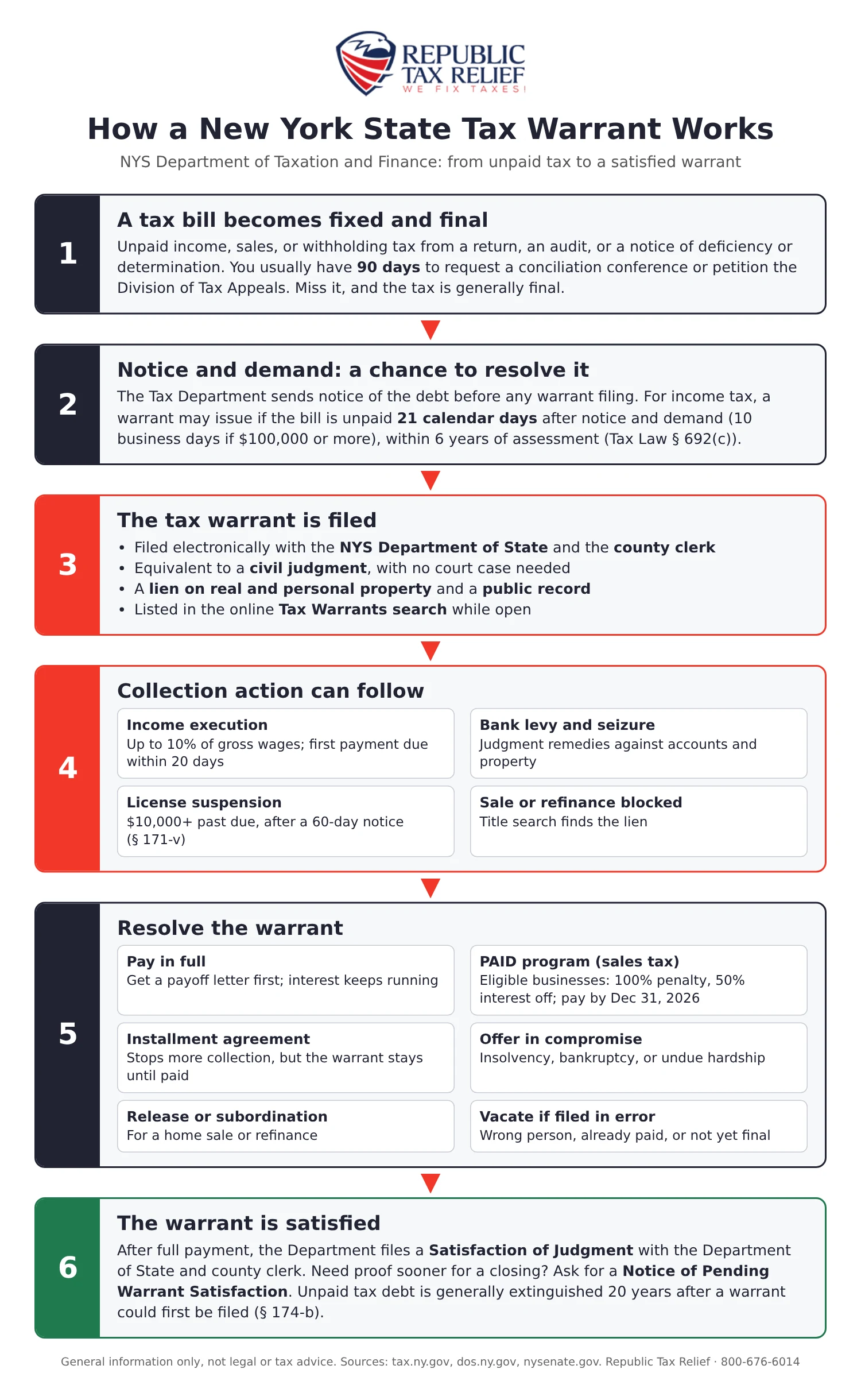
Flowchart: How a NYS Tax Warrant Works
What Happens Before the Tax Department Files a Tax Warrant
A tax warrant is not the first letter you get. The Department files one only after your past-due tax becomes fixed and final, and it sends notice of the debt and a chance to resolve it before the warrant filing. The usual path looks like this:
- A bill or assessment. The tax liability comes from a return you filed without full payment, an audit, or a notice of deficiency or determination for unpaid tax.
- A window to challenge it. Most assessments give you 90 days to request a conciliation conference or file a petition with the Division of Tax Appeals. If that window passes, the tax is generally fixed and final.
- Notice and demand. For personal income tax, if the amount is not paid within 21 calendar days after notice and demand (10 business days if it is $100,000 or more), the Department may issue a tax warrant. It has six years after the assessment to issue it (Tax Law § 692(c)).
- Collection notices. Before filing, the Department sends notice of the debt and gives you an opportunity to pay, set up a payment plan, or contact it.
- The warrant is filed. The Department files the warrant and mails you a copy. If you still don’t resolve it, further collection action follows.
The 90-day window matters more than most people think. In Matter of Halperin v. Chu, 138 A.D.2d 915 (3d Dep’t 1988), the president of a Long Island gas station chain was told he was personally liable as an officer for the company’s sales tax. He did not file a petition within 90 days, a warrant was docketed against him in Nassau County, and his later court case to vacate the warrant failed because the missed deadline had “finally and irrevocably” fixed the tax. Read every Tax Department notice when it arrives, not when a warrant shows up.
When a Tax Warrant Is Filed: Lien, Public Record, and Levy
Once a tax warrant is filed, the Department has the same remedies as a judgment creditor. These can be used one at a time or together.
The tax lien on real and personal property
Under the statute, the docketed warrant becomes a lien on the title to and interest in real and personal property of the taxpayer. For personal property such as bank accounts, vehicles, and business assets, the lien applies once the warrant is filed in the Department of State (Tax Law §§ 692(d), 1141(b)). Since July 1, 2025, every NYS tax warrant has been filed with the Department of State, and its online record is the official warrant (NYS Department of State: State Tax Warrant Notice System).
The public record and your credit
A tax warrant can create problems well beyond the debt itself. A warrant shows up in county clerk records, in the Department of State’s database, and in the Department’s own search tool. It can stall a sale or refinance, a co-op board approval, a business loan, or a commercial lease until the lien is paid, released, or subordinated.
Collection action after a warrant
| Collection tool | What it does | Key rule |
|---|---|---|
| Income execution | Takes part of each paycheck | You must make the first payment within 20 days of the notice, or your employer must deduct it; capped at 10% of gross income (NYS Tax Department: Income executions) |
| Bank levy | Takes money held in your bank accounts | Uses the judgment remedies the warrant gives the state |
| Property seizure and sale | A sheriff or Department employee can levy on and sell property | Done in the same manner as an execution on a court judgment (Tax Law § 692(f)) |
| Driver’s license suspension | Suspends a non-commercial license | Applies to $10,000 or more in past-due tax liabilities, after a 60-day notice (Tax Law § 171-v) |
| Refund offset | Applies state refunds to the old balance | Continues until the debt is paid |
Our New York tax relief page explains how income executions and license suspension notices work and how we respond to them.
How Long a New York Tax Warrant Lasts
There are two clocks, and it helps to keep them apart:
- The tax debt itself. Under Tax Law § 174-b, a tax liability generally becomes unenforceable and is extinguished 20 years after the first date a warrant could be filed, unless you and the Department agree in writing to extend the time (N.Y. Tax Law § 174-b). The warrant may show the date it expires.
- The lien on real property. Tax Law § 174-a applies the same duration and extension rules that govern a docketed court judgment’s lien on real property (N.Y. Tax Law § 174-a). For a court judgment, that lien generally runs 10 years and can be extended only in limited cases (CPLR 5203).
In practice, a NYS tax warrant can stay on the books for a very long time, and interest keeps growing until the debt is paid. Waiting it out is rarely a plan. A title search will usually find it first.
NYS Tax Warrant Search: How to Find Open and Satisfied Warrants
New York gives you two free ways to check:
- The New York State Tax Warrants search. The Department’s online tax warrants search tool lists open tax warrants and current balances. It needs no account and is updated twice a week. When a tax debt is paid in full, the warrant is satisfied and removed from the search tool (NYS Tax Department: Tax warrant search).
- The State Tax Warrant Notice System. New York also has a second record. The Tax Department files tax warrants with the Department of State, which keeps a database of warrant-related notices filed by the Tax Department, searchable by taxpayer name, city, or county. Use it to confirm satisfied warrants. For warrants filed before July 1, 2025, the official warrant comes from the county clerk where it was filed.
When you run a New York State tax warrants search, write down every warrant number, county, and amount. One taxpayer can have several outstanding warrants for different tax types and tax years, and each one has to be paid or resolved.
New York Tax Warrants for Business Sales Tax
Sales tax and withholding tax are trust taxes. You collect them from customers or employees and hold them for the state, so the Tax Department treats unpaid sales tax more strictly than an ordinary business debt. Under Tax Law § 1141(b), the Department may file a tax warrant for unpaid sales tax the same way it does for income tax.
Two points catch business owners off guard:
- Responsible persons. Owners, officers, and some employees who are responsible for collecting and paying the tax can be held personally liable for the business’s sales tax, and a warrant can be filed in their own name, as happened in Halperin.
- Settlement limits. The NYS offer in compromise program says trust taxes, meaning the unpaid sales or withholding tax itself, may have to be paid in full even when penalties and interest are settled (NYS Tax Department: Offer in Compromise program).
The Penalty and Interest Discount (PAID) program for unpaid sales tax
New York’s legislature authorized a limited-time Penalty and Interest Discount (PAID) program for businesses with unpaid sales tax bills. According to the Department, it offers the chance to save 50% of the interest and 100% of the penalty on eligible bills (NYS Tax Department: PAID program). Key points from the Department’s page:
- Who qualifies. Businesses with an active Certificate of Authority and unpaid sales tax bills that are subject to collection action and no longer have formal appeal rights. Bills tied to fraud are excluded, and only bills eligible as of September 1, 2026 count.
- Deadline. Pay the reduced total electronically by December 31, 2026. No enrollment is needed.
- Warrants. If you pay all the bills listed on the warrant in full, the warrant is automatically satisfied.
- Collections pause. The Department pauses collection action on PAID-eligible bills during the program. Collection action on those bills resumes January 1, 2027 if they aren’t paid.
- Personal bills. If you were billed as a responsible person, relief applies only when the business pays its own bill.
If you have a sales tax warrant and can raise the reduced amount before the deadline, PAID may be the fastest way to a satisfied warrant. Check the Department’s page for the current status, because the program is time-limited. For a similar warrant process in another state, see how a Florida sales tax warrant works.
A Real Court Case: Dumpling Cove, LLC v. Commissioner of Taxation and Finance
A Bronx business’s sales tax case shows how a warrant interacts with partial payments. In Matter of Dumpling Cove, LLC v. Commissioner of Taxation & Finance, 2024 NY Slip Op 04288, 230 A.D.3d 927 (3d Dep’t Aug. 22, 2024), the Appellate Division sided with the taxpayer on a key procedural point.
- The facts: After a sales and use tax audit, the business signed an agreement in January 2018 that it owed $506,091.78 in tax and interest for June 2014 through August 2017. The Department’s letter acknowledged a $100,000 check, told the business to check its balance due online, and warned that penalties and interest would keep accruing until payment in full.
- The warrant: The business made partial payments but never paid in full. In July 2018, the Department docketed a tax warrant in Bronx County for $397,451.95.
- The dispute: The business argued its partial payments should have been credited to the underlying tax, not interest, and asked the Division of Tax Appeals to sort out the balance. The administrative law judge and the Tax Appeals Tribunal dismissed the case, finding no jurisdiction because the audit agreement was final.
- The holding: The court reversed. The business wasn’t challenging the agreed tax; it was challenging how its payments were credited, and the Division of Tax Appeals could hear that. The court also treated the balance due shown on the Department’s website as a “notice” the taxpayer could challenge. The case was sent back for further proceedings.
What Dumpling Cove means for New York taxpayers
- Signing an audit agreement fixes the tax, but it doesn’t mean you must accept the Department’s math on how payments were applied.
- Keep records of every payment and, where the rules allow, tell the Department in writing how you want a partial payment applied.
- Interest on a warrant keeps running. The warrant amount on file can be very different from the payoff today, so always get a current payoff figure.
- Requiring a taxpayer to pay first and sue for a refund later was not, in the court’s view, a fair substitute for a hearing.
How to Get a NYS Tax Warrant Lifted
The Department’s rule is simple: you must pay your total warranted balance in full to satisfy your tax warrant. Everything else either stops collection, settles the debt for less, or shows the warrant shouldn’t exist. Here are the real options:
| Option | What it does to the warrant | Good to know |
|---|---|---|
| Pay in full | Satisfies it. The Department sends a Satisfaction of Judgment to the Department of State and the county clerk | Ask for a payoff figure first; interest changes daily |
| PAID program (business sales tax) | Paying all bills listed on the warrant in full automatically satisfies it | Time-limited; reduced balance due by December 31, 2026 |
| Installment payment agreement (IPA) | The warrant stays on file and remains a lien until the warranted balance is paid in full | For taxpayers who cannot pay in full; can prevent additional collection action; penalty and interest keep accruing (NYS Tax Department: IPA) |
| Offer in compromise | Settles the debt for less than the full amount if the Department accepts it | For insolvent or bankrupt taxpayers, or individuals facing undue economic hardship; ask how the warrant will be satisfied once the offer is paid |
| Release or subordination of lien | Frees one property for a sale, or lets a lender’s lien go first for a refinance | Granted only if it is in the best interest of the state |
| Vacate a warrant filed in error | Removes a warrant that never should have been filed | Examples: wrong person, debt already paid, or a bill that was not yet fixed and final |
Satisfaction of NYS tax warrant: what you get and when
- Satisfaction of Judgment. Once you pay your total warranted balance, the Department sends the New York State Department of State and the applicable county clerk a Satisfaction of Judgment, and mails you a copy. You get it only after the Department of State has filed it.
- Notice of Pending Warrant Satisfaction. If you need proof sooner, for example for a closing, you or your authorized representative can request one. The Department issues it when full payment arrives in guaranteed funds (certified check, bank check, wire, money order, or cash), when a credit card payment brings the balance to zero, or when the payment has posted and you show it cleared. Most title companies accept it as proof the lien will be removed.
- Outstanding Judgment Balance Due letter. This is the Department’s warrant payoff letter. It lists all outstanding warrants and the balance projected to a specific date.
Vacate a New York tax warrant filed in error
If the warrant names the wrong person, covers a tax that was already paid, or was filed while you still had appeal rights, contact the Tax Department right away with proof and ask that the warrant be vacated. If it was filed against you as a responsible person for a business’s tax, check whether you received a notice and whether your 90-day window ran. As Halperin shows, a court will not reopen a tax that became final because a deadline was missed.
For a single small balance with no warrant yet, you can often fix it yourself by paying online or calling the number on the notice.
Home Sale or Refinance With a NYS Tax Warrant
A title search almost always finds an open warrant, and a buyer’s title insurer will want it paid or released at closing. You have three paths:
- Pay it from the sale proceeds. Get an Outstanding Judgment Balance Due letter dated for the closing, pay in guaranteed funds, and ask for a Notice of Pending Warrant Satisfaction.
- Request a release. If you are selling and the proceeds won’t cover the warranted balance, you may qualify for a release of the state’s lien on that property. The Department wants a pre-closing statement, payoff letters, a 10-year title search, the deed, a current appraisal, and the signed sale contract (NYS Tax Department: Release or subordination of lien).
- Request a subordination. If you are refinancing or taking out a loan secured by the property, the state may agree to put the lender’s lien ahead of its own.
Send all documents together and make sure they are dated within the last six months, or the request won’t be considered. Start early. A release or subordination request that arrives the week of closing often delays the closing.
Example Scenarios: Common New York Tax Warrant Situations
The examples below are illustrative, based on situations our clients commonly face. They are not specific client cases, and names and numbers are hypothetical.
Example 1: “The title search found a warrant two weeks before our closing.”
A Queens couple selling their condo learned of a 2019 warrant for an old NY tax bill on personal income tax they never knew about, because the notices went to an old address. The fix was to get a payoff letter dated for the closing, pay from proceeds by wire, and request a Notice of Pending Warrant Satisfaction so the title company could close on time.
Example 2: “Our restaurant has a sales tax warrant and can’t pay the whole thing.”
A Brooklyn restaurant owed about $48,000 in sales tax, penalty, and interest after two slow winters, with a warrant on file. Its bills qualified for the PAID program, which dropped all the penalty and half the interest. The owner paid the reduced amount electronically before the deadline, and the warrant was satisfied automatically.
Example 3: “I set up a payment plan, so why is the warrant still there?”
A Rochester contractor entered an installment payment agreement on old income tax and assumed the warrant would disappear. It didn’t, because a payment plan stops collection but the warrant remains a lien until the warranted balance is paid in full. When he later refinanced, he requested a subordination instead of waiting for the plan to finish.
Example 4: “The warrant is in my name, but it’s my old company’s sales tax.”
A Long Island former officer of a closed retail business found a warrant for the company’s unpaid sales tax filed against him as a responsible person. Because his appeal window had closed, the realistic options were a payment plan or an offer in compromise based on his finances, with careful attention to the trust-tax portion the state usually wants paid.
Next Steps: When to Bring in a Tax Attorney or Tax Professional
- Find every warrant. Run the tax warrant search and the Department of State search under every name you have used.
- File any missing tax returns. Most resolutions require you to be current first.
- Get the full account history. Confirm the tax, interest, and penalty for each period and how past payments were credited.
- Check for errors. Wrong person, paid tax, or an assessment that wasn’t final are grounds to ask that a warrant be vacated.
- Pick the right resolution. Payment in full, PAID for eligible sales tax, an installment payment agreement, an offer in compromise, or a release or subordination for a property deal.
- Coordinate with the IRS. If you also have IRS tax debt, plan both cases together so money paid to one agency doesn’t leave the other unresolved.
Complex tax issues like a responsible person warrant or a disputed payoff are where a tax attorney or enrolled agent earns their fee. In most warrant cases we handle, the problem is fixable once every warrant and payment is on paper. If a New York State tax warrant is holding up a sale, a refinance, or your business, our team of enrolled agents, CPAs, and tax attorneys can take on your tax problem anywhere in the state of New York, pull your Tax Department records, check the math, and handle the Department for you with your written authorization. Learn more about our New York tax relief services or request a free consultation. You can also read what clients say about our 5.0-star rated Laguna Hills office and our 4.6-star rated Corona, CA office on Google.
Our offices are in California, and we represent New York taxpayers remotely.
Related New York Tax Relief
| Page | What it covers | Read it if |
|---|---|---|
| Tax Relief for New York State Taxpayers (main New York page) | New York hub: IRS and NYS tax debt help, income executions, license suspension, payment plans, and offers in compromise | You want help with IRS or New York State tax debt, or want to talk to our team |
| New York State Tax Warrant (you are here) |
How NYS tax warrants are filed, the lien they create, warrant search, and how to get a warrant satisfied, released, or vacated | You have a tax warrant or found one in a title search |
| NYS DTF Letters Explained: What Each Notice Means and Your Deadline | The common Tax Department letters, what each one asks for, and the deadline to respond | You received a letter from the Tax Department and aren’t sure what it means |
NYS Tax Warrant: Frequently Asked Questions
How long does a New York State tax warrant stay on record?
Until the warranted balance is paid and a Satisfaction of Judgment is filed, or the debt expires. Under Tax Law section 174-b, a tax liability is generally extinguished 20 years after the first date a warrant could be filed, unless the taxpayer agrees in writing to extend that time. Interest keeps accruing while the warrant is open.
How do I do a NYS tax warrant search?
Use the Tax Department’s free New York State Tax Warrants search, which lists open warrants and current balances and needs no account. Satisfied warrants drop off that tool, so use the Department of State’s State Tax Warrant Notice System to confirm a warrant was satisfied. Warrants filed before July 1, 2025 are also on record with the county clerk.
Does a payment plan remove a New York tax warrant?
No. An installment payment agreement can prevent additional collection action, but the warrant stays on file and remains a lien on your real and personal property until you pay the total warranted balance in full.
How do I prove a NYS tax warrant is paid before a closing?
Ask the Tax Department for a Notice of Pending Warrant Satisfaction. It is issued when full payment is made in guaranteed funds, when a credit card payment brings the balance to zero, or when your payment has posted and you show it cleared. Most title companies accept it. The formal Satisfaction of Judgment comes after the Department of State files it.
Can I sell or refinance my home with an open NYS tax warrant?
Yes, but the warrant has to be dealt with. You can pay it from the proceeds, ask for a release of the lien if the sale won’t cover the balance, or ask for a subordination so a new lender’s lien goes ahead of the state’s. The Department grants a release or subordination only if it is in the state’s best interest.
Can a New York tax warrant be vacated?
A warrant filed in error, such as one against the wrong person, for tax already paid, or for a bill that was not yet fixed and final, can be challenged and vacated. A warrant for a valid tax that became final because an appeal deadline was missed generally can’t be vacated; it has to be paid or resolved.
Is a NYS tax warrant the same as an IRS federal tax lien?
No. A NYS tax warrant is filed by the New York State Department of Taxation and Finance for state taxes and is equivalent to a civil judgment. A federal tax lien comes from the IRS for federal taxes. You can have both at once, and each has to be resolved with its own agency. Paying the IRS does not clear a NYS warrant.
This article is general information, not legal or tax advice for your specific situation. Republic Tax Relief is not affiliated with the New York State Department of Taxation and Finance or the IRS.