
Texas is one of the hardest states in the country for a creditor to garnish wages. The Texas Constitution says current wages can’t be garnished at all, except for court-ordered child support and spousal maintenance. A credit card company or a hospital that wins a judgment against you in Texas still can’t touch your paycheck.
That protection is why so many Texans are shocked when their employer hands them an IRS levy notice. The Internal Revenue Service collects under federal law, and Texas wage protections do not apply to an IRS wage levy. If you owe back taxes and ignore the notices, the IRS can garnish your wages in Texas, every paycheck, with no court order. Here is why, what protections you still have, and how Texans stop the IRS from garnishing their wages.
In this guide:
- Can the IRS garnish your wages in Texas? The short answer
- Why Texas wage protections don’t stop the IRS
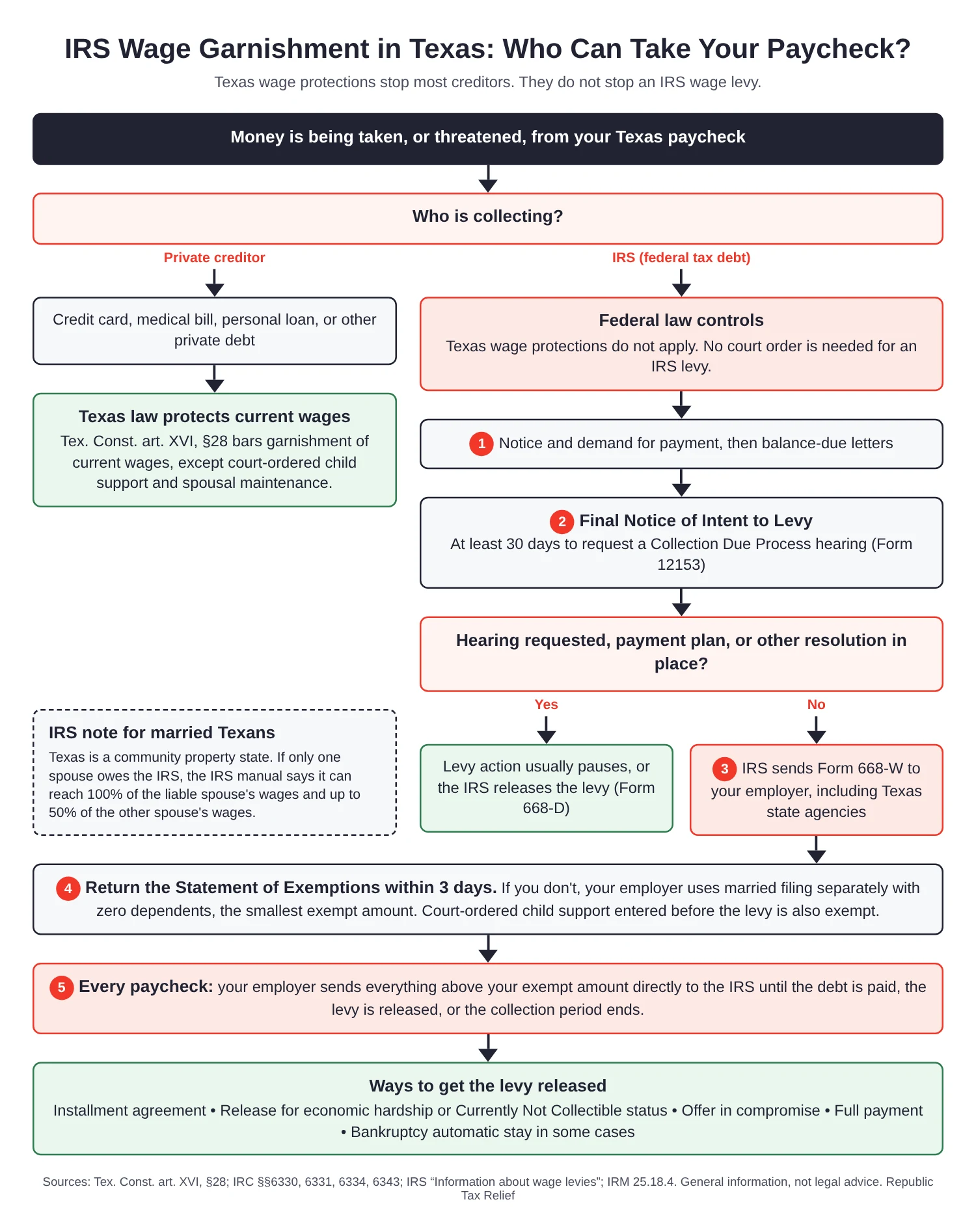
- Flowchart: who can take a Texas paycheck
- A real court case: Sims v. United States
- Texas employers, including state agencies, must honor IRS levies
- Can the IRS garnish your spouse’s wages in Texas?
- Texas child support orders and an IRS wage levy
- Protections that still apply to an IRS wage levy
- IRS wage garnishment calculator: a Texas example
- Example scenarios: common Texas situations
- How to stop IRS wage garnishment in Texas
- FAQs
Can the IRS Garnish Your Wages in Texas? The Short Answer
Yes. The IRS can garnish your wages in Texas the same way it can in any other state. What it calls a “levy on wages” is what most people call IRS wage garnishment. Before it starts, federal law requires the IRS to:
- Assess the tax and send you a notice and demand for payment.
- Send a Final Notice of Intent to Levy and Notice of Your Right to a Hearing at least 30 days before the levy.
- Give you the chance to request a Collection Due Process hearing in that 30-day window.
If the tax bill is still unpaid and nothing is in place, the IRS sends a notice of levy (Form 668-W) to your employer. Your employer must then take a portion of your wages from every paycheck and send it directly to the IRS. An IRS wage levy is continuous. It keeps going until you make other arrangements to pay, the tax liability is paid, or the IRS releases the levy (IRS: Information about wage levies).
How much the IRS takes depends on your filing status, number of dependents, and pay schedule. It’s tied to the standard deduction, and there is no 25% cap like there is for most creditors. For the current exempt amounts and a worked example, see how much the IRS can garnish from your paycheck.
For every notice in the IRS collection process before a levy, see our guide to how IRS collections work.
Flowchart: Who Can Take a Texas Paycheck?
Why Texas Wage Garnishment Protections Don’t Stop the IRS
Article XVI, Section 28 of the Texas Constitution reads: “No current wages for personal service shall ever be subject to garnishment, except for the enforcement of court-ordered: (1) child support payments; or (2) spousal maintenance” (Tex. Const. art. XVI).
That is a powerful rule for private creditors. It is not a limit on the federal government. The IRS levies wages under federal tax law, Internal Revenue Code sections 6331 and 6332, and the only wages that are exempt from levy are the amounts federal law itself exempts under section 6334. When a state exemption and a federal tax levy conflict, federal law wins under the Supremacy Clause. Texas’s own payroll rules for state agencies cite these federal code sections when they tell agencies to comply with IRS levies (more on that below).
Not sure which agency is taking your pay? Because Texas has no personal income tax, a tax levy on a Texas paycheck almost always comes from the IRS. Texas tax debt, such as sales tax or franchise tax, is owed to the Texas Comptroller and is usually a business problem handled through liens, bank account freezes, or permit action. Our Texas tax relief page explains how IRS debt and Comptroller debt differ.
So the question is never “Does Texas allow this garnishment?” For IRS debt, the question is “What does federal law exempt, and have I used the federal tools to stop or release the levy?”
Texas creditor garnishment vs. IRS wage levy
| Question | Private creditor in Texas | IRS wage levy in Texas |
|---|---|---|
| Can it garnish current wages? | No, except court-ordered child support and spousal maintenance | Yes. Texas wage protections do not apply. |
| Court order needed? | Yes, a judgment first, and even then wages are protected | No. The IRS issues an administrative levy after the required notices. |
| How much can be taken? | Nothing for ordinary consumer debt | Everything above your federal exempt amount |
| How long it lasts | Not applicable | Every paycheck until paid, released, or the 10-year collection period ends |
| Main way to stop it | Texas exemption already protects wages | CDP hearing, payment plan, hardship release, offer in compromise, or full payment |
Wages lose their payroll protection once they are paid out, too. Money sitting in a Texas bank account can be taken with a separate IRS bank levy, which is a one-time levy rather than a continuous one. Our wage garnishment questions page covers how a bank levy and a wage levy can overlap.
A Real Court Case: Sims v. United States
The clearest proof that a state can’t shield wages from an IRS levy comes from a case where the state itself was the employer. In Sims v. United States, 359 U.S. 108 (1959), the IRS served levies on the State of West Virginia, through the State Auditor, to collect federal income tax from state employees. The auditor refused to honor the levies and paid the employees their full net salaries instead.
The U.S. Supreme Court ruled for the IRS:
- Sections 6331 and 6332 of the tax code authorize the IRS to levy on the accrued salaries of state employees for the collection of any federal tax.
- The state official who controlled payroll was a person obligated to surrender the wages to the IRS.
- Because he paid the money to the employees instead, he was personally liable for the amount he should have turned over, up to the tax owed.
Why it matters in Texas: if a state government can’t protect its own employees’ paychecks from an IRS levy, a Texas wage exemption written for private creditors can’t either. It also explains why Texas employers don’t ignore Form 668-W. An employer that pays you the money instead of the IRS can end up owing it.
Texas Employers, Including State Agencies, Must Honor IRS Levies
The Texas Comptroller of Public Accounts, which oversees state payroll policy, tells state agencies and universities exactly what to do with an IRS levy. Its payroll guidance says agencies “must comply with the levy notice by surrendering salary or wages that exceed the exempt amount,” must treat the levy as a payroll deduction, and must continue it “until it receives a notification from the IRS to release the levy” (Texas Comptroller: Tax Levies).
That covers teachers at state universities, state agency staff, and other public employees in Austin and across Texas. Private employers in Houston, Dallas, San Antonio, or the oil fields of West Texas follow the same federal rule. In practice, that means:
- Your employer cannot decide to skip the levy because Texas protects wages.
- Your employer cannot stop withholding because you called the IRS or a payment plan is pending. It needs a release from the IRS.
- Employers generally have at least one full pay period after receiving the levy before they must send funds (IRS: levies on employees and other third parties). That short window is often the best time to act.
Paid on a 1099 instead of a W-2? Contract workers can still face IRS levies on payments owed to them by the companies they work for. See our wage garnishment FAQ for how that works.
Can the IRS Garnish Your Spouse’s Wages in Texas?
This is where Texas law really does change an IRS wage case. Texas is a community property state, and wages earned during the marriage are generally community property. The IRS has its own manual section on collecting in community property states, and it treats Texas specifically (IRM 25.18.4).
When only one spouse owes the tax, for example from a debt before the marriage or a separately filed return, the IRS manual says:
- The IRS can collect from 100% of the liable spouse’s wages.
- Texas law blocks creditors from the non-liable spouse’s “sole management” community property, such as that spouse’s own paycheck. But because the liable spouse still owns a half interest, the federal tax lien still reaches half.
- In the manual’s own example, the IRS “could reach 100% of the liable spouse’s wages and 50% of the non-liable spouse’s wages.”
The manual also says a levy on a non-liable spouse’s wages is not a continuous levy, and that spouse may claim an exemption. If both spouses signed a joint return, both are liable, and the community property limits don’t help in the same way.
| Situation in Texas | Whose wages the IRS can reach | Worth reviewing |
|---|---|---|
| Joint return, both spouses owe | Both spouses’ wages, each above their own exempt amount | Payment plan or offer covering the household |
| One spouse owes (separate return or premarital debt) | 100% of the liable spouse’s wages; up to 50% of the other spouse’s wages | Whether the levy on the non-liable spouse is valid and limited to half |
| Joint return, but the debt came from one spouse’s errors | Both, until relief is granted | Innocent spouse relief |
| Your tax refund was taken for a spouse’s debt | Not a wage levy, but a related offset | Injured spouse claim (Form 8379) |
Community property questions also affect homes and settlement offers. Our guide on whether the IRS can take your house in Texas covers how this plays out with a homestead.
Texas Child Support Orders and an IRS Wage Levy
Child support is one of the two debts Texas lets creditors take from a paycheck, so many Texas workers already have a child support income withholding order when an IRS levy arrives. Federal law protects that support. The amount you need to pay court-ordered child support entered before the levy is exempt from the IRS levy under section 6334(a)(8) (IRM 5.11.5).
If your employer didn’t include the child support when it figured your exempt amount, contact the IRS at the number on the levy notice. The IRS says it will release from levy the amount you need for court-ordered support. Keep a copy of the Texas order and your pay stubs ready.
Protections That Still Apply to an IRS Wage Levy
Texas law won’t stop the IRS, but federal law gives you real tools. These are the ones that matter most once an IRS levy notice or wage levy is in play:
| Federal protection | What it does | Where to start |
|---|---|---|
| Collection Due Process hearing | A timely request after the Final Notice of Intent to Levy usually pauses the levy while IRS Appeals reviews your case | Form 12153, within 30 days |
| Exempt amount | Keeps a set amount of each paycheck, based on filing status and dependents | Return the Statement of Exemptions to your employer within 3 days (Publication 1494) |
| Child support exemption | Protects court-ordered support entered before the levy | Send the order to the IRS if it was left out |
| Economic hardship release | The IRS must release a levy that leaves you unable to pay basic living expenses | Contact the IRS with income and expense proof |
| Payment plan or offer in compromise | An approved installment agreement or other resolution generally leads the IRS to release the levy | File missing returns first |
| Bankruptcy automatic stay | Filing for bankruptcy under Chapter 7 or Chapter 13 generally stops IRS levies for a time | A bankruptcy attorney can help decide if it fits |
IRS Wage Garnishment Calculator for Texas: Why the 3-Day Form Matters
There is no official IRS wage garnishment calculator, but the math is simple: take-home pay for the pay period, minus your exempt amount from IRS Publication 1494, equals roughly what the IRS takes. The example below shows how much one form changes the result.
Illustrative example using the 2026 Publication 1494 table. Hypothetical numbers.
A Midland oilfield worker is paid weekly, files as head of household, and has two dependent children. His take-home pay is $1,450 a week.
| Weekly paycheck | Statement of Exemptions returned | Statement not returned |
|---|---|---|
| Take-home pay | $1,450.00 | $1,450.00 |
| Filing status the employer uses | Head of household, 2 dependents | Married filing separately, 0 dependents |
| Exempt amount he keeps | $668.26 | $309.62 |
| Amount sent to the IRS | $781.74 (about 54%) | $1,140.38 (about 79%) |
That’s a difference of about $359 a week, or more than $1,500 a month, just from returning the form. The IRS gives you three days to return it to your employer. If you don’t, your employer must figure your exempt amount as if you were married filing separately with no dependents, the lowest amount possible. Overtime doesn’t help either: the exempt amount stays fixed, so extra hours on a rig or a job site go almost entirely to the IRS while the levy is active.
Single, married, or paid on a different schedule? The full exemption table and a second worked example are in our guide to how much the IRS can garnish from your paycheck.
Example Scenarios: Common Texas IRS Wage Garnishment Situations
The examples below are illustrative, based on situations Texas taxpayers commonly face. They are not specific client cases, and names and numbers are hypothetical.
Example 1: “My lawyer friend said Texas doesn’t allow wage garnishment.”
A Houston welder who switched from 1099 work to a W-2 job owes about $28,000 from two years of unpaid self-employment tax. He ignored the IRS letters because he’d heard Texas protects paychecks. His employer received Form 668-W, and his first levied paycheck was a few hundred dollars. The Texas rule he heard about is real, but it applies to private creditors, not the IRS. The fix was federal: return the Statement of Exemptions the same day, file the missing return, and set up an installment agreement so the IRS would release the levy.
Example 2: “I work for a state university. Can the IRS really levy a state paycheck?”
An Austin university employee owes back taxes from a side business and assumed a state employer wouldn’t process an IRS levy. Texas Comptroller payroll policy says state agencies and universities must treat an IRS levy as a payroll deduction and continue it until the IRS releases it, and Sims v. United States is why. Her best options were the same as any private-sector worker’s: show the IRS her current finances and get a payment plan or hardship release in place.
Example 3: “The IRS levied my wife’s paycheck for my old tax debt.”
A San Antonio husband owed the IRS from before the marriage. After the wedding, the IRS levied both his wages and part of his wife’s wages. Under the IRS’s Texas community property rules, the IRS can reach all of the liable spouse’s wages and up to half of the non-liable spouse’s wages. The levy on her pay was reviewed for whether it stayed within that half and whether she could claim an exemption, while a resolution was negotiated on his debt.
Example 4: “Child support and the IRS are both taking from my check.”
A Dallas worker has a Texas child support withholding order, and then an IRS levy arrives. His employer figured the IRS exempt amount without counting the support, which left almost nothing. Because the support order came before the levy, that amount is exempt from the IRS levy. Sending the order to the IRS and asking for the correct exemption restored part of his pay while he applied for a longer-term solution.
How to Stop IRS Wage Garnishment in Texas
The way to stop the IRS from garnishing your wages is the same in Texas as anywhere else, which is good news: the federal tools work. In practice:
- Act on the Final Notice of Intent to Levy. Request a Collection Due Process hearing within 30 days. This is the easiest point to avoid garnishment altogether.
- Return your Statement of Exemptions right away if the levy has already reached your employer, so you keep the full exempt amount for your filing status and dependents.
- File any missing tax returns. The IRS generally won’t approve a payment plan or settlement until you are current.
- Get a resolution in place. An installment agreement, Currently Not Collectible status, or an offer in compromise for less than the full amount owed can each lead the IRS to release the levy.
- Ask for a hardship release if the levy leaves you unable to cover rent, food, and other basic living expenses.
For the full release process, including emergency release before your next paycheck, see our wage garnishment relief services.
If you owe a smaller balance and can pay over time, you can often set up a payment plan yourself through the IRS online payment agreement.
If the IRS is already garnishing your wages, or you have a Final Notice of Intent to Levy, our team of enrolled agents, CPAs, and tax attorneys can contact the IRS for you, check your deadlines, and work toward a release. Learn more about our IRS tax relief services in Texas or request a free consultation.
Our offices are in California, and we represent Texas clients remotely.
Frequently Asked Questions
Does Texas law protect my paycheck from the IRS?
No. The Texas Constitution bars garnishment of current wages for most debts, but that rule limits private creditors, not the IRS. The IRS levies wages under federal law, and only the amounts federal law exempts are protected.
Does my Texas employer have to honor an IRS wage levy?
Yes. Private employers and Texas state agencies must withhold the levied amount and send it to the IRS until they receive a release. An employer that pays the money to you instead can become personally liable for it, as the Supreme Court held in Sims v. United States.
Can the IRS garnish my spouse’s wages in Texas for my tax debt?
It can reach part of them. Under the IRS’s Texas community property rules, when only one spouse owes, the IRS can reach all of the liable spouse’s wages and up to half of the non-liable spouse’s wages. If you filed jointly, both spouses are usually liable.
Can the IRS levy my wages if child support is already being withheld in Texas?
Yes, but court-ordered child support entered before the levy is exempt from it. If your employer left the support out of your exempt amount, contact the IRS with a copy of the order.
Can the IRS take wages after they’re deposited in my Texas bank account?
Yes. Once wages are paid out, the IRS can reach them with a separate bank levy. A bank levy is one-time, and the bank holds the funds for 21 days before sending them, which gives you a short window to request a release.
Can I stop an IRS wage garnishment in Texas without paying in full?
Often, yes. An approved installment agreement, Currently Not Collectible status, an accepted offer in compromise, or a hardship release can each lead the IRS to release the levy without full payment first.
This article is general information, not legal advice for your specific situation.