
Oct
A general contractor can finish a $400,000 job on time and on budget and still end up owing the IRS more than the project netted. Retainage gets held for months, a client pays a draw 60 days late, and the payroll deposits slip for a quarter or two.
If that sounds familiar, you are not careless and you are not alone. This article explains the tax traps built into the construction business, how a missed deposit turns into a personal problem, and exactly what the IRS can do if the debt goes unanswered.
Table of Contents
- The Cash Flow Gap Behind Most Construction Tax Debt
- Construction Accounting Traps That Create Surprise Tax Bills
- How a Missed Payroll Deposit Becomes Personal
- What Happens If a Construction Company Does Not Pay: The IRS Timeline
- Can the IRS Take Your Equipment or Payments From GCs?
- State Tax Problems Contractors Overlook
- Warning Signs Your Construction Business Is Headed for IRS Trouble
- Sample Scenarios: How Small Problems Grow
- Construction Tax Debt Questions
- Where to Get Help
The Cash Flow Gap Behind Most Construction Tax Debt
Most construction tax debt does not start with a bad decision. It starts with timing. You pay crews, suppliers, and equipment loans every week, but job money may not land for 30, 60, or 90 days.
- Retainage. Five to ten percent of each draw may be held until the project closes out.
- Slow pays. Owners and general contractors often pay late, and the IRS does not wait with them.
- Seasonal swings. Headcount rises and falls by job, so payroll deposits change every period.
- Fast growth. Taking on bigger jobs means bigger payroll before the bigger checks arrive.
When cash is short, payroll taxes are often the first bill that slips, because no supplier or crew member is calling about them. That quiet bill is the most dangerous one you can skip.
Construction Accounting Traps That Create Surprise Tax Bills
Some construction tax bills come from accounting rules, not missed payments. Owners are often surprised to owe tax in a year when the bank account felt empty.
| Trap | How It Creates Tax Debt |
|---|---|
| Percentage of completion method | You may owe tax on income earned on paper before the cash is collected |
| Retainage reporting | Held amounts can still affect taxable income, depending on your method |
| Equipment depreciation | Big write-offs lower tax now, but selling equipment later can trigger a large bill |
| Skipped estimated payments | Owners of pass-through businesses owe personally on business profit |
| Missing 1099s | Penalties, and possible worker classification questions from the IRS |
Your job cost reports and work-in-progress schedule are not just for bidding. They explain why you owe, and a tax professional will ask for them first.
How a Missed Payroll Deposit Becomes Personal
Payroll taxes you withhold from paychecks are called “trust fund” taxes. You are holding that money for your employees and the government, so the IRS treats unpaid amounts as a serious matter.
When those taxes go unpaid, the IRS can assess the Trust Fund Recovery Penalty against any responsible person. According to the IRS, the penalty equals the unpaid trust fund tax and can be collected from that person’s own assets (IRS: Employment Taxes and the Trust Fund Recovery Penalty).
- Who can be responsible: Owners, officers, partners, and sometimes bookkeepers who sign checks or choose which bills get paid.
- Why your LLC may not help: The penalty reaches past the business entity to the people in charge.
- What raises the risk: Paying suppliers or subs while payroll taxes stay unpaid can be seen as willful.
The interview the IRS uses to decide responsibility (Form 4180) matters more than most owners realize. For how representation works at that stage, see our payroll tax debt relief page.
What Happens If a Construction Company Does Not Pay Its Taxes: The IRS Timeline
IRS collection builds in stages. Knowing where you are on the timeline tells you how much time you have left.
| Stage | What You Receive | What It Means |
|---|---|---|
| 1. First bill | A balance due notice, such as CP14 or CP161 | Penalties and interest are already adding up |
| 2. Reminders | Follow-up notices with larger balances | The IRS is building a collection file |
| 3. Intent to levy | CP504 notice | The IRS can begin levying certain payments |
| 4. Final notice | LT11 or Letter 1058 | You have 30 days to request a Collection Due Process hearing |
| 5. Enforcement | Liens, levies, or a revenue officer visit | Accounts, receivables, and assets are at risk |
Payroll tax cases often skip ahead. Larger or growing balances may be assigned to a revenue officer who calls, visits your office, or shows up at a job site.
Can the IRS Seize a Construction Company’s Equipment or Garnish Payments From General Contractors?
Yes, both are possible. These are the actions that hurt construction businesses most, because they hit the tools and income you need to keep working.
Federal Tax Liens on Trucks, Tools, and Equipment
A federal tax lien attaches to all of your business and personal property, including heavy equipment. The IRS explains that a lien can affect your credit and your ability to sell or borrow against assets (IRS: Understanding a Federal Tax Lien). For contractors, that often means trouble with bonding and equipment financing.
Levies on Receivables and Retainage
The IRS can send a levy to a general contractor or property owner who owes you money. The payment goes to the IRS instead of you, and the client now knows you have a tax problem.
Equipment Seizure
Seizing equipment is less common, but it does happen in serious cases. It usually follows months of ignored notices and failed contact with a revenue officer.
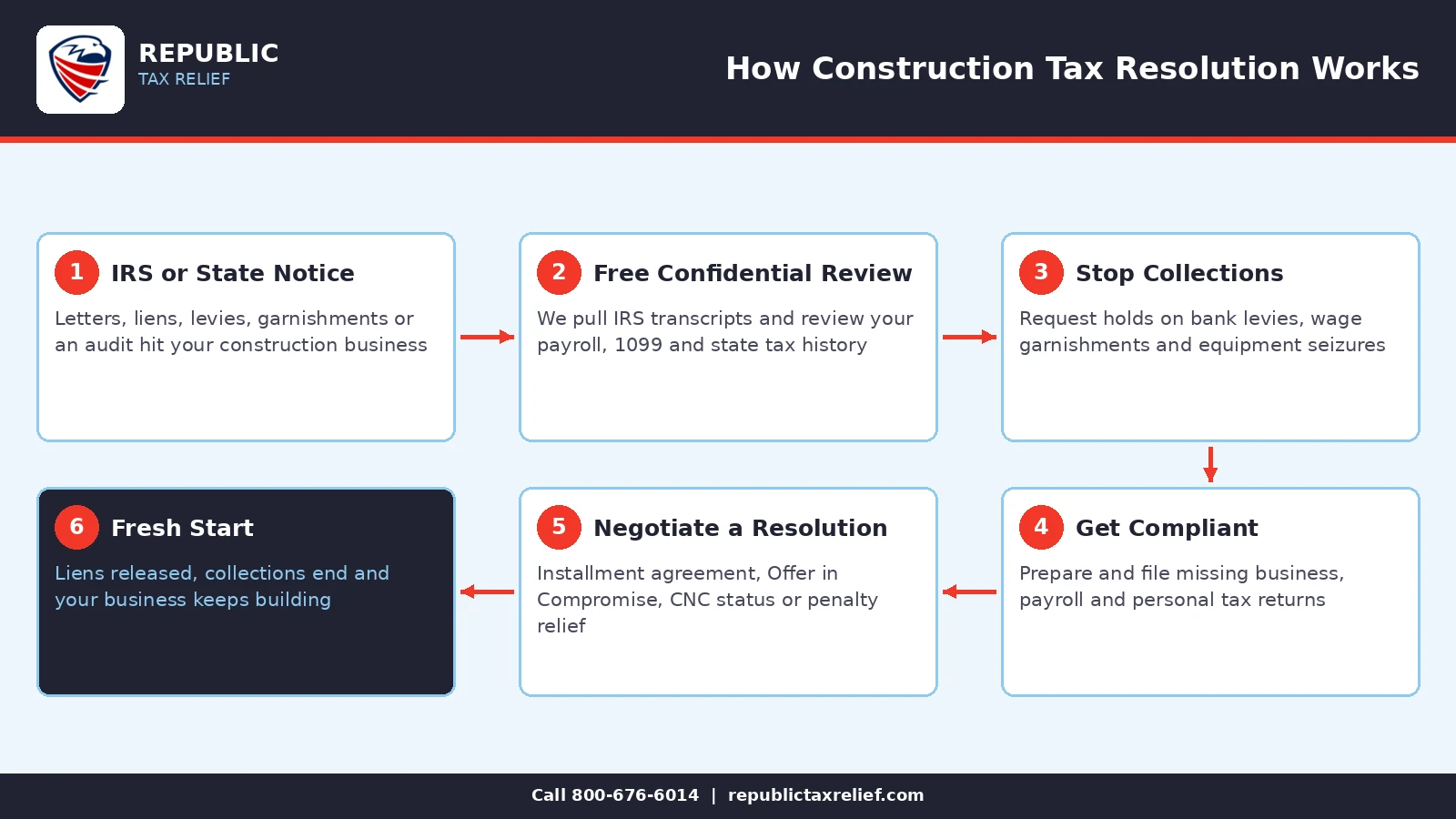
Learn how a tax lien can be released or removed and how the full IRS collection process works.
State Tax Problems Contractors Overlook
The IRS is not the only agency that collects. State tax problems often grow quietly while owners focus on federal notices.
- Sales and use tax on materials. Many states treat contractors as the end user of materials, so use tax may be owed even when labor is not taxed.
- State payroll taxes. Unemployment and disability programs have their own deposit rules.
- Multi-state jobs. Crossing a state line can create filing duties in a new state.
- License risk. Some states can suspend professional licenses for serious tax debt.
States and the IRS share information, so a problem in one place often shows up in the other.
Warning Signs Your Construction Business Is Headed for IRS Trouble
- You have used payroll tax money to cover materials or a sub’s invoice
- Your payroll provider’s deposit report does not match what the IRS shows
- You skipped one or more estimated tax payments this year
- A bonding company or lender mentioned a lien search
- You have IRS mail you have not opened
- Your books are more than three months behind
If two or more of these apply, the debt is likely growing every month. The earlier you act, the more options stay open.
Sample Scenarios: How Small Construction Tax Problems Grow
These illustrative scenarios show how quickly common mistakes turn into serious IRS problems. They are based on typical situations, not on any single business.
The framing sub with a strong year on paper
Three big jobs are 70% complete at year end, so the business shows a solid profit. The cash is still tied up in retainage, the owner skips estimated payments, and April brings a five-figure balance he cannot pay.
The remodeler who paid the lumber yard first
To keep a job moving, the owner pays a supplier instead of a $22,000 payroll deposit. The company later closes, and the IRS proposes the trust fund penalty against the owner personally.
The drywall contractor whose client got a levy
After months of unanswered notices, the IRS sends a levy to the general contractor on her biggest job. Her next draw goes straight to the IRS, and the GC starts asking questions about future bids.
Construction Tax Debt Questions
Does the IRS treat construction companies differently from other businesses?
The tax rules are the same, but construction has more risk points, such as large payrolls, subcontractor 1099s, and long-term contract accounting. That is why payroll and classification issues show up so often in this industry.
Is retainage taxable before I collect it?
It depends on your accounting method and contract terms. Under some methods, income tied to retainage counts before the cash arrives, so ask your tax professional how your method treats it.
What happens to payroll tax debt if my construction company closes?
Closing the business does not erase the debt. The IRS can still pursue the trust fund portion from responsible owners and officers through the Trust Fund Recovery Penalty.
Why did my tax bill go up even though I made payments?
Penalties and interest keep adding up on any unpaid balance. Payments may also be applied to older periods first, so newer quarters can keep growing.
Looking for quick answers on IRS calls, costs, and 1099 rules? Visit our Construction Tax Resolution FAQ with 40 answers for contractors.
Where to Get Help With Construction Tax Debt
Every problem in this article has a solution, and most contractors have more options than they think. Payment plans, penalty relief, settlements, and collection holds are all on the table when you act early.
To see how we stop collections and negotiate for contractors, visit our construction tax resolution services page.
Key Takeaways
- Most construction tax debt starts with cash timing, not bad intent
- Accounting methods can create tax bills before the cash arrives
- Unpaid payroll taxes can become your personal debt
- The IRS can levy payments owed to you by general contractors
- The final notice gives you 30 days to protect your appeal rights
“I highly recommend Republic Tax for any tax-related services. If you’re behind on your taxes or facing debt with the IRS, I strongly encourage you to contact them. They were instrumental in helping me resolve my case efficiently and effectively.
The entire process went smoothly, and I experienced no issues or stress throughout. My caseworker, Jocelin Alpizar, was outstanding. She kept me informed every step of the way and provided excellent support.
Republic Tax offers reliable and professional assistance, and I would confidently recommend them to anyone dealing with IRS-related issues.”
Your documents stay locked down. Tax returns, Social Security numbers, and bank statements you upload are protected with bank-grade 256-bit encryption and handled in full compliance with federal data protection standards.
Speak With a Tax Relief Professional
If any part of this article sounds like your business, the next step is a short, private conversation. We will look at your notices and tell you honestly where you stand.
Call 800-676-6014 or request your free consultation.
About Republic Tax Relief
Republic Tax Relief helps individuals and businesses resolve IRS and state tax debt. Our team of tax attorneys, enrolled agents, and CPAs handles payroll tax debt, liens, levies, wage garnishments, unfiled returns, audits, and settlements for clients nationwide. Call 800-676-6014 or visit our contact page to get started.
Sources
- Internal Revenue Service: Employment Taxes and the Trust Fund Recovery Penalty
- Internal Revenue Service: Understanding a Federal Tax Lien
Disclaimer: This article is for general information only and is not legal or tax advice. Every tax situation is different. Speak with a licensed tax professional about your specific situation.