
Oct
A strong year in real estate can feel like a win until April arrives. With no taxes withheld from commissions and income that comes in bursts, many agents discover they owe far more than they set aside.
This article explains why real estate agents, brokers, and investors fall behind with the IRS, what happens when estimated taxes go unpaid, and how tax debt can reach your commissions and properties. Understanding the pattern is the first step to breaking it.

Contents
- The Main Reasons Real Estate Agents Owe the IRS
- Tax Problems Independent Real Estate Agents Face
- What Happens If a Realtor Doesn’t File Taxes
- What Happens If a Realtor Doesn’t Pay Quarterly Taxes
- How a Market Slowdown Turns Into Tax Debt
- Can the IRS Garnish Real Estate Commissions?
- How IRS Tax Debt Affects Real Estate Investors
- Tax Risks for Brokers and Property Managers
- How Tax Debt Affects Mortgages and Financing
- How IRS Notices Escalate for Real Estate Professionals
- Warning Signs of Real Estate Tax Debt
- Three Common Real Estate Tax Scenarios
- When to Get Help
The Main Reasons Real Estate Agents Owe the IRS
Nobody withholds tax from commission checks
Most licensed agents are treated as self-employed under federal law, so a brokerage pays the full commission without taking out income tax or Social Security. Every dollar of tax is up to the agent to send in.
Self-employment tax catches new agents off guard
On top of income tax, self-employed people pay 15.3% for Social Security and Medicare on most net earnings (IRS: Self-Employment Tax). An agent who budgets only for income tax can come up thousands of dollars short.
Feast-or-famine income
A spring full of closings raises next year’s estimated payments. If the market cools, the agent faces last year’s balance and this year’s estimates with less money coming in.
Spending ahead of the next deal
Marketing, MLS dues, staging, and car costs come out before a commission arrives. Money meant for taxes often goes to keeping the business running between closings.
Rental income that never made it onto the return
Investors sometimes leave out a small rental, cash rents, or short-term rental income. When IRS data later shows the income, the result is a bill for the tax, penalties, and interest, sometimes for several years at once.
Investment moves with hidden tax costs
Selling a rental can trigger depreciation recapture, and a 1031 exchange that misses its 45-day or 180-day deadline can make the whole gain taxable that year.
Tax Problems Independent Real Estate Agents Face
Beyond the big causes above, smaller habits create tax trouble for independent agents year after year.
- Gross commissions on the 1099. Some brokerages report your full share before desk fees, franchise fees, or team splits. If you only report what landed in your account, your return won’t match IRS records.
- Team and referral payments. Agents who pay team members or referral fees may owe their own 1099 filings, and missing them adds penalties.
- One bank account for everything. Mixing personal and business spending makes it hard to prove deductions if the IRS asks questions later.
- No mileage log. Agents drive constantly, but without a written log, the IRS can reject vehicle deductions entirely.
- Extensions that never become returns. An extension gives more time to file, not more time to pay, and many agents forget to finish the return.
What Happens If a Realtor Doesn’t File Taxes
Not filing is usually more expensive than filing and not paying. Here is why.
The failure-to-file penalty is ten times larger
The late-filing penalty is generally 5% of the unpaid tax for each month the return is late, up to 25%. The late-payment penalty is 0.5% per month. Filing on time, even without payment, avoids the bigger charge.
The IRS may file a return for you
Using your 1099s, the IRS can prepare a substitute return. It counts your gross commissions but gives you none of your business expenses, so the bill is often far higher than what you truly owe.
The clock never starts
The IRS usually has three years to audit a filed return. For a year with no return, there is no time limit, so an unfiled year from long ago can still be assessed.
Refunds can be lost
If one of your unfiled years would have produced a refund, you generally must claim it within three years of the original due date. After that, the money is gone, even if you owe for other years.
What Happens If a Realtor Doesn’t Pay Quarterly Taxes
Skipping estimated payments starts a chain reaction:
- An underpayment penalty builds quarter by quarter, calculated like interest on each late or missing payment.
- A large balance comes due in April that many agents can’t pay in one check.
- Late-payment penalties and interest start on whatever goes unpaid after the deadline.
- Unpaid self-employment tax keeps adding up, since it is part of the same balance as your income tax.
- The next year’s estimates are still due, so the hole gets deeper if income drops.
Agents who skip filing altogether face a much steeper penalty for not filing, plus the risk that the IRS files a return for them that ignores every business expense.
How a Market Slowdown Turns Into Tax Debt
Many agents who owe the IRS were not failing when the debt started. They were coming off a great year. This simplified example shows how it happens.
| Year | What happens | Tax picture |
|---|---|---|
| Strong year | Net commissions jump, and the agent pays only part of the tax | A large balance is due in April |
| Following spring | Rates rise and listings slow down | Last year’s balance and this year’s estimates are due together |
| Slow year | Income drops, savings go to living costs | Estimated payments stop, penalties and interest grow |
| Year three | Two years of balances plus notices | The account moves toward levy and lien |
The lesson is that tax debt in real estate often comes from timing, not from earning too little. A high-income year sets expectations that a slower market can’t meet.
Can the IRS Garnish Real Estate Commissions?
Yes. After the required notices, the IRS can send a levy to your brokerage, title company, or escrow holder for commissions they owe you. They must send that money to the IRS instead of to you.
A levy generally reaches money owed at the time it is served, so the IRS may serve new levies as more deals close. The result can be closing after closing with nothing reaching your bank account.
Beyond the money, your broker now knows about your tax problem. For agents who rely on referrals and reputation, that can hurt as much as the lost commission.
How IRS Tax Debt Affects Real Estate Investors
A lien attaches to every property you own
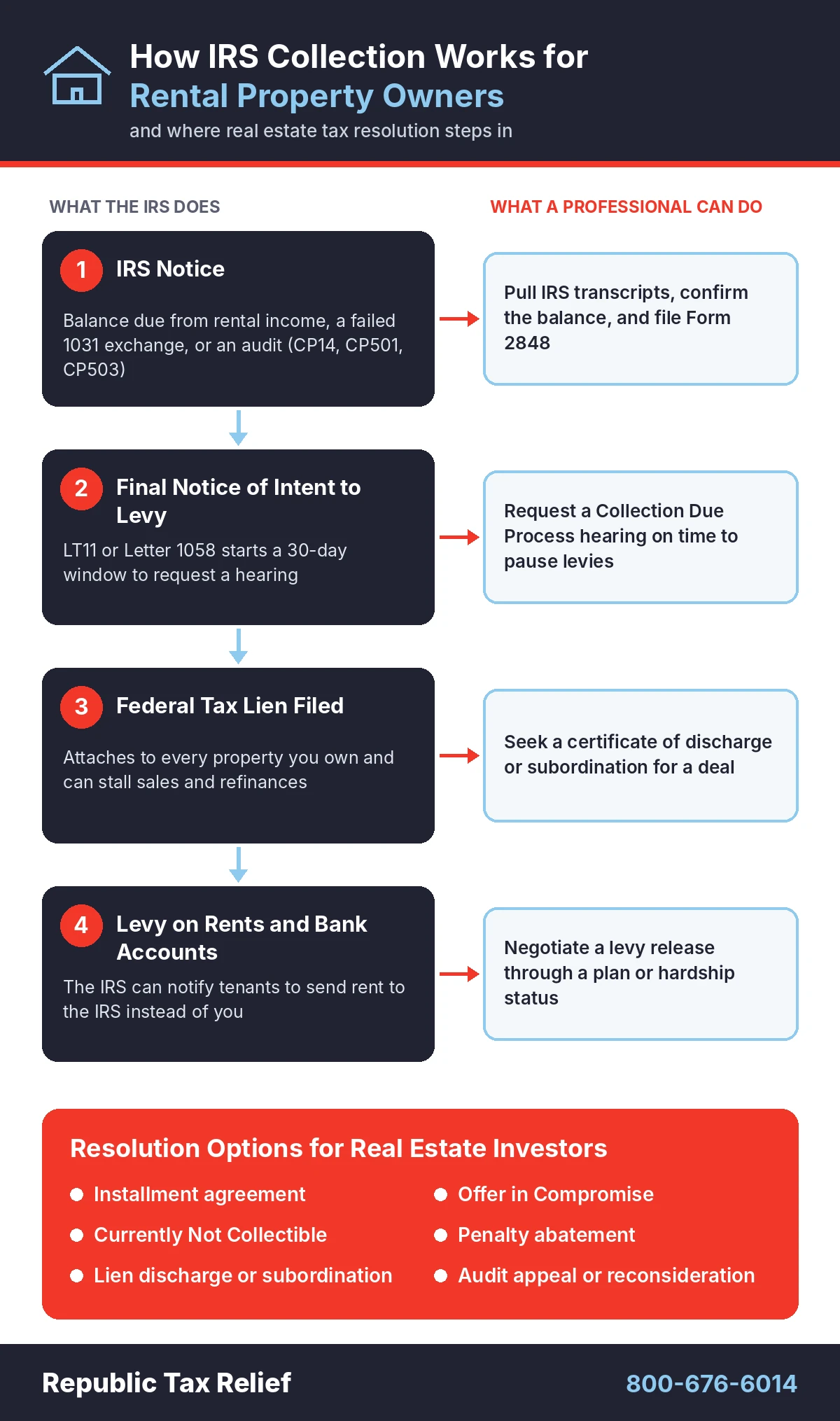
Once the IRS files a notice of federal tax lien, it attaches to all your real estate, including rentals in other counties (IRS: Understanding a Federal Tax Lien). Title companies find it in their search, and lenders usually won’t refinance until it is dealt with.
Selling a property with a lien
A lien doesn’t stop you from selling, but the IRS expects to be paid from your proceeds. A buyer can walk away if the lien isn’t handled before the closing date.
Rent can be levied
The IRS can levy rent owed by your tenants or held by your property manager, sending that money to the IRS instead of to your mortgage lender.
Rental property can be seized, though it’s rare
The IRS can seize and sell real estate to pay a tax debt. It is uncommon and requires supervisor approval, and seizing a primary residence also requires a court’s approval. Investors who keep adding debt and ignore letters face the highest risk.
Unreported rental income
Landlords who leave rent off their returns often hear from the IRS through a mismatch notice. Penalties can reach 20% of the underpaid tax, and in serious cases, fraud penalties are far higher.
Depreciation recapture and the extra investment tax
Each year you depreciate a rental, you lower your taxable income. When you sell, the IRS takes some of that benefit back. The portion of gain from depreciation can be taxed at up to 25%, and higher-income investors may also owe the 3.8% net investment income tax on top of capital gains tax.
Short-term rental surprises
Short-term rentals don’t always follow normal rental rules. When the average guest stay is very short, or you provide hotel-like services, the income may be treated differently for loss limits or even subject to self-employment tax. Many cities also charge a local occupancy tax that hosts must collect and pay.
When a real estate professional claim is denied
Investors who claim real estate professional status to deduct rental losses must meet strict time tests, including more than 750 hours a year in real property businesses. If the IRS rejects the claim, past losses can be disallowed, creating additional tax plus a possible 20% accuracy penalty for several years at once.
Tax Risks for Brokers and Property Managers
- Payroll for office staff. Unpaid withholding can make owners personally liable for the trust fund portion.
- Worker classification. Licensed agents paid by commission can usually be treated as contractors, but unlicensed assistants usually cannot.
- Information returns. Brokerages must issue 1099s to agents, and property managers may need to report rents paid to owners.
- Trust accounts. Mixing client funds with operating money can create both tax and licensing trouble.
How Tax Debt Affects Mortgages and Financing
Real estate professionals borrow more often than most people, for their own homes, rentals, and flips. Tax debt shows up in that process in several ways.
- Lenders check tax records. Most lenders verify income with IRS transcripts, which also reveal unfiled years and balances.
- Liens surface in title searches. A filed lien appears on every property search, even though it no longer shows on credit reports.
- Some loans allow a payment plan. Certain loan programs accept borrowers on an IRS installment agreement once a few on-time payments are made, while others want the balance paid or the lien handled first.
- Unfiled returns stop most loans cold. Self-employed borrowers usually need two years of filed returns to qualify.
For quick answers on 1099 mismatches, quarterly due dates, and credit reports, see our real estate tax FAQ.
How IRS Notices Escalate for Real Estate Professionals
| Stage | What usually happens |
|---|---|
| First weeks | A balance-due notice arrives after the return is processed. |
| 1 to 3 months | Reminder notices, with penalties and interest growing. |
| 3 to 6 months | A notice of intent to levy certain assets, such as state refunds. |
| Final notice | A final notice of intent to levy, a 30-day window to request a hearing, and often a filed tax lien. |
| Enforced collection | Levies on bank accounts, commissions, and rents. |
The IRS generally has 10 years from assessment to collect, so waiting rarely makes a balance go away.
Warning Signs of Real Estate Tax Debt
- You haven’t made an estimated payment in two or more quarters
- You spend each commission before the next one closes
- You filed an extension and still haven’t filed the return
- A rental or short-term rental isn’t on your return
- Your title or escrow officer mentions a lien
- You’ve received more than one IRS letter in a year
- You don’t know how much you owe right now
Three Common Real Estate Tax Scenarios
These composite examples show how tax debt builds. Names and details are illustrative.
The first-year agent with a big year
A new agent closed 14 deals in her first full year and made no estimated payments. Income tax plus self-employment tax left a five-figure balance in April, and her next quarter’s estimate was due the same day.
The investor who missed an exchange deadline
An investor sold a fourplex and planned a 1031 exchange, but the replacement property fell through after the 45-day window. The full gain, including depreciation recapture, became taxable that year.
The broker who used payroll taxes to cover rent
A small brokerage hit a slow quarter and used withheld staff taxes to pay office rent. Two quarters later, a revenue officer called and asked to interview the owner about personal liability.
When to Get Help
The best time to act is before a final notice, while every option is still open. If these scenarios sound familiar, our page on tax resolution for real estate professionals explains how we help agents, brokers, and investors resolve IRS and state debt. For quick answers on quarterly taxes, 1099s, and scam calls, see our real estate tax FAQ.
What Our Clients Say
★★★★★
“Viry was wonderful. She was professional and kept me updated on all the information I needed to know. 10/10 I would recommend this company for all your tax needs.”
NaTasha Harris, Google Review
Speak With a Tax Relief Professional
Owing the IRS doesn’t have to cost you your commissions, your properties, or your reputation. Call 800-676-6014 or request your confidential review today.
Every document you send is protected with bank-grade 256-bit encryption and handled under strict tax professional privilege standards.
About Republic Tax Relief
Republic Tax Relief helps individuals and businesses resolve IRS and state tax problems, from back taxes and unfiled returns to levies, liens, and audits. Our tax attorneys and tax professionals work one-on-one with each client to find a realistic path forward. Call 800-676-6014 or contact us online.
This content is general information, not legal or tax advice. Results depend on each taxpayer’s facts.