
In California, a tax bill does not stay in the name of the spouse who ran it up. Under California community property law, the community estate is liable for a debt incurred by either spouse before or during marriage, no matter whose name is on the account or the tax return. That means the California Franchise Tax Board (FTB) and the IRS may be able to reach shared wages, joint bank accounts, and a joint refund to pay one spouse’s tax debt, even if you never signed the return that created it.
That surprises a lot of people, especially newlyweds whose spouse brought old tax debt into the marriage and couples going through a California divorce. This article explains how community property and separate property are treated when taxes are owed, when you are personally liable for your spouse’s tax debt, why the FTB has its own innocent spouse relief (FTB 705) separate from the IRS’s, what changes at the date of separation, and why a divorce decree usually does not bind the FTB.
In this article:
- How California community property law treats tax debt
- Am I liable for my spouse’s tax debt in California?
- Can the FTB or IRS take my wages or accounts for my spouse’s taxes?
- FTB innocent spouse relief (FTB 705) vs. IRS relief
- Tax debt in a California divorce: what the decree can and can’t do
- Registered domestic partners and tax debt
- A real case: Ordlock v. Commissioner
- Flowchart: are you liable for your spouse’s tax debt?
- Example scenarios: common community property debt situations
- Frequently asked questions
How California Community Property Law Treats Tax Debt
California is a community property state, one of nine. Under the California Family Code, all property acquired by a married person during the marriage while living in California is community property, unless a statute says otherwise (Family Code 760). Separate property in California is property owned before the marriage, property received by gift or inheritance, and the income from that property (Family Code 770).
In plain terms, property acquired by either spouse during the marriage is considered community property in California regardless of whose name is on the title. That covers assets acquired with either paycheck, savings accumulated during the marriage, and most assets and debts acquired during marriage. The same logic runs on the debt side. Debts incurred by either spouse during marriage are generally community debt, the responsibility of both spouses’ shared marital property, even if only one spouse’s name is on the bill.
The rule that matters most for tax debt is Family Code 910: the community estate is liable for a debt incurred by either spouse before or during marriage, regardless of which spouse manages the property and regardless of whether one or both spouses are parties to the debt. A tax debt works like any other debt here, including credit card debt in your spouse’s name, so a creditor such as the FTB or IRS can look to community property to collect it. The IRS’s own manual lists California as a state where it can collect one spouse’s tax from 100% of community property (IRM 25.18.4, Collection of Taxes in Community Property States).
Your separate property gets more protection. Under Family Code 913, the separate property of a married person is generally not liable for a debt incurred by the person’s spouse before or during marriage. A joint return changes that, because then the debt is yours too.
Community property and separate property: what a tax agency may reach
| Asset | Usual character under California law | Available for one spouse’s tax debt? |
|---|---|---|
| Wages either spouse earned during the marriage | Community property (community income) | Generally yes. One narrow exception applies to debts from before the marriage (see below) |
| Joint bank accounts and savings funded during marriage | Community property | Generally yes |
| Home bought during the marriage, regardless of whose name is on the title | Presumed community property | Generally yes, subject to liens and homestead limits |
| Retirement accounts built up from earnings during the marriage | Community property to the extent earned during the marriage | Often yes, though special rules apply to retirement accounts |
| A joint state tax refund | Community property, according to the FTB | Yes. The FTB says it can be used to pay the debts of either spouse |
| Property owned before the marriage, gifts, and inheritances, kept apart | Separate property | Generally no, unless you are also liable for the debt |
| Your earnings after the date of separation | Separate property (Family Code 771) | Generally no, for your spouse’s separate tax debt |
Why commingled money becomes hard to protect
Separate funds don’t always stay separate. Separate funds can become community property in practice. When you commingle an inheritance with paychecks in a joint account, or pay a mortgage with both kinds of money, the account is presumed to be community property unless the separate portion can be traced. The IRS manual notes that the burden of proof is usually on the person trying to show the money is separate. Clean records of property acquired before the marriage, and of separate property assets kept in your own name, are often the difference between protected funds and funds a creditor can reach.
Am I Liable for My Spouse’s Tax Debt in California? Debt Responsibility in Three Situations
Two different questions get mixed up here. One is whether you are personally liable, meaning the tax agency can come after your own separate property and future income. The other is whether community property can be used to pay the debt. In California, the answer to the second question is often yes even when the answer to the first is no.
1. You signed a joint return
When spouses file a joint return, the liability for the tax on the combined income is joint and several (R&TC 19006(b)). Each spouse is responsible for the whole balance, not half. It doesn’t matter that the income came from your spouse’s business or that you earned nothing that year. The same is true when you file jointly on a federal joint tax return. Relief comes from an innocent spouse request, not from community property rules.
2. Your spouse filed separately during the marriage
Filing separate returns does not wall off community income. Each spouse generally reports half of the community property income, so one spouse’s earnings show up on the other’s return. California adds a rule of its own: the spouse who controls, receives, or spends community income is liable for the tax on that income along with the spouse who is taxable on it (R&TC 19006(a)). And because community property is liable for either spouse’s debts, shared accounts can still be reached for a debt shown only on your spouse’s separate return.
3. Your spouse owed taxes before the marriage
You are not personally liable for tax your spouse owed before the date of marriage, and a house or account your spouse owns separately is their problem, not yours. But California’s community property rules still let the community estate be used to pay it. The FTB says plainly that California does not have an injured spouse law: a joint refund is community property and can be used to pay the debts of either spouse, whether owed before or during the marriage. The only exception it lists is a notarized prenuptial agreement that identifies each spouse’s separate property (FTB: Tax debt relief for spouse/RDP).
There is one real protection. Under Family Code 911, the earnings of a married person during marriage are not liable for a debt incurred by their spouse before marriage. After they are paid, those earnings stay protected only while they are held in a deposit account the other spouse can’t withdraw from and are not mixed with other community money. The protection covers earned income from work. A paycheck deposited into a joint account loses it.
At a glance: who is responsible for what
| Situation | Are you personally liable? | What may be used to pay it | Relief to look at |
|---|---|---|---|
| Joint return, tax unpaid or understated | Yes, for the full amount | Your separate property, your spouse’s separate property, and all community property | FTB innocent joint filer relief (FTB 705) and IRS Form 8857, filed separately |
| Spouse’s separate return during marriage | Possibly, for tax on community income you controlled or spent | Community property and your spouse’s separate property | FTB community income relief; IRS relief from community property laws |
| Spouse’s tax debt from before the marriage | No | Community property, including joint refunds. Your earnings are protected only if kept in your own, unmixed account | Usually none needed for you; the debt itself must be resolved by your spouse |
| Spouse’s new tax debt after the date of separation | No, unless you signed a joint return for that year | Your spouse’s property. Your post-separation earnings are separate property | Document the date of separation |
Can the FTB or IRS Take My Wages or Accounts for My Spouse’s Taxes? Community Property and IRS Levy Rules
It can happen, which is why this question comes up so often. On the federal side, the IRS manual says that in all community property states it is possible in some circumstances to levy a non-liable spouse’s salary or wages to reach the liable spouse’s community share (IRM 25.18.4.5). A few details from that same section help:
- No continuous levy. A levy on your wages to reach your spouse’s community interest is not continuous. The IRS has to issue a separate levy for each payment.
- You get the wage exemption. A spouse whose wages are levied can claim the minimum exemption from levy for wages.
- No hearing rights for you. Collection due process rights belong to the liable spouse, not to you.
- Social Security is off limits. Certain assets aren’t community property at all. Your Social Security benefits are not community property, so the IRS cannot levy them for your spouse’s tax.
On the state side, the FTB is a creditor under the same Family Code rules, and it says directly that a joint refund can go to either spouse’s debt. Joint bank accounts are the most common pressure point. If your spouse owes and your paycheck lands in a shared account, treat that account as reachable until a professional tells you otherwise.
FTB Innocent Spouse Relief (FTB 705): Separate From the IRS Joint Return Relief
If you signed a joint return, the way out of the liability is relief, not community property law. The FTB calls it innocent joint filer relief, and you request it with the Innocent Joint Filer Relief Request, FTB 705, or online in MyFTB by selecting “Submit an Innocent Joint Filer Application” from the Services menu. The governing law, R&TC 18533, says the FTB makes these decisions without regard to community property laws.
IRS relief is a separate request on Form 8857 with its own deadlines. We cover the federal side in detail in our explanation of the four types of IRS innocent spouse relief. The key point for Californians: winning with the IRS does not automatically clear the state balance. You still have to ask the FTB.
Types of FTB innocent spouse relief
| Type of FTB relief | Who it fits | Key requirement |
|---|---|---|
| Traditional innocent joint filer relief | Joint filers hit with additional tax from the other spouse’s items | You didn’t know, and had no reason to know, of the understatement when you signed |
| Separate allocation of liability | Divorced, legally separated, or living apart for 12 months | The assessed tax is attributable to your spouse/RDP and you had no knowledge of the items |
| Equitable relief | Joint filers with unpaid tax shown on the return, or who don’t qualify above | All facts and circumstances, including abuse or financial control, knowledge, benefit, and later compliance |
| IRS relief | Taxpayers already granted federal innocent spouse relief | Same facts and same tax years, plus a copy of the IRS Final Determination letter |
| Community income relief | Separate filers taxed on community income they didn’t know about | The unreported community income was your spouse/RDP’s responsibility |
| Court-ordered relief | Spouses with a divorce or RDP termination order that revises the tax | The order must meet R&TC 19006(b) (see the divorce section below) |
Source: FTB 714, Innocent joint filer relief and the FTB’s tax debt relief for spouse page.
What to know before you file FTB 705
- Watch the deadline. For traditional relief and separate allocation, R&TC 18533 requires the election within two years after the FTB begins collection activities against you.
- Your spouse will be told. The law requires the FTB to notify your spouse, ex-spouse, RDP, or ex-RDP, ask them for documents, and give them a chance to appeal the decision. The FTB keeps your personal information confidential.
- Pending IRS claim. If you show the FTB that an IRS request on the same facts is pending, the FTB may not deny your state request until the federal decision is final (R&TC 18533(j)).
- Collection on those years pauses. Under R&TC 18533, while the FTB decides and any appeal runs, it generally can’t levy or go to court to collect the assessment your request covers. The collection clock is suspended for the same period.
- Notices keep coming. The FTB says that even after relief is approved, you will still get an annual notice until the tax debt is paid.
Tax Debt in a California Divorce: Property Division, the Decree, and the FTB
In a divorce in California, the family law court will divide community assets and debts between the two spouses, and this is where tax debt gets divided in a divorce. Debts acquired during the marriage and before the date of separation are divided under the property division rules (Family Code 2622), and separate debts, including debts incurred during marriage that were not for the benefit of the community, are confirmed to the spouse who incurred them (Family Code 2625).
Why a divorce decree usually doesn’t bind the FTB
The FTB and the IRS were not parties to your divorce. Even when the spouses agree in writing who pays, neither agency gave up its property interest or its claim. When a court orders one partner to pay an outstanding tax liability, the FTB says it generally is not required to follow the order (FTB: Registered domestic partner). On a joint return, both of you stay liable to the agency. A decree that says “Husband pays the 2023 taxes” gives you a claim against your ex, not protection from the FTB. The FTB does consider a decree that names who is responsible when it weighs equitable relief.
California’s exception: a court-ordered tax revision
California law lets the divorce court revise joint state income tax liability, but only if the order meets the rules in R&TC 19006(b) and the FTB’s published requirements:
- The order must state the California income tax liability for each tax year it revises and the amount each spouse must pay.
- It cannot relieve a spouse of tax on income they earned or controlled.
- It cannot revise tax that was already paid in full before the order.
- If gross income on the return is more than $150,000, or the relief is more than $7,500, a Tax Revision Clearance Certificate from the FTB must be filed with the court first.
- It takes effect when the FTB is served with the order or acknowledges receiving it.
Choose carefully. Under R&TC 18533(k), you can’t get innocent joint filer relief for a liability a divorce court has already revised under 19006(b). Before filing for divorce, or at least before the judgment, ask your divorce attorneys or family law attorney to coordinate with a tax professional before the judgment is final. The IRS has no equivalent: a state court order does not change federal joint liability.
Date of separation and what changes after it
The date of separation is the date of a complete and final break in the marriage (Family Code 70). It matters for tax debt in two ways. Earnings and accumulations after that date are separate property (Family Code 771). And debts incurred after that date and before a judgment of dissolution or legal separation are not treated as incurred “during marriage” for the community liability rule (Family Code 910(b)).
What the decree can and can’t do
| Divorce step | Effect on the FTB | Effect on the IRS |
|---|---|---|
| Decree assigns the tax debt to your ex | Generally not binding; a factor in equitable relief | Not binding; a factor in equitable relief |
| Court-ordered revision that meets R&TC 19006(b) | Binding once the FTB is served, within the limits above | No effect on federal joint liability |
| Date of separation | Your later earnings are separate property | Community property rules generally stop applying to new income |
| Property division is final | Property you received generally isn’t liable for your ex’s separate debts, but you remain liable on joint returns | Former community property may still be reachable for debts from the marriage |
One more caution: if either spouse is filing bankruptcy during or after the divorce, get advice first. Bankruptcy, tax debt, and community property interact under special rules, and the IRS manual devotes a full section to them.
Registered Domestic Partners: Same California Community Property Rules, Different Federal Treatment
Registered domestic partners in California have the same rights and obligations under state law as spouses (Family Code 297.5). That includes community property. For tax years beginning on or after January 1, 2007, RDPs file California returns using the same filing statuses as married couples, and FTB 705 relief covers RDPs.
The federal side is different. Registered domestic partners are not married for federal tax purposes and can’t file joint federal returns. But the IRS manual says that because California community property law applies to RDPs, an RDP’s community property is available to pay the other partner’s separate tax debt the same way it would be for spouses (IRM 25.18.4.4). For an RDP with a joint California return and separate federal returns, the state and federal relief paths are not the same form or the same rules.
A Real Case: Ordlock v. Commissioner (Ninth Circuit, 2008)
Ordlock v. Commissioner shows how far California community property law reaches, even after a spouse wins innocent spouse relief. Lois and Bayard Ordlock lived in California and filed joint federal returns for 1982 through 1984 that understated their tax. Over the years, payments were made toward the debt, all from community property except one payment of $2,485 from Mrs. Ordlock’s separate property. They stayed married.
In 2002 the IRS granted Mrs. Ordlock innocent spouse relief under IRC 6015(b) for all three years. The IRS agreed to refund the $2,485 she paid from separate property. She asked for her share of the community property payments back too. The Tax Court said no (126 T.C. 47 (2006)), and the Ninth Circuit affirmed in 2008. It held that nothing in the innocent spouse statute overrides California community property law for refund purposes, and it pointed to Family Code 910, under which the community estate is liable for a debt incurred by either spouse.
The IRS now cites the case in its manual: innocent spouse relief removes your liability for the tax, but the IRS can still collect from your share of community property to which its lien for your spouse’s tax attaches, and it can keep payments made from community property (IRM 25.18.4.11, Effect of Innocent Spouse Relief).
What Ordlock means for California spouses
- Relief and protection are two different things. Relief ends your personal liability. It does not shield community property while you stay married.
- Money paid from community funds usually isn’t coming back. Only payments from separate funds were refunded.
- Act before money moves. If your spouse’s tax debt is growing, how you hold your earnings and when the date of separation falls can matter as much as the relief request itself.
Flowchart: Are You Liable for Your Spouse’s Tax Debt in California?
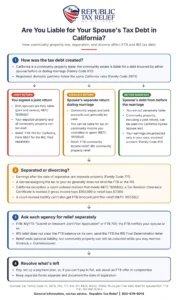
Example Scenarios: Common Community Property Debt Situations
These scenarios are illustrative. They are based on situations we commonly see in California cases, with details changed. They are not specific client results, and your outcome depends on your own facts.
Example 1: “My husband owed the FTB before we married, and they took our refund.”
A newly married teacher in San Diego filed a joint California return and expected a refund. The FTB applied it to her husband’s balance from years before the marriage. She was never personally liable for that debt, but California has no injured spouse law, and a joint refund is community property. The fix going forward was to resolve the husband’s old FTB balance through a payment plan and keep her paychecks in an account in her name only, so Family Code 911 could protect her earnings.
Example 2: “I signed the joint return. I didn’t know about his side income.”
A spouse in Sacramento learned that a joint return left out income from her husband’s side business. Both the IRS and the FTB assessed more tax. She filed Form 8857 with the IRS and, separately, FTB 705 with the state, telling the FTB about the pending federal request. Because the facts were the same for both, an IRS grant of relief could support the state request, but only one filed with the FTB would clear the California balance.
Example 3: “Our divorce decree says my ex pays the tax.”
After a divorce in Orange County, the marital settlement said the ex-husband would pay the couple’s joint 2022 California tax. He didn’t, and the FTB sent the wife an earnings withholding order. The decree was a claim against her ex, not a defense against the FTB. Her options were an equitable relief request through FTB 705, which weighs the decree, or going back to the family court for an order that met R&TC 19006(b), not both for the same liability.
Example 4: “My registered domestic partner owes the IRS.”
An RDP in Los Angeles County filed his own federal returns, as federal law requires, and his partner owed the IRS from a business they ran before registering. Because California community property law applies to RDPs, their joint account funded by both paychecks was exposed. Moving his earnings into his own unmixed account and getting the partner on an IRS payment plan were the first steps.
Next Steps: Protect Your Share Before Money Moves
- Find out which returns created the debt: joint, separate, or from before the marriage.
- Check both agencies. A balance with the FTB and one with the IRS need two separate relief requests.
- Stop commingling. Keep your earnings in an account your spouse can’t withdraw from if the debt predates the marriage.
- If you’re separating, write down the date of separation and what shows it.
- In a divorce, decide early whether you’ll seek a court-ordered tax revision or FTB 705 relief.
- Once your share of the liability is settled, look at how to pay what’s left.
A spouse with a simple, clear-cut case can file FTB 705 or Form 8857 on their own. When both agencies are involved, a divorce is pending, or community property is already being collected, a tax attorney, CPA, or enrolled agent can keep the state and federal requests consistent and time them around your divorce. See how we help California taxpayers with the IRS and FTB, or request a free consultation. You can also read what clients say about our 5.0-star rated Laguna Hills office and our 4.6-star rated Corona, CA office on Google.
Our offices are in Corona and Laguna Hills, and we work with taxpayers across California in person or remotely.
Which California Tax Problem Are You Facing?
| Your situation | What it usually means | Where to start |
|---|---|---|
| You or your spouse owe the FTB, the IRS, or both and can’t pay in full | Federal and state tax debt that our licensed team can handle with every agency for you | Call 800-676-6014 for a free consultation, or see how we help California taxpayers |
| Your share of the debt is settled, but the balance is more than you can ever pay | The FTB may accept less through its own offer program, separate from any IRS offer | How the FTB offer in compromise differs from the IRS |
| The IRS is collecting on a joint return your spouse or ex caused | Federal innocent spouse, separation of liability, or equitable relief may remove your share | The four types of IRS innocent spouse relief |
Community Property Tax Debt in California: Frequently Asked Questions
Can community property pay my spouse’s California tax debt if we filed separate returns?
Yes, generally. Separate returns don’t protect community property. Under Family Code 910, wages earned during the marriage and joint accounts can generally be used to pay either spouse’s debts, including tax. California also makes a spouse who controls, receives, or spends community income liable for the tax on that income under R&TC 19006(a).
Can the FTB take our joint refund to pay my spouse’s tax debt from before we married?
Yes. The FTB says California does not have an injured spouse law. A joint refund is community property and can be used to pay the debts of either spouse, whether owed before or during the marriage. The only exception the FTB lists is a notarized prenuptial agreement that identifies each spouse’s separate property.
Does IRS innocent spouse relief clear my California tax debt too?
No, not automatically. The FTB runs its own innocent joint filer relief. If the IRS granted you relief, you can still qualify with the FTB for the same tax years and the same facts, but you must file FTB 705 or apply online in MyFTB and send a copy of the IRS Final Determination letter.
How do I request FTB innocent spouse relief?
Apply online through MyFTB by selecting Submit an Innocent Joint Filer Application, or mail or fax the Innocent Joint Filer Relief Request (FTB 705) with a statement of why you qualify, your returns for the years involved, any IRS letters, and your divorce decree if you have one. The FTB is required to notify your spouse or ex-spouse and give them a chance to respond.
Is the FTB bound by my divorce decree if it says my ex pays the taxes?
Generally no. The FTB was not a party to your divorce, so on a joint return you both stay liable. California does allow a divorce court to revise joint state income tax liability if the order meets R&TC 19006(b), including a Tax Revision Clearance Certificate when gross income tops $150,000 or relief tops $7,500. A court-revised liability can’t also get innocent joint filer relief.
Are registered domestic partners liable for each other’s tax debt in California?
Under California law, registered domestic partners have the same community property rights and obligations as spouses, so community property can be used to pay either partner’s tax debt. RDPs file joint or separate California returns like married couples, and FTB 705 relief covers them. For federal taxes, RDPs are not married and file separate returns.
Does separation protect my paycheck from my spouse’s new tax debt?
It helps. Under California Family Code 771, earnings after the date of separation are your separate property, and debts your spouse incurs after that date are not treated as incurred during marriage for community liability purposes. You can still be liable for any joint return you sign, and former community property can remain exposed for debts from the marriage.
This article is general information, not legal or tax advice for your specific situation. Republic Tax Relief is not affiliated with the California Franchise Tax Board or the IRS.