
Opening an IRS notice and seeing IRS penalties stacked on top of what you already owe is a gut punch. In many cases, penalties and interest can add up to a large share of the total balance. The good news is that the IRS doesn’t expect everyone to pay every penalty, and it has clear rules for taking them off.
This guide explains how the IRS removes penalties, which penalties qualify, and the three main paths to relief. You’ll also learn what happens if a request is denied and when IRS penalty abatement assistance from a professional can save you time and money.
Table of Contents
- What IRS Penalty Abatement Means
- Types of IRS Penalties That Qualify
- How to Qualify for First-Time Penalty Abatement
- Reasonable Cause for Penalty Abatement
- Relief for IRS Error, Delay, or Bad Advice
- How to Remove IRS Tax Penalties and Interest
- How to Request Relief With IRS Form 843
- What to Do if Your Request Is Denied
- State Tax Penalty Relief
- Why Work With a Tax Attorney
- IRS Penalty Abatement FAQs
- Speak With a Tax Relief Professional
What Is IRS Penalty Abatement?
Penalty abatement is the IRS’s term for removing or reducing a penalty that has already been charged to your account. When the IRS removes a penalty, any interest tied to that penalty is reduced as well (IRS.gov).
Abatement does not wipe out the tax itself. It targets the extra charges added because a return was late, a payment was late, or a tax was underpaid. For many people, those extra charges are the part of the bill that feels most unfair.
Why Penalty Relief Matters
- It lowers what you owe. Removing a large failure to file penalty can cut a balance by thousands.
- It can create a refund. If you already paid the penalty, the IRS may send that money back.
- It makes other options easier. A smaller balance can make a payment plan more affordable.
If the tax itself is more than you can manage, penalty relief is often one piece of a larger plan. See our overview of tax debt relief options for a fresh start.
Types of IRS Penalties That May Qualify for Penalty Relief
Not every type of penalty qualifies for the same relief option. Knowing which penalty assessed on your notice is the first step toward the right request.
| Penalty | How It’s Figured | Common Relief Paths |
|---|---|---|
| Failure to file | 5% of unpaid tax for each month the return is late, up to 25% | First-time abatement, reasonable cause |
| Failure to pay | 0.5% of unpaid tax per month, up to 25% | First-time abatement, reasonable cause |
| Failure to deposit (payroll taxes) | 2% to 15% of the late or missed deposit | First-time abatement, reasonable cause |
| Accuracy-related | 20% of the underpaid tax | Reasonable cause and good faith |
| Estimated tax | Figured like interest on the shortfall | Limited waivers, such as casualty or disaster |
Sources: IRS pages on the failure to file penalty and failure-to-pay penalty, and 26 U.S.C. § 6662.
When both the failure to file and failure to pay penalties apply in the same month, the combined charge is capped. Even so, both keep growing until the return is filed and the balance is paid.
How to Qualify for First-Time Penalty Abatement
The IRS first-time penalty abatement program offers relief to people with a clean record with the IRS who slipped up once. It’s an administrative waiver, so you don’t need to prove a hardship or explain why you were late (IRS.gov).
First-Time Abatement Requirements
You may be eligible for penalty relief under this program if:
- You had no significant penalties in the prior three tax years. An estimated tax penalty usually doesn’t count against you.
- You filed all currently required returns or a valid extension. If you have missing years, see our guide to catching up on unfiled tax returns.
- You paid the tax due or set up a payment arrangement and are keeping up with it.
First-time abatement covers failure to file, failure to pay, and failure to deposit penalties for a single tax period. It does not cover accuracy-related penalties.
|
Client Review |
|
“Let me just start by saying the director of operations, Mark is amazing. I couldn’t be happier I was referred to this company. I believe my 10+ years of tax issues are finally starting to get resolved. I am so relieved & feel a huge weight has been lifted as well. If you need help with any tax problems; I advise you to call Republic Tax Relief. |
A Common Mistake to Avoid
First-time abatement is usually applied to the earliest year with penalties. If you have penalties in several years, requesting it for the wrong year first can waste it. A tax professional can review your account and decide which year and which relief option to use first.
Reasonable Cause for Penalty Abatement
If you don’t qualify for first-time relief, reasonable cause may still work. The IRS can waive penalties when you used ordinary care but still couldn’t file or pay on time because of events beyond your control (IRS.gov).
Situations That Often Qualify
- Serious illness, injury, or death in your immediate family
- A fire, natural disaster, or other casualty
- Being unable to get the records you needed to file
- Other events outside your control that made compliance impossible
What Usually Isn’t Enough on Its Own
- Forgetting a deadline or misunderstanding the tax law
- Not having the money to pay, without other circumstances
- Blaming a tax preparer for a late filing, in most cases
What the IRS Will Review
A strong reasonable cause request tells a clear story backed by proof. The IRS will look at the dates of the event, how it kept you from filing or paying, and how quickly you fixed things afterward. Hospital records, insurance claims, or death certificates can make a big difference.
Relief for IRS Error, Delay, or Bad Written Advice
Sometimes the penalty isn’t your fault at all. If you relied on incorrect written advice from the IRS, the law allows the IRS to remove the resulting penalty (IRS.gov).
Interest can also be reduced in limited cases of IRS error or delay, such as when the IRS took an unreasonably long time on a routine step (26 U.S.C. § 6404). In federally declared disaster areas, the IRS often postpones deadlines automatically, and a penalty charged in error can be removed.
How to Remove IRS Tax Penalties and Interest
Penalties and interest follow different rules. That surprises a lot of people, so it helps to see them side by side.
| Charge | Can It Be Removed? | How |
|---|---|---|
| Penalties | Often, yes | First-time abatement, reasonable cause relief, or a statutory exception |
| Interest on the tax | Rarely | Only for certain IRS errors or delays |
| Interest on a penalty | Yes, when the penalty goes | Reduced automatically when the IRS removes a penalty |
In short, the best way to shrink interest is to get the penalties behind it removed. If you’re also facing collection action while penalties grow, learn how the IRS collection process works and how to stop a levy.
The Penalty Abatement Process and IRS Form 843
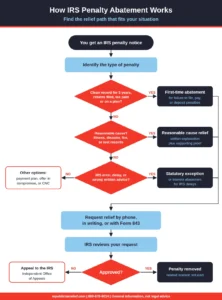
There are three common ways to request penalty abatement. The right one depends on the penalty, the amount, and how strong your records are.
- Calling the IRS. First-time abatement can often be granted over the phone, especially for smaller balances.
- A written request. Responding to an IRS notice with a letter explaining your situation is common for reasonable cause claims.
- Form 843. IRS Form 843, Claim for Refund and Request for Abatement, is the formal way to ask for relief, especially when you’ve already paid the penalty (IRS Form 843).
Timing Matters
If you already paid a penalty and want the money back, deadlines apply. A refund claim is generally due within three years of filing the return or two years of paying the tax, whichever is later. The Form 843 instructions explain the details, but missing the window can end your chance at a refund.
What Happens After You Apply
The IRS will review your abatement request, may ask for more documents, and then send a decision letter. If the IRS removes a penalty, it updates your balance and applies any overpayment to other debts or refunds it to you.
Your privacy matters to us. Every document you trust us with is handled under strict confidentiality and seen only by the professionals working on your case. Your information is used for one purpose: resolving your tax problem.
What to Do if Penalty Abatement Is Denied
A denial isn’t always the final word. If your request is denied, you can usually appeal to the IRS Independent Office of Appeals, a separate part of the IRS that takes a fresh look at your case (IRS.gov).
Appeals can succeed where a first request didn’t, especially when the case is better documented or the argument is framed around the correct standard. Your denial letter will explain the deadline and steps, so act on it quickly.
If penalty relief isn’t possible, you may still have options for the balance itself, like an installment agreement or an offer in compromise based on your ability to pay. Our explainer on the Offer in Compromise and Fresh Start Program covers the basics. Some people also ask about bankruptcy, which has its own strict rules for taxes and penalties. Our article Does Bankruptcy Get Rid of Your Tax Debts? explains the basics.
State Tax Penalty Relief
State tax agencies set their own rules for penalties from the IRS and state alike. Some follow the federal model, and others are much stricter.
California, for example, now offers a one-time abatement of certain late filing and late payment penalties for individuals, for tax years starting in 2022 or later. Reasonable cause relief is also available, though the Franchise Tax Board applies its own standards.
If you owe both the IRS and a state, one coordinated plan works better than two separate fights. Learn more about our tax relief services for IRS and state back taxes.
Why Work With a Tax Attorney for Penalty Abatement
You can ask the IRS for relief on your own, but the way a request is framed often decides the outcome. A penalty abatement tax professional knows which standard applies, what proof the IRS expects, and how to present your case the first time.
How Tax Attorney Penalty Abatement Help Works
- We handle the IRS for you. With a signed Form 2848, your representative deals with the IRS directly.
- We pick the strongest path. First-time abatement, reasonable cause, or a statutory exception, applied in the right order.
- We build the file. Timelines, records, and a clear written explanation that fits IRS guidelines.
- We fight denials. If needed, we take your case to Appeals.
How We Handle Your Case
- Free, confidential consultation. We learn what happened and what you owe.
- Account review. We pull your IRS transcripts to find every penalty and tax year.
- Strategy. We decide which relief to request and in what order.
- Request and follow-up. We prepare and submit the request, then answer IRS questions.
- Next steps. If a balance remains, we help you resolve it.
Signs You Need Help With IRS Tax Penalty Removal
- Penalties now make up a large part of what you owe
- You have penalties across several tax years
- Your first request was denied
- The IRS has already started a bank levy, a wage garnishment, or filed a federal tax lien
For the bigger picture, read our complete guide to tax resolution services or learn how our back tax help services work.
IRS Penalty Abatement FAQs
How long does the IRS take to decide a penalty relief request?
It varies. A first-time abatement request made by phone can be approved on the same call. Written requests and Form 843 claims can take several weeks to several months.
Can I get first-time abatement more than once?
Yes, but not often. You need a clean penalty history for the three tax years before the year you want relief for, so using it once usually rules it out for the next few years.
Does removing a penalty also remove interest?
It removes the interest charged on the penalty itself. Interest on the underlying tax usually stays unless the IRS caused an error or delay.
Can I still request relief if I already paid the penalty?
Yes. You can ask for a refund of the penalty, usually with Form 843, as long as you are within the refund deadline.
Can businesses get penalty relief?
Yes. Businesses often qualify for relief from failure to file, failure to pay, and failure to deposit penalties through first-time abatement or reasonable cause.
What if my penalty abatement is denied?
You can usually appeal to the IRS Independent Office of Appeals. A better-documented case or a different relief path may succeed on appeal.
Is relying on my tax preparer reasonable cause?
Usually not for a late filing, because the IRS expects you to make sure your return is filed on time. It may help in some cases involving incorrect advice on a complex issue.
Speak With a Tax Relief Professional
Penalties don’t have to be permanent. Whether you qualify for first-time abatement, have a strong reasonable cause story, or need help after a denial, we can review your account and tell you where you stand.
Call 800-676-6014 or request your free, confidential consultation today.
About Republic Tax Relief
Republic Tax Relief helps individuals and businesses resolve IRS and state tax debt, including penalties, back taxes, bank levies, wage garnishments, tax liens, and unfiled returns. Our team of tax professionals, including tax attorneys, handles each case with honesty, discretion, and a clear plan to help you move forward. Call 800-676-6014 or contact us online to get started.
Sources
- IRS: Penalty Relief
- IRS: Penalty Relief Due to First-Time Abate or Other Administrative Waiver
- IRS: Penalty Relief for Reasonable Cause
- IRS: Penalty Relief Due to Statutory Exception
- IRS: About Form 843, Claim for Refund and Request for Abatement
- IRS: Instructions for Form 843
- IRS: Independent Office of Appeals
- 26 U.S.C. § 6404, Abatements
- 26 U.S.C. § 6662, Accuracy-Related Penalty
Disclaimer: This page provides general information, not legal or tax advice. Reading it does not create an attorney-client relationship. Results depend on the facts of each case.