
If you owe the IRS and can’t pay the full balance, you are not alone, and you are not out of options. Millions of taxpayers use payment plans every year to pay off federal tax debt one month at a time.
The hard part is picking the right plan, keeping the monthly payment affordable, and avoiding mistakes that lead to default, liens, or levies. This guide explains how an IRS payment plan works, what it costs, who qualifies, and when it makes sense to bring in a tax professional to handle it for you.
Table of Contents
- What Is an IRS Payment Plan?
- Types of Installment Agreements and Payment Plans
- Payment Plan Fees, Interest, and Penalties
- Who Qualifies for a Payment Plan With the IRS?
- How to Set Up a Payment Plan: Online, Phone, or Mail
- Tax Debt Payment Plan Calculator: Estimate Your Monthly Payment
- Payroll Tax and Business Installment Payment Plans
- Why Hire a Tax Attorney for IRS Payment Plan Representation
- Managing IRS Installment Payments and Avoiding Default
- When a Payment Plan Is Not the Right Fit
- Frequently Asked Questions
- Speak With a Tax Relief Professional
What Is an IRS Payment Plan?
A payment plan is a formal agreement to pay your tax bill over time instead of all at once. The IRS calls the long-term version an installment agreement, and it covers the tax you owe plus penalties and interest.
Here is why it matters. When you request an installment agreement, the IRS is generally barred from levying your wages or bank accounts while the request is pending, with some exceptions (IRS.gov). That breathing room is often the first real relief a stressed taxpayer feels.
What a Payment Plan Does and Does Not Do
A plan gives you time. It does not erase the debt.
- It does: Stop most new collection action while you stay current, and cut the monthly late-payment penalty in half for many taxpayers.
- It does not: Stop interest from growing, remove a tax lien that is already filed, or reduce the amount owed.
- It requires: Filing every future tax return on time and paying future tax in full.
If you need the balance reduced rather than stretched out, look at our guide to tax debt relief options.
Types of Installment Agreements and Payment Plans
The IRS offers several payment options. The right one depends on how much you owe, how fast you can pay, and whether your returns are filed.
| Plan Type | Who It Fits | Balance Limit | Setup Fee | Financial Disclosure? |
|---|---|---|---|---|
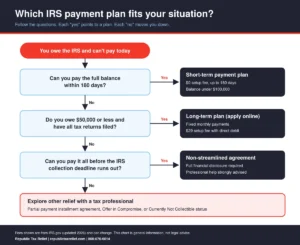
| Short-term payment plan | You can pay in full within 180 days | Under $100,000 | $0 | No |
| Long-term plan (Simple payment plan) | Individuals who need monthly payments | $50,000 or less to apply online | $29 to $178 | Usually no |
| Non-streamlined installment agreement | Higher balances or complex cases | Above online limits | $69 to $178 | Yes (Form 433-F or 433-A) |
| Partial payment installment agreement | You can’t pay the full balance before the collection deadline | Case by case | Varies | Yes, detailed |
Source: IRS Payment Plans and Installment Agreements, updated 2026. Fees can change.
Short-Term Payment Plans
A short-term payment agreement gives you up to 180 days to pay the full balance. There is no setup fee, but interest and penalties continue until you pay the tax in full.
This option works well if you are waiting on a bonus, a home sale, or a business receivable. It is also a smart bridge while you gather money for a lump sum payment.
Long-Term Installment Plans
A long-term payment plan spreads the balance into fixed monthly payments. The IRS offers a Simple payment plan for qualifying individuals and businesses, and individuals who owe $50,000 or less in combined tax, penalties, and interest can usually apply online (IRS.gov).
Most people choose this installment plan because it is fast and requires little paperwork. The tradeoff is cost: the longer you take, the more interest you pay.
Non-Streamlined and Partial Payment Agreements
If you owe more than the online limits, the IRS requires a financial statement. You list income, expenses, assets, and debts, and the IRS decides what you can afford.
This is where many taxpayers get into trouble on their own. A partial payment agreement can lower your monthly payment below what the full balance would need, but only if the numbers are presented correctly.
Payment Plan Fees, Interest, and Penalties
Every plan has two layers of cost. The first is a one-time setup fee. The second is the interest and penalties that keep growing until the balance hits zero.
Payment Plan Fees at a Glance
| How You Apply | Payment Method | Setup Fee |
|---|---|---|
| Online | Direct debit from checking | $29 |
| Online | Other payment method (check, card, Direct Pay) | $69 |
| Phone, mail, or in person | Direct debit | $107 |
| Phone, mail, or in person | Other payment method | $178 |
| Low-income taxpayers | Direct debit | Fee waived |
| Low-income taxpayers | Other payment method | $43 (may be reimbursed) |
| Short-term plan (180 days or less) | Any | $0 |
Source: IRS.gov, updated 2026. Low-income status is based on adjusted gross income at or below 250% of federal poverty guidelines. If the IRS misses your status, file Form 13844 within 30 days of your acceptance letter.
|
Client Review |
|
“I don’t usually leave reviews, but this one is very earned! After a pretty frustrating experience elsewhere, working with Ryan and Rebecca at Republic Tax Relief was a completely different story. They were both incredibly clear, professional, and just easy to work with. They helped me tackle back taxes that I’d been putting off because it felt so overwhelming. Ryan especially made sure I understood every step, which I really appreciated. Thank you you both so much!” ~Dela Meskienyar |
How Interest and Penalties Continue
Interest and penalties continue while you are on any plan. Interest is set quarterly at the federal short-term rate plus 3% and compounds daily (IRS interest rules).
The failure-to-pay penalty is normally 0.5% per month. If you filed your tax return on time, that penalty drops to 0.25% per month while an approved installment agreement is in effect (IRS penalties).
Choose a Payment Method That Saves Money
Direct debit is usually the best payment method. It carries the lowest setup fee, and automatic payments make it much harder to miss a payment.
Paying by debit or credit card adds processor fees. Those fees go to a third party, not the IRS, and they add up over dozens of months.
Who Qualifies for a Payment Plan With the IRS?
Most individual taxpayers qualify for some kind of plan. The IRS rules focus on three questions.
- How much do you owe? Under $100,000 for a short-term plan, and $50,000 or less to set up a long-term plan online.
- Are all required tax returns filed? Missing returns block approval for most long-term plans.
- Are you current on this year’s taxes? That includes withholding, estimated tax payments, and, for employers, required federal tax deposits.
If you have years of missing returns, fix that first. Our team can help you with unfiled tax returns so a payment plan can move forward.
Sole Proprietors and Independent Contractors
If you are self-employed and file a Schedule C, you apply as an individual. Business entities like corporations and partnerships follow separate rules covered below.
How to Set Up a Payment Plan: Online, Phone, or Mail
There are three ways to request an installment agreement. How you apply affects your fee, your approval time, and how much control you have over the terms.
Apply Online Through the IRS Online Payment Agreement
Individuals who qualify can apply online through their IRS Online Account. The online payment agreement tool gives you an answer right away and charges the lowest fees.
Before you log in, have these ready:
- Your most recent IRS notice and tax balance
- Bank routing and account numbers for direct debit
- A monthly payment amount you can truly afford
- Photo ID for identity verification
The IRS website also lets you revise an existing plan online, such as changing your payment amount or due date, for a small fee (IRS.gov).
Call the IRS or Apply by Mail
If you can’t apply online, you can call the IRS at the number on your notice or submit IRS Form 9465, Installment Agreement Request. Higher balances often require Form 433-F, a collection information statement.
Phone and mail requests cost more. They also take longer, and wait times during busy seasons can stretch for hours.
Why the Monthly Payment Amount Matters So Much
The online system will accept almost any payment amount that pays the balance in time. It will not warn you if that amount will wreck your budget six months from now.
A tax professional looks at your full financial picture first. The goal is a plan you can keep, not just one the computer approves.
Tax Debt Payment Plan Calculator: Estimate Your Monthly Payment
You don’t need special software for a rough estimate. Divide your total balance by the number of months you plan to pay, then expect a bit more each month because of interest.
Many professionals use 72 months as a starting point for streamlined plans. Your actual minimum depends on the plan type and how much time remains on the IRS collection clock.
| Total Balance Owed | Estimated Monthly Payment (72 Months, Before Interest) |
|---|---|
| $5,000 | About $70 |
| $10,000 | About $139 |
| $25,000 | About $348 |
| $50,000 | About $695 |
These figures are estimates for planning only. They do not include interest, penalties, or setup fees, and they are not a quote from the IRS.
Quick Tips for Lowering the Total Cost
- Make a larger initial payment if you can. Every dollar paid early stops earning interest.
- Choose direct debit to get the lowest setup fee.
- Pay more than the minimum when cash flow allows.
- Ask a professional whether any penalties qualify for removal before you sign up.
Payroll Tax and Business Installment Payment Plans
Business accounts can’t apply online for a payment plan. Owners must call the IRS business line at 800-829-4933 or work through a representative (IRS.gov).
Payroll tax debt is more serious than most tax bills. The withheld portion belongs to your employees, and the IRS can hold owners and managers personally liable through the Trust Fund Recovery Penalty.
What the IRS Requires From Businesses
- All payroll and income tax returns filed
- Current quarter deposits made on time through the Electronic Federal Tax Payment System (EFTPS)
- Financial statements, often Form 433-B, for larger balances
- Proof the business can keep up with future tax while paying old debt
If a business falls behind on required federal tax deposits while on a plan, the IRS may cancel the agreement. That can trigger a fast levy on business bank accounts. Learn more about IRS collections defense.
Why Hire a Tax Attorney for IRS Payment Plan Representation
A simple plan for a small balance can be something you handle yourself. But once collections start, the balance climbs, or a business is involved, the stakes change quickly.
With professional IRS payment plan assistance, you have someone who knows the IRS rules and speaks the language of collection officers. That means fewer surprises and better terms.
What Professional Help With an IRS Installment Agreement Includes
- Full account review: We pull your IRS transcripts to confirm what you actually owe and spot errors.
- Penalty review: We check whether penalties can be reduced or removed before the plan starts.
- Financial statement preparation: We present your income and expenses using IRS standards, so the monthly payment is realistic.
- Negotiation: We negotiate with the IRS directly, including appeals if a plan is rejected.
- Collection protection: A signed power of attorney (Form 2848) lets us handle calls and letters for you.
Tax Resolution Attorney Payment Plan vs. Doing It Yourself
| Situation | DIY Online | Tax Professional Recommended |
|---|---|---|
| Balance under $50,000, all returns filed | Often fine | Optional |
| Balance over $50,000 | Not available online | Yes |
| Wage garnishment or bank levy in place | Risky | Yes |
| Payroll tax or business debt | Not available online | Yes |
| Unfiled returns | Blocked | Yes |
| Can’t afford the full balance | Won’t qualify | Yes |
When you compare firms, look past the ads. Whether you are weighing a national tax relief brand or a local team of tax advocates and associates, ask who will actually handle your case, what credentials they hold, and whether fees are clear up front.
Clients across Southern California, from Irvine and Corona to Murrieta, CA, and taxpayers nationwide trust our team with their tax resolution. See our full overview of tax resolution services and back tax help.
Managing IRS Installment Payments and Avoiding Default
Getting approved is only half the job. The IRS may terminate a plan if you miss a payment, skip a tax return, or run up a new balance.
Rules That Keep Your Plan Active
- Pay at least the minimum monthly payment on time, every time.
- File every future tax return by the deadline.
- Pay future tax in full, including estimated tax payments if you are self-employed.
- Expect future refunds to be applied to your debt, and keep paying anyway.
- Update your address with the IRS if you move.
These steps come straight from IRS guidance on managing your plan.
What Happens If You Miss a Payment
The IRS usually sends a notice of intent to terminate before canceling a plan. Do not ignore it. You may be able to reinstate the plan, though a reinstatement fee may apply.
If the plan ends, the IRS can move to a tax levy or wage garnishment. Our team handles wage garnishment relief and bank levy help if that happens.
Payment Plans and Federal Tax Liens
A federal tax lien can still be filed while you are on a plan, especially on larger balances. In some cases, a direct debit agreement can help you request a lien withdrawal. Read more in our tax lien help guide.
When a Payment Plan Is Not the Right Fit
Installment agreements or payment plans work best when you can eventually pay the full balance. If you can’t, paying for years may only delay a bigger problem.
Other options include:
- Offer in Compromise: Settle for less than the full amount if you qualify based on ability to pay. See how the OIC program works and our article on the Fresh Start program.
- Currently Not Collectible status: Pauses collection if paying would cause real financial hardship.
- Penalty abatement: Removes penalties for reasonable cause or first-time relief.
- Other legal options: Some older tax debts may be addressed in other ways. Our attorney explains the basics in does bankruptcy get rid of tax debt?
State tax agencies, including the California Franchise Tax Board, run their own payment plans with different rules. We help with both. Explore our tax relief services.
Visual Guide: Which Payment Plan Fits You?
Frequently Asked Questions
How long can a payment plan with the IRS last?
A short-term plan lasts up to 180 days. Long-term installment agreements can run for years, but the balance generally must be paid before the IRS collection period ends, which is usually 10 years from the date the tax was assessed.
Can the IRS levy my wages while I have a payment plan?
Generally, no. The IRS usually will not take enforced collection action while a plan request is being considered, while a plan is in effect, or for 30 days after a request is rejected or terminated.
Do penalties and interest stop once I’m on a plan?
No. Interest and penalties continue until the balance is paid in full. However, the failure-to-pay penalty drops from 0.5% to 0.25% per month during an approved installment agreement if you filed your return on time.
Can I set up a payment plan if I have unfiled tax returns?
Usually not for a long-term plan. The IRS requires all required returns to be filed first. A tax professional can help you file missing returns and request a plan at the same time.
What is the cheapest way to set up an installment agreement?
Paying in full within 180 days costs no setup fee. For a long-term plan, applying online with direct debit carries the lowest fee, currently $29, and low-income taxpayers may have the fee waived.
Should I hire a tax attorney for a payment plan?
If you owe more than $50,000, owe payroll tax, have unfiled returns, or face a levy or garnishment, professional help is strongly recommended. A tax attorney can protect you from collections and negotiate terms you can actually keep.
Speak With a Tax Relief Professional
You don’t have to guess which plan is right or face the IRS by yourself. One conversation can show you your real options and a monthly payment that fits your life.
Call 800-676-6014 or request your free, confidential consultation today.
🔒 Your privacy is protected. Every tax return, bank statement, and Social Security number you share stays strictly confidential, transmitted and stored securely, and seen only by the professionals working your case.
About Republic Tax Relief
Republic Tax Relief helps individuals, families, and business owners resolve IRS and state back taxes. Our team handles payment plans, Offers in Compromise, penalty relief, liens, levies, and wage garnishments, and we speak with the IRS so you don’t have to. Call 800-676-6014 or visit our contact page to get started.
Sources and References
- IRS: Payment Plans; Installment Agreements
- IRS: Online Payment Agreement Application
- IRS: Taxpayers Who Need Help Paying Their Tax Bill Have Options (Tax Tip 2026-31)
- IRS: Publication 594, The IRS Collection Process
- IRS: About Form 9465, Installment Agreement Request
- IRS: Interest and Penalties
- IRS: Taxpayer Bill of Rights
Disclaimer: This page provides general information, not legal or tax advice. IRS fees, thresholds, and rules change. Contact a qualified tax professional about your specific situation.