
An IRS audit notice can turn a normal week into a stressful one. Whether the IRS is asking about a single deduction or reviewing several tax years, the letter alone doesn’t mean you did anything wrong. It does mean the clock is running, and how you respond matters.
This guide explains IRS audit representation, who can provide it, what the audit process looks like from notice to resolution, and how a qualified tax attorney, CPA, or Enrolled Agent can speak to the IRS so you don’t have to. If you’ve been selected for an IRS audit and want someone in your corner, you’re in the right place. On this page:
• What Is IRS Audit Representation?
• Types of IRS Audits: Correspondence, Office, and Field
• Who Can Provide IRS Audit Representation Services
• The IRS Audit Process, Step by Step
• What Happens If You Ignore an Audit Notice
• Common Mistakes to Avoid During IRS Audit Representation
• Cost of IRS Audit Representation
• Benefits of Professional Representation
• If You Disagree With the Audit Results
• How Republic Tax Relief Can Help
What Is IRS Audit Representation?
IRS audit representation means a licensed tax professional handles your audit. Instead of meeting with an IRS agent yourself, your representative reviews your file, gathers records, and communicates directly with the IRS on your behalf.
Under federal law, every taxpayer has the right to representation during an audit. The IRS itself cannot require you to attend a meeting in person if you have someone authorized to appear for you, and in most cases, your representative can handle the entire audit without you ever speaking to an IRS agent directly.
The Taxpayer Bill of Rights, published by the IRS, spells out this right and guarantees the right to retain representation and to a fair, impartial audit process.
What an Audit Representative Actually Does
• Reviews the audit notice and figures out exactly what the IRS is questioning
• Organizes and presents supporting records, receipts, and documentation
• Responds to IRS information requests and deadlines
• Attends or handles all IRS meetings and phone calls
• Negotiates the audit findings and, when needed, files an appeal
Types of IRS Audits: Correspondence, Office, and Field
Not every audit looks the same. The type of audit you’re facing affects how much time it takes, how much documentation you need, and how much representation matters.
|
Audit Type |
How It Works |
Typical Scope |
|
Correspondence Audit |
Handled entirely by mail. The IRS sends a letter asking about a specific item, such as a deduction or credit. |
Narrow, usually one or two issues on a single tax return |
|
Office Audit |
You or your representative will meet with an IRS auditor at a local IRS office to review records in person. |
Moderate, may cover several line items or one full tax year |
|
Field Audit |
An IRS agent visits your home or business to conduct a more detailed examination. |
Broad, can involve multiple tax years and business records |
According to IRS Data Book figures, most individual audits are handled by correspondence, while field audits are reserved for higher-income returns and business filings with more complex issues at stake.
Who Can Provide IRS Audit Representation Services
The IRS allows three types of professionals to represent taxpayers under Circular 230: Enrolled Agents, Certified Public Accountants, and tax attorneys. Each one is qualified, but they bring different strengths to an audit.
|
Best |
Best Suited For |
Notes |
|
Enrolled Agent (EA) |
Standard IRS audit representation and ongoing IRS dealings |
Federally licensed specifically in tax matters, can represent taxpayers in any state |
|
Certified Public Accountant (CPA) |
Audits involving detailed financial records or business tax returns |
Strong background in accounting and financial statement preparation |
|
Tax Attorney |
Audits with legal exposure, fraud concerns, or a real chance of Tax Court |
Only representative who can invoke attorney-client privilege and argue your case in court |
For a simple correspondence audit, an Enrolled Agent or CPA audit representation service is often enough. For a field audit involving multiple tax years, potential penalties, or a business under review, an experienced tax attorney adds a layer of legal protection a CPA or EA cannot offer.
The IRS Audit Process, Step by Step
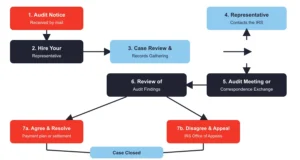
Every audit follows a similar path, even though the details change based on the type of audit and what the IRS is questioning. Here is what the process generally looks like from the moment the audit notice arrives.1. Audit Notice Received by mail2. Hire YourRepresentative3. Case Review &Records Gathering4. Representative contacts the IRS5. Audit Meeting or Correspondence Exchange6. Review of Audit Findings7a. Agree & Resolve Payment plan or settlement7b. Disagree & Appeal IRS Office of Appeals; case closed IRS audit representation process: from audit notice to case resolution or appeal.
Step-by-Step Breakdown
• Audit notice received: The IRS notifies you by mail. The IRS never initiates an audit by phone, text, or email.
• Hire your representative: A CPA, Enrolled Agent, or tax attorney reviews the notice and takes over communication.
• Case review and records gathering: Your representative pulls together the tax return, receipts, bank statements, and other documentation tied to the year under audit.
• Representative contacts the IRS: Using a signed power of attorney (IRS Form 2848), your representative communicates directly with the IRS on your behalf.
• Audit meeting or correspondence exchange: Depending on the audit type, this happens by mail, at an IRS office, or in the field.
• Review of audit findings: The IRS issues a report. You can agree to the proposed changes or dispute them.
• Resolution or appeal: Agreed cases move to payment or resolution. Disputed cases can go to the IRS Office of Appeals and, in rare cases, Tax Court.
What Happens If You Ignore an Audit Notice
Ignoring an audit notice is one of the costliest mistakes a taxpayer can make. The IRS does not go away when a letter is ignored. It moves forward using only the information it already has.
• The IRS can disallow deductions or credits you claimed simply because you didn’t respond
• You lose the chance to explain your position before the IRS finalizes additional tax assessments
• Interest and penalties keep building on any amount the IRS decides you owe
• Missed deadlines can also limit your options for appeal later
If you’re facing an IRS audit and unsure where to start, the safest move is contacting a tax professional before the response deadline passes, not after.
Common Mistakes to Avoid During IRS Audit Representation
Audit mistakes usually come from good intentions. Most taxpayers want to cooperate and explain everything. That instinct, without the right guidance, can work against you.
Audit Mistakes That Cost Taxpayers
• Volunteering extra information: Answering more than what the IRS asked can open new issues you didn’t need to raise.
• Meeting with the IRS alone: Facing an IRS audit without representation means every word you say becomes part of the record.
• Missing deadlines: Late responses can trigger automatic adjustments with no chance to explain your side.
• Handing over disorganized records: A messy audit file can raise more questions than it answers.
• Assuming a correspondence audit is minor: Even a small correspondence audit can expand once the IRS starts reviewing your return closely.
• Not knowing your appeal rights: Some taxpayers accept audit results simply because they don’t know they can dispute them.
Cost of IRS Audit Representation
The cost of IRS audit representation depends on the complexity of your case, the type of audit, and which professional handles it. There is no single price that fits every situation.
|
Audit Complexity |
What Drives the Cost |
General Range* |
|
Simple correspondence audit |
Single issue, limited documentation |
Lower end of the fee scale |
|
Standard office audit |
Multiple line items, in-person meeting |
Mid-range fee |
|
Complex field audit |
Multiple tax years, business records, potential appeal |
Higher fee, often billed as a flat case rate |
*Actual fees vary by firm, case complexity, and geographic market. Most tax relief firms, including ours, provide a fee estimate after a free case review rather than a blind quote.
It helps to compare the cost of representation against what’s at stake. An additional tax assessment from a field audit can run into the tens of thousands of dollars, so professional representation is often less expensive than facing that outcome alone.
Benefits of Professional Representation
Hiring professional representation changes the entire dynamic of an audit. Instead of you against the IRS, it becomes your representative’s job versus the IRS’s job, with your interests protected the whole way through.
• You are not required to attend IRS meetings in person
• Your representative knows IRS procedures and what documentation actually satisfies an auditor
• Experienced representation can often narrow the scope of an audit instead of letting it expand
• You avoid saying something that unintentionally invites a deeper look at other tax years
• If the audit results in a balance due, your representative can also help you resolve your tax debt through a payment plan or settlement option
If You Disagree With the Audit Results
You are not required to accept an IRS auditor’s conclusions. Taxpayers have the right to dispute audit findings through a formal process.
Your Options When You Disagree
• IRS Office of Appeals: An independent office within the IRS reviews your case away from the original auditor
• Mediation: In some cases, the IRS offers alternative dispute resolution before a formal appeal
• Tax Court: If appeals don’t resolve the dispute, you can petition the U.S. Tax Court, generally without having to pay the disputed amount first
Deadlines for each of these options are strict, often 30 days from the date on the audit report. A tax attorney or experienced tax law professional can tell you quickly whether an appeal or Tax Court is worth pursuing for your specific audit.
How Republic Tax Relief Can Help
Republic Tax Relief provides IRS audit representation services for individuals and businesses facing correspondence, office, and field audits. Our team includes CPAs, Enrolled Agents, and tax attorneys who communicate directly with the IRS so you don’t have to.
• Free initial case review to understand your specific audit notice
• A dedicated audit representative assigned to your case from start to finish
• Direct handling of IRS meetings, calls, and correspondence
• Support with appeals if you disagree with the audit findings
• Help resolving any resulting tax debt with IRS and state tax authorities
Your information stays private. Everything you share with us, tax returns, bank statements, and personal records, stays protected under strict tax professional confidentiality standards, secured with bank-grade 256-bit encryption from upload to case closure.
Frequently Asked Questions
Do I have to meet with the IRS in person during an audit?
No. If you have a representative with a signed power of attorney on file, the IRS generally deals directly with your representative instead of you.
Can an Enrolled Agent represent me in an IRS audit?
Yes. Enrolled Agents are federally licensed tax professionals who can represent any taxpayer before the IRS in any state, for any type of audit.
What’s the difference between a CPA and a tax attorney for audit representation?
A CPA audit representation service focuses on the accounting and financial side of your case. A tax attorney adds legal protection, including attorney-client privilege, and can represent you in Tax Court if needed.
How long does an IRS tax audit usually take?
A correspondence audit can close in a few months. Office and field audits involving multiple tax years or business records can take a year or longer, especially if an appeal follows.
What should I do if I already missed my audit response deadline?
Contact a tax professional right away. Even after a missed deadline, there are often still options to respond, request more time, or appeal an automatic adjustment.
Facing an IRS Audit? You Don’t Have to Handle It Alone.
Talk to a licensed tax professional before your response deadline passes. Speak With a Tax Relief Professional
Or call us directly: (800) 676-6014