
Oct
You open an IRS notice and the penalties are almost as big as the tax itself. That happens more often than most people think. Late-filing and late-payment penalties grow every month, and interest grows on top of them. The good news is that many IRS penalties can be reduced or removed if you ask the right way, with the right facts.
This penalty abatement blog walks through the main types of IRS penalty relief, what has changed in 2026, how to build a strong request, and when it makes sense to have a tax professional handle it for you.
Table of Contents
- Common IRS Penalties and What They Cost
- Types of IRS Penalty Abatement
- What Is Considered Reasonable Cause?
- How to Apply for IRS Penalty Abatement
- How Long Does IRS Penalty Abatement Take?
- Does Penalty Abatement Remove Interest?
- What If the IRS Denies Your Abatement Request?
- When to Get Help From a Tax Professional
- Penalty Abatement FAQs
Common IRS Penalties and What They Cost
Before you request relief, you need to know exactly which penalty you were charged. Each one has different rules, and not every type of abatement works for every penalty. Your IRS notice lists the penalty name, the tax year, and the amount.
| Penalty | How It Is Charged | Relief Options |
|---|---|---|
| Failure to file | 5% of unpaid tax per month, up to 25% | First-time relief, reasonable cause |
| Failure to pay | 0.5% of unpaid tax per month, up to 25% | First-time relief, reasonable cause |
| Failure to deposit (payroll) | 2% to 15%, based on how late the deposit is | First-time relief, reasonable cause |
| Accuracy-related penalty | 20% of the underpaid tax | Reasonable cause and good faith |
| Estimated tax penalties | Interest-like charge for underpaying during the year | Limited waivers (disaster, retirement, disability) |
Example: Maria owed $8,000 on her return and filed three months late without paying. The combined failure-to-file and failure-to-pay charge is capped at 5% per month during that time, so she added about $1,200 in penalties in just 90 days, before interest.
Takeaway: Pull your notice and write down each penalty by name and tax year. That list decides which relief path you use.
Types of IRS Penalty Abatement
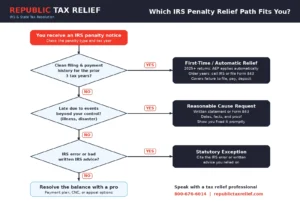
The IRS gives penalty relief in three main ways. A skilled tax pro will usually check them in this order, because the first one requires the least proof.
First-Time Abatement and the New Automatic Relief
For years, the IRS First-Time Abatement (FTA) program has removed failure-to-file, failure-to-pay, and failure-to-deposit penalties for taxpayers with a clean three-year history. You did not need to explain why you were late. You only needed to ask.
That is changing. According to the IRS administrative penalty relief page, FTA is being replaced by the Automatic Exemption from Penalty (AEP), starting in summer 2026. AEP applies to 2025 tax year returns and 2026 quarterly returns going forward. If you qualify, the penalty is never assessed in the first place, and you get a letter explaining why.
To qualify for either program, you generally need:
- The same type of return filed on time for the prior three tax years (or 12 quarters for payroll filers)
- No penalties in that window, other than an estimated tax penalty or one already removed for reasonable cause
- For businesses, no more than three failure-to-deposit waivers in that period
Takeaway: If your penalty is from 2024 or earlier, first-time penalty abatement is still a request you have to make. If a 2025 penalty shows up and you think you should have qualified for automatic relief, contact the IRS.
Reasonable Cause Relief
If you do not qualify for first-time relief, IRS reasonable cause penalty relief is the next option. Here you explain what happened and show that you used ordinary care but still could not meet your tax obligations. The IRS will consider the facts and circumstances of your situation, so documentation matters more than anything else.
Statutory Exceptions
IRS statutory exceptions for penalty waiver cover situations written into tax law. The most common is relying on incorrect written advice from the IRS. Others include IRS errors and certain disaster or combat zone relief. These are less common, but when they apply, they can be very strong.
What Is Considered Reasonable Cause?
Reasonable cause is based on whether something outside your control kept you from filing or paying on time. The IRS guidance on reasonable cause lists examples like these:
- Fire, flood, or other natural disaster
- Serious illness, injury, or death of you or an immediate family member
- Being unable to get records despite real effort
- Other events that made compliance impossible, despite ordinary business care
What usually does not qualify: forgetting the deadline, not having the money with no other explanation, or relying on a tax preparer for something you were responsible for, like signing and filing the return.
Example: A contractor misses two quarterly filings while caring for a parent in the hospital. Medical records, dates of the hospital stay, and proof he filed soon after things settled create a strong reasonable cause argument. “I was busy at work” does not.
Takeaway: Tie each late period to a specific event with dates. Gaps in the timeline are the most common reason the IRS denies the request.
How to Apply for IRS Penalty Abatement
There are three ways to request penalty abatement. The best choice depends on the penalty amount and how complex your story is.
- Call the IRS at the number on your notice. Simple first-time requests are often approved on the phone.
- File Form 843, Claim for Refund and Request for Abatement.
- Send a written statement with your notice and supporting documents.
IRS Form 843 Instructions: Quick Tips
The IRS Form 843 page has the official instructions and mailing addresses. A few tips that help:
- Use one Form 843 per tax period and per penalty type when possible
- Enter the exact penalty amount and the tax period from your notice
- Explain your reason in plain language and attach proof
- Keep copies and send it by certified mail
IRS Penalty Abatement Letter Sample (Outline)
A good letter is short and factual. Here is a simple structure:
- Header: Your name, SSN or EIN (last four digits on copies), notice number, tax year
- Request: “I am requesting abatement of the failure-to-file penalty of $1,200 for tax year 2023.”
- Facts: What happened, with dates
- Effort: What you did to comply and how quickly you fixed it once you could
- Proof: A list of attached documents
Takeaway: Make sure every return is filed before you ask for relief. If you still have unfiled tax returns, the IRS will usually not grant abatement.
How Long Does IRS Penalty Abatement Take?
Timing varies a lot. A phone request for first-time relief can be approved during the call. A written reasonable cause request often takes several weeks to a few months, and longer when the IRS has a backlog or asks for more documents.
While you wait, the failure-to-pay penalty and interest can keep growing on any unpaid tax. Many taxpayers pair an abatement request with an IRS payment plan so collection stays on hold.
Takeaway: Do not wait on the IRS to protect yourself. Respond to every notice by its deadline, even if your request is still pending.
Does Penalty Abatement Remove Interest?
Partly. When the IRS removes a penalty, it also removes the interest charged on that penalty. However, interest on the original tax due generally stays. The IRS can reduce that interest only in narrow cases, such as unreasonable IRS errors or delays.
Example: If the IRS removes a $2,000 penalty that built up $300 of interest, both go away. Interest on the unpaid tax itself remains part of your tax liability.
What If the IRS Denies Your Abatement Request?
A denial is not always the end. As a taxpayer, you can usually ask for a manager review or file an appeal with IRS Appeals, an independent office. Appeals often looks at the reasonable cause argument with fresh eyes.
- Read the denial letter for the reason and your appeal deadline
- Add missing documents or fix gaps in the timeline
- Consider a tax attorney or enrolled agent for the appeal
Takeaway: Most denials come from weak proof, not a weak situation. A stronger file can change the result.
When to Get Help From a Tax Professional
Any taxpayer can request penalty relief on their own. Still, some situations go beyond what a penalty abatement blog can cover, and professional help clearly pays off:
- Penalties across several tax years or several types of returns
- Payroll or business penalties, which tend to be large
- A previous denial, or an IRS audit tied to the penalty
- Active collection, such as a wage garnishment or levy
A professional reviews your IRS transcripts, picks the strongest relief option for each penalty, and handles the IRS for you. Learn more about our IRS penalty abatement services, or see how penalty relief fits into broader tax resolution services. Business owners facing payroll penalties can also review our payroll tax debt relief page.
“I love this company! They’re amazing great people. Ask for Kristine Krouder she’s the best!”
— Christina C., Google Review ★★★★★
Your privacy is protected. Every document you share is guarded by bank-grade 256-bit encryption and strict tax client confidentiality, so you can focus on solving your tax problem, not worrying about your data.
Penalty Abatement FAQs
How do I apply for IRS penalty abatement?
You can call the IRS at the number on your notice, file Form 843, or send a written statement with supporting documents. First-time requests are often handled by phone, while reasonable cause requests usually need a written explanation and proof.
What qualifies as reasonable cause for the IRS?
Events outside your control, such as serious illness, a death in the family, natural disasters, or being unable to get records. You must show you used ordinary care and fixed the problem once you were able to.
How long does IRS penalty abatement take?
Phone requests for first-time relief can be approved immediately. Written requests often take several weeks to a few months, depending on IRS workload and whether more documents are needed.
Does penalty abatement remove interest?
It removes the interest charged on the penalty that was abated. Interest on the underlying unpaid tax generally remains, except in limited cases of IRS error or delay.
Can I remove a failure to file or failure to pay penalty with the IRS?
Yes. Both penalties can be removed through first-time relief, the new automatic exemption for 2025 and later returns, or a reasonable cause request if you do not have a clean three-year history.
Is the First-Time Abatement program still available in 2026?
It is being phased out for newer returns. The IRS is replacing it with the Automatic Exemption from Penalty for 2025 tax year returns and 2026 quarterly returns. First-time abatement can still be requested for earlier tax periods.
Key Takeaways
- Identify each penalty and tax year before you request relief.
- Check first-time or automatic relief first, then reasonable cause, then statutory exceptions.
- File all returns and respond to every notice on time.
- Strong documentation is the difference between approval and denial.
- Get professional help for multi-year, payroll, or previously denied penalties.
We hope this penalty abatement blog helps you take the next step with confidence.
Speak With a Tax Relief Professional
Republic Tax Relief helps individuals and businesses resolve IRS and state tax problems, from penalty relief to full tax debt resolution. Our team reviews your account, explains your options in plain language, and deals with the IRS so you do not have to. Every case is different, and results depend on your facts, but you deserve a clear plan.
Call 800-676-6014 or request your confidential consultation today.