
You signed a joint tax return because you trusted your spouse. Now the IRS says you owe money for income you never saw or a mistake you never made. That is a scary place to be, and you are not the first person to land there.
The good news is that federal tax law has a way out. Innocent spouse relief can remove some or all of the tax, interest, and penalties that belong to your spouse or ex-spouse. This page explains the four types of relief, who qualifies, and how our team helps you build a strong claim.
Table of Contents
- What Is IRS Innocent Spouse Relief?
- The Four Types of Innocent Spouse Relief
- Which Type of Relief Fits Your Situation?
- How to Qualify for Innocent Spouse Relief
- Injured Spouse Relief vs. Innocent Spouse Relief
- How to Request Relief With IRS Form 8857
- How Innocent Spouse Relief Works After You Apply
- State Tax Debt and California Relief for Joint Filers
- Why Work With an Innocent Spouse Relief Tax Attorney
- Other IRS Tax Resolution Options If You Do Not Qualify
- Innocent Spouse Relief FAQs
- Speak With a Tax Relief Professional
Key takeaways
– When you file a joint return, the IRS can collect the full tax bill from either spouse, even after a divorce.
– There are four types of relief: innocent spouse, separation of liability, equitable, and community property relief.
– Most requests use IRS Form 8857. Some deadlines are as short as two years from the first IRS collection action.
– Injured spouse relief is a different program. It helps you get back a refund taken for your spouse’s separate debts.
– A tax professional can help you pick the right type of relief and prove your case with the right evidence.
What Is IRS Innocent Spouse Relief?
When you file a joint return with your spouse, you both sign one promise to the IRS. The law calls this “joint and several liability.” In plain terms, each spouse is 100% responsible for the tax owed, no matter who earned the income or made the mistake.
That rule holds even after you separate. It also holds if your divorce decree says your ex will pay the tax debt. The IRS did not sign your divorce agreement, so it is not bound by it.
The innocent spouse program lets a spouse ask the IRS to remove their share of a federal tax bill that is really the other person’s fault. It comes from Section 6015 of the Internal Revenue Code. The IRS grants relief when the facts show it would be unfair to hold the innocent spouse liable.
Common situations where this relief applies
- Your spouse underreported income from a side business, a second job, or cash sales.
- Your spouse claimed deductions or credits they could not back up.
- Your spouse told you the balance due was paid, but it never was.
- You found out about hidden accounts or income only after a separation.
- You were pressured, controlled, or abused and could not question the return.
What this relief does not cover
- Taxes on a return you filed separately (with one exception for community property states, covered below).
- Business payroll tax debts like the trust fund recovery penalty, which follow their own rules.
- Tax on your own income that you left off the return.
The Four Types of Innocent Spouse Relief
The IRS offers four forms of relief for spouses. Each one has its own rules, deadlines, and results. Picking the wrong one, or missing one you qualify for, can cost you thousands of dollars.
1. Innocent spouse relief (classic relief)
This type covers understated tax. That means tax that should have been on the return but was left off because your spouse understated income or overstated deductions.
To get relief, you generally must show:
– You filed a joint return that has an understatement of tax caused by your spouse’s errors.
– When you signed, you did not know, and had no reason to know, about the error.
– Considering all the facts, it would be unfair to hold you liable for the additional tax.
– You file Form 8857 within two years after the IRS first starts collection activity against you.
If you knew about part of the problem, you may still get partial relief for the part you did not know about.
2. Separation of liability relief
Separation of liability relief splits the understated tax between you and your spouse or former spouse. Each person is then responsible only for the items that belong to them, as if you had filed separate returns.
You may qualify if, at the time you file your request:
– You are divorced or legally separated, or
– Your spouse has died, or
– You have not lived in the same household at any time during the 12 months before you file.
The IRS must show you had actual knowledge of an item to deny you. This type of relief does not create a tax refund, and it does not apply to tax that was reported correctly but never paid.
3. Equitable relief
Equitable relief is the safety net. It can apply when you do not qualify for the first two types, and it is the only type that covers unpaid tax. That is tax that was correctly reported on the return but never paid.
A common example: your spouse promised to send the payment with the return, and you later learned they never did. Equitable relief may also apply to understated tax when the other options are not available.
Deadlines are longer here. For unpaid tax, you generally have until the IRS’s 10-year collection period ends. For a refund, you must file within the normal refund period.
4. Relief from liability tied to community property law
This fourth type is for married people in community property states who did not file a joint return. In these states, state law can make you liable for tax on half of your spouse’s income.
Community property states include:
– Arizona
– California
– Idaho
– Louisiana
– Nevada
– New Mexico
– Texas
– Washington
– Wisconsin
If you did not know about your spouse’s income and it would be unfair to tax you on it, this relief may help. Its deadline is tied to the IRS’s assessment window, so acting early matters.
Side-by-side comparison
| Type of relief | Covers understated tax | Covers unpaid tax | Must be divorced or living apart | Can lead to a refund | General deadline |
|---|---|---|---|---|---|
| Innocent spouse relief | Yes | No | No | Yes | 2 years from first collection activity |
| Separation of liability | Yes | No | Yes | No | 2 years from first collection activity |
| Equitable relief | Yes | Yes | No | Yes | Collection period (unpaid tax) or refund period |
| Community property relief | Yes (separate returns) | Depends on facts | No | Depends on facts | Tied to the assessment period |
Source: IRS Publication 971 and Internal Revenue Code Sections 66 and 6015. Deadlines have exceptions, so confirm your dates with a professional.
Which Type of Relief Fits Your Situation?
Use the flowchart below as a quick starting point. It walks you through the main questions the IRS will ask. Your real answer depends on your full records, so treat this as a guide, not a decision.
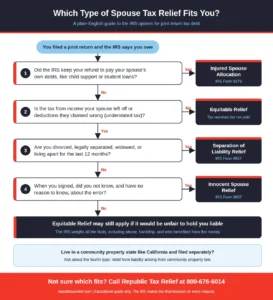
How to Qualify for Innocent Spouse Relief
The IRS does not grant relief just because a marriage ended badly. It looks closely at what you knew, what you gained, and how you live now. Strong claims are built on facts and documents, not just a personal story.
What the IRS will look at
Under IRS guidance (Revenue Procedure 2013-34), the IRS will also consider whether:
– Knowledge: You knew, or should have known, about the error or that the tax would go unpaid.
– Benefit: You received a significant benefit from the unpaid tax money, beyond normal support. Think vacations, luxury items, or a new car.
– Marital status: You are now divorced, separated, or living apart.
– Economic hardship: Paying the tax would leave you unable to cover basic living costs.
– Legal obligation: A divorce decree or agreement says your ex must pay the tax.
– Tax compliance: You have filed and paid your own taxes since then.
– Health: You had a mental or physical health condition when the return was filed.
No single factor decides the case. The IRS weighs them together.
Abuse and financial control
If your spouse abused you or controlled the household money, tell your tax professional. The IRS gives abuse serious weight. It can outweigh the fact that you knew about a problem if you could not safely question the return.
You do not need a police report to raise abuse. Statements from counselors, doctors, shelters, clergy, or friends can help support your claim.
Documents that help your case
- Copies of the joint tax return(s) in question
- IRS notices and letters
- Your divorce decree, separation agreement, or proof of living apart
- Bank records showing who controlled the accounts
- Proof of your income, expenses, and current finances
- Any records of abuse, threats, or financial control
Injured Spouse Relief vs. Innocent Spouse Relief
These two names sound alike, which confuses many taxpayers. They solve very different problems. Filing the wrong form can delay your case by months.
Injured spouse relief allows a spouse to reclaim their share of a joint federal tax refund. It applies when the IRS took the refund to pay debts that belong only to your spouse, such as past-due child support, federal student loans, or older taxes owed only by your spouse. You request an injured spouse allocation on Form 8379.
| Injured spouse relief | Innocent spouse relief | |
|---|---|---|
| The problem | Your share of a joint tax refund was applied to your spouse’s separate debts | You are being held liable for tax caused by your spouse’s errors or nonpayment |
| Who owes the debt | Only your spouse | Both of you, because you filed jointly |
| IRS form | Form 8379 | Form 8857 |
| What you get back | Your portion of the tax refund that was applied to the debt | Removal of some or all of the tax, interest, and penalties |
|
Client Review |
|
“Ryan at Republic Tax was a huge help in getting our taxes caught up. We had six years of unfiled tax returns and were overwhelmed by the process. When we checked with TurboTax, we were projected to owe nearly $30,000. Ryan and his team carefully reviewed everything, found deductions and credits we were missing, and ultimately got our balance down to around $5,000. They were professional, responsive, and made a stressful situation much easier to handle. I highly recommend Ryan and Republic Tax to anyone dealing with back taxes.” ~Ezequiel Garza |
How to Request Relief With IRS Form 8857
You request relief by filing IRS Form 8857, Request for Innocent Spouse Relief. One form covers classic innocent spouse claims, separation of liability, and equitable relief. The IRS reviews your request for every type you may qualify for.
The form itself is only a few pages. The hard part is the written explanation and proof behind it. What you say about your knowledge, your finances, and your marriage will be tested against your spouse’s version and the IRS’s own records.
Deadlines to watch
- Innocent spouse and separation of liability: within two years of the IRS’s first collection activity against you, such as taking your refund or sending a notice of intent to levy.
- Equitable relief for unpaid tax: generally within the 10-year collection period.
- Equitable relief for a refund: within the normal refund time limits.
Do not wait to file Form 8857 until your paycheck is garnished. Waiting can close the door on the strongest forms of relief.
Mistakes that sink claims
- Choosing words that suggest you knew about the income or the unpaid balance
- Leaving out evidence of abuse or financial control
- Missing the two-year deadline
- Sending the form without supporting documents
- Ignoring your own filing problems, like unfiled tax returns, which can hurt your claim
How Innocent Spouse Relief Works After You Apply
Many people worry about what happens once the form is in. Here is the typical path. Reviews often take six months or longer, so patience and good records matter.
| Stage | What happens |
|---|---|
| 1. IRS receives your request | You get a letter confirming the IRS has your Form 8857. |
| 2. Your spouse is notified | The law requires the IRS to contact your current or former spouse and let them respond. The IRS does not share your new address, phone number, or employer. |
| 3. IRS review | An examiner reviews your statements, your spouse’s response, and IRS records. You may be asked for more proof. |
| 4. Preliminary decision | The IRS sends a letter granting full relief, partial relief, or denial. You generally have 30 days to appeal to the IRS Independent Office of Appeals. |
| 5. Final decision | After any appeal, you get a final determination letter. |
| 6. Tax Court option | You can petition the U.S. Tax Court within 90 days of the final letter. You can also petition if the IRS has not decided within six months of your filing. |
Does IRS collection stop while you wait?
In most cases, the IRS cannot levy your wages or bank accounts for the tax in your request while it is under review. The collection clock is also paused. However, the IRS can still file a tax lien and keep a tax refund to apply toward the balance.
If you are already facing a bank levy or wage garnishment, contact a professional right away. Timing your request correctly can help protect your income.
State Tax Debt and California Relief for Joint Filers
Winning your federal claim does not erase a state tax bill. Most states that have an income tax run their own relief programs. Each one has separate forms, rules, and deadlines.
In California, the Franchise Tax Board calls it “innocent joint filer relief.” You request it on Form FTB 705. California may follow the IRS decision in some cases, but it still expects its own request.
Because California is a community property state, spouses here can face extra tax problems. Our team handles federal and state claims together, so your two cases tell the same story.
Why Work With an Innocent Spouse Relief Tax Attorney
You can file Form 8857 on your own. But these claims are judged on details, and your spouse gets a chance to argue against you. An experienced tax professional can help you avoid costly mistakes and present your side clearly.
How our innocent spouse tax resolution services work
At Republic Tax Relief, our team of tax attorneys, enrolled agents, and CPAs has helped individuals and business owners resolve IRS and state tax problems since 2005. Here is how we approach your case:
- Free, confidential review: We listen to your story and look at your IRS notices to spot the best path forward.
- Full account investigation: With your written permission, we pull your IRS records to see every year, balance, and deadline.
- Strategy: We identify the appropriate type of relief, or combination of relief, for your facts.
- Claim preparation: We prepare your request, written statement, and evidence, and file with the IRS and your state.
- Representation: We speak with the IRS for you, answer follow-up requests, and handle appeals if needed.
- Collection protection: We work to stop or prevent levies and garnishments while your case is pending.
When to get help with an innocent spouse relief claim
| Your situation | Why a professional helps |
|---|---|
| Your ex is fighting your claim | We respond to their statements with evidence |
| You experienced abuse or financial control | We present sensitive facts safely and effectively |
| The IRS is already collecting | We act fast to protect your wages and accounts |
| You owe both IRS and state tax | We coordinate both claims |
| Your first request was denied | We handle appeals and Tax Court options |
| You run a business with your spouse | We separate personal and business tax issues |
Whether you need an IRS innocent spouse relief lawyer to argue your appeal or tax representation for ex-spouse tax debt that has followed you for years, our team is ready to help. Learn more about our full tax resolution services.
Other IRS Tax Resolution Options If You Do Not Qualify
Not everyone qualifies for full relief. If the IRS grants only partial relief, or you owe tax that is truly yours, you still have options. The right choice depends on your income, assets, and how much you owe.
- Offer in Compromise: You may be able to settle for less than the full balance based on your ability to pay. See how the OIC program works and our article on the Fresh Start program.
- Installment agreements and hardship status: Monthly payments or a pause on collections may be available. Compare your tax debt relief options.
- Collections defense: Learn how the IRS collection process works and how to stop a levy.
- Lien release: Get help with a federal tax lien that is hurting your credit or blocking a home sale.
- Back tax help: Get a plan for IRS back taxes across several years.
- Bankruptcy: Some older income taxes can be discharged, but the rules are strict. Our tax lawyer explains whether bankruptcy gets rid of tax debt.
For a broader look at all types of tax relief, visit our tax relief services page.
Innocent Spouse Relief FAQs
What is the difference between innocent spouse relief and injured spouse relief?
The innocent spouse program removes tax you are being held liable for because of your spouse’s errors or nonpayment on a joint return. Injured spouse relief returns your share of a joint refund that the IRS used to pay your spouse’s separate debts, like child support or student loans.
How long do I have to file Form 8857?
For classic innocent spouse and separation of liability claims, you generally have two years from the IRS’s first collection activity against you. Equitable relief allows more time: up to the 10-year collection period for unpaid tax, or the refund period if you want money back.
Will the IRS tell my spouse or ex-spouse that I asked for relief?
Yes. The law requires the IRS to notify the other spouse and give them a chance to respond. However, the IRS will not share your new address, phone number, employer, or other contact details with them.
Can I get relief if I am still married?
Yes. You can request classic innocent spouse or equitable relief while you are still married and living together. Separation of liability relief is the only type that requires you to be divorced, legally separated, widowed, or living apart for 12 months.
My divorce decree says my ex pays the taxes. Why is the IRS coming after me?
The IRS is not a party to your divorce, so it can still collect from either spouse on a joint return. Your decree can still help your claim, since the IRS considers it when deciding equitable relief.
Will the IRS stop collecting while my claim is reviewed?
In most cases, the IRS cannot levy your wages or bank accounts for the tax covered by your request while it is pending. It can still file a tax lien and apply your tax refund to the balance.
How long does the IRS take to decide?
Most requests take six months or more. Cases where the other spouse disputes the claim, or where the IRS needs more documents, can take longer.
Do I need a tax attorney to apply for innocent spouse relief?
No law requires one. But your spouse can challenge your claim, and a denial can be hard to reverse. A tax attorney or other tax professional can help you choose the right relief, meet deadlines, and present strong evidence.
Speak With a Tax Relief Professional
You should not have to pay for a spouse’s mistakes. If the IRS or your state is holding you responsible for tax problems you did not create, the sooner you act, the more options you keep.
Your privacy is protected. We never share your contact details, documents, or case information with your spouse or ex-spouse, and every file is handled only by the licensed professionals working your case.
Speak With a Tax Relief Professional or call us now at 800-676-6014 for a free, confidential consultation.
About Republic Tax Relief
Republic Tax Relief has helped individuals and business owners resolve IRS and state tax debt since 2005. Our in-house team of tax attorneys, enrolled agents, and CPAs has resolved more than 18,000 cases, handling everything from innocent spouse claims and offers in compromise to levies, liens, and wage garnishments. Call 800-676-6014 or contact us online to get started.
Sources and References
- IRS: Innocent Spouse Relief
- IRS: About Form 8857, Request for Innocent Spouse Relief
- IRS Publication 971, Innocent Spouse Relief
- IRS: About Form 8379, Injured Spouse Allocation
- 26 U.S. Code Section 6015 (Cornell Law School)
- 26 U.S. Code Section 66 (Cornell Law School)
- Taxpayer Advocate Service
- California Franchise Tax Board (Form FTB 705)
Disclaimer: This page is for general information only and is not legal or tax advice. Every case is different, and results depend on your specific facts. Reading this page does not create an attorney-client relationship.