
If you have not filed a tax return in a year or more, you are not alone. Millions of Americans fall behind because of a job loss, an illness, a divorce, a struggling business, or simple fear of what they might owe. The longer the silence lasts, the heavier it feels.
Here is the good news. Unfiled taxes are one of the most fixable problems in tax law, especially when you act before the IRS does. This guide explains what happens when returns go unfiled, the penalties and risks you face, and how a professional team can help you catch up on unfiled tax returns and get back in control.
Your privacy is protected. Every document you share is guarded by strict tax professional confidentiality and bank-grade 256-bit encryption, so you can get help without worrying about who sees your information.
Table of Contents
- What Happens When You Have Unfiled Tax Returns
- Penalties for Unfiled Tax Returns
- How the IRS Files for You: Substitute for Return
- Statute of Limitations on Unfiled Tax Returns
- How Many Years of Back Taxes You Need to File
- How Our Team Handles Unfiled Tax Returns
- Tax Relief Options After Filing Missing Returns
- Unfiled State Tax Returns
- Unfiled Returns for Business Owners
- Do You Need an Unfiled Tax Return Attorney?
- Why Taxpayers Choose Republic Tax Relief
- Unfiled Tax Returns FAQ
- Speak With a Tax Relief Professional
What Happens When You Have Unfiled Tax Returns
Not filing does not keep you off the IRS radar. Employers, banks, brokers, and clients send copies of your W-2s, 1099s, and K-1s to the government every year. That income reported to the IRS is matched against your IRS account, and a missing return gets flagged automatically.
At first, you may only receive a letter asking where your return is. If you do not respond, the letters get firmer. Eventually, the IRS may prepare a return for you, assess a tax bill, and start collection.
Common Reasons People Fall Behind
- A serious illness, injury, or death in the family
- Divorce or separation that scrambled your records
- Self-employment income with no tax withheld
- A business that lost money or closed
- Fear of owing money you cannot pay
- Lost records that made filing feel impossible
None of these reasons makes you a bad person. They do, however, make it important to address tax issues now, before penalties and interest pile higher.
Warning Signs the IRS Is Already Moving
- Notices such as CP59 (“We have no record of your return”) or CP518 (final reminder)
- A letter proposing a tax assessment based on a return you did not file
- A 90-day Notice of Deficiency
- Notices of intent to levy wages or bank accounts
- A call or visit from an IRS revenue officer
If you have any of these, time matters. Getting tax help early gives you more choices and more control.
Penalties for Unfiled Tax Returns
The IRS charges separate penalties for filing late and paying late. The penalty for not filing is 10 times larger than the penalty for not paying, which is why filing, even when you cannot pay, is almost always the smarter move.
| Penalty or Charge | How It Works | Maximum |
|---|---|---|
| Failure to file | 5% of the unpaid tax for each month or part of a month the return is late | 25% of the unpaid tax |
| Minimum late-filing penalty | Applies when a return is more than 60 days late; the dollar amount is adjusted each year for inflation | The set minimum or 100% of the tax owed, whichever is less |
| Failure to pay | 0.5% of the unpaid tax per month | 25% of the unpaid tax |
| Fraudulent failure to file | 15% per month when the IRS proves fraud | 75% of the unpaid tax |
| Interest | Federal short-term rate plus 3%, compounded daily, on tax and many penalties | No cap until paid in full |
Sources: IRS Failure to File Penalty; IRS Failure to Pay Penalty; Internal Revenue Code § 6651.
When both penalties apply in the same month, the combined charge is generally 5% per month. Over time, the two can add up to 47.5% of the original tax, before interest. That is how a $10,000 unpaid tax balance can quietly grow past $15,000.
Can Penalties Be Removed?
Often, yes. Penalties for unfiled returns may be reduced or removed through:
- First-time penalty abatement for taxpayers with a clean record in the prior three years
- Reasonable cause relief for events like serious illness, natural disasters, or the loss of records outside your control
- Statutory exceptions in limited situations, such as written IRS advice that turned out to be wrong
A tax professional knows how to document these requests so they hold up. Learn more in our complete guide to tax resolution services.
How the IRS Files for You: Substitute for Return
When you ignore the notices, the IRS may use its authority under Internal Revenue Code § 6020(b) to prepare a Substitute for Return (SFR). It sounds helpful. It almost never is.
An SFR is built only from the income the IRS can see. It usually leaves out the business expenses, dependents, credits, and deductions you are entitled to, which leads to a much higher tax liability than you really owe.
| Substitute for Return (SFR) | Return Filed by You or Your Tax Team | |
|---|---|---|
| Filing status | Often single or married filing separately | The most favorable status you qualify for |
| Deductions and credits | Few or none | Every deduction and tax credit you earned |
| Business expenses | Usually ignored | Fully claimed with records |
| Resulting balance | Often inflated | Accurate, and often much lower |
| Next step | Assessment, then collections | Leads to relief options and possible refunds |
After an SFR, the IRS sends a 90-day Notice of Deficiency. During that window, you can challenge the numbers, including by petitioning the U.S. Tax Court. After it closes, the IRS assesses the tax and can file a federal tax lien or move to levy.
The good news: an SFR can often be replaced. Filing an accurate original return, even after the assessment, can bring the balance down, sometimes dramatically. This is one of the most valuable things a professional does for taxpayers with unfiled returns.
Statute of Limitations on Unfiled Tax Returns
Many people hope the problem will “time out.” Unfortunately, the statute of limitations works against you when no return is on file. There are no time limitations on unfiled tax returns when it comes to assessment.
| Rule | What It Means for You | Source |
|---|---|---|
| Assessment period | If no return is filed, the IRS can go back and assess tax for that year at any time | IRC § 6501(c)(3) |
| Collection period | Once tax is assessed, the IRS generally has 10 years to collect | IRC § 6502 |
| Refund deadline | You generally must file within 3 years of the due date to claim a tax refund | IRC § 6511 |
| Criminal charges | The government generally has 6 years to bring charges for willful failure to file | IRC § 6531 |
The refund rule catches many people by surprise. If you had taxes withheld from your paychecks or qualified for credits like the Earned Income Tax Credit, that money is lost forever once the three-year window closes.
Is Jail a Real Risk?
Willful failure to file a federal income tax return is a misdemeanor under IRC § 7203. Criminal cases are rare, and most involve people who had significant income, ignored repeated IRS contact, or hid money.
Still, the risk is real enough that the order of your next steps matters. Coming forward before the IRS opens an investigation is viewed very differently than waiting to be found. If criminal exposure is possible, speaking with a tax attorney first protects you, because attorney-client privilege covers conversations that a regular preparer’s privilege does not.
How Many Years of Back Taxes You Need to File
If you have missed many years, you may not need to file all of them. Under IRS Policy Statement 5-133, the IRS generally requires the last six years of returns to consider a taxpayer back in good standing.
That rule is a guideline, not a guarantee. The IRS may ask for more years if there is a large unpaid tax balance, signs of fraud, or significant income. In other cases, fewer years may be enough.
Deciding which years to file is a strategy question, not just a paperwork question. A professional will weigh:
- Which years the IRS has already contacted you about
- Which years still have refunds available
- Whether any year already has an SFR that should be replaced
- Your state’s own filing requirements
- Whether older years carry criminal or fraud risk
If you need to file years of unfiled taxes, getting this plan right from the start can save you thousands of dollars and months of back-and-forth. For a broader look at the process, read our guide to back tax help and expert tax relief services.
How Our Team Handles Unfiled Tax Returns
People often search for how to file back taxes, then feel overwhelmed by missing forms, old notices, and years of changes in tax law. You do not have to sort it out alone. Here is how our team gives you help filing unfiled tax returns from the first call to the last.
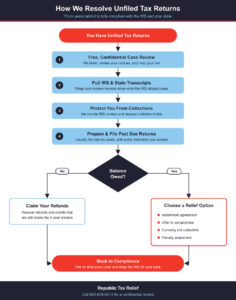
Step 1: Free, Confidential Consultation
We listen to your story, review any IRS or state letters, and identify urgent deadlines. You get an honest picture of where you stand and what your options look like.
Step 2: IRS and State Transcript Review
With your signed authorization (IRS Form 2848), we pull your wage and income transcripts and account transcripts. These show exactly what the IRS already knows, so nothing gets missed.
Step 3: Protection From Collections
We become your point of contact, so you no longer have to deal with the IRS directly. When appropriate, we request a temporary collection hold while the returns are being prepared.
Step 4: Rebuilding Your Records
Missing paperwork is normal. We use transcripts, bank statements, and other records to rebuild accurate income and expense figures for each tax year.
Step 5: Preparing and Filing Your Returns
We prepare each past due return, claim every deduction and credit you qualify for, and replace any SFRs with accurate numbers. Before anything goes to the IRS, our CPA David from Republic and the tax team review the figures for accuracy.
Step 6: Resolving the Balance
Once your returns are filed, we look at what you owe and match you with the right resolution. Then we help you set up a plan to file your tax returns each year on time, so this never happens again.
Tax Relief Options After Filing Missing Returns
Filing is the key that unlocks relief. The IRS generally will not approve a payment plan, settlement, or hardship status until your required returns are on file. Once they are, these tax relief options open up.
| Relief Option | Best For | What It Does |
|---|---|---|
| Installment agreement | Taxpayers who can pay over time | Spreads your balance into monthly payments and stops most levies |
| Offer in compromise | Taxpayers who truly cannot pay in full | Settles your unpaid tax debt for less than the full amount, based on ability to pay |
| Currently not collectible | Taxpayers facing financial hardship | Pauses active collection while your finances recover |
| Penalty abatement | Taxpayers with a clean history or a strong reason for filing late | Removes some or all penalties and related interest |
| Innocent spouse relief | People held liable for a spouse’s tax errors | Can remove responsibility for tax on a joint return |
An offer in compromise is the closest thing to tax debt settlement the IRS offers. To see whether you might qualify, read how the OIC program works and our explainer on the Offer in Compromise and Fresh Start Program.
Some people ask whether bankruptcy can wipe out old tax debt. It can in limited cases, but unfiled or late returns often block that path. Our tax lawyer covers the details in Does Bankruptcy Also Get Rid of Your Tax Debts?
For a full breakdown of each program, visit our guide to tax debt relief options.
Unfiled State Tax Returns
Your state tax agency and the IRS share information. If you skip your federal income tax return, there is a good chance your state return is missing too, and state agencies can move faster than the IRS.
State tax agencies may:
- Estimate your tax and bill you without your input
- Add their own late-filing and demand penalties
- Garnish wages or seize bank funds with little warning
- File state tax liens on your property
- Suspend certain professional or driver’s licenses in some states
In California, for example, the Franchise Tax Board can issue a demand to file and then assess tax on its own estimate if you do not respond. A good resolution plan handles federal and state tax obligations together, so fixing one does not trigger a new problem with the other.
Unfiled Returns for Business Owners
Business owners face extra layers of risk. Beyond personal income taxes, you may have missing payroll returns, sales tax filings, or business returns such as Forms 1120, 1120-S, or 1065.
Payroll taxes deserve special attention. If withheld employee taxes were not paid, the IRS can hold owners and managers personally responsible through the Trust Fund Recovery Penalty. These cases move quickly and often involve revenue officers.
If you own a business with unfiled returns, it is wise to get professional representation before you respond to the IRS on your own. Our guide to tax relief services for IRS and state back taxes explains how we handle business cases.
Do You Need an Unfiled Tax Return Attorney?
Not every case needs a lawyer, but some absolutely do. The right choice depends on how complex your situation is and whether there is any legal risk.
| Type of Help | Can Prepare Returns | Can Represent You Before the IRS | Attorney-Client Privilege | Best For |
|---|---|---|---|---|
| Tax preparer | Yes | Very limited | No | Simple, recent returns with no IRS contact |
| CPA or Enrolled Agent | Yes | Yes | Limited, civil matters only | Multiple years, SFRs, penalties, payment plans |
| Tax attorney | Yes, often with a CPA team | Yes, including Tax Court | Yes | Criminal exposure, large balances, complex disputes |
Consider working with an unfiled taxes relief attorney if:
- You have not filed for many years and had significant income
- An IRS special agent (criminal investigator) has contacted you
- You have foreign bank accounts or unreported offshore income
- You own a business with unpaid payroll taxes
- You face a serious tax dispute or a Tax Court deadline
At Republic Tax Relief, attorneys, CPAs, and Enrolled Agents work side by side. That means your returns get prepared correctly and your legal rights stay protected at the same time.
Why Taxpayers Choose Republic Tax Relief
When you are dealing with unfiled tax returns, you need more than a preparer. You need a team that understands IRS procedures, state rules, and how to protect you while the work gets done.
- One team for everything: return preparation, IRS representation, and tax resolution under one roof
- Federal and state coverage: we handle IRS and state tax issues together
- Honest guidance: we tell you what is realistic, not what you want to hear
- Proven process: transcript review, protection, filing, and relief in a clear order
- Strict confidentiality: your financial information stays private and secure
Bank-grade protection for your documents. Your tax returns, Social Security number, and bank statements are protected with 256-bit encryption and handled in full compliance with federal data protection standards.
If you want help with your unfiled taxes and a clear path forward, we are ready to listen.
Unfiled Tax Returns FAQ
What happens if I never file my tax returns?
The IRS may prepare a Substitute for Return using only the income it can see, which usually leads to a higher bill. It can then add penalties and interest, file a tax lien, and levy wages or bank accounts. In rare, willful cases, criminal charges are possible.
How far back can the IRS go for unfiled taxes?
There is no time limit for the IRS to assess tax on a year when no return was filed. In practice, the IRS generally asks for the last six years of returns to bring you back into compliance, though it can ask for more.
Can I still get a refund on past due tax returns?
You generally have three years from the original due date to claim a refund. After that, the refund is lost for good, even if you are owed money. Filing sooner protects any refunds still inside that window.
Should I file even if I cannot pay what I owe?
Yes, in most cases. The failure-to-file penalty is much larger than the failure-to-pay penalty, and filing is required before you can qualify for payment plans, settlements, or hardship status.
Will I go to jail for not filing taxes?
Jail is rare. Criminal cases usually involve willful behavior, high income, and ignored IRS contact. If you are worried about criminal exposure, speak with a tax attorney before contacting the IRS, because attorney-client privilege protects those conversations.
Can penalties for unfiled returns be removed?
Many can. First-time penalty abatement and reasonable cause relief can reduce or remove penalties when you qualify. A professional can document your request and present it to the IRS in the strongest way.
How long does it take to catch up on unfiled tax returns?
It depends on how many years are missing and how complete your records are. Simple cases may take a few weeks, while complex cases with missing records or business returns can take a few months.
Do I need a lawyer or a CPA for unfiled returns?
A CPA or Enrolled Agent can handle most cases involving missing returns, penalties, and payment plans. A tax attorney is the better choice when there is criminal risk, a large balance, offshore income, or a Tax Court dispute.
Speak With a Tax Relief Professional
Every month you wait, penalties and interest grow and refund deadlines slip away. The fastest way to stop that cycle is to get an expert on your side who can file your returns correctly and protect you from IRS collection.
Your first conversation is free and completely confidential. We will review your situation, explain your options in plain language, and show you a clear path back to good standing.
Speak With a Tax Relief Professional or call 800-676-6014 today.
About Republic Tax Relief
Republic Tax Relief helps individuals and business owners resolve IRS and state tax problems, including unfiled tax returns, back taxes, wage garnishments, bank levies, and tax liens. Our team of tax attorneys, CPAs, and Enrolled Agents works as your Unfiled Tax Return Attorney and representation team, preparing past due returns, negotiating with tax agencies, and securing relief options that fit your budget. Call 800-676-6014 or contact us online for a free, confidential consultation.
Disclaimer: This page provides general information and is not legal or tax advice. Tax laws change, and every situation is different. Speak with a qualified tax professional about your specific circumstances before taking action.
Sources and References
- IRS: Filing Past Due Tax Returns
- IRS: Failure to File Penalty
- IRS: Failure to Pay Penalty
- IRS: Penalty Relief
- IRS: Taxpayer Bill of Rights
- IRS: Internal Revenue Manual 1.2.1 (Policy Statement 5-133)
- Internal Revenue Code: § 6020, § 6501, § 6502, § 6511, § 6531, § 6651, § 7203
- California Franchise Tax Board: ftb.ca.gov