
A letter from the IRS stamped “Final Notice” can make your stomach drop. You may be wondering if your paycheck is next, or if the money in your bank account is still safe. Those fears are normal, and you are not alone.
Millions of Americans fall behind on taxes every year. The IRS collection process follows set rules, deadlines, and taxpayer rights, and each step gives you a chance to act before the Internal Revenue Service takes your money.
This guide explains how IRS collections work, what each notice means, and which options can stop collection. It also covers when to bring in an IRS Collection Defense Attorney, CPA, or enrolled agent who can speak to the IRS for you.
Table of Contents
- What Are IRS Collections?
- How the IRS Collection Process Works
- IRS Collection Notices and What They Mean
- Enforced Collection Actions: Levy, Garnishment, and Liens
- Automated Collection System vs. Revenue Officer
- Private Collection Agencies and IRS Debt
- Your Right to a Collection Due Process Hearing
- IRS Collection Alternatives
- The 10-Year Collection Statute
- State Tax Collection
- Why Hire an IRS Collection Defense Attorney
- How We Resolve IRS Collection Cases
- IRS Collections FAQ
- Speak With a Tax Relief Professional
IRS Collections at a Glance
| Key Fact | Why It Matters to You |
|---|---|
| The IRS generally has 10 years to collect after a tax is assessed | Every tax year has its own deadline, and some events pause the clock |
| A final levy notice gives you 30 days to request a hearing | Missing this window limits your appeal rights |
| Private collection agencies cannot levy or garnish | Only the IRS can seize property or wages |
| Most installment agreements stop levies while in good standing | A plan can protect your paycheck and bank account |
| You can have a professional deal with the IRS for you | A power of attorney shifts IRS contact to your representative |
What Are IRS Collections? What Happens When You Owe Back Taxes
IRS collections begin when a tax is assessed and not paid in full. The assessment can come from a tax return you filed without full payment, an audit, or a substitute return the IRS prepared for you. From that point, the IRS starts working to recover unpaid taxes.
The balance does not sit still. A failure-to-pay penalty of 0.5% per month can build up to 25% of the unpaid amount, and interest adds up daily (IRS: Failure to Pay Penalty). A $15,000 tax bill can grow much larger if it is ignored for a few years.
People end up facing collections for many reasons. Common causes include:
- Job loss, a pay cut, or a business slowdown
- Divorce, illness, or a death in the family
- Self-employment income with no tax withheld
- Unpaid payroll taxes for business owners, which can lead to personal liability through the Trust Fund Recovery Penalty
- Unfiled years that turned into IRS-prepared returns with a higher balance
None of these make you a bad person. They do mean you need a plan before the IRS picks one for you.
How the IRS Collection Process Works, Step by Step
Understanding how the IRS collection process works takes away some of the fear. The IRS moves in a predictable order, and it almost always starts by mail. The IRS explains these stages in Publication 594, The IRS Collection Process.
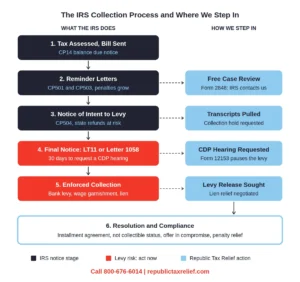
Here is the typical path:
- Assessment. The IRS records the tax you owe and sends your first bill.
- Reminder letters. More notices follow, each warning of stronger action.
- Case assignment. Your account goes to the Automated Collection System or to a field revenue officer.
- Lien filing. The IRS may file a public lien against your property.
- Final warning and levy. After a final notice with hearing rights, the IRS can seize wages, bank funds, or other assets.
- Resolution or expiration. The case ends when the debt is paid, resolved through an approved option, or the collection period runs out.
A quick safety note: the real IRS does not call to demand payment by gift card, wire, or crypto, and it does not threaten immediate arrest. If you get a call like that, it is a scam.
IRS Collection Notices: From Your First Bill to the Final Notice of Intent to Levy
Each notice from the IRS has a code in the top or bottom right corner. That code tells you exactly where you are in the process and how much time you have. The table below shows the most common letters.
| Notice | What It Means | What It Signals |
|---|---|---|
| CP14 | First bill showing the balance due | Collection has started. Penalties and interest are growing. |
| CP501 | First reminder of the unpaid balance | The IRS has not received payment or a response. |
| CP503 | Second reminder, often with stronger wording | The IRS is preparing to escalate. |
| CP504 | Notice of intent to levy | The IRS can take your state tax refund and may file a lien. |
| LT11 or Letter 1058 | Last warning before a levy, with your hearing rights | You have 30 days to request a Collection Due Process hearing. |
| Letter 3172 | Notice that a federal lien was filed | You have a limited window to request a lien hearing. |
The LT11 and Letter 1058 usually arrive by certified mail. Treat the date on that letter as a hard deadline, because it controls your strongest appeal rights.
Some taxpayers also receive an LT16 from the Automated Collection System asking them to call. It is a request to contact the IRS, but it often comes right before enforcement.
Enforced Collection Actions: Levy, Wage Garnishment, and Lien
When notices go unanswered, the IRS moves to enforced collection actions. These are the steps that hurt the most, because they reach your paycheck, your bank account, and your property. Knowing how each one works helps you and your representative respond fast.
Bank Levy
A bank levy lets the IRS take money from your checking or savings account. When the bank receives the levy, it must hold the funds for 21 days before sending them to the IRS. That window gives a professional time to seek a release or set up an alternative.
Wage Garnishment
The IRS can garnish wages through a continuous levy sent to your employer. It takes part of every paycheck until the debt is paid, the levy is released, or you reach a resolution. A portion of your pay is exempt based on your filing status and number of dependents (IRS Publication 1494).
Other Levies
The IRS can levy more than wages and bank funds. Other targets include:
- Social Security benefits, through the Federal Payment Levy Program
- Future tax refunds, both federal and state
- Retirement accounts and brokerage accounts
- Accounts receivable owed to your business
- Vehicles, real estate, or business equipment in rare cases
The IRS also may certify a seriously delinquent tax debt to the State Department, which can block a passport renewal (IRS: Passport Certification).
Federal Tax Lien: A Claim on Everything You Own
A federal tax lien is the government’s legal claim against your property. It arises automatically when you owe and do not pay after a bill. When the IRS files a Notice of Federal Tax Lien, it becomes public and attaches to your home, vehicles, and business assets.
A filed lien can make it harder to get a loan, refinance, or sell property. For businesses, it can hurt relationships with lenders and vendors.
| Lien | Levy | |
|---|---|---|
| What it is | A legal claim on your property | The actual seizure of money or property |
| Effect | Protects the government’s interest | Takes the asset to pay the debt |
| Public record? | Yes, once filed | No, but your bank or employer is notified |
| Common relief | Withdrawal, discharge, subordination | Release, hardship status, installment agreement |
Automated Collection System vs. Revenue Officer: Who Is Handling Your Case?
Most accounts are handled by the Automated Collection System, often called ACS. ACS is a network of IRS call centers that send letters, answer phones, and issue levies. You may speak to a different person every time you call.
Larger or more complex cases often go to a revenue officer. A revenue officer is a field employee who works out of a local IRS office and may visit your home or business. These cases often involve unpaid payroll taxes, large balances, or several unfiled years.
A revenue officer will usually ask for detailed financial statements, such as Form 433-A for individuals or Form 433-B for businesses. They set firm deadlines and can move quickly to levy if those deadlines slip.
Once you sign Form 2848, a power of attorney, the IRS generally directs communication with the IRS through your representative. That means fewer stressful calls and a trained advocate on every conversation (IRS: About Form 2848).
Sent to Collections? What Private Collection Agencies Can and Cannot Do
Under a 2015 federal law, the IRS assigns certain overdue accounts to approved private collection agencies. This private debt collection program usually applies to older accounts the IRS is not actively working. Being sent to collections this way does not change what you owe.
The IRS always mails you a letter first telling you your account has been assigned. The agency then sends its own letter. IRS Publication 4518 explains what to expect.
Private collection agencies can:
- Call and write to discuss your balance
- Set up certain payment arrangements
- Answer questions about your collections status
They cannot:
- Levy bank accounts or garnish wages
- File liens or threaten arrest
- Ask you to pay them directly or pay with gift cards
All payments go to the IRS, never to the agency. If you are unsure whether a caller is real, hang up and verify through the IRS private debt collection page.
Your Right to an IRS Collection Due Process (CDP) Hearing
A collection due process hearing is one of the strongest protections you have. It lets an independent officer from the IRS Independent Office of Appeals review your case before the IRS takes your property. The right comes from Internal Revenue Code sections 6320 and 6330.
To request a collection due process hearing, your representative files Form 12153 within 30 days of the date on your LT11, Letter 1058, or Letter 3172 (IRS: About Form 12153). A timely request for a levy hearing generally stops the levy while the appeal is pending.
At the due process hearing, you can:
- Propose an installment agreement, offer, or hardship status
- Challenge the tax itself if you never had a prior chance to dispute it
- Ask for a lien withdrawal or other lien relief
- Raise innocent spouse or other spousal defenses
If you disagree with the Appeals decision, you can usually ask the U.S. Tax Court to review it. The IRS outlines these options in Publication 1660, Collection Appeal Rights.
| Appeal Type | Deadline | Stops Levy? | Tax Court Review? |
|---|---|---|---|
| CDP hearing | 30 days from the notice | Generally yes | Yes |
| Equivalent hearing | Within 1 year of the CDP deadline | No | No |
| Collection Appeals Program (CAP) | Before or after a levy, lien, or plan denial | Often paused during review | No |
IRS Collection Alternatives That Stop Collection Action on Unpaid Tax
The best way to stop IRS collection actions is to put the right resolution in place. The IRS offers several IRS collection alternatives, and the best one depends on your income, expenses, assets, and how much you owe. A professional reviews your full financial picture before recommending one.
| Option | Best For | Generally Stops Levies? | Key Detail |
|---|---|---|---|
| Installment agreement | Taxpayers who can pay over time | Yes, while in good standing | Monthly payment based on balance or ability to pay |
| Currently Not Collectible | Taxpayers with no money left after basic expenses | Yes | Interest and penalties still grow |
| Offer in compromise | Taxpayers who cannot pay the full balance before the deadline | Yes, while pending | Settles for less than the full amount |
| Penalty abatement | Taxpayers with a clean history or a good reason | No, by itself | Can cut the balance by thousands |
| Lien relief | Taxpayers who need to sell, refinance, or borrow | Not applicable | Withdrawal, discharge, or subordination |
Installment Agreements (IRS Payment Plans)
An installment agreement lets you pay the taxes you owe over time. Individuals who owe $50,000 or less in combined tax, penalties, and interest may qualify for a streamlined agreement of up to 72 months (IRS: Payment Plans). Short-term plans of up to 180 days are also available.
Larger balances need a non-streamlined agreement backed by a financial statement. In some cases, a partial payment installment agreement lets you pay less than the full balance before the collection period ends.
Currently Not Collectible Status
If paying anything would leave you unable to cover rent, food, or utilities, the IRS may place your account in Currently Not Collectible status. Collection pauses, and the IRS reviews your finances from time to time. The 10-year clock keeps running during this status.
Offer in Compromise
An offer in compromise lets you settle your tax debt for less than the full amount. The IRS bases its decision on your reasonable collection potential, which looks at your income, expenses, and equity in assets (IRS: Offer in Compromise).
Offers are powerful but strict, and many are rejected due to errors or missing documents. Learn more in our guide to how the OIC program works and our article on the Fresh Start program.
Penalty Abatement
Penalties can make up a large share of what you owe. First-time abatement may remove certain penalties if you have a clean compliance history. Reasonable cause relief may apply if illness, disaster, or other events outside your control caused the problem.
Lien Withdrawal, Discharge, and Subordination
Lien relief can help you move forward even before the debt is gone. A withdrawal removes the public notice, a discharge releases a specific property, and a subordination lets a lender move ahead of the IRS for a refinance.
Innocent Spouse Relief
If a current or former spouse caused the tax problem on a joint return, you may qualify for relief from some or all of the debt. This is often raised during a collection hearing.
A Note on Bankruptcy
Some older income taxes can be discharged in bankruptcy under specific timing rules, but many tax debts cannot. It is a legal decision that needs careful review. Our article Does Bankruptcy Get Rid of Tax Debts? explains the basics.
For a wider look at every path, see our Tax Debt Relief Options guide.
The 10-Year Collection Statute and Your Tax Liabilities
The IRS generally has 10 years from the date a tax is assessed to collect it, under Internal Revenue Code section 6502. This deadline is called the collection statute expiration date, or CSED. Each tax year has its own date, so a person with several years of debt may have several deadlines.
Certain events pause the clock and push the deadline out. These include:
- A pending offer in compromise
- A pending CDP hearing
- A bankruptcy filing
- A pending installment agreement request
- Living outside the U.S. for six months or more in a row
This is different from the statute of limitations on assessment, which limits how long the IRS has to assess additional tax. If you never filed a return, the collection clock does not start until the IRS assesses the tax.
A professional checks your IRS transcripts to find each CSED before choosing a strategy. In some cases, the right plan balances today’s payments against how much time is left on the clock. Trying to “wait out” the IRS without advice can backfire.
How State Tax Collection Differs From the IRS
State tax agencies follow their own rules, and many move faster than the IRS. Some states have collection periods much longer than 10 years. California’s Franchise Tax Board, for example, can often collect for up to 20 years.
States can also use tools the IRS does not have. Depending on the state, these can include suspending driver’s or professional licenses, intercepting a state tax refund, and garnishing wages with less notice.
If you owe both the IRS and your state, the two cases need to be coordinated. A plan that works for one agency can fall apart if the other keeps levying. Learn more about tax relief services for IRS and state back taxes.
Why Hire an IRS Collection Defense Attorney or Tax Attorney
You have the right to represent yourself, but the IRS knows the rules far better than most taxpayers. A trained representative levels the field. Tax attorneys, CPAs, and enrolled agents all have unlimited rights to represent taxpayers before the IRS under Treasury Circular 230.
Some people search for an IRS collections lawyer when a levy hits. Whether you choose an attorney, CPA, or enrolled agent, strong representation for IRS collection defense includes:
- Taking over contact. Your representative files Form 2848 so the IRS calls them, not you.
- Requesting a collection hold. A representative can often get enforcement paused while your case is reviewed.
- Pulling your full record. Transcripts show every balance, penalty, and CSED.
- Protecting your appeal rights. Deadlines like the 30-day CDP window are tracked and met.
- Building accurate financials. Mistakes on Forms 433-A, 433-B, or 656 are a top reason plans and offers fail.
- Negotiating with revenue officers. Experienced pros know what the IRS will accept.
- Keeping conversations private. Attorney communications are privileged, and CPA or enrolled agent communications have protection in noncriminal federal tax matters.
| Your Situation | Why Professional Help Matters |
|---|---|
| You received an LT11 or Letter 1058 | The 30-day hearing deadline is running |
| A levy has already hit your bank or paycheck | Fast action may get funds or wages released |
| A revenue officer is assigned | Deadlines are strict and the stakes are higher |
| You owe payroll taxes as a business owner | Personal liability and business survival are at risk |
| You owe more than $50,000 | Streamlined options may not apply |
| You have unfiled years | Returns must be handled correctly before most options open up |
How to Choose the Right Firm
Not every tax relief company works in your best interest. Watch for these red flags:
- Promises to settle for “pennies on the dollar” before reviewing your finances
- Guaranteed results or guaranteed approval
- Pressure to pay large fees before any investigation
- No named, credentialed professionals on staff
Look instead for licensed professionals, a clear process, and honest answers about what you qualify for. You can also verify a representative’s credentials through the IRS or your state bar or board of accountancy.
How We Resolve Your IRS Collection Case and Protect Future Tax Years
At Republic Tax Relief, all resolution work is handled in house by enrolled agents, CPAs, and tax attorneys. Our IRS collection representation follows a clear process so you always know what comes next.
- Free consultation. We review your notices, your balance, and your goals at no cost.
- Investigation. We file authorization forms with the IRS and any state agency to pull a full record of your account.
- Protection. We step in with the IRS, request holds where available, and protect your appeal deadlines.
- Resolution. We build and negotiate the option that fits your finances, from installment agreements to offers.
- Compliance. We help you stay current on future tax filings and payments so the problem does not come back.
Working with the IRS through a trusted team means you stop reacting to letters and start moving toward a real finish line.
| Our Track Record | |
|---|---|
| Cases resolved | 18,000+ |
| Tax debt settled | $220M+ |
| Average client rating | 4.9 out of 5 |
| Experience | Serving taxpayers since 2005 |
Results vary based on each taxpayer’s facts and circumstances. Past results do not guarantee a future outcome.
Your information is safe with us. Your tax matters stay between you and your tax team. We protect every conversation and document under strict attorney-client and tax professional privilege standards, so you can speak openly and get real help.
Explore our related services:
IRS Collections Frequently Asked Questions
How do I stop IRS collection enforcement right away?
The fastest options are usually requesting a Collection Due Process hearing within 30 days of a final levy notice, setting up an installment agreement, qualifying for Currently Not Collectible status, or submitting an offer in compromise. A tax professional with a power of attorney can also ask the IRS for a temporary collection hold while your case is reviewed. Timing matters, so act as soon as a notice arrives.
How long does the IRS have to collect a tax debt?
In most cases, the IRS has 10 years from the date a tax is assessed to collect it. This deadline is called the collection statute expiration date. Certain events, such as a pending offer, a CDP hearing, or bankruptcy, can pause the clock and extend it.
Can the IRS take money from my bank account without warning?
In most cases, the IRS must send written notice and give you at least 30 days to request a hearing before it levies a bank account. When a bank levy is issued, the bank holds the funds for 21 days before sending them to the IRS. That window gives a professional a short time to seek a release.
What is the difference between a tax lien and a levy?
A lien is a legal claim against your property that protects the government’s interest. A levy is the actual seizure of money or property, such as funds from a bank account or part of your paycheck. A lien can hurt your ability to borrow or sell, while a levy takes the money itself.
Is a private collection agency calling me about my taxes legitimate?
It can be. The IRS assigns some overdue accounts to approved private collection agencies, but it mails you a letter first, and the agency sends its own letter. Legitimate agencies never ask for gift cards or payment to themselves, and they cannot levy or garnish. All payments go to the IRS.
What happens at an IRS Collection Due Process hearing?
An independent Appeals officer reviews whether the IRS followed the law and whether a collection alternative fits your situation. You can propose an installment agreement, offer in compromise, or hardship status, and in some cases dispute the tax itself. If you disagree with the result, you can usually ask the U.S. Tax Court to review it.
Can the IRS garnish my wages?
Yes. The IRS can garnish wages through a continuous levy that takes part of each paycheck until the debt is paid, the levy is released, or a resolution is reached. A portion of your pay is exempt based on your filing status and dependents.
Do I need an IRS Collection Defense Attorney, or can a CPA or enrolled agent help?
Attorneys, CPAs, and enrolled agents can all represent you before the IRS in collection matters. An attorney may be the better fit when there are legal disputes, large business liabilities, or concerns about criminal exposure. Our team includes all three, so your case is matched to the right professional.
Will a payment plan stop the IRS from levying?
Generally, yes. The IRS usually cannot levy while an installment agreement request is being considered or while an agreement is in effect and in good standing. Missing payments or filing future returns late can cause the agreement to default.
Speak With a Tax Relief Professional
You do not have to face the IRS alone, and you do not have to wait for the next letter to find out what happens. One conversation can show you where your case stands and which options can stop collections.
Our consultations are free and 100% confidential. Every tax return, bank statement, and Social Security number you upload is protected with bank-grade 256-bit encryption and handled in full compliance with federal data protection and security standards.
Speak With a Tax Relief Professional
Prefer to talk now? Call 800-676-6014 for a free, confidential case review.
About Republic Tax Relief
Republic Tax Relief helps individuals and business owners resolve IRS and state tax debt, stop wage garnishments and bank levies, and get back on track. Since 2005, our in-house team of enrolled agents, CPAs, and tax attorneys has resolved more than 18,000 cases and settled over $220 million in tax debt. Call 800-676-6014 or contact us online for a free, confidential consultation.
Sources and References
- IRS Publication 594, The IRS Collection Process
- IRS Publication 1660, Collection Appeal Rights
- IRS Publication 4518, What You Can Expect When the IRS Assigns Your Account to a Private Collection Agency
- IRS Publication 1494, Table for Figuring Amount Exempt From Levy on Wages
- IRS: About Form 12153, Request for a Collection Due Process or Equivalent Hearing
- IRS: Payment Plans and Installment Agreements
- IRS: Offer in Compromise
- IRS: Taxpayer Bill of Rights
- Taxpayer Advocate Service
Disclaimer: This page provides general information about IRS collections and is not legal or tax advice for your specific situation. Tax laws and IRS thresholds change, and results vary based on individual facts. Speak with a qualified tax professional before making decisions about your case.