
A tax lien can stop a home sale, kill a refinance, and scare off lenders. It also attaches to property you buy later, so it does not go away on its own.
Republic Tax Relief provides tax lien help for individuals and business owners with IRS and state liens. We request releases, withdrawals, discharges, and subordinations, and we handle every call and form with the IRS so you don’t have to.
How do you get rid of a federal tax lien? Pay the balance for a release, qualify for a withdrawal through a direct debit installment agreement or an IRS error, or free one property through a discharge or subordination. A tax professional can tell you which option is fastest for your goal and request it from the IRS for you.
How Do You Get a Tax Lien Removed From Your Credit Report?
In most cases, you don’t have to. Equifax, Experian, and TransUnion removed all tax liens from consumer credit reports in April 2018 and stopped reporting new ones. A federal tax lien still sits in county public records, though, so lenders and title companies can find it until the IRS releases or withdraws it.
- Check your reports for free at AnnualCreditReport.com. If an old tax lien still shows, dispute it with that bureau.
- Clear the public record, which is what lenders actually search. A lien withdrawal removes the public notice. A release only marks it “released.”
- Ask the IRS to notify the bureaus. When you request a withdrawal on Form 12277, you can ask the IRS to send notice of it to credit reporting agencies and lenders you name.
How Do You Get a Federal Tax Lien Released?
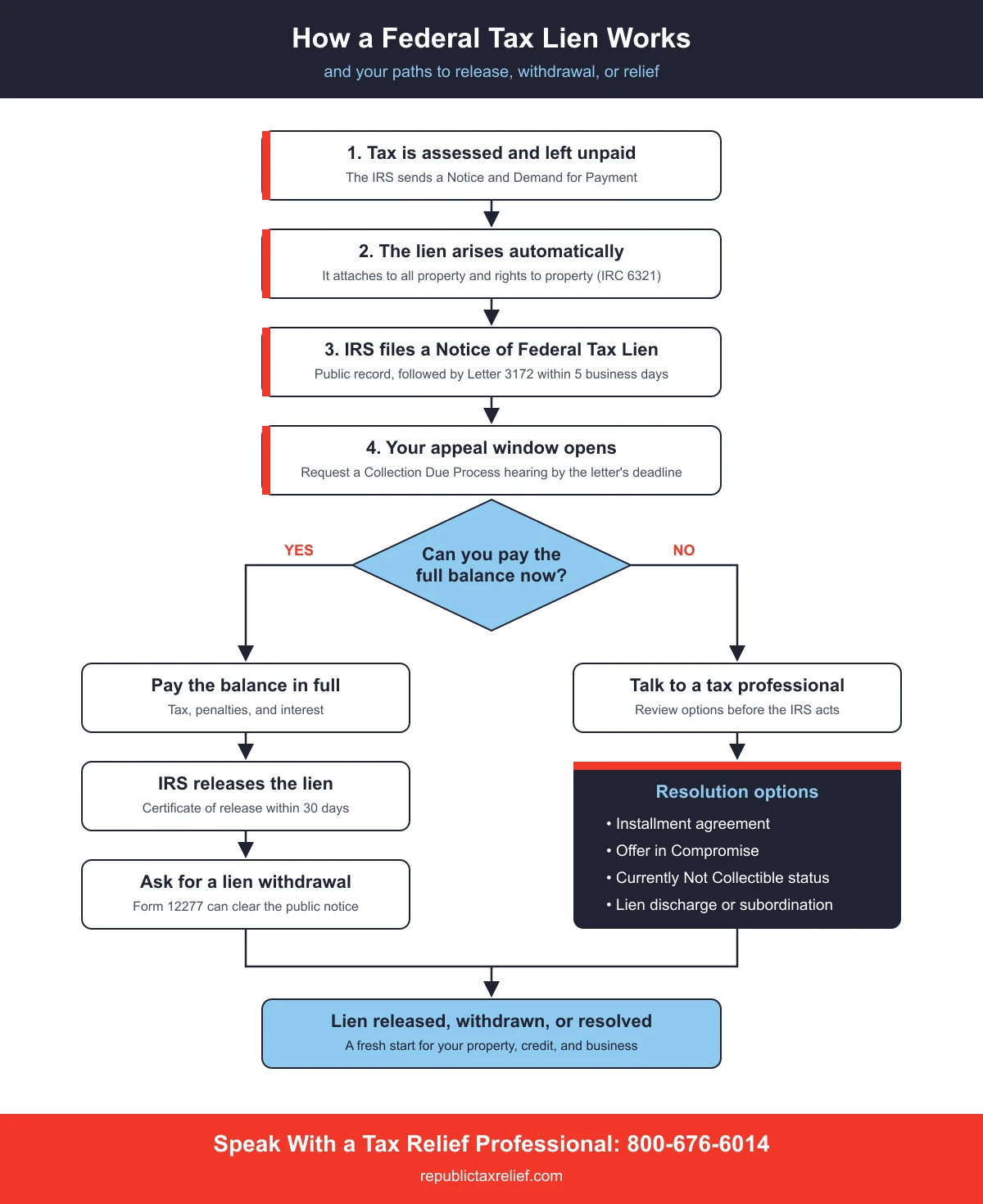
Pay the full balance, including penalties and interest, and the IRS must release the lien within 30 days by issuing a Certificate of Release of Federal Tax Lien (Form 668(Z)). The IRS must also release it when the 10-year collection period ends or when it accepts a bond. Paying with certified funds can speed up the certificate.
- Get an exact payoff amount from your IRS online account or transcripts, so no small balance keeps the lien alive.
- Pay with guaranteed funds, such as a cashier’s check or certified check, if you need the certificate fast, for example before a closing.
- Follow up if 30 days pass with no release. Per IRS Publication 1450, you can call the IRS Centralized Lien Operation at 800-913-6050 or send a written request with proof of payment.
- Then request a withdrawal with Form 12277 so the public notice comes off the record, too.
How Do You Clear a Federal Tax Lien for an FHA Loan?
FHA does not always require paying the lien off first. Under HUD guidelines, you need a valid IRS installment agreement, at least three months of on-time payments (prepaying does not count), and the IRS must subordinate its lien to the new FHA mortgage. Your lender also counts the IRS payment in your debt-to-income ratio.
- Paying in full also works. Once the lien is released, it no longer blocks the loan.
- Start the subordination early. The IRS asks for Form 14134 at least 45 days before closing.
- Ask about lender overlays. Some lenders add stricter rules on top of FHA’s, so check with your loan officer before you start the clock.
Source: HUD Single Family Housing Policy Handbook 4000.1
Buying a home with a tax lien? We set up the right IRS payment plan and request the subordination so your FHA timeline stays on track.
Our Tax Lien Relief Services
“Removing” a lien can mean different things. The right service depends on your balance, your assets, and whether you need to sell, borrow, or clean up your record.
- Lien releaseOnce the balance is paid or settled, we make sure the IRS issues and records your Certificate of Release (Form 668(Z)) within 30 days.
- Lien withdrawalWe file Form 12277 to pull the public notice as if it was never filed, the best outcome for your record.
- Lien dischargeWe free one property, such as a home you are selling, from the lien so the sale can close (Form 14135).
- Lien subordinationWe ask the IRS to let your lender go first so you can refinance or borrow (Form 14134).
- Collection Due Process appealWe file Form 12153 before your deadline to challenge the lien and protect your appeal rights.
- Resolve the debt behind the lienWe negotiate installment agreements, an Offer in Compromise, Currently Not Collectible status, or penalty relief.
Every option has its own forms, deadlines, and IRS standards. For a broader look at settling the balance itself, see our tax debt relief options.
Signs You Need Help With a Tax Lien Now
The longer a lien sits, the more interest and penalties grow, and the closer the IRS moves toward a levy. Call a professional right away if any of these apply:
- You received Letter 3172 (Notice of Federal Tax Lien Filing and Your Right to a Hearing)
- A title company or lender found a lien during a sale or refinance
- You owe more than $10,000 and have no payment plan in place
- You received a Final Notice of Intent to Levy, or a levy already hit your bank account or paycheck
- A state agency such as the FTB, CDTFA, or EDD filed its own lien
- You have unfiled tax returns, which block most IRS relief programs
Not sure what your letter means? Our page on IRS notices explains the most common ones.
How a Federal Tax Lien Works
A federal tax lien is the government’s legal claim on your property when you don’t pay a tax debt. It does not seize anything. It makes sure the IRS gets paid before most other creditors if your property is sold or refinanced.
Under Internal Revenue Code Section 6321, the lien arises automatically after three events:
- Assessment: The IRS records the tax you owe, usually from a tax return or an audit.
- Notice and demand: The IRS mails you a bill.
- Nonpayment: You don’t pay in full by the deadline.
The lien covers the full balance, including penalties and interest. It attaches to all your property and rights to property, including your home, vehicles, bank accounts, business assets, and property you acquire later.
The Notice of Federal Tax Lien and your appeal window
The lien becomes public when the IRS files a Notice of Federal Tax Lien with your county recorder or secretary of state. The IRS often files when you owe more than $10,000, although it can file for less (IRS).
Within five business days of filing, the IRS must send Letter 3172. You then generally have 30 days to request a Collection Due Process hearing with Form 12153. At that hearing, you can challenge the filing, propose a payment plan, or ask for withdrawal, discharge, or subordination.
Tax lien vs. tax levy
| Tax Lien | Tax Levy | |
|---|---|---|
| What it does | Places a legal claim on your property | Takes property, such as wages or bank funds |
| When it happens | Automatically after assessment, demand, and nonpayment | After a Final Notice of Intent to Levy and a 30-day window |
| Main impact | Blocks sales, loans, and refinancing | Removes money or assets |
| Public record | Yes, once the notice is filed | No public filing |
If the IRS is already taking money, see our IRS collections defense services.
Got Letter 3172? Your appeal clock is already running. We can review your notice today and protect your hearing rights.
How a Tax Lien Affects Your Home and Business
A lien will not force you out of your home. But the problems it causes tend to grow the longer it stays in place.
- Selling or refinancing: Title companies and lenders will find the notice, and most won’t close until it is paid, discharged, or subordinated.
- New credit: Credit bureaus stopped listing tax liens in 2018, but lenders still search public records.
- Your business: The lien attaches to equipment, vehicles, and accounts receivable, which makes financing and leases harder.
- Jobs and licenses: A public lien can surface in background checks for clearances and professional licenses.
- Bankruptcy limits: A filed lien may survive bankruptcy. Read whether bankruptcy gets rid of tax debts before counting on it.
A federal tax lien generally lasts until the debt is paid or the 10-year collection period ends. Certain actions can pause or extend that clock.
| Client Review |
| “I highly recommend Republic tax service, they have helped me out with my back taxes issue.i have a very complicated issues with the IRS.and form the start they hit the ground running! But i really like to Thank agent MR.DON DAVIS! he took the time to sign me up and give me all the information and tools I needed to make this a smooth transition! I’ve recently experience some hiccups in my life and Don went above and beyond the call of Duty for me!! I really appreciate everything you’ve done peace!💯” |
| ~ Anthony Brown |
Tax Lien Withdrawal vs. Release vs. Discharge
A release ends the lien once the debt is paid or can no longer be collected, but the notice stays in public records marked “released.” A withdrawal removes the public notice as if it was never filed. You request a withdrawal with IRS Form 12277, either while you are still paying or after the lien is released.
| Option | What it does | Debt paid first? | Public record | IRS form |
|---|---|---|---|---|
| Release | Ends the lien | Yes, or statute expired | Stays, marked released | Automatic; Pub. 1450 |
| Withdrawal | Removes the public notice | Not always | Removed | Form 12277 |
| Discharge | Frees one property | No | Stays on other property | Form 14135, Pub. 783 |
| Subordination | Lets a lender go first | No | Stays | Form 14134, Pub. 784 |
Many clients want both: first the release, then a withdrawal so the notice stops showing up in searches. You can request a withdrawal after release if you have stayed current on filing and payments for three years.
How to request a withdrawal with Form 12277
Form 12277 is the Application for Withdrawal of Filed Form 668(Y), Notice of Federal Tax Lien. Under 26 U.S.C. § 6323(j), the IRS may approve it when:
- The notice was filed too early or without following IRS procedures
- You entered an installment agreement, unless the agreement says otherwise
- Withdrawing the notice will help the IRS collect the tax
- The National Taxpayer Advocate agrees withdrawal is in your best interest and the government’s
On the form, you can also ask the IRS to send notice of the withdrawal to credit reporting agencies, lenders, and creditors you name. A clear explanation and proof, such as your payment history or release certificate, makes approval faster.
How to Calculate Your Lien Withdrawal Payment
One of the fastest ways to get a public lien notice pulled is the IRS Fresh Start withdrawal path. It works for balances of $25,000 or less paid through a direct debit installment agreement.
Total Balance OwedLesser of 60 Months or Months Left on the Collection Statute
Requirement: Total Balance Owed ≤ $25,000
What each part means
- Total Balance Owed: Your full IRS balance, including tax, penalties, and interest. Your IRS account transcript shows the official number.
- 60 Months: To qualify for withdrawal, the plan generally must pay the balance in full within five years.
- Months Left on the Collection Statute: The IRS usually has 10 years from assessment to collect. If fewer than 60 months remain, the plan must finish before that date.
- $25,000 limit: If you owe more, you may be able to pay the balance down to $25,000 first.
Example payments at a 60-month term
| Balance owed | Estimated monthly payment |
|---|---|
| $10,000 | $167 |
| $15,000 | $250 |
| $21,600 | $360 |
| $25,000 | $417 |
Example: Maria owes the IRS $21,600 and has about seven years left on the collection statute. Since 60 months is shorter, her estimate is $21,600 ÷ 60 = $360 per month. After three on-time automatic payments, she can request a withdrawal while she keeps paying.
Why a DIY estimate is risky: Using the wrong balance, missing a tax year, or setting up a plan that isn’t direct debit can disqualify you from withdrawal. A professional checks your numbers against your IRS transcripts and structures the agreement to meet IRS guidelines the first time.
How We Get a Federal Tax Lien Released Faster
The IRS does not always move quickly, and mistakes happen. Here is what our team does to speed things up:
- Pull your IRS transcripts to confirm the true balance and every tax year involved
- Check for errors, such as a lien filed against the wrong person, a debt already paid, or an expired collection period
- Pick the strongest path for your goal: release, withdrawal, discharge, subordination, or a payment plan
- File the right requests and handle every IRS contact for you
- Follow up until the release is recorded, then send proof to your lender or title company
Typical timelines
| Action | General timeframe |
|---|---|
| Release after full payment | Within 30 days (26 U.S.C. § 6325) |
| Discharge or subordination | Apply at least 45 days before closing |
| Withdrawal request | Several weeks to a few months |
| Direct debit agreement withdrawal | After three consecutive on-time payments |
If the IRS fails to release a lien it should have, the Taxpayer Advocate Service can step in. In some cases, federal law lets taxpayers seek damages for a wrongful failure to release.
Selling or refinancing soon? Discharge and subordination requests need lead time. Call before you set a closing date so the lien doesn’t derail your deal.
State Tax Lien Resolution: FTB, CDTFA, and EDD
State agencies file their own liens for unpaid income, sales, and payroll taxes. They follow different rules from the IRS. In California, three agencies file most of them:
| Agency | Type of tax | Who it usually affects |
|---|---|---|
| Franchise Tax Board (FTB) | State income tax | Individuals, self-employed people, and businesses |
| CDTFA | Sales and use tax | Retailers, restaurants, and other sellers |
| EDD | Payroll taxes | Employers and business owners |
- State liens can last longer than federal liens and may be renewed
- They are often recorded in several counties at once
- A state lien and a federal lien can sit on the same property
County property tax liens can even take priority over a federal tax lien. Because the rules overlap, it helps to have one team review every lien at once. Learn more about our IRS and state tax relief services.
Why Hire a Tax Lien Professional
You can call the IRS yourself. But the lien rules are detailed, and one wrong move can cost you months or lock you into a plan that doesn’t qualify for withdrawal.
Please don’t try to negotiate an IRS lien on your own or rely on generic AI tools for advice. A chatbot can’t read your IRS transcripts, spot a procedural error, or speak to the IRS for you, and one wrong form can cost you your appeal rights.
- Direct representation: With a signed Form 2848, your representative speaks to the IRS for you.
- A strategy that fits your goal: Selling, refinancing, and cleaning up your record each need a different approach.
- Error spotting: Professionals catch filing mistakes and expired deadlines that taxpayers often miss.
- Less stress: You stop dreading the mailbox and get back to your life.
Who can represent you before the IRS
Tax attorneys, CPAs, and enrolled agents all have unlimited rights to represent taxpayers under Treasury Circular 230. Whether you choose a tax lien release attorney or another licensed professional, look for verifiable credentials, written fees, and an honest review of your options. The FTC warns against any company that promises results before reviewing your finances.
Who we help
- Homeowners who need a lien cleared to sell, refinance, or protect equity
- Self-employed people with unpaid income tax from past years
- Business owners facing payroll, sales, or business income tax liens
- Taxpayers with several liens from the IRS and a state agency at once
Our Tax Lien Resolution Process
- Free consultation: We listen to your situation and answer your questions with no pressure.
- Investigation: We pull your transcripts, confirm every lien filing, and identify the tax years involved.
- Strategy: We recommend the best path: release, withdrawal, discharge, subordination, or a debt resolution plan.
- Negotiation: We work with the IRS and state agencies on your behalf.
- Follow-through: We stay on it until the lien is released, withdrawn, or resolved, and help you stay compliant.
Mistakes we see most often in lien cases
- A payment plan that isn’t direct debit, which blocks a Fresh Start withdrawal
- Home sellers who ask for a discharge a week before closing
- Unfiled returns that stop every relief option until they are caught up
- State liens that keep growing while the taxpayer focuses only on the IRS
See the bigger picture in our tax resolution services, back tax help, and all services.
Your privacy is protected at every step. We guard your tax records under strict attorney-client and tax professional confidentiality standards, secured by bank-grade 256-bit encryption.
Tax Lien FAQs
How long does a federal tax lien last?
A federal tax lien generally lasts until the debt is paid or the collection period ends, which is usually 10 years from assessment. Some actions, such as bankruptcy or an Offer in Compromise, can pause that clock.
What is the difference between a tax lien withdrawal and a release?
A release ends the lien after you pay or the debt becomes unenforceable, but the notice stays in public records marked as released. A withdrawal removes the public notice as if the IRS never filed it.
Can I sell or refinance my home with a federal tax lien?
Often, yes. You can ask the IRS for a discharge to sell the property or a subordination to refinance. These requests should be filed at least 45 days before closing.
How do I get a federal tax lien released?
Pay the balance in full, settle it through an accepted Offer in Compromise, or wait until the collection period ends. The IRS then has 30 days to release the lien. See how a federal tax lien is released for the full steps.
What is a Certificate of Release of Federal Tax Lien?
It is IRS Form 668(Z), the official document showing the lien is released. The IRS records it in the same office where the lien was filed. Keep a copy for lenders and title companies, and request one under Publication 1450 if it never arrives.
Can I get a tax lien withdrawn while I am still making payments?
Yes, in many cases. If you owe $25,000 or less and pay through a direct debit installment agreement, you may qualify for withdrawal after three consecutive on-time payments.
Can I get an FHA loan with an active federal tax lien?
Yes, if you meet HUD’s rules: a valid IRS payment plan, at least three on-time payments, and IRS subordination of the lien to the FHA mortgage. See clearing a tax lien for an FHA loan.
How much does professional lien resolution cost?
Fees depend on how many tax years, liens, and agencies are involved. Your first consultation is free, and we explain our fees in writing before any work begins.
Speak With a Tax Relief Professional
A tax lien can feel like a weight you carry everywhere. You don’t have to carry it alone. Get professional help resolving your tax lien today.
About Republic Tax Relief
Republic Tax Relief helps individuals and business owners resolve IRS and state tax problems, including tax liens, levies, back taxes, and unfiled returns. Our tax professionals negotiate installment agreements, Offers in Compromise, penalty relief, and lien releases so clients can move forward with confidence. Call 800-676-6014 or contact us online for a confidential consultation.
Sources
- IRS: Understanding a Federal Tax Lien
- 26 U.S.C. § 6321, § 6323, § 6325
- IRS Publications 783, 784, 1450; Forms 12153, 12277, 14134, 14135
- Taxpayer Advocate Service
- Federal Trade Commission: Tax Relief Companies
Disclaimer: This page provides general information, not legal or tax advice for your specific situation. Tax laws change, and outcomes depend on individual facts. Consult a qualified tax professional before acting.