
Opening your mailbox and finding an envelope from the IRS is enough to make your stomach drop. Before you panic, know this: most IRS notices are routine, and every one of them tells you exactly what it wants if you know how to read it.
This guide walks you through the most common IRS notices, why the IRS sends them, and what happens if a notice or letter goes unanswered. Most importantly, it explains when handling an IRS notice on your own is fine, and when it is time to bring in a tax notice attorney or CPA before you reply.
Table of Contents
- What Is an IRS Notice?
- Common IRS Notices and What They Mean
- Why You Received an IRS Notice or Letter
- How to Respond to an IRS Notice or Letter
- What Happens If You Ignore an IRS Notice
- When to Get Professional Help With an IRS Notice
- How Republic Tax Relief Handles IRS Notices
- The IRS Notice Response Process
- Frequently Asked Questions
What Is an IRS Notice?
An IRS notice is a letter the Internal Revenue Service mails when something on your account needs your attention. Every notice has a code, usually starting with “CP” (Computer Paragraph) or “LTR” (Letter), printed in the upper right corner.
That code tells you exactly what the notice is about. A CP14 is not the same problem as an LT11, and treating them the same way is one of the most costly mistakes a taxpayer can make.
Each notice or letter includes:
- A notice number in the top right corner
- The tax year in question
- A summary of the tax issue and the amount owed, if any
- A response deadline
- Contact information for the IRS
Common IRS Notices and What They Mean
Receiving an IRS notice doesn’t always mean bad news. Some notices simply confirm a change to your refund. Others demand a response within a set window or warn that collection action is coming. Here are the notices taxpayers ask about most.
| Notice Number | What It Means | Typical Deadline |
|---|---|---|
| CP14 | First notice of a balance due on your federal tax return | 21 days |
| CP2000 | Proposed changes because income on your return does not match employer or bank records | About 30 days |
| CP501 / CP503 | First and second reminders that a balance is still unpaid | 21 days each |
| CP504 | Final balance due notice; the IRS can begin seizing state refunds | Immediate action needed |
| LT11 / Letter 1058 | Final Notice of Intent to Levy; your last chance to request a hearing | 30 days |
| CP90 | Intent to seize (levy) assets, including Social Security benefits | 30 days |
| CP12 | The IRS corrected a math error, changing your refund or balance | 60 days to dispute |
This is not a complete list. The IRS sends dozens of notice and letter types covering everything from an earned income tax credit review to a notice of federal tax lien. If your notice number is not listed here, the safest move is to have a professional confirm what it means before you respond.
Why You Received an IRS Notice or Letter
The IRS does not send notices at random. A notice usually means one of these things happened:
- You have a federal tax balance the IRS has not received payment for
- Information reported on your tax return does not match what an employer, bank, or other payer sent to the IRS
- The IRS found a difference between your tax return and its own records and adjusted your tax liability
- Your return is being reviewed before a refund is released
- The IRS is asking for missing information or documentation, such as proof of a dependent or a tax credit claim
- A prior balance was not resolved, and the notice reflects the next step in IRS collection
In many cases, the notice means the IRS found a difference and adjusted your account automatically. That is not the same as an audit, and it does not always mean you owe additional tax once the full picture is reviewed.
How to Respond to an IRS Notice or Letter
Every IRS notice includes instructions specific to that notice. In general, taxpayers who choose to respond on their own should:
- Read the entire notice, not just the amount at the top
- Confirm the tax year and notice number match your own tax forms and personal copy of the tax return
- Note the deadline and mark it clearly, since IRS deadlines are strict
- Compare the notice to your own tax records before agreeing or disputing anything
That said, this is exactly the point where many taxpayers get into trouble. Calling the IRS directly without understanding your rights, agreeing to a number that is wrong, or missing a deadline by even a few days can turn a manageable notice into a much bigger tax issue. Because a wrong response can create years of tax debt or a lost appeal right, this is not the place to guess. A tax professional who handles IRS notice response every day can tell you in minutes whether a notice is routine or urgent, something a self-filed response often cannot catch until it is too late.
What Happens If You Ignore an IRS Notice
Ignoring an IRS notice does not make it disappear. The IRS sends notices and letters in a set sequence, and each one escalates.
- A CP14 that goes unanswered leads to CP501, then CP503, then CP504
- CP504 allows the IRS to seize a state tax refund without further notice
- The final step is an LT11 or CP90, a Notice of Intent to Levy, which can lead to wage garnishment or a bank levy
- Interest and penalties continue to grow on the tax owed at every stage
If you receive a notice of intent to levy, you generally have 30 days to request a Collection Due Process hearing. Missing that window can mean losing your right to appeal before the IRS takes your wages or bank funds. This is one of the most time-sensitive tax issues a taxpayer can face, and it is almost never something to handle without representation.
When to Get Professional Help With an IRS Notice
Not every letter from the IRS requires a lawyer. A simple refund adjustment notice may only need a quick review. But certain situations call for professional IRS notice representation right away.
Get help immediately if:
- You received a Notice of Intent to Levy (LT11, CP90, or similar)
- The notice mentions a lien on your property
- You disagree with the amount but are not sure how to prove it
- You have multiple unresolved notices from the IRS or your state
- You run a business and the notice involves payroll tax or trust fund penalties
- You already missed a prior deadline
Seeking assistance from a tax professional at this stage protects you in two ways. It stops you from saying something to the IRS that hurts your case, and it puts someone in your corner who communicates with the IRS on your behalf so you are not doing it alone.
How Republic Tax Relief Handles IRS Notices
Republic Tax Relief provides IRS Notice Response Services for individuals and business owners who want a licensed professional standing between them and the IRS. Our team reviews your notice, pulls your IRS transcripts, and builds a response strategy before anyone contacts the IRS on your behalf.
Whether the letter is a routine CP2000 or a final notice before a levy, we handle IRS notice representation from the first phone call through resolution. That includes requesting a Collection Due Process hearing, negotiating a payment plan, or preparing an Offer in Compromise when the debt qualifies.
Your information stays protected
We understand that resolving a tax issue means sharing sensitive documents like tax returns, bank statements, and Social Security numbers. Handling that information with strict confidentiality is part of how we operate, not an afterthought.
Trust and security statement: Your financial documents are protected by bank-grade 256-bit encryption and handled under strict tax professional confidentiality standards, so you can share what the IRS needs without worrying about who else sees it.
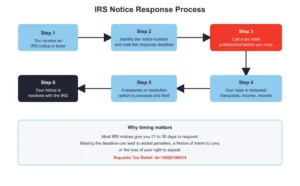
The IRS Notice Response Process
The graphic below shows how our IRS notice response process moves from the moment you receive a letter to the moment your case is resolved.
Frequently Asked Questions
What should I do first when I get an IRS notice?
Read the notice fully, note the notice number and deadline, and compare it to your own tax records before responding or paying anything.
Does getting an IRS notice mean I am being audited?
Not usually. Most notices are automated adjustments or requests for information. An audit is a separate, more formal process the notice will clearly identify.
How long do I have to respond to an IRS notice?
It depends on the notice. Many give 21 to 30 days, but a Notice of Intent to Levy also gives only 30 days to request a hearing, so check your specific notice for the exact date.
Can a tax professional respond to the IRS on my behalf?
Yes. Once you sign a power of attorney (IRS Form 2848), a licensed tax attorney, CPA, or enrolled agent can communicate with the IRS directly so you do not have to.
What if I cannot pay the amount the notice says I owe?
You may still have options, including an installment agreement or an Offer in Compromise, depending on your financial situation. A tax professional can review your tax liability and recommend the right path.
Get Professional Help With Your IRS Notice Today
An IRS notice or letter will not go away by itself, and every day you wait narrows your options. Republic Tax Relief offers professional IRS notice resolution for individuals and businesses across the country, and confidential document handling from your first call.
Call 800-676-6014 or contact us online to speak with a tax relief professional about your IRS notice today.